
Preparing for birth with a chronic illness comes down to one document and one conversation: a written birth plan, reviewed line by line with your obstetric clinician, your condition specialist, and a maternal-fetal medicine specialist well before labor starts. That review is where delivery timing, anesthesia, device access, and your worst-case flare scenario get decided in advance instead of on the worst night of your life.
This guide walks through that preparation in six steps. It covers what to gather, how to run the care-team meeting, what to ask about medications and monitoring, how to plan for labor and pain relief, the logistics of the hospital stay, postpartum support, and how to build a backup plan. Most of it takes a few focused appointments spread across the second and third trimesters.
A word before we start: this is general education, not individual medical advice. Your obstetric clinician, your specialist, and your pharmacist need to make the actual calls about your care. Nothing here should replace a conversation with them, and nothing here should change a single medication without their sign-off.
Table of Contents
- What You Need to Prepare for Birth With a Chronic Illness
- Step-by-Step
- Step 1: Build a Care Team and Ask for a Birth Plan Review
- Step 2: Review Medications, Symptoms, and Monitoring
- Step 3: Plan for Labor, Mobility, and Pain Management
- Step 4: Organize the Practical Logistics
- Step 5: Arrange Support and a Postpartum Plan
- Step 6: Create a Backup Plan and Share the Packet
- Common Mistakes
- Frequently Asked Questions
- When should I start preparing for birth with a chronic illness?
- Can my partner, doula, or family member join the birth-plan conversation?
- What should I ask about medications during labor and after delivery?
- How can I prepare if my illness may limit walking or change positions?
- What postpartum support matters when managing a chronic condition with a newborn?
- When should I contact my medical team during pregnancy or after birth?
- Conclusion
What You Need to Prepare for Birth With a Chronic Illness
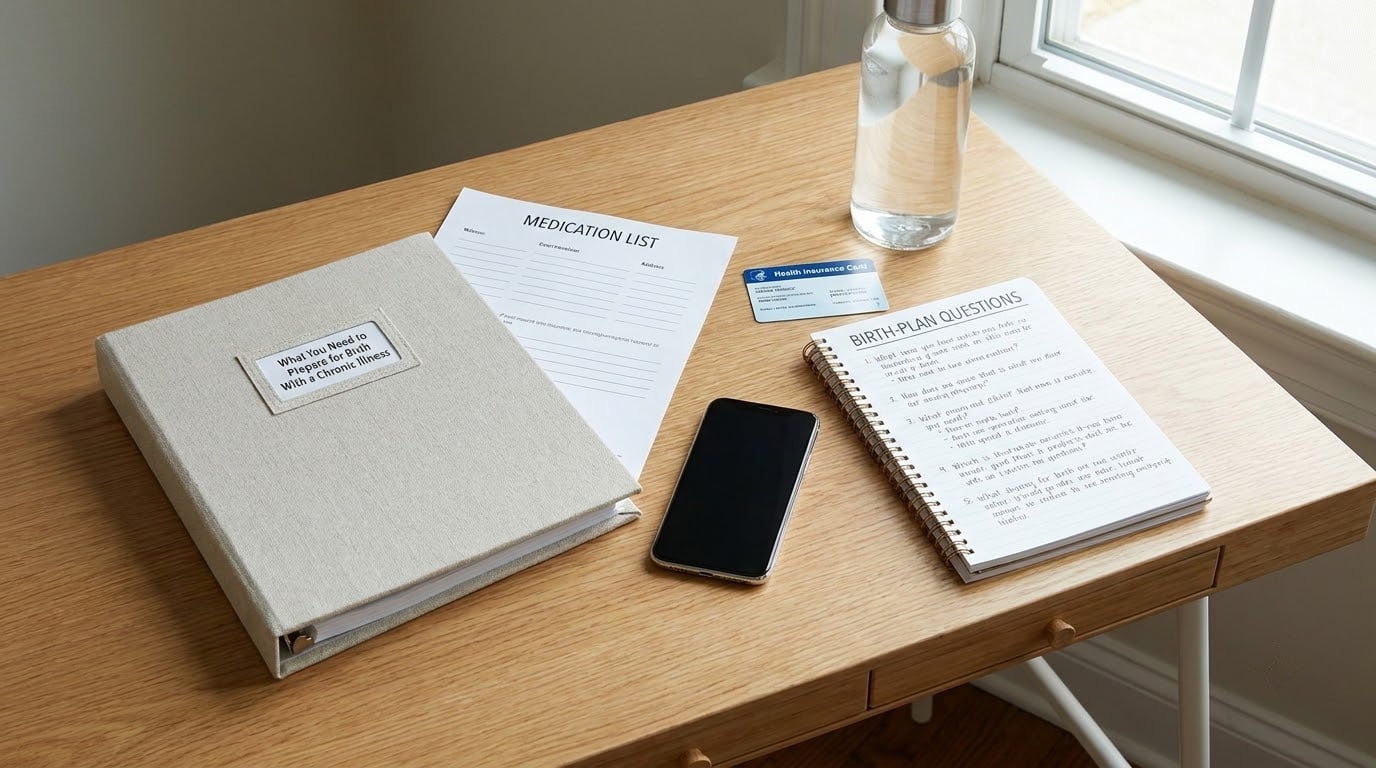
The single most useful thing you can build before labor is a binder or folder that holds every piece of your health history in one place. Memory fails you at 4 a.m. in a triage bay, and a two-page summary beats a twenty-page chart every time.
Assemble these items:
- Medical records: a current list of diagnoses, past surgeries, allergies, and recent test results. Include any records your specialist thinks your delivery team should see.
- Care-team contact list: names and direct numbers for your obstetric clinician, maternal-fetal medicine specialist, condition specialist, primary care clinician, pharmacy, and the labor and delivery unit where you plan to deliver.
- Insurance and hospital pre-registration: confirm your hospital is in network, complete pre-registration and any required authorization, and ask about the financial deposit process so it is not a surprise on admission night.
- Written medication list: every prescription, over-the-counter product, and supplement, with dose, timing, and pharmacy. Bring the actual containers too. Add your allergy list here.
- Device and equipment list: insulin pumps, continuous glucose monitors, inhalers, nebulizers, catheters, ostomy supplies, mobility aids, and refrigeration needs for temperature-sensitive medication.
- Birth preferences document: your wishes on pain relief, movement and positioning, who is in the room, feeding, and what happens if plans change.
- Accessibility notes: any sensory needs, fatigue limits, weight limits, transfer assistance, or communication needs that affect how you labor.
- Transportation and support details: who drives you, who stays with you, who is on call as backup, and where they will wait.
Everything specific to your situation — which hospital, which medications, which monitoring — has to be confirmed directly with your obstetric and chronic-illness care team. A facility’s policies on devices, visitors, and monitoring differ, and only they can tell you what applies to your admission.
Step-by-Step
Work through these in order. Each one builds on the last, and the earlier you start, the more decisions get made calmly rather than urgently.
Step 1: Build a Care Team and Ask for a Birth Plan Review
Schedule a dedicated prenatal visit for the purpose of reviewing delivery planning, ideally before 36 weeks. Ask your obstetric clinician whether a maternal-fetal medicine specialist should be involved. For many chronic conditions, that referral is standard, and having it early means their notes are part of your plan rather than an add-on later.
At that meeting, work through the coordination questions directly:
- Which clinician has final say over decisions about my delivery timing and mode?
- Can my condition specialist be copied on hospital records, or should they be called directly?
- Will my specialist be reachable during labor, and by which number?
- Does the hospital have a unit or team experienced with my condition?
- Who runs the anesthesia discussion, and when does it happen?
- Will rounds include my condition-specific concerns, or only obstetric ones?
You will also learn whether your hospital is a high-risk or tertiary center, and whether maternal transport could apply to you. Ask who communicates with your family when updates happen during an emergency.
You will know this step worked when you have a named clinician for each area and a written summary in your binder. If two specialists are giving you conflicting advice, do not arbitrate it yourself. Ask them to speak with each other, or request a joint visit. Forum conversations about high-risk births return to one theme again and again: patients get left in the middle when two experts disagree and nobody owns the disagreement.
Step 2: Review Medications, Symptoms, and Monitoring
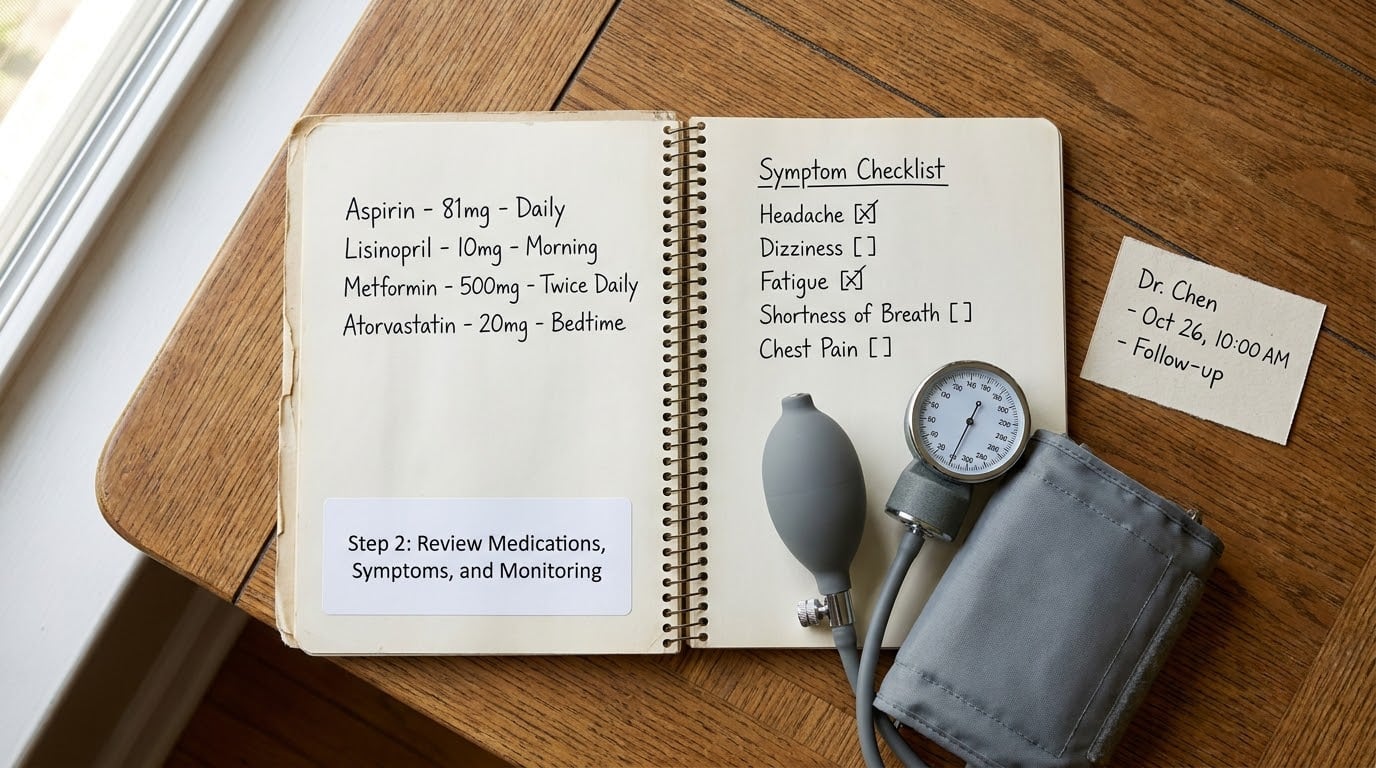
Build one accurate record: medication name, dose, timing, what it treats, and who prescribes it. Then bring it to both your prescriber and your obstetric clinician for review. Some conditions require dose adjustments in the third trimester, while some medications are paused around delivery for entirely different reasons. Your team needs to make those calls with you and write them down.
Ask specific questions rather than a general “is my medication okay?”
- Which of my medications continue during labor, and which are held?
- Which can I take during an unmedicated or general-anesthesia delivery?
- What happens to each medication after birth, especially if I plan to breastfeed?
- Who administers my specialty medications if the nursing staff are not trained on them?
- Can my pump, monitor, or inhaler stay with me during labor and surgery?
- What monitoring do I need during labor, and how often?
Track your symptoms in writing too — blood pressure readings, glucose patterns, pain scores, bowel function, sleep, or whatever your condition tracks. A baseline you recorded while well is the only fair comparison when something shifts.
Know your warning signs before you need them. Seek prompt medical attention for any of the following, and call your obstetric clinician or emergency services rather than waiting for your next appointment:
- Heavy vaginal bleeding that soaks a pad in an hour, or bleeding that starts suddenly
- Severe or persistent abdominal pain, or pain that is new and worsening
- Chest pain, shortness of breath, fainting, or a racing heartbeat
- Fever, chills, or feeling suddenly and severely unwell
- Severe headache with vision changes, sudden swelling, or upper abdominal pain
- Very low or very high blood glucose readings that do not correct as instructed, or ketones that will not settle
- Seizure, or any symptom your clinician has listed for your specific condition
- Severe pain, vomiting, or inability to keep fluids down
Never start, stop, or adjust a medication or dose on the basis of anything you read here, including this section. Discuss every change with the prescriber and your obstetric team.
Step 3: Plan for Labor, Mobility, and Pain Management
Labor with a chronic illness is still labor, but your options may be narrower. Work through positioning, monitoring, and pain relief before you are in it.
Monitoring. Ask what continuous or intermittent monitoring your condition requires, what it restricts, and what happens if it alarms. If you use a device to manage your condition, get a written answer on whether it stays on, and if not, what the backup plan is.
Movement and positioning. If fatigue, joint disease, balance, or a stoma limits how long you can stand, ask about positions you can use while lying down or sitting, peanut balls, side-lying, a birth ball, and how often you can change position. A long labor paced slowly is different from a fast one, and your team can plan for your stamina rather than be surprised by it.
Pain management. This is the part most guidance leaves out. If you already live with chronic pain or take daily pain medication, the usual advice does not map neatly onto your body, and withdrawal concerns, tolerance, and pain that reads differently when contractions layer on top of existing pain all change the conversation.
Raise it with the anesthesiologist in advance, not in the delivery room. Ask about:
- Epidural, spinal, and combined spinal-epidural options, and how an existing opioid history affects each
- Whether an epidural would add to any pain or numbness you already have
- Local anesthetic, nitrous oxide, and IV options, and what they would mean for your mobility
- Non-drug techniques: movement, breathing, counter-pressure, support person, and hydrotherapy if offered
- A plan for what happens if you decide you do not want an epidural partway through
Some people choose to birth without pain medication. That is a reasonable preference, and it goes better with preparation: understanding the stages of labor, practicing relaxation and breathing, building movement into early labor, and having a support person and clear decision rules in place ahead of time. Not having pain medication and not having a plan for when you change your mind are different situations.
Timing. Ask about induction timing and whether a planned C-section is recommended for your condition. Whatever your preference, the choice belongs jointly with your obstetric clinician, your maternal-fetal medicine specialist, and your condition specialist. Ask them to explain the tradeoff in writing, including what changes with each option for your specific condition.
The flare scenario. This is the section people most often skip and most often need. Write a short paragraph describing what a flare of your condition looks like, what usually helps, what medication is normally used, what makes it an emergency, and who to contact. Put it at the top of your birth plan. If you cannot advocate for yourself, this is how your team knows what to look for.
Available options depend on your condition, your hospital, your clinicians, and current clinical guidance. Confirm all of it in advance rather than on the day.
Step 4: Organize the Practical Logistics
Labor timing is unpredictable, so pack in a way that works whether you walk in at 2 a.m. or get a call at 6 p.m.
- Go-bag by the door: ID, insurance card, medication list, devices and chargers, charger cable, loose clothing, toiletries, and anything you need to manage a stoma, catheter, or refrigeration.
- Food and hydration preferences: clear liquids are usually the rule in labor. Ask your hospital what it provides and whether your condition changes anything about that.
- Mobility aids: cane, walker, wheelchair, grab bars. Confirm in advance that the hospital has them so you are not improvising on a weak day.
- Rest and fatigue: ask about early admission and about whether a support person can stay during early labor.
- Specialty medications: bring your own supply in original labeled packaging in case the hospital pharmacy does not stock them.
- Refrigeration: confirm whether the unit has a refrigerator you can use for temperature-sensitive medication.
- Paperwork: pre-register, confirm your delivery location, and ask about any prior authorization or benefits paperwork — leave and disability paperwork is easier to complete now than during recovery.
- Backup transport: a second driver for after midnight, and a plan if labor starts early.
Adapt the list to you. Fatigue, limited standing, sensory needs, a demanding work schedule, and uncertain timing all change what matters most. Someone managing frequent bathroom trips needs a different bag than someone managing temperature sensitivity.
Step 5: Arrange Support and a Postpartum Plan
Choose who will be with you during labor, and a backup if that person cannot make it. Consider a doula alongside your partner or family — they provide continuous hands-on support, which is a different role from your partner’s.
Talk through boundaries before labor: who is in the room during pushing, who steps out for procedures, whether you want to be told information before or after a decision, and how you want your preferences handled if you are not able to speak. People are calmer and more useful in a room when they know their job in advance.
Postpartum is when chronic illness tends to surprise people. Sleep deprivation, blood loss, and hormone shifts stack on top of your baseline, and conditions that eased during pregnancy often rebound after delivery. Plan it like labor, not like follow-up.
- Schedule your postpartum visit before you leave the hospital, and know how to reach your team between visits.
- Ask when your medications get reviewed and changed, and what changes for you in the first six weeks.
- Arrange food, transport, and help with household tasks for at least the first two weeks.
- Plan sleep in protected blocks, even though the schedule will not cooperate.
- Ask about wound, incision, or stoma care if relevant, and what healing looks like.
- Set up feeding support early — a lactation consultant helps with positioning, supply, and pumping when your condition makes breastfeeding harder.
- Name the warning signs that mean call someone, and put them where your support person will find them.
- If you have a mental health condition, plan the postpartum check separately from the physical one. Ask about screening and about what support is available in the first weeks, not just at six weeks.
- Ask about a NICU stay in advance: what it would mean for your feeding plan, and how you would be involved.
You will know this step worked when your support person can describe your plan, your medication schedule, and your warning signs without you repeating any of it.
Step 6: Create a Backup Plan and Share the Packet
Assemble everything into one packet: medical summary, medication list, birth preferences, the flare scenario, named clinicians and contacts, support person details, and the postpartum plan. Give a copy to your support person, one to your obstetric clinician, and keep one with you.
Write two lines for the emergency case: who steps in as your decision-maker if you cannot speak, and what they should know. Then talk about it now, while you are well, rather than in a hallway later.
Revise the packet whenever something changes — a new medication, a symptom pattern shift, a hospital policy change, a revised delivery plan, or new guidance from your clinicians. A birth plan that is three weeks out of date is worse than one you never wrote, because it creates false confidence.
Keep it flexible. Very few births follow a plan exactly, and a plan with clear priorities rather than rigid instructions serves you better on the day.
Common Mistakes
Waiting until the third trimester. Medication reviews, anesthesia consultations, and logistics take weeks to arrange. Start at 28 to 32 weeks if you can. Fix: book the dedicated planning visit now, even if it feels early.
Relying on memory instead of a written record. Under stress, most people misremember their own medication list. Fix: a typed, dated list, with containers in the bag.
Assuming every hospital has the same rules. Device access, visitor policy, monitoring, and anesthesia availability differ by facility. Fix: call the labor and delivery unit directly and ask their specific questions.
Planning postpartum support only after the baby arrives. Help arranged at week two is often help arranged too late. Fix: book meals, transport, and cleaning help during your pregnancy.
Skipping the flare paragraph. Your delivery team rarely knows what a flare looks like for you. Fix: write it in plain language, at the top of the plan.
Reading online checklists as if they were your clinical plan. General advice cannot account for your condition, your history, or your hospital’s protocols. Fix: use any checklist as a prompt for a conversation, then change medications or treatment only with your clinician.
Trying to resolve a specialist disagreement yourself. Fix: ask for a joint conversation or a written recommendation, and ask which clinician owns the final decision.
Waiting until labor to bring up chronic pain. Fix: raise it at the anesthesia consultation, where there is time to build a plan instead of improvising.
Frequently Asked Questions
When should I start preparing for birth with a chronic illness?
Start in the second trimester, ideally with a dedicated prenatal visit before 36 weeks. Medication reviews, anesthesia consultations, hospital logistics, and postpartum arrangements all take time to schedule. Many people begin around 28 to 32 weeks. Earlier is better if your condition is unstable or your care needs are complex.
Can my partner, doula, or family member join the birth-plan conversation?
Yes, and it usually helps. Your support person can help remember details, advocate during labor, and manage logistics afterward. Include them when you draft the plan so they understand your preferences, your boundaries, and the warning signs in your condition. Tell the hospital in advance who will be present and who is the backup, since visitor rules vary by facility.
What should I ask about medications during labor and after delivery?
Ask which medications continue during labor, which are held, which you can take if you deliver without regional anesthesia, and what changes after birth, especially if you plan to breastfeed. Also ask who administers specialty medications if nursing staff are not trained on them, and whether your own supply is accepted. Never start, stop, or change a dose without your prescriber and obstetric team.
How can I prepare if my illness may limit walking or change positions?
Tell your team before labor so they can plan for it. Ask which positions work while lying down or sitting, what equipment the hospital has, how often you can change position, and whether early admission is possible. If a mobility aid or transfer assistance is needed, arrange that in advance. For conditions where positioning is restricted, discuss the implications with your obstetric clinician before delivery.
What postpartum support matters when managing a chronic condition with a newborn?
Plan meals, transport, and household help before delivery. Protect sleep in blocks. Confirm when your postpartum visit and medication review happen, and name warning signs your support person should watch for. If you have a mental health condition, schedule that check separately and earlier. Conditions that eased during pregnancy often rebound after birth, so ask your team what to expect and when to call.
When should I contact my medical team during pregnancy or after birth?
Contact them promptly for heavy bleeding, severe or worsening pain, chest pain, shortness of breath, fainting, fever, severe headache with vision changes, seizures, vomiting that prevents hydration, or blood sugar readings that do not correct as instructed. After birth, also call for worsening incision or stoma pain, signs of infection, or mood changes that feel unmanageable. Use your provider’s number, or emergency services for anything urgent.
Conclusion
Start with one action: schedule a dedicated prenatal visit before 36 weeks to review your delivery plan. Bring a written list of your conditions, medications, and devices, and leave that visit asking for a written labor and postpartum plan in your hands.
Here is how to prepare for birth with a chronic illness, step by step: schedule the planning visit, write down your conditions and medications, and ask for a written labor and postpartum plan.
That plan is a starting point for a conversation with qualified clinicians, not a substitute for individual medical advice. What it gives you is something no checklist can — a care team that already knows your condition before the day you need them to.