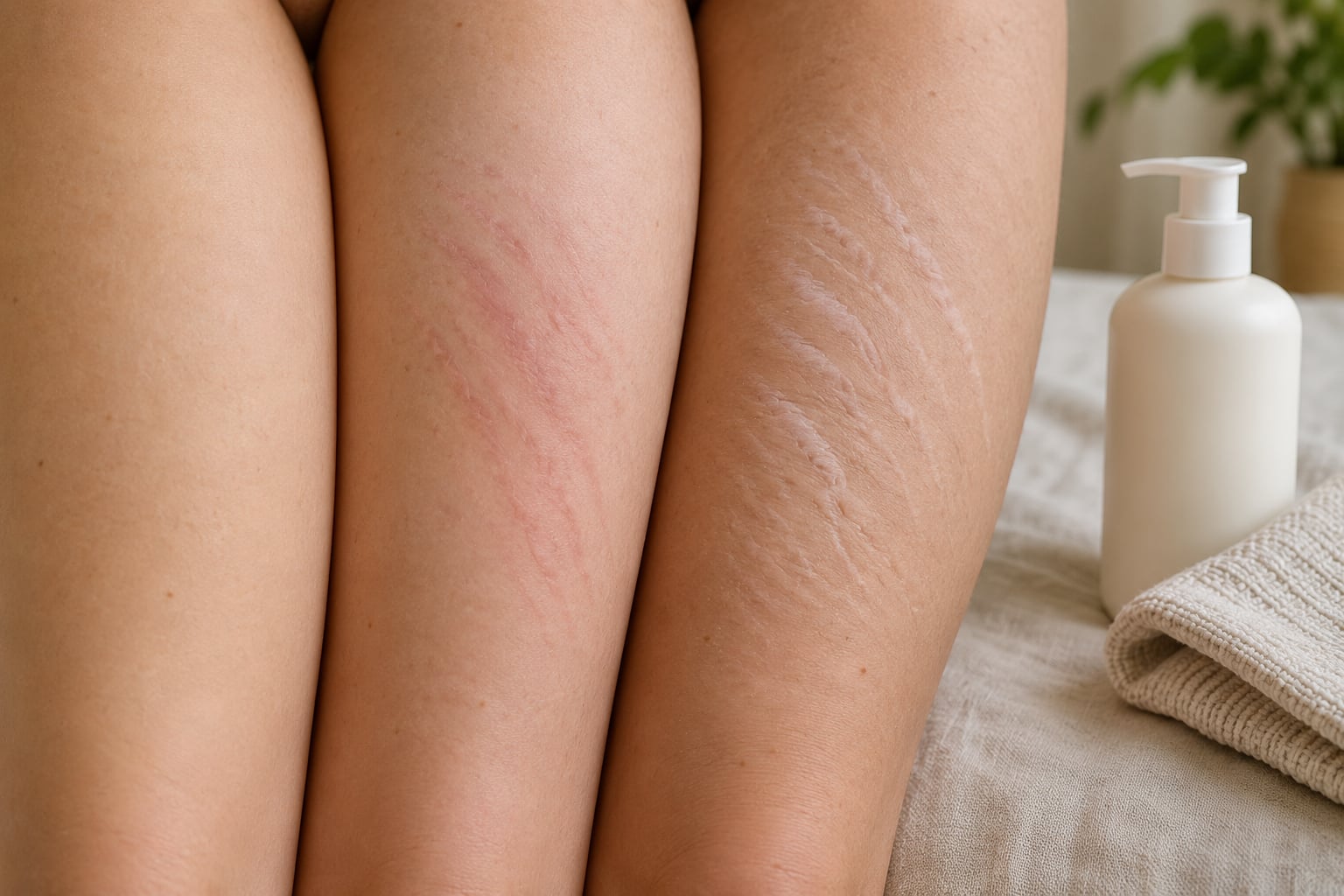
Stretch marks during pregnancy are indented streaks that form when skin stretches faster than the collagen and elastin fibres beneath it can adapt. They are common, they are almost always harmless, and they are driven mostly by genetics and pregnancy hormones rather than by anything you did or did not do.
No cream, oil, massage or supplement has been shown to reliably prevent them. That is the sentence most product pages leave out, so the rest of this guide sets out what the published research actually supports, where the evidence is thin, and where a clinician is a better source of advice than an influencer.
Table of Contents
- Stretch Marks During Pregnancy: What Research Says
- The three stages researchers describe
- What the numbers actually say
- What Causes Stretch Marks During Pregnancy?
- The mechanical side: skin outrunning its fibres
- The hormonal side: collagen gets loosened
- What biomechanical studies actually measure
- Why family history outweighs anything on a product label
- When Do Stretch Marks Appear and What Do They Look Like?
- Can You Prevent Stretch Marks During Pregnancy?
- What the prevention trials found
- Ingredients with a signal worth discussing, but not promising
- Ideas with no evidence behind them
- What Products or Treatments Actually Work?
- Do Genetics, Weight Gain, and Age Make a Difference?
- What raises the odds
- What does not mean you failed
- When Should You Ask a Doctor About Stretch Marks?
- Frequently Asked Questions
- Do stretch marks during pregnancy hurt?
- Are stretch marks more common with twins or a larger body change?
- Will stretch marks disappear after giving birth?
- Is it safe to use retinol or tretinoin during pregnancy?
- Can massage or coconut oil prevent stretch marks?
- What to Do First
Stretch Marks During Pregnancy: What Research Says
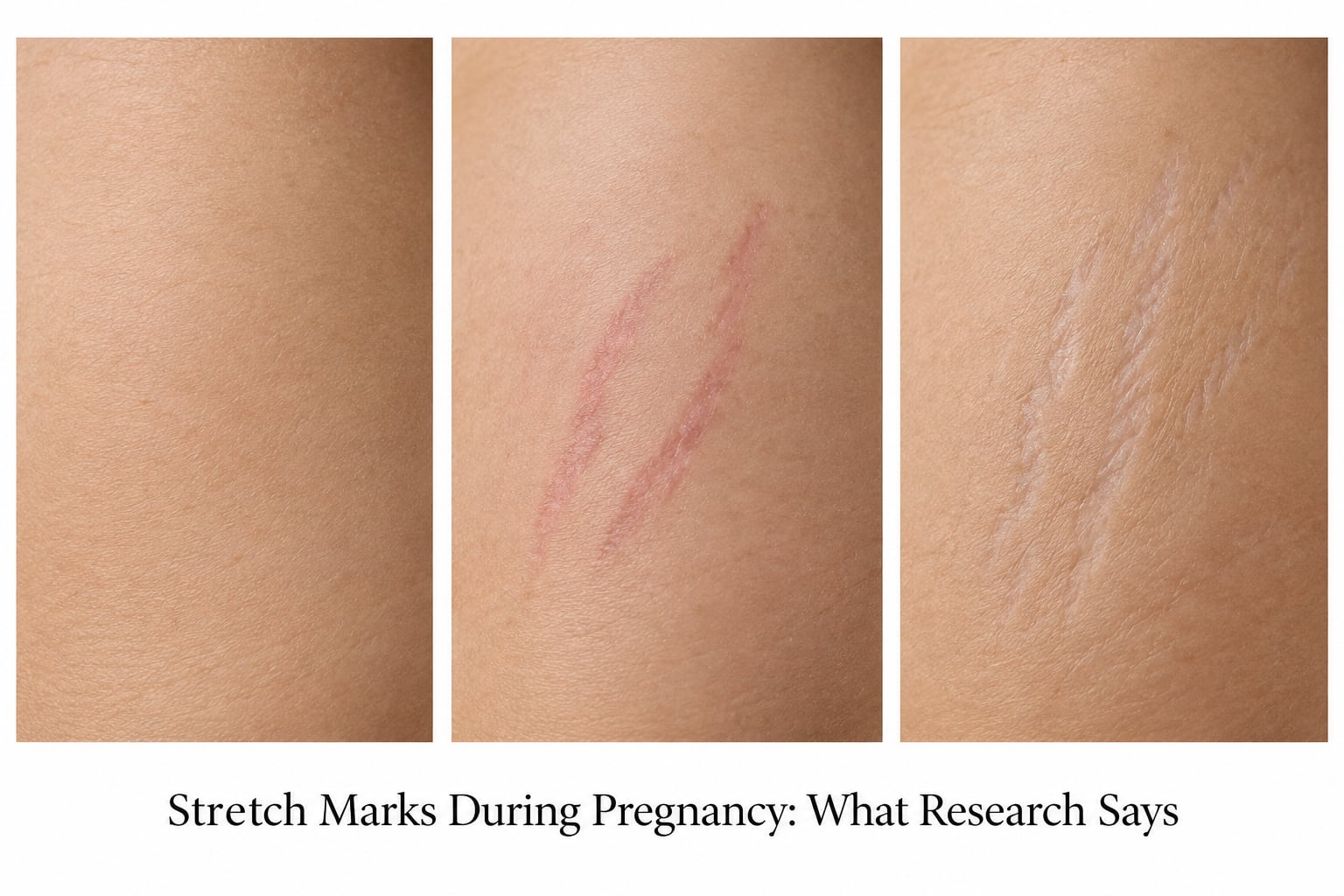
Stretch marks have a medical name: striae gravidarum. They form in the dermis, the deeper layer of skin where collagen gives strength and elastin gives stretch. When that layer is pulled beyond what it can take, the fibre network tears in a pattern, and the tear heals as a scar.
Here is the short answer most searchers need: they are common, they usually fade over months after birth, they are not a sign that a body did something wrong, and no product on the market can stop them from forming. The rest is detail.
The three stages researchers describe
Dermatologists usually describe three phases. Early marks, called striae rubrae, look pink, red or purple and can feel slightly raised or itchy. Over months they flatten, and the colour drains out, leaving paler, thinner lines called striae albae.
On deeper skin tones the early phase often shows as darker red, brown or grey rather than pink, and the late phase can look lighter than the surrounding skin rather than silvery. Skin can also look indented or depressed in the same area. None of that pattern is a sign of something going wrong.
What the numbers actually say
Estimates vary widely by how the study defined the marks, but most reviews put prevalence somewhere between 50 and 90 percent of pregnancies. Higher reported figures usually come from self-report surveys; clinical examinations tend to find somewhat lower rates. The honest summary is that at least half of pregnant people develop them, and most do.
They cluster in the third trimester, though some people first notice them much earlier, and a minority never develop any at all.
What Causes Stretch Marks During Pregnancy?
Two forces act together, and neither alone fully explains it. The first is mechanical: the skin over the abdomen, hips, breasts and buttocks has to accommodate a growing uterus, a changing chest and shifting fat distribution. The second is hormonal, and it is the part most people never hear about.
The mechanical side: skin outrunning its fibres
Skin is elastic, but it has a limit. Stretch that happens slowly gives the dermal fibre network time to reorganise. Stretch that happens quickly, over weeks rather than months, can outpace that adaptation and produce micro-tearing along the lines of tension.
That is also why marks tend to follow the direction of pull. On the abdomen they often fan out from the navel, and on the upper thighs and breasts they run diagonally or in curved bands.
The hormonal side: collagen gets loosened
Pregnancy raises levels of cortisol, progesterone and estrogen. These hormones change how the dermis behaves: collagen bonds soften, water retention rises, and the skin holds more fluid. Cortisol in particular is associated with weakened elastic fibres.
The result is a dermis that is simultaneously more fluid and structurally looser at exactly the moment it is being pulled hardest. Hormones alone do not produce stretch marks in people who are not pregnant, and pregnancy alone does not produce them in people whose skin adapts well. It is the combination.
What biomechanical studies actually measure
Research using skin-testing instruments has found that striae are measurably less firm, less elastic and less deformable than the surrounding skin, and that these properties differ across the body. Three-dimensional imaging of the dermal fibre network shows it fraying and losing its orderly alignment where marks form.
What those studies do not show is a clear threshold. Two people with the same degree of abdominal expansion can end up with very different results, which is one reason researchers keep coming back to genetics as the dominant factor.
Why family history outweighs anything on a product label
On pregnancy forums, the most repeated observation is not about creams. It is about resemblance to a relative. People who report stretch marks across generations describe the same pattern repeating, and people whose mothers had none often say they had none either, despite doing everything the internet recommends.
That is anecdotal, and anecdotes are not evidence. But it lines up with what studies of predisposing factors consistently find: family history is the strongest and most reproducible risk factor in the literature.
When Do Stretch Marks Appear and What Do They Look Like?
Most stretch marks during pregnancy first show up in the third trimester, though plenty of people notice them in the second. The abdomen is the most common site, followed by the breasts, hips, thighs, buttocks and lower back. Marks can appear on the arms or chest too, particularly with larger weight change.
Timing within the pregnancy is not a reliable signal. Some people get marks at 20 weeks with a big early gain; others get them at 37 weeks with none at all. If you are watching your skin every week for changes, that is exhausting and it is not giving you useful information.
| Stage | Colour | Texture | Typical change over time |
|---|---|---|---|
| Early (striae rubrae) | Pink, red, purple; darker red, brown or grey on deeper skin tones | Slightly raised, sometimes itchy or tender | Fades over roughly 6 to 12 months |
| Maturing | Colour draining, becoming less saturated | Flattening, texture closer to surrounding skin | Gradually approaches final appearance |
| Mature (striae albae) | Silvery, white, or lighter than surrounding skin | Thin and slightly indented or depressed | Usually stable; rarely fully disappears |
Appearance varies enormously between people. Two people with the same pregnancy can have very different numbers, colours and locations of marks, and that variation is normal rather than a sign that one of them did something wrong.
Can You Prevent Stretch Marks During Pregnancy?
Short answer: no routine has been shown to prevent stretch marks during pregnancy. That is not a marketing line. It is the finding of a Cochrane review of randomised trials on topical prevention, which concluded that none of the interventions studied prevented stretch marks reliably, and that the trials were generally too small and too short to be confident about even modest effects.
What the prevention trials found
The Cochrane review pooled randomised trials of topical preparations used to prevent striae gravidarum. Across the studies, the evidence was consistently weak and inconsistent, with different products showing different results in different trials. Massage, water-soluble collagen supplements and various topical combinations all failed to show a clear, reproducible benefit.
A few individual ingredients have produced interesting signals in small trials. Almond oil has been compared with nothing and reported fewer new marks in one well-known study, though later reviews have not treated that finding as robust. Centella asiatica, hyaluronic acid and vitamin D have each appeared in trials with positive results, and all of them have been limited by small sample sizes and inconsistent methods.
Ingredients with a signal worth discussing, but not promising
- Almond oil. One frequently cited trial reported fewer new stretch marks than the control group. Later reviews have been cautious about the finding.
- Centella asiatica. Studied in small trials for both prevention and treatment, with mixed results and low participant numbers.
- Hyaluronic acid. Appears in prevention trials as a moisturising ingredient; evidence quality is low.
- Vitamin D. One study reported fewer new striae in a group with adequate vitamin D levels, but it has not been widely replicated.
A good prenatal visit is a good place to raise any of this, and what shared decision making looks like in obstetric care explains why asking how a recommendation was arrived at is a reasonable question to ask.
Ideas with no evidence behind them
Cocoa butter, vitamin E creams, sugar scrubs, aloe, coconut oil and almond-oil massage are widely recommended online. Some studies have found cocoa butter and vitamin E make no measurable difference. Exfoliation cannot prevent the dermal tearing itself, because exfoliation acts on the outermost layer while the damage happens deeper.
Support belts and belly bands have a plausible mechanical story attached, but no controlled trial has shown they reduce stretch marks. People often report them as comfortable, which is a fine reason to wear one.
Moisturiser still has a place. It does not prevent stretch marks, but it can reduce the dry, tight feeling many people notice in the third trimester, and comfort on its own is worth something.
What Products or Treatments Actually Work?
Prevention and treatment are different problems. Nothing has been shown to reliably prevent stretch marks during pregnancy, while several options can improve how marks look after birth. Those improvements are cosmetic. None of them is medically necessary, and a dermatologist is the right person to tell you which, if any, is worth doing for your skin.
| Approach | Evidence | Appropriate timing | Limits | Pregnancy and breastfeeding |
|---|---|---|---|---|
| Daily moisturiser | Comfort benefit only; no evidence for prevention | Any time during pregnancy | Helps dryness, nothing more | Safe |
| Tretinoin (retinoid) | Modest evidence for early pink marks | Postpartum only | Irritation; poor results on mature marks | Avoid during pregnancy; discuss timing with a clinician if breastfeeding |
| Microdermabrasion | Small studies, mixed results | Postpartum | Risks irritation and, rarely, pigmentation change | Postpartum |
| Chemical peels | Weak evidence | Postpartum | Irritation risk; limited effect on dermal scarring | Postpartum |
| Microneedling | Growing evidence, often in combination | Postpartum | Pain, cost, multiple sessions | Postpartum |
| Laser therapy | Best-studied option, still mixed results | Postpartum, after marks have faded | Expensive, multiple sessions, results vary widely | Postpartum; tell the clinician you are breastfeeding |
Two cautions are worth repeating. First, retinoids are not for use during pregnancy, and any personal advice about when to start one belongs with your clinician. Second, laser and other procedures target appearance, not health, and the price people pay for them often surprises them. Forum accounts of treatment tend to split cleanly between visible improvement for some and little change at high cost for others.
Do Genetics, Weight Gain, and Age Make a Difference?

Yes to genetics, less directly to weight gain, and in a way that is easy to misread to age. Research repeatedly finds that family history is the strongest predictor, followed by having had stretch marks before, most commonly during puberty.
What raises the odds
- A family history of stretch marks, especially in a mother or sister
- Stretch marks that appeared during puberty
- Younger maternal age and some studies report higher rates at both younger and older ages
- Twins and higher-order multiples, which bring faster change in body shape
- Larger pre-pregnancy body mass index in several studies
- Rapid change in body size, whether from weight gain or a different distribution of it
One small study also reported a link between lower vitamin D status and more severe striae. It has not been replicated well enough to treat as a cause.
What does not mean you failed
Weight gain during pregnancy is necessary and medically guided. Nobody should try to prevent stretch marks by restricting gain, and no clinician would suggest it. The research that links higher weight change to more marks describes an association, not a fault.
Age is similar. Studies that include very young and older pregnant people find more marks at both ends, which likely reflects differences in skin elasticity and hormonal profile rather than anything a person could change.
If weight, blood pressure or growth is on your mind, that conversation fits naturally into routine prenatal care, including the mid-pregnancy anatomy scan at 20 weeks and what they check, rather than into a stretch mark search.
When Should You Ask a Doctor About Stretch Marks?
Ordinary stretch marks during pregnancy need no appointment on their own. They do not itch enough to keep you awake, they are not open, they do not bleed, and they are not a sign of anything wrong with your pregnancy.
Do raise them with your doctor or midwife if the marks appear suddenly and spread quickly, if they are painful rather than mildly itchy, if they look bruised or purple in a pattern that is not typical, or if they appeared without any pregnancy-related body change. Stretch marks that are very wide and purple, especially alongside easy bruising, muscle weakness or high blood pressure, are worth mentioning, because rare hormonal conditions such as Cushing syndrome can produce similar changes. The same applies to tall, slender people with a family history of a connective tissue disorder such as Marfan syndrome.
Also worth raising: how much they are bothering you. A Michigan Medicine survey of 116 patients using the Dermatology Life Quality Index found measurable psychological burden, with around 38 percent reporting moderate to severe embarrassment and correlations between lesion severity and anxiety and depression scores. That is a real finding, and quality of life is a legitimate reason to ask for help rather than something to feel silly about.
Being clear about what you want is a reasonable part of any appointment, and what informed consent really means in maternity care covers what you should be told before any procedure.
Frequently Asked Questions
Do stretch marks during pregnancy hurt?
Fresh stretch marks can feel itchy or mildly tender, especially on the abdomen and thighs, because new skin in that area is thinner and more sensitive. Most people describe the sensation as dry, tight or slightly irritated rather than painful, and it usually eases within a few weeks. Plain fragrance-free moisturiser often helps the dryness. See your clinician if the itching is severe, or if it comes with a rash or swelling, since those point to something other than stretch marks.
Are stretch marks more common with twins or a larger body change?
Yes, both are associated with a higher likelihood. Studies report more stretch marks in twin and higher-order pregnancies, where the abdomen changes shape faster than it would with a single baby. Rapid change in body size, including larger pre-pregnancy body mass index, also shows up as a risk factor. These are associations, not causes you control, and no clinician would recommend limiting medically advised weight gain to avoid marks.
Will stretch marks disappear after giving birth?
Usually they fade but do not disappear completely. New pink or red marks gradually lose their colour over roughly six to twelve months after birth, settling into a paler, thinner or slightly indented line that tends to be stable long term. Earlier marks fade sooner than later ones. Treatments such as laser, microneedling or tretinoin can improve appearance for some people, but results vary and none of them reliably removes marks entirely.
Is it safe to use retinol or tretinoin during pregnancy?
No. Retinoids including tretinoin are not recommended during pregnancy, and topical retinoids are generally advised against while breastfeeding unless a clinician says otherwise. They were once studied for preventing stretch marks, and benefit was not clearly shown. After birth, tretinoin has modest evidence for improving early pink marks, so discuss timing with your doctor rather than restarting it on your own, especially if you are nursing.
Can massage or coconut oil prevent stretch marks?
Neither has been shown to prevent them. A Cochrane review of randomised trials found no topical preparation reliably prevented stretch marks in pregnancy, and massage has not been shown to reduce new marks either. That said, both can feel good. Coconut oil and plain moisturiser are often reported as helpful for the dry, itchy tightness many people get in the third trimester. Think of them as comfort measures rather than prevention, and patch test anything new first.
What to Do First
Treat ordinary stretch marks as a common bodily change rather than a problem to solve. Use moisturiser if you like it, for the comfort it gives, and stop expecting it to prevent anything.
If the marks bother you, talk with your prenatal clinician or a dermatologist after birth rather than spending the pregnancy on products that cannot deliver what they promise. And if a mark appears suddenly, hurts, or looks nothing like the ones described here, get it checked.