Packing a hospital bag for labor takes about an hour the first time you do it, and most families finish packing between 36 and 38 weeks of pregnancy, or closer to 34 to 35 weeks if the pregnancy is high-risk or you are expecting multiples. You need four groups of things: documents and logistics, items for you through labor and recovery, a small newborn essentials set for the ride home, and a separate overnight kit for your partner or doula. Here is the full breakdown, updated for 2026.
The reason to sort it this way is timing. Some things you need at 3 a.m. during early labor, some only at discharge, and some only if you end up staying an extra night. Grouping by when you need something keeps the bag from turning into a suitcase nobody can find anything in.
One more thing worth saying up front: every hospital and birth center stocks different items and enforces different rules about outside food, own-gown policies, and cord length. Call your labor and delivery unit or check its website before you pack, then adjust the list below to match what they told you.
Table of Contents
- What to Pack in a Hospital Bag for Labor at a Glance
- What to Pack in a Hospital Bag for Labor: When to Start
- 1. Essential Documents and Hospital Information
- 2. The Birth Plan and Labor Preferences
- 3. Comfortable Clothing for Labor and Early Recovery
- 4. Toiletries and Personal-Care Basics
- 5. Labor Support and Comfort Items
- 6. Electronics, Chargers, and Entertainment
- 7. Food, Drinks, and Snacks for the Support Person
- 8. Newborn Essentials for the Ride Home
- 9. Postpartum Recovery Supplies
- 10. Feeding and Soothing Items
- 11. A Separate Bag for the Partner or Doula
- 12. What to Leave Out and How to Pack Smart
- Frequently Asked Questions
- When should I start packing my hospital bag for labor?
- Do you wear a bra during labor?
- What does the hospital provide during labor and delivery?
- Do I need to bring diapers, pads, and peri supplies?
- What should I pack for a cesarean birth?
- What should my partner pack for the hospital?
- Conclusion
What to Pack in a Hospital Bag for Labor at a Glance
Start with these categories rather than a flat item list, because each one answers a different question.
- Documents and logistics: photo ID, insurance card, hospital pre-registration paperwork, birth plan copies, pediatrician’s phone number, and a list of medications.
- For you during labor: front-opening gown or loose clothes, robe, non-slip socks, hair ties, lip balm, a long charger, water bottle, pillow.
- For recovery after birth: nursing bra, high-waisted underwear, supportive clothing you can open without twisting, dry shampoo.
- For the baby going home: installed rear-facing car seat, a going-home outfit in two sizes, a hat, socks, and a receiving blanket.
- For your support person: phone and charger, snacks, a change of clothes, toiletries, a pillow, and the contact list.
What to Pack in a Hospital Bag for Labor: When to Start
Pick a date around 36 to 37 weeks and treat it as a deadline, not a suggestion. Have the bag packed and by the door by 37 to 38 weeks, with the car seat installed before then. For a high-risk pregnancy, multiples, or a planned hospital admission, start at 34 to 35 weeks.
If you want a version you can print and tick off, use this page as the checklist and mark items as you add them to the bag. Anything on the list that your facility does not supply, or that you have decided not to bring, gets crossed out rather than deleted, so you can see what you considered.
1. Essential Documents and Hospital Information
Put your documents in a slim zip pouch or envelope that stays on top of the bag, not in the bottom, because the first person who asks for them is usually a registration clerk before you have even changed into a gown.
The core set is a government photo ID, your insurance card, and any hospital pre-registration or admission forms you filled out ahead of time. If you have a birth plan or a signed consent paperwork packet, bring two or three copies on plain paper. One goes into your chart, one goes to your nurse or midwife, and one stays with your partner.
Add the phone number for your OB-GYN or midwife’s office and for the pediatrician you plan to use. Write both on an index card as well as saving them in your phone, since phones die and hospital Wi-Fi fails more often than anyone expects. Include your blood type if you know it, and a short list of current medications and doses.
Check in advance whether your hospital requires anything specific. Some facilities want a copy of a prenatal record or a signed living will on file. Others will not accept outside prescriptions and will dispense everything from their own pharmacy, which surprises a lot of first-time parents.
2. The Birth Plan and Labor Preferences
Bring one page, not ten. A single readable sheet of preferences tells your care team what matters to you without burying the important lines in detail they cannot act on.
A useful sheet names the support people you want present, your preferences around movement and position changes, how you feel about an epidural or other pain management, whether you want an immediate or delayed skin-to-skin contact, and your feeding plan. Leave space for the team to write back to you. A document that cannot be annotated gets ignored.
Treat it as a conversation starter, not a contract. Birth plans shape a conversation and a record of what you asked for; they do not guarantee a specific clinical outcome, and emergency decisions always follow medical judgment rather than a piece of paper. Read your plan out loud to your nurse when you arrive so it becomes a live discussion instead of paperwork in a folder.
3. Comfortable Clothing for Labor and Early Recovery
Pack a front-opening gown or two, a robe, non-slip socks, and one easy outfit for the ride home, because you will not want to wrestle with waistbands, ties, or anything you cannot see in the first days after birth.
The gown question comes up constantly, and the honest answer is that most people end up wearing the hospital gown for the whole stay. Bring your own if it would make you feel more like yourself, but check the facility’s policy first. Many labor and delivery units ask you to arrive in your own clothes and change when you are admitted, which means your own outfit needs to be easy to get out of while contractions are running.
For the ride home, choose something with a wide waistband or a dress or tunic that does not press on a healing incision or perineal area. If a cesarean is possible, add a soft top that opens at the front so nothing has to be pulled over your head, and skip anything that ties at the waist.
A few other small clothing notes. Socks with grip soles matter more than you would think, because hospital floors get wet. Keep clips and pins out of your hair and use a headband or hair ties, since you will be on your back for long stretches and a loose ponytail presses straight into the back of your skull.
4. Toiletries and Personal-Care Basics
Bring toothbrush, toothpaste, deodorant, lip balm, face wash, dry shampoo, hair ties, and a few face wipes, all in travel sizes, because the single most common packing mistake is bringing the full-size bottles.
Lip balm earns its place more than any other toiletry. L&D rooms are climate-controlled and dry, and dry mouth during labor is miserable in a way you cannot fix with water alone. Lollipops and hard candies help too, if your facility allows food by mouth.
For a planned cesarean or if you have sensitive skin, add your own unscented wash, a barrier cream, and your own pillowcase if you want a familiar surface against your skin. If you plan to birth in a pool, pack a swimsuit for you and your partner plus a towel you do not mind getting wet.
Skip the full beauty arsenal. Perfume, hair straighteners, and a makeup bag sit untouched in the bag for the entire stay. Parents repeatedly say the item they were most glad to have was dry shampoo, because showering depends on your IV, your mobility, and your provider’s timing.
5. Labor Support and Comfort Items
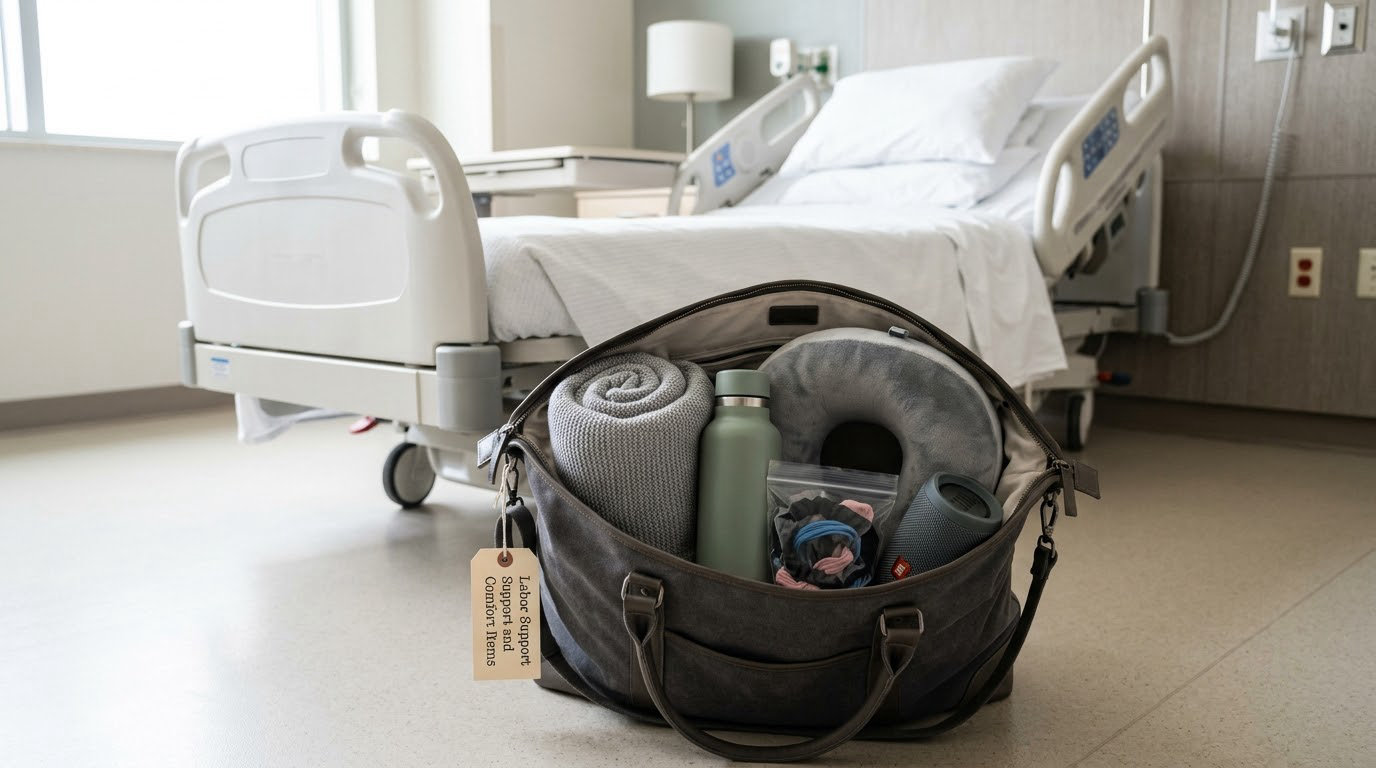
Bring a pillow and a blanket you recognize from home, because a labor room bed is not a bed you will remember fondly. These two items are the most-used comfort objects on most hospital bag checklists.
Add a tube sock filled with uncooked rice or a tennis ball, which is a low-cost trick for pressing into a low back during back labor, and a small bottle of massage oil or lotion for counter-pressure. Ask your hospital first, since a few units do not allow oils in the room. A small handheld fan, an eye mask, and a neck pillow also fit into a labor bag without crowding it.
For a water birth or a labor that happens at a birth center, add a swimsuit for the person supporting you. Neither of you needs anything fancier than a pair of hands and a clear idea of what helps, so talk through that before labor starts rather than in the middle of it.
6. Electronics, Chargers, and Entertainment
Bring your phone, an extra-long charging cable, a power bank, and headphones, because the charger is the single most-cited essential across parent packing lists and the one people most often leave behind.
Ten feet of cord is the number to aim for, because the outlet is often across the room from the bed and behind a curtain rail you cannot reach. A power bank covers the case where you move rooms mid-labor and the new room has no free socket.
Download your labor playlist before you go rather than streaming it. Hospital Wi-Fi is not reliable, and music is one of the few predictable comfort measures in an unmedicated birth. A small portable speaker works too, if your unit allows Bluetooth devices and you keep the volume low.
Two practical notes. Write your partner’s phone number, your doctor’s number, and your hospital’s main number on paper, since a dead phone takes your whole support system offline with it. And check your facility’s rules on cords, personal devices, and screen time; some units ask visitors to leave devices outside the room during procedures.
7. Food, Drinks, and Snacks for the Support Person
Pack snacks for your partner, not for yourself, because what you are allowed to eat or drink in labor is entirely up to your hospital’s policy and your provider’s instructions.
That split matters. Many L&D units allow clear liquids only in early labor and nothing by mouth later, especially if a cesarean becomes likely, because of anesthesia rules. Others run a full food policy. Ask yours, and if you are planning an unmedicated birth, check whether they permit snacks and when those stop.
Your support person is the one who will be awake at 4 a.m. with nothing but vending machine options. Pack food that needs no refrigeration or microwave: granola bars, nuts, crackers, dried fruit, sandwiches from a cooler if you have one, and a refillable bottle. A cooler is worth the space for a long labor. Hospital meals usually arrive on a schedule that does not match a 14-hour labor.
Add a few coins and a prepaid card for vending machines, and note that pharmacies and cafeterias on the hospital campus often close overnight.
8. Newborn Essentials for the Ride Home
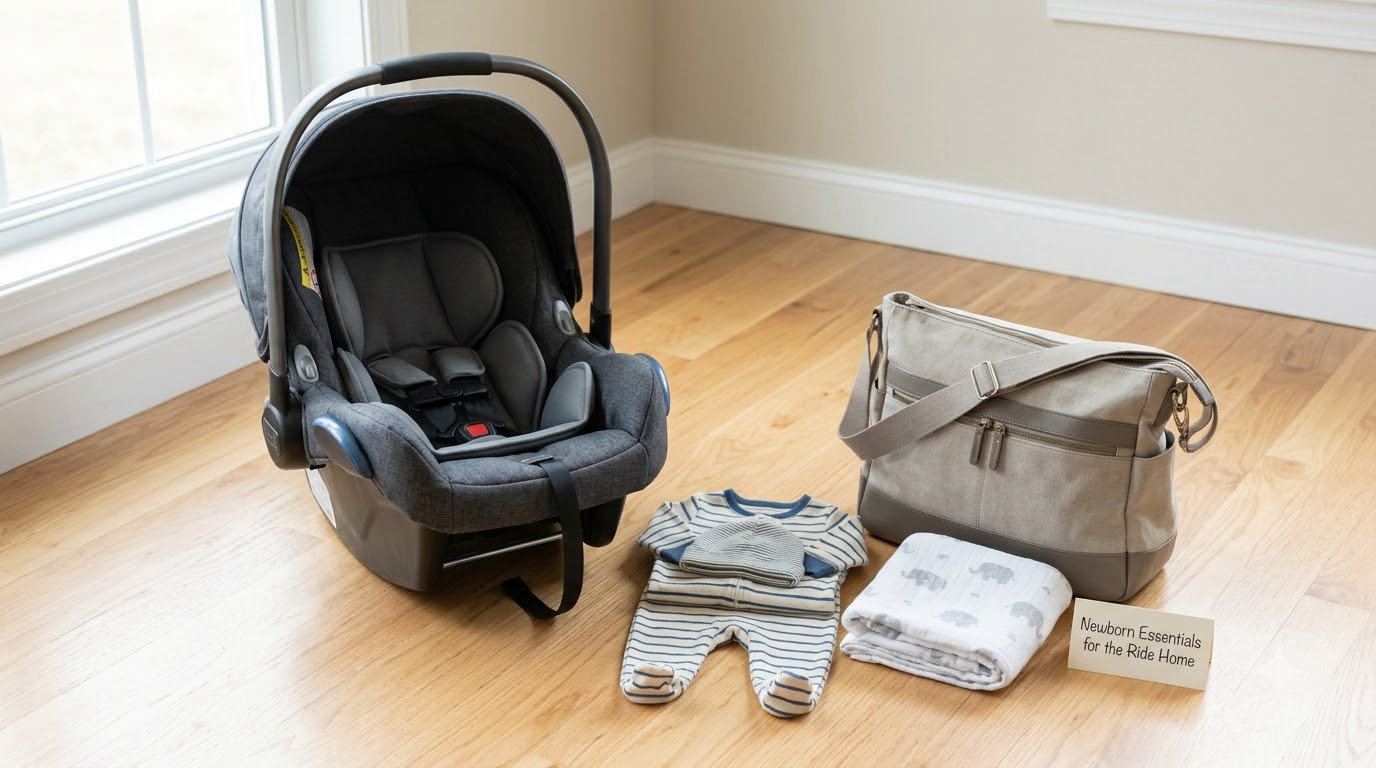
The non-negotiable item is an installed rear-facing infant car seat, because most hospitals will not complete discharge without it, and installing a seat at 5 a.m. in a hospital parking lot is a miserable way to start your first day home.
Install it in the car and have it checked before 37 weeks if you can, and follow the instructions that came with the seat or your vehicle’s owner’s manual. If you cannot get it checked, ask your hospital’s newborn nursery whether they run installation clinics, because many do.
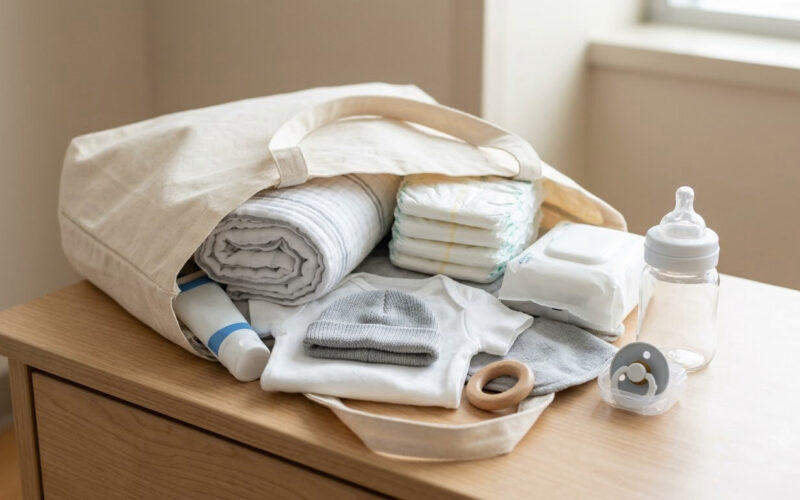
For clothes, pack a going-home outfit in two sizes, since newborn sizing is famously unreliable. Add a soft hat, socks or booties, and one or two receiving blankets. A single easy-to-change outfit and a blanket covers most first hours; the newborn comes home wearing whatever the hospital has on hand more often than not.
Diapers, wipes, blankets, and a peri bottle for you are almost always supplied by the facility, so pack a small diaper bag only if you want your own brand of diaper or a specific blanket for photos. The rest is optional.
9. Postpartum Recovery Supplies
Pack enough for comfort after birth, then follow your hospital and clinician’s instructions, because what you need depends heavily on whether you had a vaginal birth or a cesarean.
Bleeding, perineal soreness or an incision, sore breasts, and exhaustion are the four things worth planning for. Bring supportive clothing you can open without twisting, high-waisted underwear, and a nursing bra if you plan to breastfeed. For a cesarean, add anything that keeps pressure off the incision site while you sit and lie down.
A peri bottle is standard issue at nearly every hospital, so ask before packing one. If you want a perineal spray bottle or cooling pads, check that they are allowed in the room. Pack any medication your provider has told you to take at home, in its original labeled container, and keep the discharge paperwork that tells you the dosing.
Stay ahead of hydration and meals. Ask when you can eat, and have your partner bring in something you actually want to eat in the first hour rather than relying on whatever the tray offers.
10. Feeding and Soothing Items
Pack a small, flexible set of feeding and soothing supplies and hold the plan loosely, because plenty of families change their minds about how they feed in the first forty-eight hours and that is a normal outcome.
For nursing, bring two or three nursing bras, a box of nursing pads, nipple balm, and whatever support you normally use. Many hospitals loan hospital-grade pumps and provide pumping kits, so a full pump kit often goes unused. Ask before packing one.
For formula or combination feeding, bring a small number of ready-to-feed bottles and one or two days of formula if you want to be sure of the brand you have used before. Bringing your own formula can conflict with hospital policy on early feeding, so check.
Soothing items: burp cloths, a small receiving blanket, a lovey with no loose parts, and a pacifier if you plan to offer one. Pack a clean folded blanket for the car seat, and remember that hospitals provide sleep sacks for the newborn’s time in the unit.
11. A Separate Bag for the Partner or Doula
Give your support person their own small bag, because a single suitcase shared between you keeps them digging through your things at 3 a.m. while you are trying to rest.
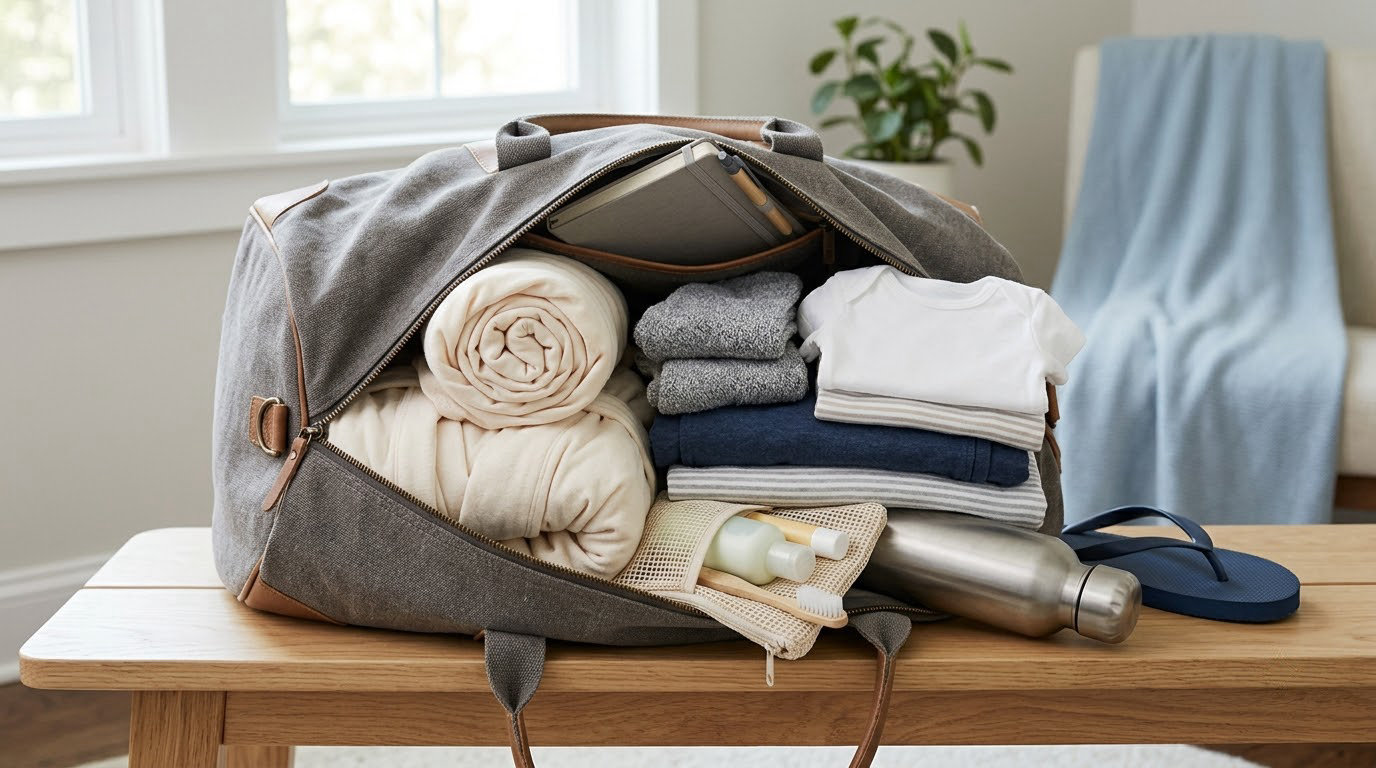
Fill it with a phone and charger, a change of clothes including something they can sleep in, a toothbrush and deodorant, snacks, a refillable water bottle, a sweater or cardigan for cold units, a hair tie, and a spare pair of socks. Add a folded blanket or travel pillow for the recliner.
Put a printed copy of your birth plan, the pediatrician’s number, and your own phone number in that bag too. A doula brings her own kit, but a partner who is the only person there needs those references within reach.
Keep it to what fits in a backpack or a small tote. The support person’s job is to stay useful, and lugging a heavy bag through a parking garage at midnight works against that.
12. What to Leave Out and How to Pack Smart
Leave out jewelry, heirlooms, cash, laptops, hardcover books, and anything breakable, then pack the rest in two or three smaller bags rather than one large suitcase.
Splitting works well: a labor bag for comfort items and electronics, a postpartum and baby bag that stays at home until you need it, and the partner bag. You can hand off a car full of overflow to someone the next morning without making anyone move your essentials.
Use packing cubes or a clear checklist so nothing becomes archaeology at the bottom of a bag. Put items you need first at the top, and tape a card to the outside of the bag with your name, your doctor’s number, and the date. Then do a trial run: lay everything out on the bed a week before your due date and take anything you have not touched twice off the list.
Leave a sticky note on the bag with the last-minute items to grab if labor starts fast: phone, charger, lip balm, water bottle, ID, insurance card. Many urgent trips happen without the bag at all, and a small pouch kept next to the bed or in the car covers that night.
Frequently Asked Questions
When should I start packing my hospital bag for labor?
Most families finish packing between 36 and 38 weeks, with the bag by the door and the car seat installed by 37 to 38 weeks. Start earlier, around 34 to 35 weeks, if your pregnancy is high-risk, you are expecting multiples, or your hospital has scheduled a planned admission. Packing early costs nothing and removes the risk of doing it during a rushed night of labor.
Do you wear a bra during labor?
It depends on your plan and your facility. Many people labor in a hospital gown with no bra, which is common and fine; monitors, monitoring straps, and an IV line can all be awkward over a bra band. If you plan an unmedicated or water birth, a sports bra is often practical and gets covered by the gown. Ask your Lu0026amp;D unit about their policy when you call to confirm your other packing questions.
What does the hospital provide during labor and delivery?
Most Lu0026amp;D units supply diapers, wipes, mesh or disposable underwear, pads, a peri bottle, basic blankets and sleep sacks, gown and socks for you, and basic baby clothing. Many also provide a breast pump and pumping kits. Items vary widely by facility, and medication is typically dispensed by the hospital pharmacy rather than brought from home, so ask your unit what they stock before duplicating any of it.
Do I need to bring diapers, pads, and peri supplies?
Usually not. The list parents most often over-pack is diapers, pads, underwear, and peri supplies, because most families do not realize these are standard items in a delivery unit. Bring them only if you want a specific brand, or if your hospital has told you it does not supply them. Confirm with your facility, because birth centers are more likely to ask you to bring some of your own.
What should I pack for a cesarean birth?
Shift weight toward recovery items: loose clothing that opens at the front, nothing tight across the incision, dry shampoo, a peri bottle or spray if your unit does not supply them, and your discharge medication instructions. A hospital stay after a cesarean commonly runs two to four days rather than one or two, so pack a second outfit and more nursing supplies than you think you need.
What should my partner pack for the hospital?
Give them their own small bag with a phone and charger, a change of clothes, snacks, water, toiletries, a sweater, and a pillow or blanket for the recliner. Include printed copies of your birth plan and the pediatrician’s number. A single shared suitcase works fine until someone needs something at 3 a.m. and starts moving your belongings around.
Conclusion
Call your hospital or birth center first and ask what they supply and what they will not allow. Then pack documents in a pouch on top, comfort items in one bag, newborn going-home clothes and the installed car seat in a second, and a small overnight kit for your partner.
Start by 36 to 37 weeks, or 34 to 35 weeks if your pregnancy is high-risk or you are carrying multiples, and check the bag against the list a second time before it goes by the door. Everything else on the internet is a starting point, not a requirement.