
Labor induction works by encouraging your body to do the four things that start a birth: soften and open the cervix, break the amniotic sac, contract the uterus regularly, and keep those contractions strong enough to move the baby down and out. In practice that means a clinician decides how ready your cervix is, then chooses from medications or mechanical methods to begin the process, which usually unfolds in that order over hours and sometimes days.
If you have been told you will be induced, the biggest source of anxiety is usually not pain, it is not knowing the order of events. Knowing the sequence, the realistic timings, and what decisions belong to you takes a lot of that out of the day.
This is general information about how induction is done, not a plan for your pregnancy. Your own maternity care team decides which methods are safe for you.
Table of Contents
- What Is Labor Induction and Why Is It Used?
- How Labor Induction Works Step by Step
- How Labor Induction Works Step by Step: Before Induction Begins
- How Labor Induction Works Step by Step: Preparing the Cervix
- How Labor Induction Works Step by Step: Starting and Building Labor
- Common Methods Used to Induce Labor
- Common Methods Used to Induce Labor: Medication and Mechanical Options
- What Happens During an Induction
- How Long Does Labor Induction Usually Take?
- Induction vs. Augmentation: What Is the Difference?
- Risks, Side Effects, and Reasons to Call the Care Team
- Questions to Ask About Your Induction Plan
- Frequently Asked Questions
- Does labor induction always require an epidural?
- What happens if an induction does not start labor?
- Can I eat, drink, or move around during labor induction?
- When might an induction lead to a C-section?
- What happens after a membrane sweep or amniotomy?
- Does having an induction mean the baby will arrive sooner?
- What to Do First
What Is Labor Induction and Why Is It Used?
Labor induction is the process of starting labor artificially before it has begun on its own. It is not the same as augmentation, which means strengthening labor that has already started on its own.
Clinicians recommend induction when waiting carries more risk than delivering. Common reasons include a pregnancy that has passed the due date, high blood pressure or preeclampsia, gestational diabetes, a baby who is growing too large or too small, a prior stillbirth, fluid leaking from the sac without labor starting, or a maternal health condition such as heart or lung disease. Cholestasis of pregnancy, a condition involving bile acids and intense itching, is another common reason.
Some inductions are planned rather than urgent. The 2018 ARRIVE trial studied planned delivery between 39 and 39 weeks and 6 days in low-risk pregnancies, and found fewer cesarean births and no increase in stillbirth compared with waiting for labor to start. That is why 39 weeks comes up so often in conversations about elective induction, and also why induction before 39 weeks is generally not offered when both parent and baby are healthy.
Most pregnancies never need one. The decision is always individual.
How Labor Induction Works Step by Step
Induction moves through a predictable sequence even though the methods inside each stage vary. The order below is the usual shape of the process; your clinician will tailor it to your cervix, your history, and how your baby is doing.
First comes an assessment of whether you and your baby are ready. Then cervical ripening, if needed. Then membrane procedures, which may or may not happen. Then contractions are started or strengthened with oxytocin and titrated over hours. Throughout, the baby’s heart rate is monitored and your cervix is periodically rechecked. Finally, once labor is progressing, the birth itself proceeds, and oxytocin usually continues afterward to help the placenta come away.
How Labor Induction Works Step by Step: Before Induction Begins
Before anything is done, a clinician reviews how far along you are, whether the baby is head-down, your medical and birth history, and how your labor has been progressing if it has started. A vaginal exam then checks your cervix, and those findings are often scored with the Bishop score.
The Bishop score rates five things on a scale that adds up to a total of 0 to 13: how far open the cervix is (dilation), how thin and shortened it is (effacement), how firm it is, which direction it is pointing, and how far the baby’s head has descended in the pelvis (station). A score of 6 or less generally means the cervix is not ready, and ripening methods are usually offered first. Your score tells your team how long to expect and which method will probably work better, and it is worth asking for it by name.
On the day, expect an IV, a blood draw, and a fetal monitor. Bring your birth plan, your support person, and a list of your questions.
How Labor Induction Works Step by Step: Preparing the Cervix
Ripening is the stage that softens, thins, and slightly opens a cervix that is still long, firm, and closed. Its purpose is to make the later stages work, because contractions on an unready cervix often disappoint.
Prostaglandins are the most common ripening medication. They come as a gel, a vaginal pessary that releases slowly, or tablets placed near the cervix. Dinoprostone is one prostaglandin used this way, and misoprostol is another. Prostaglandins are powerful and unpredictable, which is why most hospitals schedule a wait between doses.
A balloon catheter, often a Foley catheter with a small balloon inflated inside the cervix, applies steady mechanical pressure instead. It works more predictably, is often easier to tolerate, and is frequently the option chosen after a previous cesarean. Membrane sweeping, in which a gloved finger separates the membranes from the lower uterus, is a gentler option often done at a routine late-pregnancy visit or at the start of an induction.
Patients describe the cramping from prostaglandins as sharp and insistent, and the phrase that comes up most often in birth communities is prostin pains. It is a real effect of the medication, not a sign something has gone wrong. Ask for pain relief early rather than toughing it out; you are in a monitored unit with clinicians who can help.
How Labor Induction Works Step by Step: Starting and Building Labor
Once the cervix is ready, contractions are started with oxytocin, given through an IV drip and known as Pitocin in the US and Syntocinon elsewhere. Contractions usually begin within about 30 minutes of the drip starting.
Oxytocin is titrated: the dose is increased, decreased, paused, or restarted many times in a labor, in response to how your contractions and your baby’s heart rate are behaving. If the uterus becomes too active, the rate slows or stops for a while and then restarts. This is routine management, not a complication you caused.
Continuous electronic fetal monitoring, usually a CTG band around your waist, is standard during an induction. A wireless monitor, where available, lets you walk, shower, and use a birth ball instead of sitting beside a machine. Ask whether your unit has them, because that single question changes the shape of the whole day.
After the baby is born, a third stage follows. Oxytocin is commonly continued to help the placenta separate and reduce bleeding. The placenta is delivered, and then you are monitored for bleeding and blood pressure for a couple of hours before moving to a recovery room.
Common Methods Used to Induce Labor
No single method is right for everyone, and most inductions combine two or three of them. What follows is a general comparison of the methods clinicians use, not a recommendation for you.
| Method | How it works | When a clinician might consider it | Limitations and risks |
|---|---|---|---|
| Membrane sweep | A gloved finger separates the membranes from the lower uterus to encourage hormone release | Slightly favorable cervix, or at a late-pregnancy visit | Usually does not start labor on its own; cramping and spotting afterward are common |
| Balloon catheter | A balloon inflated inside the cervix applies steady outward pressure | Cervix not ready, or a previous cesarean | Can cause cramping and a period-like flow; does not reliably start labor by itself |
| Prostaglandins | Hormone medication softens and thins the cervix | Cervix long, firm, and closed | Unpredictable timing, significant cramping, and a possible need to wait between doses |
| Amniotomy | The amniotic sac is opened with a small hook, so fluid releases and prostaglandins are absorbed | Cervix partway open, with the baby in a safe position | Not appropriate in every situation; contractions can become intense quickly afterward |
| Oxytocin | An IV hormone makes the uterus contract regularly | Cervix ready, or when labor stalls after starting | Requires monitoring and dose adjustment; can cause too-frequent contractions |
Amniotomy and membrane sweeping get confused constantly. A sweep does not break your water; it separates the bag from the cervix. Amniotomy does break the water, and it is not part of every induction in every hospital.
Common Methods Used to Induce Labor: Medication and Mechanical Options
The simplest way to think about induction drugs is that they do two different jobs. Some prepare the cervix, and some drive the contractions.
Cervical ripening medications, meaning prostaglandins and cervical balloons, do not reliably create labor contractions. They change the cervix so that contractions, if they come, actually work. Starting labor with oxytocin before the cervix is ready is one of the more common reasons an induction stalls, which is why ripening comes first so often.
Contraction-stimulating medications, meaning oxytocin, do the opposite. They make the uterus contract but they do little to change a firm, closed cervix. Some clinicians use both, in sequence, and it is common to see a ripening method the night before and oxytocin the next morning.
Because oxytocin works on a moving body, care teams usually give it by IV drip rather than a single injection, so the dose can be turned down or off quickly if contractions become too strong or frequent.
What Happens During an Induction
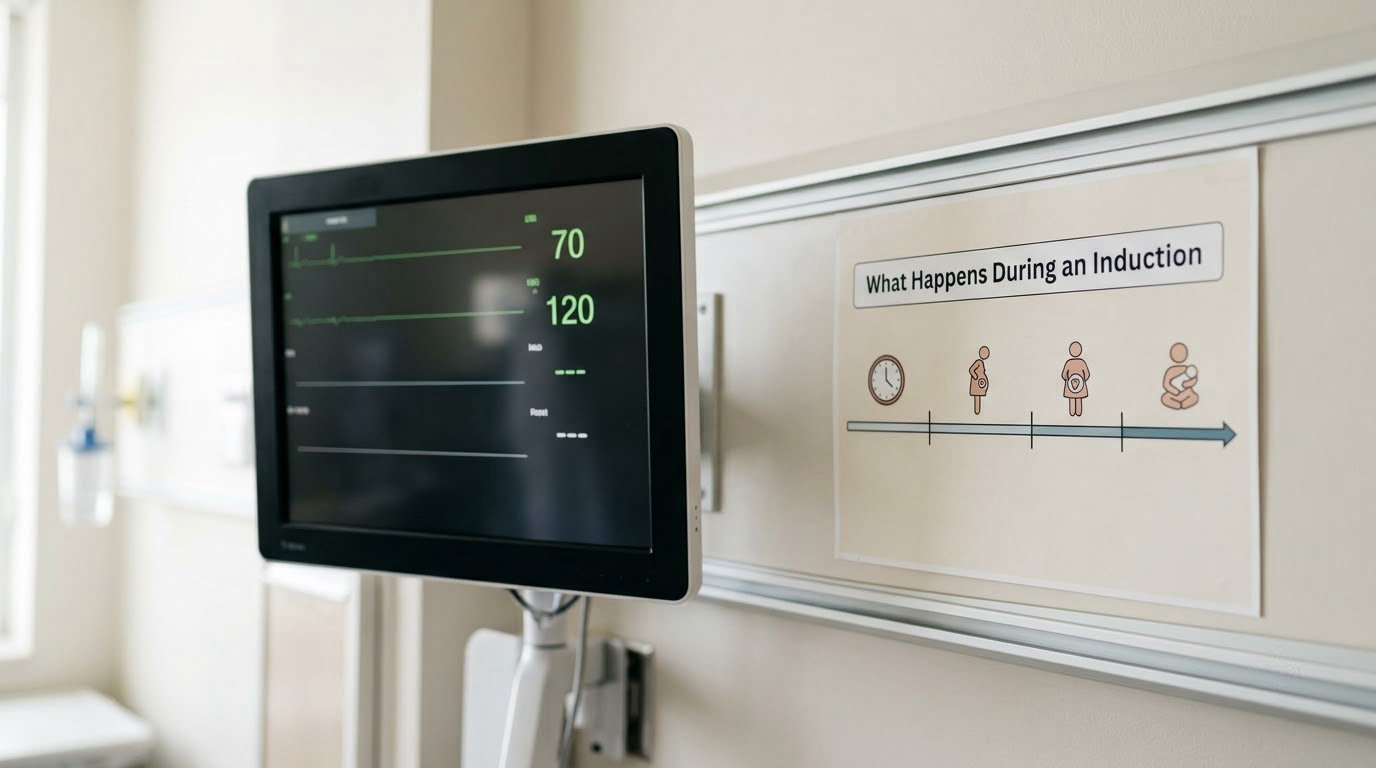
On a typical inpatient induction you are checked in, examined, given an IV, and placed on a monitor. A nurse or midwife comes in and out through the day, checking your cervix every few hours, adjusting the oxytocin, and watching your baby’s heart rate.
Outpatient induction is now common and works differently. You go home after the ripening method is placed, come back for checks, and return when contractions meet a set pattern. Ask which protocol your hospital uses, because it changes the whole timeline and changes whether you are managing contractions at home.
Food and drink rules vary widely. Some units allow clear liquids until active labor, some allow a light meal, and some are strict nil by mouth because a general anesthetic might be needed if a cesarean becomes necessary. Nausea is common on prostaglandins, so the rules tend to exist for practical reasons rather than yours.
Movement, showers, a birth ball, and upright positions are often allowed, depending on your monitor and your cervix. Ask for what is permitted rather than assuming, and ask the nurse to re-explain anything you did not catch.
How Long Does Labor Induction Usually Take?
There is no reliable single number, and anyone who gives you one is guessing. These are broad ranges commonly used in US practice.
| Phase | Broad range | What usually drives the length |
|---|---|---|
| Cervical ripening | Several hours to more than a day, often overnight | How unfavorable the cervix is, and how many medication rounds are needed |
| Contractions after oxytocin | Often begin within about 30 minutes; progress to active labor takes longer | How far along you already were when the drip started |
| Active labor and pushing | Many hours, longer for a first birth | Whether you have had a baby before, and how your pelvis and baby are positioned |
| Total induction to birth | Often roughly one to two days for a first birth; frequently much shorter for a second birth | Everything above, plus whether the plan changes partway through |
ACOG clinical thresholds allow up to 24 hours or longer for early labor and at least 12 to 18 hours of oxytocin after membrane stripping, which is a good clue about what counts as a reasonable wait. Individual experiences reported in birth communities range from about 12 hours after starting Pitocin to 24 hours or more from 2 cm to delivery.
Prepare for it to take longer than you hope. A slow induction is a common experience, not a sign that anything has gone wrong.
Induction vs. Augmentation: What Is the Difference?
Augmentation means helping labor that has already started. Induction means starting labor that has not. The word changes in your chart, and it changes what the plan looks like.
If your water broke on its own at 37 weeks and nothing is happening, your labor has not begun, so starting it is an induction. If your water broke, you are having contractions, and they are just not strong or frequent enough, that is augmentation, usually with oxytocin and nothing else. If you are past your due date with a closed cervix and no contractions, that is induction, and ripening usually comes first.
Augmentation is generally the simpler path. It skips the ripening stage, and many people describe it as a shorter, less complicated experience.
Risks, Side Effects, and Reasons to Call the Care Team
Common side effects of induction methods include cramping, nausea, diarrhea, headache, irregular or back-to-back contractions, and some bleeding that resembles a period. Prostaglandins most often cause the sharp cramping. Oxytocin most often causes too-frequent contractions, called uterine tachysystole, which is usually managed by reducing the drip.
Other risks to discuss with your team include changes in the baby’s heart rate, infection after the membranes are opened, bleeding after birth, and the possibility that induction does not produce labor and a cesarean is needed. Induced labor also has a higher chance of operative vaginal delivery in some studies, partly because inductions are treated as higher-risk labors.
Call your maternity care team or emergency services right away for any of these: the baby’s movements slowing or changing pattern, bleeding heavier than a heavy period, fluid that looks green or brown, a severe headache with vision changes, sudden swelling of the face or hands, chest pain, difficulty breathing, or regular painful contractions that do not ease between them. Do not take any medication or try any technique to start labor on your own without asking your provider first.
This article is educational and does not replace advice from your own obstetrician, midwife, or nurse. Dosing and method selection are clinical decisions that depend on your full medical picture.
Questions to Ask About Your Induction Plan
These are the questions that reveal how the day is most likely to go, and how long it is expected to take.
- Why exactly is induction being recommended, and what happens if we wait?
- What is my Bishop score, and does that change which methods are on the table?
- Do you plan ripening first, or do you expect to start oxytocin today?
- Is my induction inpatient or outpatient, and what are the rules for each?
- Can I have a wireless monitor, and how much movement is allowed?
- What can I eat and drink, and when does that change?
- How often will my cervix be checked, and how will we know labor is progressing?
- What pain options are available to me, including nitrous oxide, walking, and an epidural?
- How long will you allow the first method before trying the next one?
- What is the plan if labor does not progress?
Frequently Asked Questions
Does labor induction always require an epidural?
No. An induction can be managed without an epidural, and many people manage it that way, sometimes with nitrous oxide, directed breathing, movement, and a support person. Contractions from induction often build quickly rather than easing in gradually, so the timing of pain relief is worth planning rather than waiting until you cannot speak. Decide in advance when you want to ask, so you are not making that call during the worst contraction.
What happens if an induction does not start labor?
Your team has options. They may repeat or switch ripening methods, start oxytocin, or break the water if it is appropriate. If labor still does not progress after a reasonable trial, the discussion moves to rest, going home, or a cesarean. ACOG allows up to 24 hours or longer for early labor and at least 12 to 18 hours of oxytocin after membrane stripping, so one long day does not automatically mean failure.
Can I eat, drink, or move around during labor induction?
It depends on your hospital and how active your labor is. Some units allow clear liquids only, some allow a light meal, and some ask you to stop eating because general anesthesia might be needed in an emergency. Most units allow walking, showers, and a birth ball, particularly with a wireless monitor. Ask all three questions before you arrive: food, drink, and movement.
When might an induction lead to a C-section?
A cesarean may become necessary if labor does not progress, if the baby shows signs of distress that do not resolve, if the baby is positioned in a way that prevents vaginal birth, or if a medical condition makes vaginal delivery unsafe. Induction itself does not automatically raise C-section risk, and the 2018 ARRIVE trial found planned delivery at 39 weeks did not increase C-section rates in low-risk pregnancies. The risk is tied to why induction was started.
What happens after a membrane sweep or amniotomy?
After a membrane sweep you will usually have cramping, an irregular discharge, and some blood-tinged fluid, and labor often starts within a day or two. After amniotomy, fluid releases, prostaglandins begin to be absorbed, and contractions commonly begin or become stronger within a few hours, often more intense than before. Your baby is monitored closely because the water is no longer cushioning the cord.
Does having an induction mean the baby will arrive sooner?
Usually, but not always, and not on the schedule you would choose. An induction may take a day, two days, or longer, and induction is frequently used because waiting is considered riskier than delivering now. An induction that does not progress may end in a cesarean, which is surgery and recovery, so a planned induction is not a guarantee of an earlier vaginal birth.
What to Do First
Ask your maternity care team four things before you say yes: why induction is being recommended, which methods they plan to use, what the monitoring and time limits are, and what the plan is if labor is not progressing. Those four answers tell you more about the day ahead than anything else.
Most inductions are not emergencies, and an informed decision made with your own clinician is worth the time it takes. The details in this guide can help you recognize your options in the room and ask better questions, but the plan itself belongs to you and your care team together.