If you are pregnant with your first baby and undecided about pain relief, here is the short version: an epidural gives strong relief from labor pain, lets you rest through a long labor, and can be topped up for surgery in minutes, but it also limits movement and position changes, usually requires continuous fetal monitoring, and sometimes leaves you too numb to feel the urge to push. There is no wrong answer here, only tradeoffs you should know before you are in it.
About 70 to 75 percent of births in the United States involve some form of neuraxial analgesia, which is the umbrella term for epidurals and spinals. Roughly 60 percent of vaginal births use an epidural, and about 95 percent of cesareans receive one. In other countries the numbers swing widely, from about 20 to 30 percent in England to roughly 65 percent in Ireland, so what is normal in one birth room may feel unusual in another.
This is educational information about a common procedure, not medical advice. Your OB, midwife, and anesthesiologist can tell you what applies to your pregnancy specifically.
Table of Contents
- Epidural pros and cons for first time moms at a glance
- How does an epidural work during labor?
- How long does an epidural take to start working?
- What are the main pros of an epidural for first time moms?
- What are the main cons and possible risks?
- Common short-term effects versus rare serious reactions
- Does an epidural slow down labor or affect delivery?
- Can an epidural help with back pain after delivery?
- What questions should I ask about an epidural before labor?
- How can first time moms make an informed epidural decision?
- What if I change my mind during labor?
- Frequently Asked Questions
- What percentage of first time moms get an epidural?
- Is it too late to get an epidural at 8 centimeters?
- Can you still move around with a walking epidural?
- Will an epidural increase my chances of a C-section?
- Does an epidural affect my baby?
- How long does recovery take after an epidural?
- The bottom line
Epidural pros and cons for first time moms at a glance

| Factor | What an epidural usually means | The tradeoff |
|---|---|---|
| Pain relief | Strong, adjustable relief from contractions and delivery | Some people feel it as pressure rather than no sensation at all |
| Mobility | Legs often weak or numb; many stay in bed | Walking and changing position usually stop once the block is strong |
| Possible side effects | Itching, nausea, shivering, grogginess, drop in blood pressure | Most settle on their own within a day or two |
| Effect on labor | About 32 minutes longer first stage, 15 minutes longer second stage on average | First births are longer regardless of the epidural |
| Flexibility | Dose can be lowered, paused, or topped up at any point | Once monitoring and an IV are in place, they usually stay |
| Recovery | Sore injection site for a few days; numbness wears off | Plan on help with the baby for the first day or two |
How does an epidural work during labor?
An epidural is a block, not a sedative. An anesthesiologist places a thin flexible catheter through the skin and ligament of your lower back into the epidural space, the sac that surrounds the spinal cord. Medicine travels through the catheter: a local anesthetic such as bupivacaine or ropivacaine for numbness, often mixed with a small opioid such as fentanyl to take the edge off.
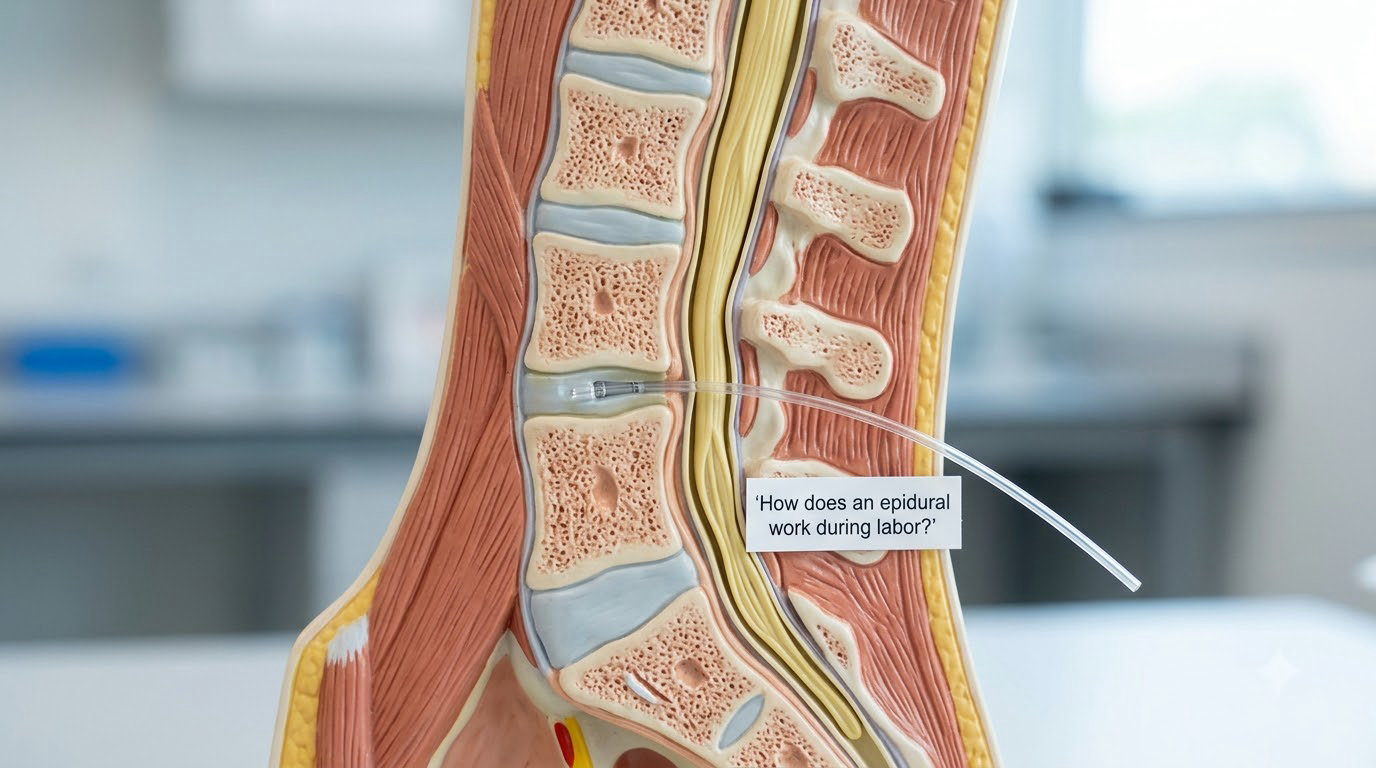
What it changes: the pain of contractions, the pressure of the baby against your pelvis, and often the sensation of being vaginal. What it usually does not change: your consciousness, your ability to see and hold your baby right away, or your breathing.
The needle comes out when placement is done. A soft plastic catheter stays in your back for the rest of labor, which is the part people find reassuring and the part that makes dosing adjustable.
How long does an epidural take to start working?
Placement takes about 10 minutes. The medication typically begins working 10 to 20 minutes after the catheter goes in, and the block builds over another 15 to 20 minutes to its full effect. Once an epidural is in place, the same catheter can be topped up for an emergency cesarean in roughly 10 minutes, which is one reason clinicians like having it available.
Timing is about dilation, and the numbers people quote have shifted. There is no longer a 4 centimeter rule. Most providers are comfortable placing one around 4 to 5 centimeters, many will try at 6 to 7, and some attempt it at 8 centimeters or beyond, though the harder it is to reach your back the more likely you are to have a patchy block. Induction changes the clock entirely, because you can hit 6 centimeters on a schedule.
What are the main pros of an epidural for first time moms?
Relief you can actually depend on. This is the most effective labor pain relief available. In the 2018 Cochrane review of 40 studies and more than 11,000 participants, people with an epidural were 90 percent less likely to need additional pain medicine than those given injectable opioids.
Rest when you need it. A long or induced labor can run for a day. Without an epidural, most people cannot sleep. Many describe being able to nap between contractions and then wake up genuinely present for the delivery rather than wrecked by it.
Less stress in your body. Untreated labor pain raises your stress hormones and can reduce blood flow to the placenta. Lowering the pain lowers the stress response, which is part of why the 2024 Scottish study found less severe maternal morbidity in the epidural group.
A fast path to surgery. If an unplanned cesarean becomes necessary, an epidural already in place saves the ten to twenty minutes a fresh spinal or general anesthetic would take. That is not an argument for getting one you do not want. It is a fact about what happens if everything is fine until it is not.
Dose control. You can ask for it turned down between pushes, or paused, or given in a lower concentration so you feel pressure without losing all sensation. Moms who ask for the lowest dose that still works often get a block they can push with.
What are the main cons and possible risks?
Mobility and positions. A strong block means your legs are heavy and you are staying in bed. Sidelying, hands-and-knees, and the peanut ball are much harder without feeling in your legs. Moms describe this as the real cost more than anything else.
Pushing. Some people feel the urge to push on their own. Some do not and need coaching about when to push, which can make the second stage feel long and uncertain. First-time moms already push for longer on average, so this is where the epidural debate gets loudest.
Itching. Pruritus from the opioid in the epidural can be intense and maddening, and scratching does not help much. It resolves when the block wears off, usually within a day.
Grogginess and shivering. You may doze off, which plenty of women love, and some are disappointed by. Shivering is common and temporary. Nausea can happen, particularly as the block takes effect.
Blood pressure drops. Maternal hypotension is common, which is why a blood pressure cuff goes on your arm every few minutes and IV fluids are usually running. It is managed by topping you up with fluids and adjusting the dose.
A block that does not fully work. It happens often enough to plan around. Reports of a hot spot on one side, or needing a second dose, or a block that fades early are all common. Tell your nurse. A repeat dose or a reposition usually fixes it.
Common short-term effects versus rare serious reactions
Common but usually minor: low blood pressure, fever, itching, nausea, urinary retention needing a catheter, heavy leg weakness, soreness at the injection site, drowsiness. In the Cochrane review, epidural users had about 11 times the risk of low blood pressure and about 3 times the risk of fever compared with injectable opioids or no medication.
Rare but serious: a spinal headache if the needle nicks the dura, infection around the spine, an epidural hematoma, or temporary or lasting nerve injury. Cleveland Clinic puts these at roughly one in several hundred thousand. In a 10-year US study tracking serious complications, zero deaths from labor epidurals were reported. If you get a spinal headache, an epidural blood patch usually fixes it within a day.
On mood, a 2021 systematic review of 11 observational studies and roughly 5,700 people found nine with no significant difference in postpartum depression risk and two with lower risk among epidural users. A cross-national study of 4.5 million people and their siblings found no association between labor epidurals and later autism or ADHD diagnoses.
Does an epidural slow down labor or affect delivery?
Randomized trials say no to a meaningful increase in cesarean rate. That is the finding of the 2018 Cochrane review. The observational studies that do show a gap are confounded, which is worth understanding because the 2024 Kearns study in Scotland is the one making the rounds.
Kearns and colleagues looked at about 541,000 births with a 22 percent epidural rate and reported a 35 percent relative reduction in severe maternal complications. Here is the part headlines drop: 35 percent relative means absolute risk moved from about 0.43 percent to about 0.28 percent, roughly 4.3 to 2.8 serious complications per 1,000 births. The same study’s table shows the epidural group had twice the induction rate and far more first-time mothers. First births are longer and more likely to end in operative delivery regardless of epidural, so most of that gap is who was in the group, not what the epidural did.
On duration, the Cochrane review found an epidural adds about 32 minutes to the first stage and about 15 minutes to the second stage on average. If you are a first-time mom, your labor is going to be longer than a second-time mom’s with or without the epidural. That distinction matters more than the 32 minutes.
One more thing people forget: an epidural usually arrives with monitoring. Continuous fetal heart rate monitoring, a blood pressure cuff, an IV, sometimes a bladder catheter, sometimes pitocin to strengthen contractions. Not every part of that bundle is automatic where you are giving birth, and it is worth asking which pieces are standard locally.
Can an epidural help with back pain after delivery?
Rarely, and this is worth being straight about. The soreness most people notice after an epidural is at the injection site: a tender, bruised feeling where the needle went in, usually for two or three days. Warm showers help. Sitting on a cushion helps more than anyone expects.
Persistent lower back pain after birth is common, especially in first-time moms, and it usually has nothing to do with the epidural. Hormonal relaxation of ligaments, a stretched abdominal core, poor sleep, and carrying a newborn all contribute. When epidural and non-epidural groups are compared in studies, long-term back pain rates are similar.
A spinal headache is different from back pain. It is worse, often worse when you sit up, and shows up in the first few days postpartum. Call your clinician if you have a headache that will not go away, especially with light sensitivity or a stiff neck, and if pain or numbness in your legs or the area around your genitals does not resolve as the block wears off.
What questions should I ask about an epidural before labor?
Bring this list to a prenatal visit. Anesthesia is often a separate service from your OB, and calling anesthesia directly is a reasonable thing to do.
- Is anesthesia staffed around the clock, and how many epidurals does this unit do in a typical week?
- At what dilation do you usually offer one, and what is your plan if I arrive already 6 or 7 centimeters?
- What monitoring comes with an epidural here, and is any of it optional?
- Can I use a lower concentration so I feel pressure without losing leg strength?
- Will I need a bladder catheter, and when would that come out?
- Can I still change positions, and do you have a peanut ball or peanut ball equivalent?
- What do you do if the block is patchy or wears off early?
- If I want to wait and decide later, how do I signal that in the room without it being awkward?
Ask about access too. Around 75 percent of insured pregnant people receive labor neuraxial analgesia versus about half of uninsured people. ACOG holds that pain management should not be withheld based on ability to pay, which is a useful thing to have in your back pocket if cost comes up.
How can first time moms make an informed epidural decision?
Start by deciding what matters most to you. There is no quiz that answers this. Write down your actual priorities: being present and alert, moving freely, avoiding anything that reaches your baby, not wanting a catheter, having a partner who wants to do the work with you. Whichever list you write will tell you more than any list of pros and cons.
Then be honest about your pain history. People who have had severe dental work or a bad procedure done without relief tend to know what they want. People who have coped well with hard things tend to cope well here too.
Check your venue. Hospital-based birth centers have anesthesia. Freestanding birth centers do not, and changing your mind there means a transfer, which is a real factor in the decision and one people rarely mention out loud.
Decide who is with you. This gets skipped and it matters. If you may be asleep or drowsy, your partner needs to know they are still in the room and still useful. Doulas and partners report that an epidural often makes their job easier, not harder, because you can actually talk to them.
Here is what real moms say. In long-running pregnancy forum threads, the recurring positive is that the anticipation was worse than the needle and the relief was faster than expected. The recurring ambivalence is loving the relief and grieving not feeling the contractions. The recurring surprise is the cascade: monitors, IV, cuffs, and a catheter arriving together, sometimes feeling like an assembly line. And the most repeated advice is that nobody knows what they will want until they are in it.
Treat that last one as evidence, not as a platitude. It is why flexibility beats a locked-in plan.
What if I change my mind during labor?
You can change your mind at any point, in either direction. Consent for an epidural is ongoing, not a signature you gave at 36 weeks. Many people who planned to avoid one ask for it in the middle of a long labor, and many who planned to have one decide they want it turned down for pushing.
Say it plainly to your nurse: “I have changed my mind and I would like an epidural now.” That sentence is enough. Nurses hear variations of it several times a week. If you would rather not say the words, write “open to an epidural, ask me at each check” on your birth plan and hand a copy to your nurse when you arrive.
You can also ask for a dose reduction rather than a full stop, which gets you relief without losing the ability to feel pushing. If you are at a freestanding birth center and change your mind, ask about transfer timing early, because that decision moves faster when it is made before you are in transition.
Frequently Asked Questions
What percentage of first time moms get an epidural?
Around 70 to 75 percent of all US births involve neuraxial analgesia, which covers epidurals and spinals. Roughly 60 percent of vaginal births use an epidural and about 95 percent of cesareans receive one. First-time mothers are over-represented among epidural users in observational data, partly because they have longer labors and more inductions. Rates also vary widely by state, hospital, and insurance status.
Is it too late to get an epidural at 8 centimeters?
It is harder, not impossible. The old 4 centimeter rule is gone, and many providers will place one at 6 to 7 centimeters. At 8 centimeters or beyond the placement is technically more difficult and more likely to give you a patchy block. Inductions change the timing entirely, since you can reach 6 centimeters on a schedule rather than by surprise. Ask your provider about their cutoff before labor.
Can you still move around with a walking epidural?
Sometimes, and the term causes confusion. A low-dose epidural or combined spinal epidural keeps more sensation in your legs, and some people can change positions or walk a step or two. Many still cannot, because dose, body, and hospital protocol all vary. The Cochrane review found no meaningful mobility difference for most people. The honest framing is that mobility is unpredictable, which is exactly why it is worth asking for the lowest dose that still works.
Will an epidural increase my chances of a C-section?
Randomized trials say no. The 2018 Cochrane review of 40 studies and more than 11,000 participants found no increase in cesarean rate with an epidural. Observational studies showing a gap, including the 2024 Scottish study, are confounded by induction rates, parity, and pre-existing conditions. Absolute numbers matter here: one headline figure moved risk from about 0.43 percent to about 0.28 percent per birth.
Does an epidural affect my baby?
Medication does cross the placenta, but in small amounts and far less than injectable opioids deliver. Babies of epidural moms can have a slightly lower Apgar score and a bit less muscle tone in the first minutes, which is why practitioners prefer neuraxial analgesia to IV opioids. A study of 4.5 million people and their siblings found no link to later autism or ADHD diagnoses. Your baby will also be monitored more closely, not less.
How long does recovery take after an epidural?
The block wears off over several hours and is usually fully gone within a day. The injection site stays tender for two or three days, and many people are wobbly when they first stand. Plan on help with the baby for that first day. Most people walk, urinate unaided, and feed comfortably within a day or two, and long-term back pain rates are the same with or without an epidural.
The bottom line
If you want one thing to do first, make it a conversation before labor rather than a decision. Ask your provider the eight questions above, find out how anesthesia is staffed where you plan to give birth, and write your birth plan in flexible language so nobody has to guess what you meant.
Then decide which tradeoff you would rather live with. Some people cannot imagine going back on hard contractions. Some cannot imagine not feeling their own body during the birth. Both are reasonable, and epidural pros and cons matter far less once you know which of those two sentences is yours. Keep the option open in both directions and you will not be stuck either way.