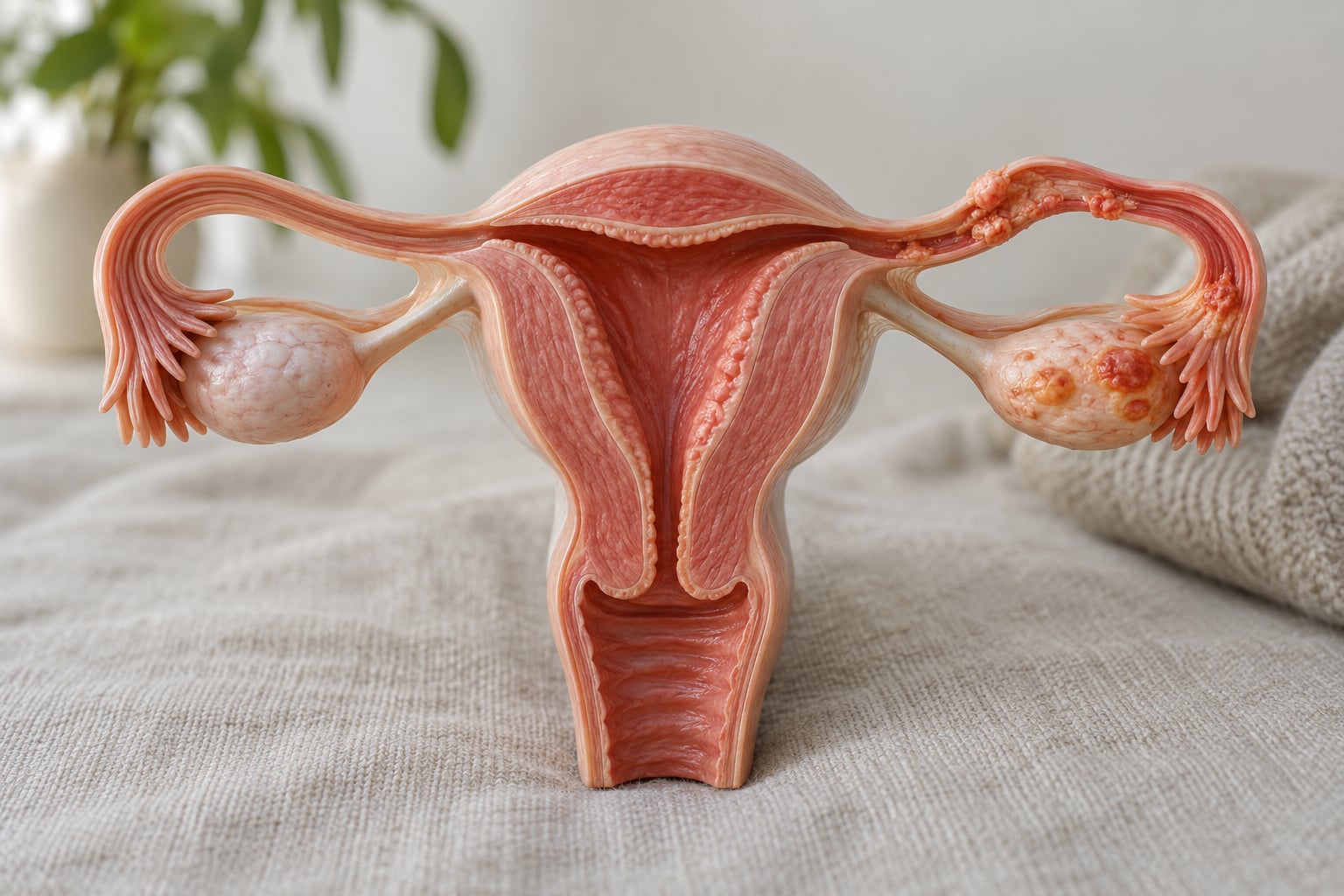
Endometriosis is associated with lower fertility, but it is not the same as infertility. Roughly 30% to 50% of people with the condition have trouble conceiving, compared with about 10% to 15% of the general population. At the same time, more than 7 in 10 people with mild to moderate disease conceive naturally, and outcome for any one person depends on stage, age, ovarian reserve and partner factors more than the diagnosis alone.
If you are reading this with a fresh diagnosis and a fear sitting in your stomach, hear the first part carefully. A diagnosis is not a prediction. It is a description of tissue that has been somewhere it should not be, and it deserves a plan, not a prognosis.
This is general health information, not medical advice. Your own situation needs a clinician who knows your history, your imaging and, if you have it, your surgical findings.
Table of Contents
- What Endometriosis Means for Fertility
- How Endometriosis Can Affect Conception
- Does the Stage of Endometriosis Predict Fertility?
- How Is Endometriosis Diagnosed and Assessed?
- What Fertility Testing May Be Recommended?
- What Treatments May Help Someone Trying to Conceive?
- How Can Pain and Fertility Planning Work Together?
- When Should Someone Seek Medical Advice?
- Frequently Asked Questions
- Does everyone with endometriosis have fertility problems?
- Do I need a diagnosis before I start trying to conceive?
- Does surgery improve the chance of getting pregnant?
- Can endometriosis be diagnosed without surgery?
- When do symptoms or a positive home pregnancy test need a medical call?
- What to Do First
What Endometriosis Means for Fertility
Endometriosis is a long-term condition where tissue similar to the uterine lining, the endometrium, grows outside the uterus. It settles on the ovaries, the fallopian tubes, the bowel, the bladder or the peritoneum that lines the pelvis. Each cycle that tissue bleeds and swells in a place that cannot shed it, then heals, then bleeds again.
What endometriosis means for fertility is best understood as a range rather than a verdict. The condition can reduce the number of eggs available, alter how the tubes and ovaries move, and change the hormonal and immune environment around a growing embryo. None of that happens to every person, and none of it happens to the same degree in everyone.
Two numbers frame the picture, and they are usually quoted together. Between roughly 30% and 50% of people with endometriosis experience infertility, a figure cited by the American Society for Reproductive Medicine. More than 7 in 10 people with mild to moderate disease conceive naturally, per Tommy’s, the UK charity that works with the NHS on pregnancy loss and fertility. Reading only the first number makes the condition look like a verdict. Reading only the second makes it sound harmless. Both together tell the truth.
Where you sit on that range depends on things that are partly outside your control: your age, how much ovarian reserve you have left, whether a fallopian tube is blocked, whether a partner has any contributing factor, and how deep and extensive the disease is.
How Endometriosis Can Affect Conception
Four main routes are described in the literature, and researchers rarely point to just one in an individual case.
- Chronic pelvic inflammation. The bleeding-and-healing cycle keeps an inflammatory environment going in the pelvis. That environment is hostile to sperm travel, egg pickup, fertilisation and the first days of embryo development.
- Adhesions and pelvic distortion. Scar tissue can tether the tubes and ovaries to each other or to the bowel. A tube that cannot pick up a released egg, or an ovary stuck behind a fallopian tube, is a mechanical problem no amount of waiting fixes.
- Ovarian endometriomas. These are cysts, often called chocolate cysts, that sit on or inside the ovary. They can stretch the ovarian tissue and are associated with reduced egg quality and a lower ovarian reserve.
- Altered immune and hormonal function. Endometriosis is an estrogen-dependent, immune-mediated condition. The hormonal milieu around the egg and the embryo differs from the norm, and implantation can be harder as a result.
Then there are the pathways that have nothing to do with biology. Painful intercourse is one of the most common symptoms of endometriosis, and it can put a physical ceiling on how often conception is attempted. Fatigue, heavy bleeding and the logistics of managing a chronic illness all quietly narrow the window.
Superficial disease on the pelvic surface behaves differently from deep infiltrating disease that has burrowed into the muscle or around the bowel, rectum and bladder. The second kind is more likely to distort anatomy. The first kind is more likely to be painful and easy to miss.
Does the Stage of Endometriosis Predict Fertility?
Not on its own. The revised ASRM staging system, which runs from stage 1 (minimal) to stage 4 (severe), describes how much disease is present and where. It was not built to predict who will conceive. A person with stage 1 disease can have worse fertility than someone with stage 3, because stage is a map of lesions and not of function.
Stage still carries useful signal, particularly at the severe end where distortion and tubal damage are more common. Read it alongside symptoms, age, ovarian reserve and your partner’s assessment, never as a verdict of its own.
| Stage | Typical findings | Reported effect on natural conception | Commonly discussed next step |
|---|---|---|---|
| Stage 1, minimal | A few superficial implants | Little to no measured difference from the general population | Trial of trying naturally, with follow-up |
| Stage 2, mild | More superficial implants, some adhesions | Usually still within the range seen in people without endometriosis | Trying naturally, pain management alongside |
| Stage 3, moderate | Deep implants, adhesions, endometriomas | Fertility is reduced; pelvic distortion and inflammation both play a part | Specialist review to weigh surgery against assisted conception |
| Stage 4, severe | Extensive deep disease, dense adhesions, distorted anatomy | Lowest natural conception rates of the four stages | Specialist-led discussion of IVF, with or without surgery |
Those rows are general patterns drawn from published series, not a set of numbers for you. If you read a stage-specific conception figure online, treat it as a population average from one clinic’s patients rather than a personal forecast.
Age sits oddly alongside stage in these discussions, and it is worth naming. Ovarian reserve declines with age for everyone, and endometriosis can consume some ovarian reserve when endometriomas form or when surgery touches the ovary. The two together compound faster than either alone, which is why the age conversation tends to be the most time-sensitive part of the whole discussion.
How Is Endometriosis Diagnosed and Assessed?
There is no single blood test that says yes or no. Diagnosis is usually built in layers, and it often takes years, which is why so many people meet the condition in a fertility clinic rather than a pain clinic.
A clinician starts with a symptom history: cyclical or severe pelvic pain, painful periods, pain during or after sex, painful bowel movements or urination around the time of a period, heavy or long-lasting bleeding, and difficulty conceiving. A pelvic examination can reveal tenderness, nodules or a fixed uterus.
Transvaginal ultrasound can show endometriomas, deep nodules, and adhesions that tether structures together. MRI does something similar with a wider view and can map disease near the bowel and bladder. Neither sees every lesion, and a normal scan does not clear you.
Laparoscopy with biopsy remains the most definitive way to confirm the diagnosis and to remove tissue at the same time. It is invasive, carries anaesthetic and surgical risks, and many clinicians now avoid offering it purely as a diagnostic step in people who are not otherwise having surgery.
Two things are routinely underestimated here. The first is silent or asymptomatic disease, where the only clue is difficulty conceiving. The second is adenomyosis, where the lining grows into the muscle of the uterus rather than outside it. It has its own fertility implications and a different treatment picture, and it is frequently mistaken for or bundled together with endometriosis.
Confirming the diagnosis and assessing fertility are two different jobs. A clear diagnosis tells you what is happening. A fertility assessment tells you whether you are ovulating, whether the tubes are open, what your ovarian reserve looks like and whether a partner factor is present. You can need the first before you benefit from the second.
What Fertility Testing May Be Recommended?
These tests narrow down where a fertility problem sits. Most people do not need all of them, and a clinician will choose based on your age, your history and how long you have been trying.
Ovulation assessment. A blood hormone panel taken across a cycle, sometimes combined with basal body temperature or urine tests, shows whether you are releasing an egg and roughly when. It is the standard starting point before anything more complex.
Ovarian reserve testing. An AMH blood test and an ultrasound count of small follicles give an estimate of how many eggs remain. It describes quantity, not quality, and it cannot predict whether you will conceive, but it does help you and your clinician think about timing.
Tubal patency testing. A hysterosalpingogram uses dye and an X-ray to show whether the tubes are open. Some clinics use a sonohysterogram or saline infusion instead. Relevant especially with stage 3 or 4 disease, or when an endometrioma sits near a tube.
Semen analysis. Around half of the fertility problems in couples involve the male partner, and it is the least invasive test in the whole process. Skipping it delays answers for no good reason.
Assessment of partner factors. Where there has been difficulty conceiving, the partner’s evaluation is part of the standard workup rather than an afterthought.
None of these tests is a verdict either. They describe patterns over time, and interpreting them well takes experience with endometriosis specifically.
What Treatments May Help Someone Trying to Conceive?
Options usually arrive as a sequence rather than a single decision, and the right order depends on symptoms, disease extent, age, ovarian reserve and what your goals are.
Trying to conceive naturally. For mild to moderate disease this is often where people start, and it is a reasonable choice. Tracking cycles, timing intercourse to the fertile window and treating the pain so that intercourse is actually possible all matter more than the tracking apps suggest.
Hormonal suppression is not a fertility treatment. Suppressing ovulation with the combined pill, a progestogen or a GnRH agonist can control pain, and the ASRM notes that medical therapy does not improve pregnancy rates. The difficulty readers describe is real: coming off suppression feels like losing pain management at the exact moment you most want to be well. Ovulation can also take a couple of months to return afterwards, and if you go on to IVF that gap is sometimes managed with a medicated frozen embryo transfer.
Surgery. Laparoscopic excision of lesions and adhesions can restore pelvic anatomy and reduce pain. Whether it improves natural conception rates is genuinely contested, particularly in stage 3 and 4 disease. The tension is that surgery near the ovary can itself reduce ovarian reserve, and endometriosis commonly recurs, sometimes within a few years. This is the surgery-versus-IVF argument readers get stuck on, because one clinician recommends operating first and the next says go straight to IVF.
If you are weighing it, the questions that resolve most of the tension are: what did the surgeon expect to find, is there a blocked tube or a distorted pelvis, what is your age, and what is your ovarian reserve doing now. Recurrence data and post-surgical conception timing are worth asking about explicitly, because they are often left out of the conversation.
IUI. Intrauterine insemination involves placing prepared sperm into the uterus around ovulation, sometimes with ovulation induction. It suits people with at least one open tube and reasonably healthy sperm. Success rates with endometriosis are lower than with IVF, particularly as disease stage rises.
IVF. In vitro fertilization bypasses the tubes and most of the pelvic environment. With endometriosis, the realistic picture is that IVF gives a better per-cycle chance than trying naturally, and that success still tracks age and ovarian reserve. It is not a guarantee, and anyone quoting you a number without qualifying it by age and stage is selling rather than informing.
Alongside all of this, pain treatment while you are trying deserves its own conversation with a clinician, because the options are not identical during a conception attempt. NSAIDs, for instance, are often advised around implantation, and hormonal options suppress ovulation entirely. What is safe for you depends on where you are in your cycle and on your own history, which is exactly the conversation to have before changing anything yourself.
How Can Pain and Fertility Planning Work Together?
Chronic pelvic pain is not a side issue here. It shapes how often you can try, how well you sleep, whether you can hold a job through a flare, and whether you can afford the appointments.
Fatigue is the one people forget to mention. Heavy bleeding can leave you iron-deficient and short of breath, and low energy makes the whole process harder than it needs to be. Worth having your iron and general health checked rather than pushing through it.
Access is its own barrier. Finding a clinician who takes endometriosis seriously, waits that are measured in months rather than weeks, insurance limits on the number of cycles, and time off work for appointments add up. People who have had repeated surgery describe not only the physical recovery but the erosion of having your pain dismissed between procedures.
Questions worth taking to a specialist: what is my stage and how was it determined, what are my realistic options in order, what happens to my ovarian reserve if I have ovarian surgery, how long should I wait after surgery before trying, what pain options are compatible with trying to conceive, and what would make you recommend IVF over more waiting? Bring written symptom and cycle notes. Memory under appointment pressure is unreliable, including yours.
On the emotional side: it is normal to grieve the easy path you did not get, and it is also normal to feel pressure to make decisions on a deadline that somebody else set. r/TTCEndo and r/endometriosis threads are full of people weighing the same surgery-or-IVF question, and reading other timelines is often more comforting than any statistic, in either direction.
When Should Someone Seek Medical Advice?
Book an appointment if you have severe or worsening pelvic pain, bleeding that is heavier or longer than it has ever been, pain during sex, urinary or bowel symptoms that track your cycle, or any fertility concern. Do not wait out endometriosis hoping it improves. It is a progressive condition for many people.
Seek urgent care for sudden severe pelvic pain, fainting or dizziness, fever with pelvic pain, or bleeding heavy enough to soak protection in an hour. Those can point to something other than a routine endo flare and should not be self-assessed.
A positive home pregnancy test with endometriosis is worth a call to your clinician rather than a private victory lap or a private worry. They can arrange early monitoring, check for ectopic pregnancy if needed and adjust any treatment you are on.
Frequently Asked Questions
Does everyone with endometriosis have fertility problems?
No. Roughly 30% to 50% of people with endometriosis experience difficulty conceiving, which means the majority do not. More than 7 in 10 people with mild to moderate disease conceive naturally without treatment. Whether you fall inside or outside that group depends on stage, age, ovarian reserve, tubal patency and partner factors, which is why two people with the same diagnosis can have completely different experiences.
Do I need a diagnosis before I start trying to conceive?
No, and many people start trying without one. But a confirmed diagnosis changes the conversation meaningfully: it explains your symptoms, gives clinicians a map of where the disease sits, and opens the discussion about staging, surgery and assisted reproduction. Ultrasound and MRI can give a strong picture without surgery. If you have lived with unexplained pain and fertility trouble, being evaluated tends to bring relief as well as answers.
Does surgery improve the chance of getting pregnant?
It depends, and the honest answer is that the evidence is mixed. Excision of lesions and adhesions can restore pelvic anatomy and improve pain, particularly in stage 3 and 4 disease. But surgery near the ovary can itself reduce ovarian reserve, and the condition often recurs. Current practice generally favours IVF over repeated surgery in moderate to severe disease. A specialist who knows your imaging, age and reserve can weigh the trade-off far better than a general answer.
Can endometriosis be diagnosed without surgery?
Yes. A symptom history, pelvic examination and transvaginal ultrasound can often identify endometriomas, deep nodules and adhesions, and MRI gives a wider view of disease near the bowel and bladder. A normal scan does not rule it out, because imaging misses many superficial lesions. Laparoscopy with biopsy remains the most definitive confirmation, but it is invasive and is not usually offered purely to confirm a diagnosis when no other surgery is planned.
When do symptoms or a positive home pregnancy test need a medical call?
Seek urgent care for sudden severe pelvic pain, fainting, fever with pelvic pain, or bleeding heavy enough to soak protection in an hour. More routine but still important: heavy or lengthening periods, pain during sex, or cycle-related urinary and bowel symptoms, since endometriosis tends to progress rather than settle. If a home pregnancy test is positive while you have endometriosis, contact your clinician so they can arrange early monitoring and check for an ectopic pregnancy.
What to Do First
Start a simple written record: cycle dates, pain levels, bleeding, and what you have already tried. Then book an evaluation with a clinician who works with endometriosis regularly, and ask directly about what your stage means, what your ovarian reserve looks like, and what the full range of options is for someone with your picture.
Ask when you should be reviewed again if you try naturally, and what would change the plan. Get sudden severe pain, fainting, fever or heavy bleeding seen urgently.
Endometriosis raises real questions about fertility. It does not give you a fixed answer, and it does not close the door. Most people with the condition need a plan rather than a prediction, and that plan is worth building with someone who knows your details.