Newborn tests and screenings in the first 48 hours come down to three standard screens: a blood spot (heel prick) test, pulse oximetry to read blood oxygen, and a hearing screen, all finished once your baby is at least 24 hours old and usually before you go home. They are quick, mostly painless, and they look for conditions that give a newborn no visible symptoms at all.
- Blood spot (heel prick) test — dried blood from the heel checked for metabolic, endocrine, blood and hormone conditions.
- Pulse oximetry screening — a small sensor on the hand and foot reads oxygen saturation to flag critical congenital heart disease.
- Hearing screening — either otoacoustic emissions (OAE) or an auditory brainstem response (ABR) test, aimed at catching hearing loss before speech and language develop.
Below is what each one involves, when it happens, and what happens if a result needs a second look. This is general information about how newborn screening programs work in the United States, not advice about your baby. Your midwife, obstetrician, pediatrician, and your state follow-up program are the right sources for anything specific to your family.
Table of Contents
- Newborn Tests and Screenings in the First 48 Hours: What to Expect
- What Are Newborn Tests and Screenings in the First 48 Hours?
- Which Tests Are Usually Included?
- How Are the Tests Done?
- What Happens If a Screening Result Is Abnormal?
- How Can Parents Prepare and Ask Questions?
- What Warning Signs Should Prompt a Call to the Doctor?
- Frequently Asked Questions
- When should newborns get screening tests?
- Which newborn screening test is required by all states?
- Why is newborn screening done after 24 hours instead of right after birth?
- How long does it take to get newborn screening results?
- How common are false positives in newborn screening?
- Can I decline the newborn heel prick?
- Conclusion
Newborn Tests and Screenings in the First 48 Hours: What to Expect
Screening exists because of one stubborn fact about newborns: several serious conditions look perfectly healthy on day one. A baby with phenylketonuria, congenital hypothyroidism, sickle cell disease, or a critical heart defect typically feeds well, sleeps well, and has normal color. The only way to find them is to look.
Because these conditions are so much easier to treat in the first days of life, sometimes before any harm has occurred, every state runs a newborn screening program and treats screening as the standard of care for well babies. The tests are designed to be fast and low-impact so they can slot into the first two days without crowding out feeding, skin-to-skin time, or sleep.
One distinction worth holding onto from the start: screening is not diagnosis. A screen tells you a result might need a closer look. A diagnosis comes from follow-up testing, usually bloodwork or imaging ordered by a clinician. Nothing about these tests is diagnostic, and holding that line makes the waiting weeks a little easier to get through.
What Are Newborn Tests and Screenings in the First 48 Hours?
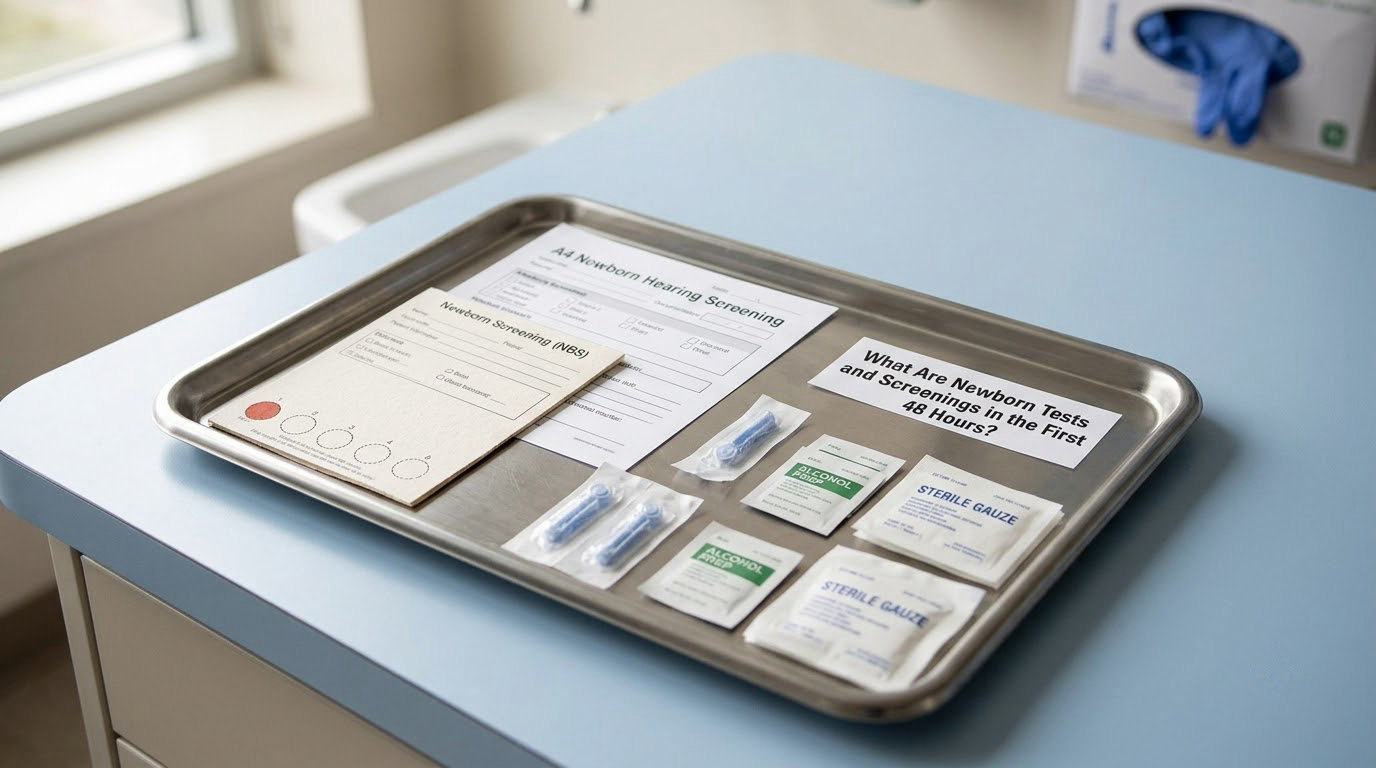
The core newborn screening tests are the blood spot, pulse oximetry, and hearing screen. Alongside them, the newborn care team does a full physical exam and checks your baby’s heart, lungs, hips, eyes, and reflexes, plus a screening for critical congenital heart disease that has been part of the standard US panel since 2011.
The word “first 48 hours” is doing specific work here. HRSA and NICHD both describe screening as happening between 24 and 48 hours of age, and the HRSA newborn screening process notes that a baby tested before 24 hours may need to be retested. That is not a formality. The blood spot test needs your baby to have had protein from breast milk or formula in the gut for roughly a day, or the results come back falsely normal.
Your hospital may also offer or be required to offer things beyond the core three, such as a critical congenital heart disease pulse oximetry recheck, a glucose screen for infants of diabetic mothers, or newborn imaging in some states. The exact panel is set by your state program, so what one hospital does may not match another across the country.
Which Tests Are Usually Included?
Most US hospitals deliver four things in the first 48 hours: the three screening tests plus a head-to-toe newborn examination. Here is the side-by-side view.
| Test | What it screens for | How it is done | When results arrive |
|---|---|---|---|
| Blood spot (heel prick) | Metabolic, endocrine, blood and hormone conditions, including phenylketonuria, congenital hypothyroidism, sickle cell disease and cystic fibrosis | A few drops of blood from the heel dried onto a filter paper card and sent to the state lab | Usually 2 to 3 days after the card reaches the lab |
| Pulse oximetry | Critical congenital heart disease (CCHD) | A small sensor on the right hand and one on the foot reads blood oxygen; can be done during a nap or a feed | Immediately, while your baby is still there |
| Hearing screening | Hearing loss in one or both ears | Either a small earpiece measuring otoacoustic emissions (OAE) or soft sensors on the head measuring an auditory brainstem response (ABR) | Immediately, or within a day |
| Newborn examination | Visible problems such as heart murmurs, hip dysplasia, eye findings and reflexes | A clinician examines your baby head to toe and discusses findings with you | Before discharge, in person |
Conditions on the blood spot panel are grouped by what they affect. Metabolic and amino acid disorders include phenylketonuria (PKU), galactosemia, maple syrup urine disease, MCAD deficiency and homocystinuria. Endocrine conditions include congenital hypothyroidism and congenital adrenal hyperplasia. Blood and immune conditions include sickle cell disease, severe combined immunodeficiency (SCID) and spinal muscular atrophy. Cystic fibrosis sits alongside them, detected through immunoreactive trypsinogen with a follow-up sweat chloride test if the first screen is out of range.
How many conditions that means depends on your state. National resource centers such as the HRSA newborn screening program track panel size, and the count changes over time as evidence improves and states add conditions.
What is not screened in this window matters too. Newborn vision is not part of standard screening; your baby’s eyes are examined during the physical exam, but a vision screen is a separate thing that happens later. And pulse oximetry is a screen for specific heart defects, not a general cardiac test. A baby who passes all three screens can still have a health problem. Screening lowers risk, it does not replace a pediatrician who knows your baby.
How Are the Tests Done?
Each test takes minutes, and your baby usually stays in the nursery or beside you in the room while it happens.
The heel prick. A warm pack or blanket goes on the foot first, which makes the heel easier to prick and often reduces crying. The blood is collected onto a special filter paper card, allowed to air dry, and then couriered to the state public health laboratory. The prick itself is brief. Parents describe the crying honestly, and it is normal to cry with your baby, but the discomfort is over in seconds.
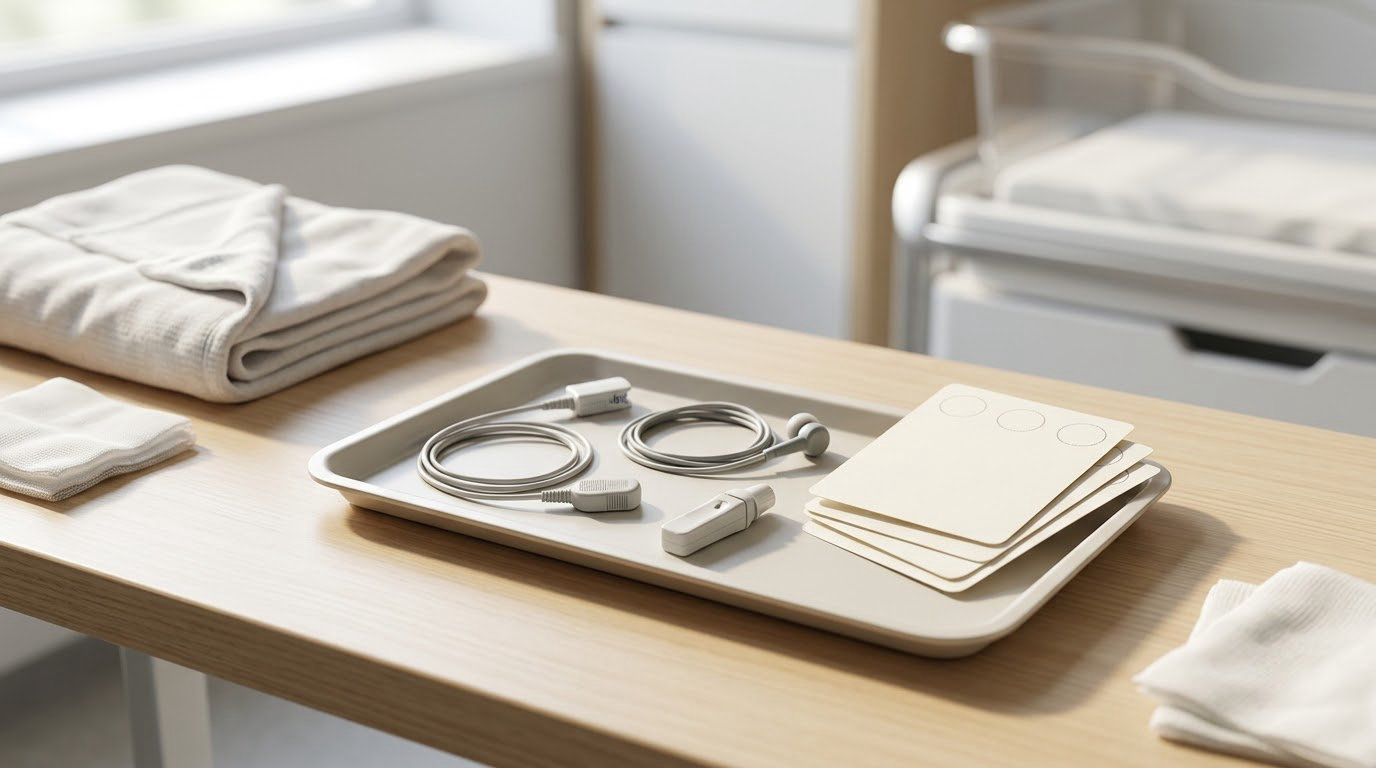
Pulse oximetry. A small sensor goes on the palm of the hand and another on the sole of the foot. Both read the oxygen level in the blood, and the numbers are compared to each other. Because it is a sensor rather than a needle, many families find this the easiest of the three to be present for. It is often scheduled for a feed or a nap so your baby is settled.
Hearing screening. With OAE, a small soft earpiece is placed in the ear canal and a gentle sound is played, measuring how the inner ear responds. With ABR, small sensors sit on the head and neck and a series of clicks or tones plays while a computer reads the nerve response. ABR takes a little longer and usually requires your baby to be still, so many hospitals do it while babies are sleepy.
The newborn exam. A clinician checks your baby’s head, eyes, ears, heart, lungs, abdomen, hips, reflexes and skin. This is the moment to ask about anything you noticed, including sounds your baby makes while sleeping or how they are feeding.
On timing: research on parents’ views of the heel prick, published in a 2022 qualitative study in Pediatric Nursing, found that what parents remembered most was not the prick itself but how well it was explained at the moment it happened. That is a good argument for asking questions instead of waiting quietly.
What Happens If a Screening Result Is Abnormal?
Start with the part that matters most: an abnormal screen is not a diagnosis, and it very often is not a problem at all. A result that reads out of range means the sample or the reading needs a second look before anyone says anything about your baby’s health.
There are four ordinary reasons a screen gets repeated, and none of them means your baby is sick:
- The sample was drawn too early. Samples taken before 24 hours of age routinely need to be redrawn, because the baby has not had enough feeding for the test to be accurate. Parents frequently mix this up with the second-specimen window at 48 to 72 hours; they are two different things.
- Not enough blood, or a sample problem. If the card is not saturated properly or the blood did not dry correctly, the lab asks for another draw. This is common and boring, and it is a technical issue rather than a health one.
- The result fell outside the normal range. Some conditions flag on a borderline value, and the standard response is a repeat screen or a different test before anyone concludes anything.
- Your baby was sick, or blood was given, at the time. A transfusion, some medications, or an illness in the first days can affect results and change how the screen is interpreted.
If a second look is needed, a confirmatory test follows, usually a venous blood draw or other testing arranged by your baby’s clinician or by your state newborn screening follow-up program. Those programs exist specifically for this: they contact families directly, help schedule the follow-up, and track the result. You should never be left to chase this on your own.
On false positives, be honest with yourself about the numbers. Children’s Hospital of Philadelphia reports significant hearing loss in about 3 in 1,000 newborns, and CCHD in about 2 in 1,000. Conditions such as PKU, congenital hypothyroidism, MCAD deficiency, and congenital adrenal hyperplasia each occur in roughly 1 in 10,000 to 15,000 births. When the base rate of a condition is that low and the screen is deliberately sensitive, false positives outnumber true positives in a lot of families. That is arithmetic, not reassurance.
Waiting is the hardest part, and the panic loop after an out-of-range result is real even when the result turns out to be nothing. Concrete numbers help more than comfort language, so ask when the result is due and who will call you if it is late.
How Can Parents Prepare and Ask Questions?
You can do more than wait, and most of it happens before the test rather than after.
Confirm the practical details. Make sure the birth facility has your current address and phone number, and that your chosen pediatrician has the same. If the follow-up program needs to reach you a year from now, a phone number that changes in six months is a real problem. Before leaving, get a written copy of which screens were done and when.
Ask these questions. Which of the three parts of newborn screening have been completed, and which are still pending? When will the blood spot card reach the lab, and when should I expect to hear a result? What happens on an out-of-range result in our state, and who calls me? If we disagree about anything, can we talk before discharge rather than after?
Know the situations that change the plan. Babies in the NICU follow a different schedule, and babies who received a blood transfusion or dialysis usually need their blood spot drawn again once the donated blood has cleared. Preterm babies have their own rules. A family history of inherited metabolic disease is worth raising explicitly, because it may add tests to the panel.
Home and birth center births. Screening still happens, but the logistics are different and are not well explained in most hospital-focused material. Your midwife or birth center arranges the heel prick with a qualified collector, and timing still depends on your baby being 24 hours old and fed. Ask your provider, before the birth, exactly who will collect the card and how you will receive results. This is the piece birth-center families most often have to chase down on their own.
You can decline. Newborn screening programs in the US are opt-out, which means you are enrolled unless you actively refuse. Parents do have the right to decline, usually with a signed refusal form in the chart. Talk it through with your provider rather than deciding in a tired moment, and ask what the state program recommends for you if you do decline. This is your call to make with a clinician, not one to make from an article.
Ask about the dried blood spot card. Some states retain the card for a period and then destroy it, and rules about storage and research use vary. If you want to know what happens to your baby’s sample, ask your state program directly.
What Warning Signs Should Prompt a Call to the Doctor?
Most questions about newborn tests are routine, and a phone call to your pediatrician or midwife during office hours is the right move for all of them: a result you did not understand, a hearing screen that was repeated, a question about the blood spot card, a missed appointment for follow-up.
A small number of situations in a newborn are a different matter and should not wait for a routine call. Contact your pediatric provider urgently, or seek emergency care, for signs such as difficulty breathing, blue or very pale lips, skin, or fingertips, a fever in a baby under three months old, a baby who is markedly harder to wake or unusually floppy, persistent poor feeding with fewer wet diapers, repeated vomiting, or a yellowing of the skin or eyes. Yellow skin and eyes in the first days of life can indicate jaundice, which is a routine and treatable newborn issue that still deserves same-day attention.
I am not able to diagnose anything or tell you whether a symptom your baby has is serious. Your clinician can, and the general rule holds: if something about your baby looks wrong to you and does not settle, call.
Frequently Asked Questions
When should newborns get screening tests?
Screening usually happens once your baby is 24 to 48 hours old and before you go home, according to HRSA and NICHD. A sample taken before 24 hours often has to be redone because your baby needs about a day of feeding for the blood spot test to work accurately. In some states, a second blood spot is collected at 48 to 72 hours. Ask your birth facility which windows your state follows.
Which newborn screening test is required by all states?
The blood spot, or heel prick, test is the one every state requires, and it is drawn 24 to 48 hours after birth once your baby has ingested breast milk or formula. It screens for conditions including phenylketonuria, congenital hypothyroidism, sickle cell disease and cystic fibrosis. Hearing screening and pulse oximetry for critical congenital heart disease are also part of the standard panel in every state today.
Why is newborn screening done after 24 hours instead of right after birth?
Because the blood spot test measures substances your baby builds up only after feeding. Proteins from breast milk or formula trigger the metabolic and hormone reactions the test is looking for, so a sample taken too early can read as falsely normal. HRSA notes that babies tested before 24 hours of age may need to be retested, which means another prick for your baby.
How long does it take to get newborn screening results?
Pulse oximetry and hearing screening results are usually available immediately, or within a day, while your baby is still in the hospital. Blood spot results usually take 2 to 3 days after the card reaches the state laboratory. If a screen is out of range, confirmatory testing and any follow-up take longer, and your state newborn screening follow-up program will contact you directly.
How common are false positives in newborn screening?
Common enough that you should expect the possibility and not treat an out-of-range result as a diagnosis. When a condition affects only about 1 in 10,000 to 15,000 births, as phenylketonuria and MCAD deficiency do according to Children’s Hospital of Philadelphia, a deliberately sensitive screen will flag more babies than it identifies. A repeat or confirmatory test is the routine next step, not a diagnosis.
Can I decline the newborn heel prick?
You can, in most states, because US newborn screening programs are opt-out and you are enrolled unless you actively refuse. Declining usually involves a signed refusal form in your baby’s chart. Because some screened conditions are far easier to treat when caught in the first days of life, raise it with your midwife, obstetrician or pediatrician before you decide, and ask what your state program recommends.
Conclusion
Before you leave the birth setting, do three things: ask which parts of newborn screening were completed and which are still pending, get a written record of the results and your state follow-up contact, and book any follow-up appointment before the paperwork gets lost in a diaper bag. Everything else about these tests is ordinary routine, and knowing exactly who will call you and when makes the waiting considerably shorter.
Sources: HRSA newborn screening process, NICHD newborn screening fact sheet, AAP newborn screening policy statements, and Children’s Hospital of Philadelphia newborn screening condition information. Reviewed for 2026. This article is general information, not medical advice.