
Postpartum bleeding is normal for the first days and weeks after birth, and clinicians call it lochia. It usually tapers from heavy red flow to pink, then brown, then pale discharge over roughly six weeks. Postpartum bleeding what is normal and what is not comes down to a few numbers: how many pads you soak in an hour, how large your clots get, and whether fever, odor, or dizziness show up alongside it.
That first week is genuinely messy, and almost nobody is warned well enough for it. This guide walks through what lochia looks like day by day, why it happens, how to measure it at home, and the specific signs that mean call your midwife or OB now rather than wait.
This is general information, not a diagnosis. Your own discharge instructions from the birth team always come first, because your birth, your history, and your recovery may not match anyone else’s.
Table of Contents
- Postpartum Bleeding: What Is Normal After Birth?
- Postpartum Bleeding: How Much Is Too Much?
- Why Does Postpartum Bleeding Happen?
- How Postpartum Bleeding Changes Over Time
- Why Bleeding Sometimes Stops and Then Starts Again
- Lochia vs. Your First Period After Birth
- What About Light Pink or Brown Bleeding at Five or Six Weeks?
- What Signs Are Not Normal?
- When Should You Seek Urgent Medical Care?
- What Can Change the Amount or Duration of Bleeding?
- How to Monitor Bleeding at Home
- Frequently Asked Questions
- How is postpartum bleeding different from a normal period?
- Is postpartum bleeding different after a cesarean birth?
- Does breastfeeding change how long postpartum bleeding lasts?
- Are small blood clots normal after giving birth?
- Is weakness or dizziness normal during postpartum recovery?
- What to Do First
Postpartum Bleeding: What Is Normal After Birth?
Normal postpartum bleeding after birth is called lochia, and it is the blood, mucus, and shed tissue your uterus clears while it shrinks back to its pre-pregnancy size. Expect heavy red bleeding for the first two to four days, lighter pink or brown discharge for about a week after that, then a creamy pale discharge that fades by around six weeks. Some people bleed lightly for a few days longer, and that can still be within range.
No two births produce identical bleeding. A vaginal birth with a long third stage, a cesarean birth, a multiple birth, or a previous uterine surgery all change the picture. The timeline below is a guide, not a rulebook.
Two things count as normal even when they surprise people: small clots up to roughly the size of a golf ball early on, and bleeding that seems to increase in the morning, during a feed, or when you stand up after resting.
Postpartum Bleeding: How Much Is Too Much?
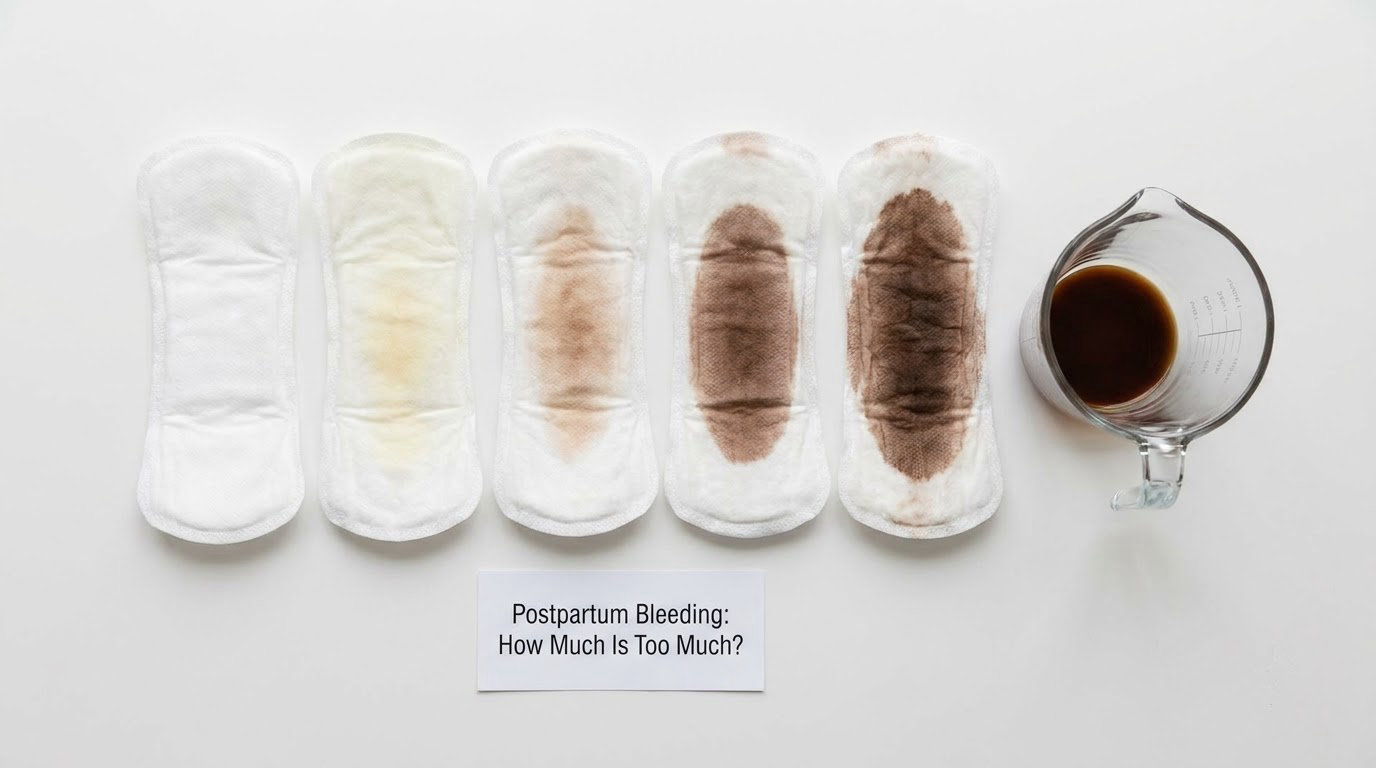
Most guidance points to soaking a large maternity pad in an hour, for two hours in a row, as the practical threshold that moves bleeding from expected into a call-your-care-team range. Clinics often use about 470 millilitres, roughly one pint, in 24 hours as the formal definition of postpartum hemorrhage. You will not measure that at home, so the pad test is the proxy most people actually use.
| What to check | Often expected | Call your care team |
|---|---|---|
| Pad saturation | Changing a pad every few hours in week one, less often after that | Soaking a large pad in under an hour, repeatedly |
| Clots | Small clots, up to about golf-ball size, more common in the first few days | Clots larger than a golf ball, or clots that keep coming back |
| Color | Bright red early, then pink, brown, and cream | Bright red bleeding that returns full-strength after it had faded |
| Odor | Mild, like a normal period | Foul or putrid smell |
| Alongside symptoms | Afterpains during feeds, mild cramping | Fever, chills, worsening abdominal pain, faintness, racing heart, bad headache, blurred vision |
| Duration | Fading steadily, done by about six weeks for most | Heavy bleeding that has not tapered by week two, or heavy bleeding that starts again after stopping |
One practical note that comes up constantly in birth communities: if the difference between your midwife and your hospital is frightening, ask for the number in writing. A pad change every four hours and a pad change every thirty minutes are very different conversations, and you deserve a clear answer before you are the one deciding alone.
Volume on its own is a poor measure, which is why clinicians pair it with everything else. A bright red loss that is steady and gradually easing is often less worrying than a smaller amount that arrives suddenly, keeps arriving, and comes with dizziness. Color, clots, symptoms, and trend over time matter together, and reading them together is much more reliable than staring at a single pad.
Why Does Postpartum Bleeding Happen?
During pregnancy the uterine lining thickens to support the placenta and the placenta attaches to the uterine wall. When the placenta comes away, it leaves raw attachment sites full of open blood vessels. That is where the bleeding comes from.
The mechanism that stops it is contraction. As the uterus shrinks, its muscle fibers clamp down on those vessels like a drawstring closing, and the placental-site blood supply shuts down. That shrinking is called uterine involution, and it is usually well under way by the time you get home.
Uterine involution is not instant either. The fundus, the firm upper part of the uterus, sits higher in the belly in the first days and drops lower each day as the organ shrinks, and it climbs again if the bladder is full or the uterus is not contracting well. That is why a clinician presses your lower belly during a check, and why your own discharge instructions often tell you to empty your bladder before an appointment. By around six weeks the uterus has usually returned close to its pre-pregnancy size, and most lochia has finished by then.
Hormones help drive it. Oxytocin, released during breastfeeding and during skin-to-skin contact, makes the uterus contract. Prostaglandins do the same thing. It is why many people notice a crampy squeeze and a short surge of bleeding during a feed, and why a full bladder or a long night lying flat can produce a heavier morning.
A vaginal birth tends to start with more blood in the first hours, because the birth canal has been stretched and possibly cut. A cesarean birth removes the placenta surgically and leaves a uterine incision, so bleeding tends to start lighter but can surface later as a slow, steady loss rather than a gush. Afterpains, the cramping during contractions of the shrinking uterus, often track the same process.
How Postpartum Bleeding Changes Over Time
Lochia moves through three named stages. Learning their names helps, because it turns a vague worry into something you can describe accurately to a clinician on the phone.
| Stage | Typical days | Colour | Flow | What it contains |
|---|---|---|---|---|
| Lochia rubra | Days 1 to 4 | Bright or dark red | Heaviest; changing a pad every few hours | Blood with decidua, the thickened lining, and mucus |
| Lochia serosa | About days 5 to 10 | Pinkish or brownish | Lighter, no clots usually | Mostly serum, thin fluid, with old blood |
| Lochia alba | About days 10 to 21 and beyond | Creamy white or pale yellow | Spotting to a slow trickle | Mostly mucus, fat cells, and epithelial cells |
Some people move through these faster, some slower. Clots are most common in rubra while the uterus is still shedding heavily, and they usually taper as the colour changes.
Read as a week-by-week picture rather than a countdown: in the first 24 hours you are changing a pad often and passing clots, and this is the heaviest stage by far. Days three to five the flow stays red but noticeably drops, and the afterpains are often at their strongest. Days six to ten it turns pink or brown and clots usually stop. From around day ten onward it is pale, creamy, and light enough that a pad may not even be needed some days. By weeks five and six most people are down to occasional spotting, and any increase at that point tends to follow activity rather than a stage change.
Somewhere in the second or third week there is often a short stretch where bleeding seems to pause entirely, and then starts again. That is the pattern that catches people off guard.
Why Bleeding Sometimes Stops and Then Starts Again
Bleeding that seems to stop and restart is one of the most common searches in this topic, and one of the least explained. Several things can cause it. Activity that was too much on day three can produce a heavier day four. A shower, a walk to the end of the street, or standing up quickly after lying down can bring a small red surge that settles within a few hours.
Some bleeding also appears around weeks three to six as activity increases and the uterus finishes shrinking. A useful piece of framing that shows up in parent communities: any bleeding within 56 days after birth is still technically classified as lochia, while postpartum hemorrhage can occur as late as 12 weeks after birth. Knowing that window helps you decide whether you are looking at a normal restart or something that needs assessment.
The line is simple enough to hold onto. A small increase that settles with rest and has no fever, no odor, and no worsening pain is usually not an emergency. A return to heavy red bleeding that soaks pads, or a restart accompanied by cramping that does not ease, is a reason to call.
Lochia vs. Your First Period After Birth
Lochia and menstruation get confused more than almost anything else in early recovery. Lochia comes from the inside of the uterus as it sheds and repairs, so it can include tissue, mucus, and small clots. A period comes from the uterine lining rebuilding and shedding again after ovulation, and it usually arrives heavier and redder than the tail end of lochia.
The timing is what confuses most people. Your first period usually shows up somewhere around six to eight weeks after birth if you are not breastfeeding, and later, sometimes many months later, if you are. If bleeding starts, tapers, and then comes back with cramping and a heavier red flow around that time, it may be your first period rather than a failed taper. The practical check is not to count, but to describe it to your care team when you call.
What About Light Pink or Brown Bleeding at Five or Six Weeks?
Light pink or brown discharge at five or six weeks is often still normal, particularly if it comes after activity or a longer stretch of rest. Brown colour is older blood oxidising, not a problem in itself. Ask your care team if it comes with odor, fever, or pain, or if the amount is more than spotting.
What Signs Are Not Normal?
The following signs are not normal and should prompt a call to your midwife, OB, or labor and delivery unit the same day. Postpartum hemorrhage and uterine infection can move quickly, and neither is something to sit with overnight.
- Soaking a large maternity pad in an hour, or passing large clots repeatedly
- Bright red bleeding that returns at full strength after it had faded to pink or brown
- Clots larger than a golf ball, or a heavy, persistent gush rather than a steady flow
- Foul or putrid odor, which is a common sign of uterine infection
- Fever or chills, especially with abdominal pain or uterine tenderness
- Abdominal or perineal pain that is getting worse instead of easing
- Faintness, dizziness, a racing heart, cold sweat, or being unable to stand without feeling swimmy
- Severe headache, blurred vision, or sudden swelling, which can accompany very heavy blood loss
- Bleeding that has not tapered by the second week, or that keeps restarting in heavy form
- Very little or no bleeding in the first 24 hours alongside feeling unwell, which can itself signal a problem
Infection deserves separate mention because it is easy to dismiss as ordinary tiredness. Endometritis, an infection of the uterine lining, typically shows up as fever, chills, worsening cramping, uterine tenderness, and discharge that smells bad. Mastitis is different and usually shows up in the breast with flu-like symptoms.
Not every heavy day means something is wrong. But a reasonable rule from experienced parents and clinicians alike: if you cannot get a straight answer and something feels off, you are allowed to be evaluated anyway. You do not have to prove it is serious first.
When Should You Seek Urgent Medical Care?
There are three practical tiers, and matching your situation to the right one saves time when you are frightened and tired.
Ask your birth team within a day or two: a change in pattern you are unsure about, a small return of red bleeding that settles, an odor you are not confident about, or a question about how your bleeding compares with a previous birth. This is the ordinary channel, and most midwives and OB offices would rather hear from you early.
Get same-day advice: bleeding heavier than your usual pattern, clots that are larger or more frequent than before, temperature above 38 degrees Celsius, abdominal pain that is building, or bleeding that starts again after a stretch of stopping. Call your care team and follow their advice, and if you cannot reach anyone, use the labor and delivery unit or an urgent care line.
Go for emergency evaluation now: soaking a large pad in an hour or faster, bleeding with faintness, palpitations, cold sweat, confusion, or difficulty staying upright, heavy bleeding with abdominal pain and a tender belly, or any bleeding with fever and shaking chills. Call your local emergency number rather than driving yourself.
For partners and support people, the pattern worth memorising is simple: heavy bleeding plus feeling unwell is the emergency combination. One of those alone may still be within normal range. Both together are not.
It also helps to know what the discharge paperwork usually says, so you can read it with the person you are helping rather than waiting for them to explain while exhausted. Most documents name a pad-saturation threshold, a clot size reference, a fever number, and a phone number for the birth unit. Put that page somewhere visible in the first fortnight. When the moment comes, nobody wants to hunt through paperwork.
The other useful thing a support person can do is take the worry seriously without escalating it. Saying that a colour change sounds normal and offering to sit with them while they change a pad is genuinely more helpful than a long list of things that could be wrong.
What Can Change the Amount or Duration of Bleeding?
Several factors shift how much you bleed and for how long, and understanding them helps you interpret a day that does not match yesterday.
Contraction quality. The uterus has to squeeze hard to close the placental-site vessels. When it contracts poorly, called uterine atony, bleeding stays heavy. This is the most common cause of postpartum hemorrhage, and it is more likely after a long labour, a difficult birth, or with a larger baby.
Retained tissue. If a piece of placenta or thickened lining stays attached, the uterus cannot fully contract and bleeding continues. Postpartum hemorrhage from retained products of conception can happen at delivery or show up later.
Trauma. A perineal tear, an episiotomy, or a cervical injury can bleed separately from lochia. Clues that point this way: bleeding that seems to come from the perineal area, pain that is sharp and localised rather than crampy and wave-like, or visible swelling or bruising. Do not assume everything is lochia. Bleeding from a tear needs assessment, not watchful waiting.
Infection. Infection of the uterine lining interferes with normal healing and can restart or prolong bleeding, usually with fever and pain.
Medication and blood factors. Blood thinners and some anti-inflammatory medicines affect bleeding. Always tell your care team about everything you take, including over-the-counter products and supplements.
Prior uterine surgery. A previous cesarean birth, fibroid surgery, or other uterine procedures can change how the uterus contracts and heals.
| Factor | Vaginal birth | Cesarean birth |
|---|---|---|
| First 24 hours | Heavier, especially right after delivery | Usually lighter overall |
| Typical pattern | Rubra, then serosa, then alba | Same three stages, often starting lighter |
| Source of bleeding | Placental site plus any perineal or cervical trauma | Placental site plus the uterine incision |
| Blood loss thresholds used clinically | About 1000 millilitres or more in 24 hours | About 1500 millilitres or more in 24 hours |
| Common early comfort issue | Afterpains and perineal soreness | Incision pain, which can mask cramping |
These figures are the clinical thresholds teams use for defining hemorrhage, not targets for home measurement. You are not expected to keep a running tally at home, and nobody expects you to.
How to Monitor Bleeding at Home
Monitoring well is mostly about creating a record you would not have to reconstruct from memory while panicking on the phone.
Note the time when you change a pad. Clock-and-count is the simplest method: write the time on the wrapper or in your phone, then count how long until the next change. Days where you are changing every few hours and days where you go eight hours between changes tell you far more than a memory of heavy or light.
Track colour changes, not just volume. Red to pink to brown to cream is the expected sequence. Staying bright red past the first week, or snapping back to bright red after cream, is worth reporting.
Compare clots to something you can see. Coin, egg, golf ball, plum. Size references are more useful than adjectives, and asking your midwife to show you the reference before you leave is one of the more practical conversations you can have in the first week.
Take your temperature when something feels off. A number removes the guessing. Any fever alongside bleeding or pain deserves a call.
Write down your symptoms, not just your flow. Dizziness on standing, palpitations, chills, worsening cramping, and headache all matter, and providers cannot assess what you do not mention.
Follow the discharge instructions you were given. These override anything generic, including this article.
Five things commonly reduce bleeding in the first days, all of them things a midwife or nurse may have told you already. Empty your bladder regularly, because a full bladder stops the uterus contracting. Rest, and step back from anything more strenuous than a short walk. Eat and drink more than usual, since you are replacing real volume. Breastfeed or pump on your usual schedule, because oxytocin helps the uterus contract. And if your care team has shown you how, fundal massage, which supports contraction.
None of these are a substitute for assessment, and none should be used to talk yourself out of calling.
Frequently Asked Questions
How is postpartum bleeding different from a normal period?
Postpartum bleeding usually starts much heavier than a period and includes tissue, mucus, and clots from the uterine lining rather than blood alone. It fades over weeks instead of ending within days, shifting from red to pink to brown to cream. Afterpains during feeds often come with it, which a period does not cause.
Is postpartum bleeding different after a cesarean birth?
Yes. Because the placenta is removed surgically and the uterus is incised, bleeding in the first 24 hours is typically lighter than after a vaginal birth, and later loss can appear as a slow steady seep rather than a sudden gush. The same three stages still apply, but the pattern and the pain feel different, and incision pain can hide cramping.
Does breastfeeding change how long postpartum bleeding lasts?
Often it shortens it slightly. Suckling triggers oxytocin release, which contracts the uterus and helps close the placental-site vessels, and many people notice a short surge of bleeding with a feed. Over several weeks the difference is modest, but it is one reason a small red increase during nursing is usually reassuring if no other warning signs are present.
Are small blood clots normal after giving birth?
Small clots are common in the first few days, when lochia rubra is heaviest, and they usually shrink as the colour moves to pink and brown. Ask your care team to show you what size counts as small, because a rough reference helps more than the word clot, which frightens most new parents. Clots larger than a golf ball, or clots that keep recurring, need a call.
Is weakness or dizziness normal during postpartum recovery?
Tiredness is common in early recovery because of broken sleep and the demands of feeding. Dizziness or faintness while bleeding is a different matter and is treated as a warning sign. Sit or lie down, do not stand up quickly, and contact your care team promptly, especially if the feeling comes with a racing heart, cold sweat, or heavy bleeding.
A last thought on the emotional side, which deserves its own line. Feeling frightened by unexpected bleeding is common and is not a silly reaction. Many parents describe being caught off guard by the volume in the first days, and being scared of it is what keeps people alert to the warning signs. If the fear itself is staying with you, that is a conversation worth having with your care team too.
What to Do First
Start with the discharge instructions your birth team gave you. They know your birth, and their thresholds outrank any general guide, including this one.
Then set up a simple record: pad change times, colour, clot sizes, temperature when something feels off, and any symptoms like dizziness or cramping. That record turns a panicked phone call into a clear one.
Finally, contact a healthcare professional promptly when bleeding is heavy, when it is getting heavier rather than lighter, when it returns in full force after fading, or when it comes with fever, odor, worsening pain, or feeling faint. You do not have to be certain something is wrong. Being assessed and told you are fine is a perfectly good outcome.
This is general education, not personal medical advice. Your midwife, OB, nurse, or doctor can give you guidance specific to your recovery.