
Building a postpartum support network comes down to three moves: write down every task you will actually need help with, name the specific people who could handle each one, and then ask them for something concrete rather than hoping they guess. Done before birth or in the first chaotic weeks after, that simple loop is the difference between a village and a scramble. It takes about an hour of planning to build, and most of the work is in the asking.
This guide is for expectant parents, new parents, and the partners, friends and relatives who want to help well. It works whether you are eight months pregnant or already three weeks into a recovery you did not expect to be this hard.
A postpartum support network is the set of people and services a new parent can count on after birth — family, friends, neighbors, and paid or clinical professionals such as a doula, a lactation consultant, a midwife or OB, a pediatrician, and a perinatal therapist — arranged so that emotional support, practical help, and medical or informational guidance are all covered before you need them. It is not a list of people who like you. It is a set of commitments with names and times attached.
One thing to sort out first: ACOG notes that while the first 12 weeks after birth is the standard clinical definition of the postpartum period, the whole first year carries elevated risk. Complications such as preeclampsia, heavy bleeding, cesarean recovery, and postpartum depression or anxiety often show up well after the six-week visit. Plan for the fourth trimester, but keep the network running through the year.
Last reviewed: October 2026. This is general educational information, not medical advice. Talk with your obstetric provider, midwife, or pediatrician about anything specific to your recovery, and call a clinician for any warning sign that worries you.
Table of Contents
- What You Need
- The three kinds of support your network must contain
- The task inventory to copy
- Materials to have ready
- The support-plan grid
- Step-by-Step: How to Build a Postpartum Support Network
- 1. Map Your First Four Weeks of Support
- 2. Identify the People You Can Call
- 3. Make Specific Requests Instead of Waiting
- 4. Create a Shared Plan for the First Month
- 5. Build a Backup System for Unexpected Needs
- 6. Protect Boundaries and Communication
- 7. Review and Adjust the Network
- Common Mistakes
- What supporters and partners can do without being asked
- Where to get help right now
- Frequently Asked Questions
- Who should be in my postpartum support network?
- What should I actually ask for after giving birth?
- How do I involve my partner in postpartum support?
- What if I have no family nearby or a limited budget?
- How do I keep support going past the first month?
- Conclusion: Start With One Essential Request
What You Need
Before you recruit anyone, you need three things: an honest inventory of what you need, a way to keep track of who has agreed to what, and the honesty to admit what you do not want.
The three kinds of support your network must contain
- Emotional support. Someone who will pick up the phone, listen to the thing you cannot stop thinking about, and not rush you toward a solution.
- Practical support. Meals, laundry, dog walking, a two-hour childcare shift, a grocery run, someone holding the baby so you can sleep.
- Informational and clinical support. Your OB or midwife, your baby’s pediatrician, a lactation consultant, a pelvic floor physical therapist, a perinatal mental health specialist. These are people you consult, not people who fetch.
Most households get the first one by accident and forget to build the second on purpose. The third is where a plan usually falls apart, because new parents assume their delivery team stays assigned to them indefinitely. It does not. Ask your hospital which clinicians will follow you after discharge and how to reach them.
The task inventory to copy
Write these down even if you think you will not need them. Every item on this list is something a real person has asked a friend to handle in the first month.
- Cooking, or a standing meal-delivery slot
- Laundry, including the endless baby-load rotation
- Cleaning the bathroom and kitchen
- Errands: pharmacy, groceries, diapers, prescriptions
- Transportation to appointments, or rides for an older child
- Childcare for older children during feeds, appointments, or sleep
- Pet care
- A defined rest window during the day when nobody asks you anything
- Someone to talk to when the crying starts and does not stop
- Back-up care if you get sick before your own baby is old enough to be an infection risk
Materials to have ready
A shared calendar everyone can see. A contact list with phone numbers and addresses — not just names. A group chat, if your people tolerate one. A written note for the freezer cupboard or the pantry, so a visitor can see what is needed without you having to explain it twice.
The support-plan grid
One grid ties it together. Fill it in once and you have answered most of your own questions about who to call. Set up four columns — task, who, exact ask, when — and run down these rows:
- Task: evening meal, three nights a week. Who: blank. Exact ask: blank. When: blank.
- Task: laundry and dishes. Who: blank. Exact ask: blank. When: blank.
- Task: transport to the six-week appointment. Who: blank. Exact ask: blank. When: blank.
- Task: two-hour childcare shift. Who: blank. Exact ask: blank. When: blank.
- Task: dog walks. Who: blank. Exact ask: blank. When: blank.
- Task: someone to call when it gets bad. Who: blank. Exact ask: blank. When: blank.
Printing it matters more than it sounds. A grid on the fridge is answered; a grid in your head generates nothing but good intentions.
Step-by-Step: How to Build a Postpartum Support Network
The framework below runs from identifying needs to a network that keeps working after the newborn phase. It follows what the research on mothers’ experiences of mobilizing support actually found: women reported using tactics like making written lists and rehearsing the ask in their heads to convert good intentions into actual help. Guessing is what fails. Planning is what works.
1. Map Your First Four Weeks of Support
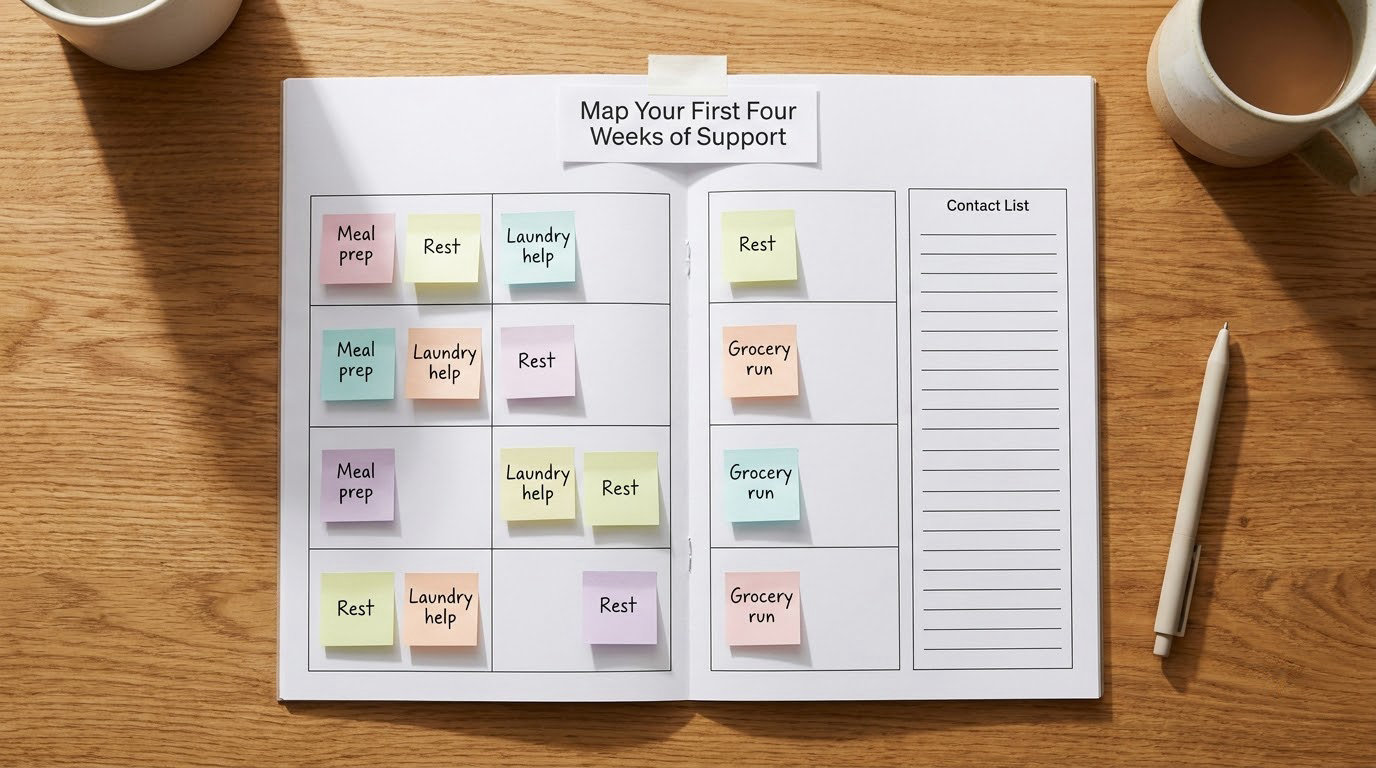
Sit down with a blank month and write what each week will demand. Week one is feeding, bleeding, pain management, and visitors. Week two is the first stretch of near-continuous sleep deprivation. Weeks three and four are where the initial wave of help has already come and gone and you discover what is left.
Then sort every item into two piles: the things you cannot do safely or at all this month, and the things that would simply make the month easier. Only the first pile needs to be spoken out loud to anyone else. Most new parents over-ask by trying to hand over both piles, then feel oddly unsatisfied when someone takes the second pile and nothing changes.
Try naming one need per person rather than one need across everyone. “Bring dinner Tuesday and Thursday” is a commitment. “Help with meals” is a wish.
2. Identify the People You Can Call
Work through categories deliberately, because the obvious circle is rarely the whole circle. Ask who has actually changed a diaper or held a crying baby before. Ask your midwife or hospital social worker whether they run a postpartum group or can point you to one. Ask the hospital social worker directly — that service exists for exactly this and it is free.
Partners and co-parents are a category, not a given. If your partner is not taking leave, say that out loud to the people you are recruiting and ask for help covering the tasks their leave would have covered. That is a legitimate request and it lands better than you might expect.
Parents in your area whose babies arrived around the same time are the strongest match in practice. Informal networks built out of a group chat where everyone is in the same month tend to outlast anything organised, because the give-and-take is naturally reciprocal. People in the r/Mommit and r/torontomoms communities describe exactly this arrangement as the one that worked, and hospital-run or virtual hospital groups get singled out as the ones that delivered what members wanted.
Also consider a postpartum doula or night nurse for a fixed block of shifts, a housekeeper for a cleaning-only visit, a local teenager or college student who can drive and walk the dog, or a faith community and mutual-aid group if they are part of your life. Paid help is not a lesser option. It is help with a schedule attached.
3. Make Specific Requests Instead of Waiting
This is the step everyone skips, and it is the whole article. The sentence “let me know if you need anything” is an offer with no task in it, and most people receiving it cannot convert it into action. You have to do the converting, or nothing happens.
These are real scripts that work. Adjust the names, keep the structure:
- “Could you bring dinner on Tuesday? Anything works, and a casserole is perfect. We’re usually awake until 9.”
- “Could you take the dog out at 7am while I get a shower? He’s fine on a lead.”
- “I’m going to need a lift to my six-week appointment on the 14th. Would you be able to drive?”
- “Could you come over for two hours on Saturday afternoon and just hold the baby so I can nap? You don’t have to do anything else.”
- “I have an older daughter who needs picking up at 3pm that week. Is that a job you could take?”
- “My laundry is piling up. If you do one load while you’re here, that would genuinely help.”
The pattern is always the same: a named task, a named time, and permission to make the task smaller than you imagined. Add one line that makes it easy for the other person to say yes or no honestly — “no pressure, but I’d love it” or “if next week is better, that works too.”
4. Create a Shared Plan for the First Month
Put every commitment into one place. A shared calendar works; a group chat with pinned messages also works. What matters is that each person can see what they are on the hook for without asking you.
Three things keep a plan from collapsing. First, a priority list — three items, in order, so that when everything is genuinely impossible you cut the same three things and everyone knows it. Second, a named backup for each essential task, because illness and flat tires are not edge cases. Third, a check-in rhythm: a five-minute message on Sunday evening where everyone confirms what is coming up and what is falling through.
Reliability comes from removing your repeated asking, not from people trying harder. If you are the only one requesting, the network is a project you run alone, and you are already depleted.
5. Build a Backup System for Unexpected Needs
Something will break the plan. The newborn will not stop feeding, the delivery will go sideways, your mother will cancel, someone at work will need you back early, or you will simply hit a stretch of bad days where talking to anyone feels impossible.
Line up, before you need them: a second person for each of your top three tasks; a list of nearby services for food, childcare, and cleaning; your hospital’s after-hours number; the numbers below; and one person you have explicitly told, “If I stop replying, check on me.” That last one matters more than the rest when the problem is a mood or a fog that keeps you from asking.
6. Protect Boundaries and Communication
Support that ignores your preferences is still exhausting. Set visiting hours out loud, and repeat them kindly when needed: “We’re doing quiet afternoons this month. Come by after 4 and we’ll be glad to see you.” For advice you did not ask for: “I know that worked for you. We’re going to try it our way this week.”
Tell people not to come when you are sick. Tell them what you do not want handled — visitors who want to inspect the house, comparisons about feeding or sleep, or anyone who treats the baby as a prize to be passed around.
Also protect your rest window, and defend it once. If you told people the baby naps at 1, then someone arrives at 12:45 with a casserole. One calm restatement before the fact works better than one frustrated explanation after.
Partners deserve the same clarity. Agree on what is actually being shared: feeding, night sleep, and early-warning signs. The most common complaint from new parents is not that help is insufficient, it is that the person providing most of the care never gets asked to talk about their own needs.
7. Review and Adjust the Network
Check in three times: one week after you are home, one month in, and again around the four-month mark when parental leave ends and everything shifts. Ask what actually happened rather than whether people meant well. “You offered to bring dinner and then did not come Tuesday — did something come up?” gets you a usable answer. “Were you not coming Tuesday?” gets you a defence.
Thin it out when needed. A network with fifteen people and no commitments is harder than a network of four who show up, and sometimes the people who matter are the ones you drop because their version of help was noise. Set the review, even if it is a ten-minute call.
Common Mistakes
Waiting until after the birth. Most of the useful recruiting happens before delivery, when asking is easier and people have more warning. Six weeks late, your list is thinner and your need is larger. Fix: start with the task inventory now.
Accepting only vague help. “Let me know if you need anything” feels generous and delivers nothing. Fix: name the task the first time, then thank them specifically afterward so the pattern sticks.
Recruiting too many people. Managing twenty helpers takes more energy than managing three. Fix: ask two or three people for one concrete job each before you ask anyone for anything else.
Neglecting the person doing most of the care. The network serves the primary caregiver and should include them as a member, not just as the beneficiary. Fix: put “who is checking on me” on the grid as its own line.
Not communicating boundaries. Help that ignores your hours, your space, or your preferences wears down the relationship faster than no help. Fix: state hours and preferences in the same message as the request, so there is only one conversation.
Relying on one person. One devoted helper will get sick, go on holiday, or burn out. Fix: every essential task has a named backup, and no single person holds more than about a third of your practical load.
What supporters and partners can do without being asked
Friends and family search this question too, and the answer is dull on purpose. Bring food. Hold the baby for an hour so a parent can nap. Do one laundry load without announcing it. Ask “what would make today easier” instead of “do you need anything.” Text whether or not the baby is doing well, because the message itself is the point. Drop an anonymous gift card for a postpartum doula visit. Ask about mental health the way you would ask about a fever, and take the answer seriously.
Keep showing up after week six. That is when most offers quietly end and most parents quietly fall apart.
Where to get help right now
- Postpartum Support International (postpartum.net) — free peer-facilitated online groups and a therapist directory. Free, no sign-up friction.
- 1-833-TLC-MAMA (1-833-852-6262) — 24/7 free, confidential support for pregnant and new parents, run through womenshealth.gov.
- SAMHSA National Helpline, 1-800-662-4357 — free, confidential treatment information and referral, 24/7.
- 988 Suicide and Crisis Lifeline — call or text 988 for immediate crisis support.
- Your hospital’s social work department — free, often underused, and a good route to local groups, financial assistance, and transportation.
Peer support, support groups, and therapy are three different things. Peer groups help with the ordinary texture of a hard month. Therapy is treatment for a clinical condition. If low mood, anxiety, intrusive thoughts, or frightening experiences last more than two weeks, or if you cannot function, that is a clinician conversation, not a group-chat one — call your provider, a perinatal mental health specialist, or the helpline above. Your network is there to get you to that appointment and to help you keep going afterwards, not to replace it.
Some situations need a deliberately different network: after a pregnancy loss or stillbirth, a NICU stay, a traumatic birth, a multiple birth, a NICU-adjacent month of repeated hospital visits, or parenting without a co-parent. Loss-specific and partner-specific groups exist, and generic new-mom groups often land wrong in those months. Ask the hospital social worker for a referral rather than improvising one.
Frequently Asked Questions
Who should be in my postpartum support network?
Include people who cover three separate jobs: someone who listens, someone who does physical tasks like meals, laundry, rides and childcare, and the clinicians you consult, including your OB or midwife, your baby’s pediatrician, a lactation consultant, and a perinatal mental health specialist. Add a doula or postpartum doula if you can, and at least one named backup for every essential task. Group chats work well when several people had babies around the same time.
What should I actually ask for after giving birth?
Start with the tasks that are unsafe or impossible for you right now, rather than everything that would be nice. Common first requests are a standing dinner slot, a lift to appointments, childcare for an older child, dog walking, one laundry load, and a defined two-hour shift where someone holds the baby so you can sleep. Give every person one named task and one named time so nothing depends on them guessing.
How do I involve my partner in postpartum support?
Be specific rather than general: say which tasks you want covered, which ones you do not, and what early warning signs to watch for. Agree in advance on sleep blocks, feeding roles, and who drives to appointments. If your partner cannot take leave, say that plainly to the people you are recruiting and ask them to cover the tasks their leave would have covered. Partners also need their own support, which often does not exist yet.
What if I have no family nearby or a limited budget?
Build the network outward instead. Hospital and virtual hospital support groups, Postpartum Support International’s free online meetings, your hospital social worker, a local faith community or mutual-aid group, and a food bank can all supply real help. For physical tasks, a housekeeper booked for cleaning-only, a postpartum doula booked for a few night shifts, a local student who can drive and walk the dog, and a childcare swap with another new parent are all realistic on a tight budget.
How do I keep support going past the first month?
Most offers quietly end around week six, which is when many new parents start to struggle. Keep the structure alive with a weekly check-in, a shared calendar, and a review at one month and again around four months when leave ends. Rotate the practical load rather than leaning on the same two people, keep at least one no-agenda relationship, and use a group chat so your asking is not repeated one person at a time. Support is often needed well into the first year.
Conclusion: Start With One Essential Request
To build a postpartum support network, inventory the tasks you genuinely cannot do this month, name one person per task, put the request and the date on a shared calendar, and check the whole thing again a week after you get home. Sentences like “let me know if you need anything” will not build it for you. Named tasks and named times will.
So do one thing today: pick the single task you most dread doing for the next month, find one person who could plausibly do it, and send them a message with the task and a time in it. That is the whole first step, and the rest follows from it.