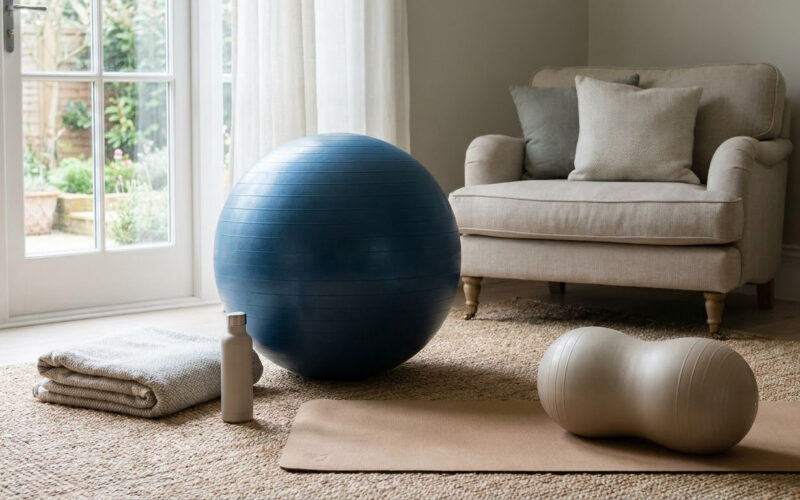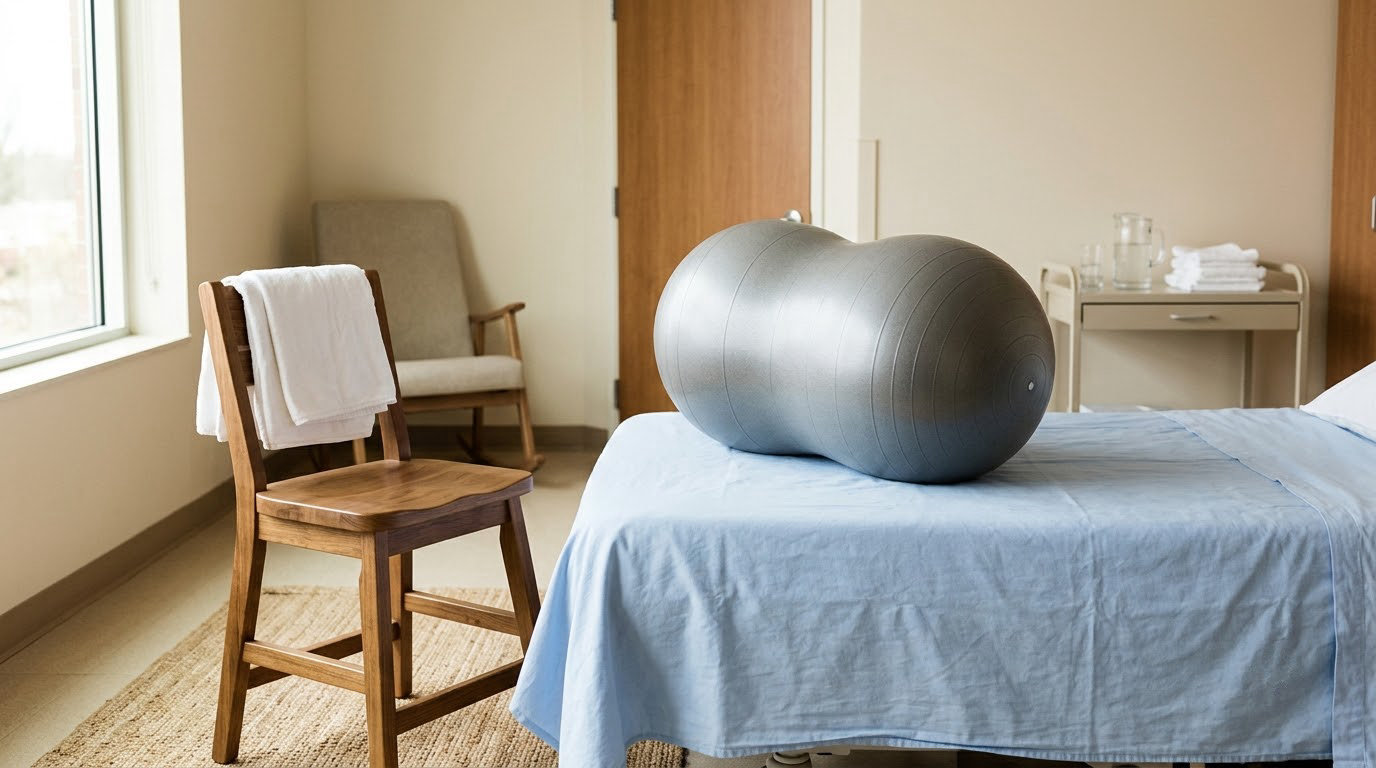
Labor positions that help the baby move down fall into three groups: upright postures that use gravity, wide-hip postures that make the pelvic outlet bigger, and asymmetrical postures that give an off-centre head room to rotate. You can use them before labor starts, in early labor, and during pushing. None of them guarantees descent, and the ones that suit you depend on your baby’s position, your monitoring, and your own comfort.
Most of the good stuff here is unglamorous. Leaning over a counter, rocking on a ball, walking a hallway, or hanging off a door frame will do more good than memorizing diagrams. What matters is that you change something every so often and that you keep doing whatever lets you breathe and stay present.
A note on evidence first, because the numbers matter. A 2013 Cochrane review of maternal positions and mobility in the first stage of labor found that upright and mobile labor was associated with a first stage roughly an hour and a half shorter, with fewer assisted deliveries and fewer caesareans. That is an association across trials, not a promise about your labor. Plenty of people who move a lot still have a long labor, and plenty who lie flat have a short one.
This is general information, not a plan for your labor. Your midwife, doctor or nurse knows your baby’s position, your monitoring and your history, and they should set the boundaries. Bring your questions to them before labor starts and again during it.
Table of Contents
- Labor Positions That Help the Baby Move Down: Quick Guide
- 1. Upright Forward-Leaning Position
- 2. Hands-and-Knees Position
- 3. Side-Lying Position
- 4. Supported Squat
- 5. Asymmetrical Standing Position
- 6. Pelvic Rocking
- 7. Birth Ball Sitting
- 8. Slow Walking With Purposeful Movement
- 9. Kneeling at the End of a Bed
- 10. Laboring in a Supported Half-Squat
- How to Choose a Position That Feels Safe and Useful
- When to stop a position and call your birth team
- Why labor sometimes pauses right after the baby drops in
- Frequently Asked Questions
- What is the best labor position to help the baby move down?
- How often should I change positions during labor?
- Can walking or using a birth ball help labor progress?
- Are labor positions safe if I have an epidural or medical monitoring?
- When should I stop trying a labor position and call my birth team?
- Do labor positions guarantee that the baby will descend?
- Conclusion
Labor Positions That Help the Baby Move Down: Quick Guide
The table below is a starting map, not a checklist to complete. Most people find two or three positions they genuinely like and rotate between those.
| Position | What it may help with | Often useful | Important cautions |
|---|---|---|---|
| Upright forward-leaning | Gravity, back pain relief, mobility | Early labor, back ache | Needs a stable surface or partner |
| Hands and knees | Rotation of an off-centre head, pressure relief | Active labor, back labor | Knee and wrist comfort matters |
| Side-lying | Rest without losing an upright option | Tired labor, monitoring, epidural | Get help changing position |
| Supported squat | Widening the pelvic outlet | Late labor, pushing | Never unsupported, especially on a bed |
| Asymmetrical standing | Making one side of the pelvis larger | Any stage, especially if baby feels off-centre | Hold on, keep balance |
| Pelvic rocking | Gentle movement without standing | Any stage, can be done seated | Keep it comfortable, pause if it hurts |
| Birth ball sitting | Upright posture plus pelvic movement | Early and active labor | Fall risk, needs clearance and support |
| Slow walking | Circulation, gravity, position change | Early labor | Not a substitute for rest when exhausted |
| Kneeling at bed end | A new angle, pressure relief | Late labor | Modify for knees, hips or weight-bearing limits |
| Supported half-squat | Experimenting with gravity and hip width | Late labor | Skip it without trained support nearby |
1. Upright Forward-Leaning Position
This is the workhorse. You stand, sit or perch and lean forward onto a counter, table, the back of a chair, a wall, or your partner’s shoulders, with your weight supported rather than hanging.
Two things happen. Gravity pulls the head down through the pelvis, and the forward lean takes the constant aching work off a lower back that is being compressed by contractions. Plenty of people in back labor say this is the first position that made the pain bearable.
Try it when contractions are regular enough that you want something to do between them, and again when you need to rest without lying down flat. Stop if the pressure on your wrists or shoulders becomes the thing you are noticing. If you are on a hospital bed, ask for the bed to be raised rather than trying to lean over the side rails.
2. Hands-and-Knees Position
On all fours, you can rock your hips back toward your heels and forward again, circle one knee out to the side, or simply hang your head and let a contraction pass through you.
It is the position people describe most often as comfortable in active labor, and the one that makes an asymmetrical or tilted head easier to rotate, because the movement changes the angle of the pelvis while the head is still above the inlet. Rocking your hips backward adds a mild posterior pelvic tilt, which many find relieves the low-back ache of a head pressing near the sacrum.
Protect your knees with a folded towel or a mat, and put a pillow under your head if you want to rest your forehead between contractions. If wrists, knees or shoulders hurt, go to a seated or side-lying version. Nobody needs to earn a hard position.
3. Side-Lying Position
Lying on your side with a pillow between your knees and another behind your back keeps you off your back while staying in one place, and it is one of the few positions that works with continuous monitoring, an intravenous line and an epidural in place.
Use whichever side is more comfortable and switch whenever you want. Side-lying is also the position to return to when a laboring person is exhausted, because it allows real rest without a flat-on-back position. During contractions, you can lift the upper knee, press your lower leg into the bed, or have a partner press on the crest of your upper hip to create a little asymmetry.
Rollers make rolling over far easier, and they are worth asking for before you actually need one. Let someone help you turn if you have had an epidural.
4. Supported Squat
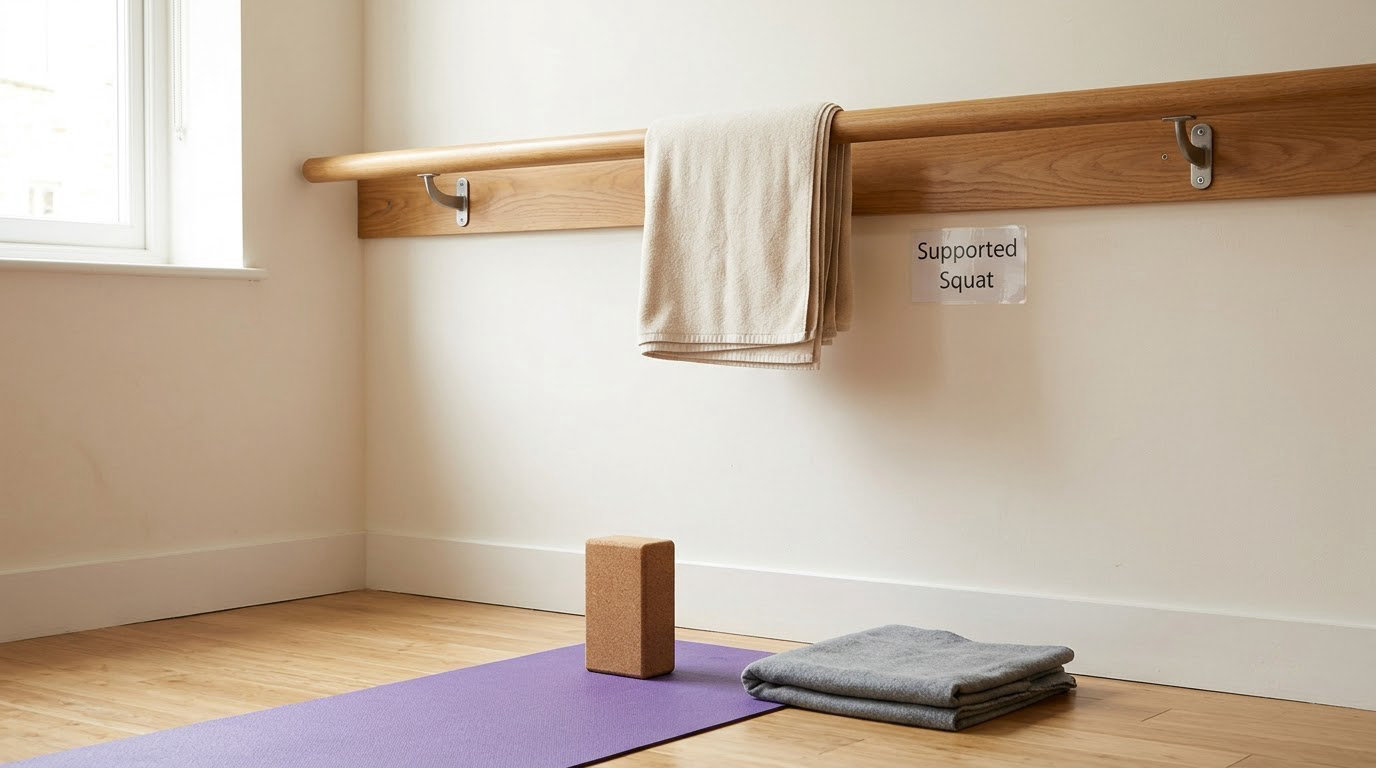
A deep squat with your knees wider than your feet lets the ischial bones spread, which is the narrowest part of the pelvic outlet. That extra room is the whole point, and a squat is one of the few postures that changes the outlet diameter rather than just the direction of gravity.
Set it up properly: both feet flat and a little wider than your shoulders, toes turned out slightly, and your full weight held by a partner, a birth bar, or a sturdy frame at floor level. Some people use a low stool or the edge of a bed under one heel to make the position possible. Take your time coming down and coming up, and breathe out as you settle.
Never attempt an unsupported squat in a hospital room, and never attempt one on a hospital bed, where a slip has nowhere to go. Your team should be involved the first time, and if you have had an epidural your leg control may rule it out entirely.
5. Asymmetrical Standing Position
Stand with one foot on a low step, a chair or a folded towel, or step into a long lunge with one foot well forward and the other trailing behind. One side of your pelvis opens more than the other, and that asymmetry is what many birth workers rely on when a head seems stuck off-centre.
You can hold the lunge still through a contraction and pulse the hips gently forward, or you can walk a few steps and come back to it. The wide-knee principle that circulates in birth communities is the same idea: keep the knees further apart than the ankles whenever you can, seated or standing, and the top of the pelvis gets a little more room.
Keep one hand on something stable. Skip the elevated step if your balance is off, if your ankles are unstable, or if you are managing an epidural and cannot feel your foot well.
6. Pelvic Rocking
Rocking is a movement you can add to almost any posture. Standing, seated on a chair, or on all fours, tip the pelvis forward so your lower back rounds slightly, then back so the tailbone tucks under.
Small range, slow tempo, and it pairs naturally with breathing: tip back as the contraction builds, tip forward as it eases. The point is not to force anything, it is to keep the pelvis changing shape so a head that is sitting awkwardly has a chance to shift. In a hospital, rocking on the edge of the bed with your feet on a floor mat works nearly as well as standing.
Stop if rocking makes you feel worse rather than better. Some people find it increases the sensation of the head pressing on the front of the pelvis, and for them, holding still is the better choice.
7. Birth Ball Sitting
Sitting on a firm ball, feet wide and grounded, keeps you upright while allowing slow circles, figure-eights and gentle bouncing through the pelvic floor. Popular birth-prep groups suggest wide-knee sitting on the ball, leaning forward over it with your forearms and head down, which is a supported version of the forward-leaning position.
The caveats matter. A ball can roll, so you want a wide, non-slip base, a flat floor, and a spot within arm’s reach of something to grab. It is not appropriate if you are not cleared to get out of bed, if your care team wants you monitored in a fixed position, or if getting on and off the ball would exhaust you more than it helps. Some hospitals will not let you use one with continuous monitoring unless someone stays in reach.
Community forums also flag a fair substitute: a firm chair, or a folded blanket over the back of a chair, does a surprising amount of the same work. Nobody needs to own equipment to get upright.
8. Slow Walking With Purposeful Movement
Slow walking with wide, deliberate steps is a real technique rather than something to do for its own sake. Long strides and a slight rotation of the hips change the shape of the pelvis as you go, and the sideways-up-stairs move that birth educators describe does the same thing while gravity is still on your side.
Walking fits early labor at home and in a birth center, where you are usually upright and moving anyway. Hold a wall rail or your partner’s arm. Turn around at the end of a hallway and walk back, which keeps the movement going for longer than you would expect.
Walking is not a guarantee of dilation, and it is not the right answer to exhaustion. If you have been going for hours and the walking is making you worse rather than better, rest instead. A side-lying hour followed by another walk is a reasonable pattern.
9. Kneeling at the End of a Bed
Kneeling at the foot or side of the bed, torso folded forward onto the mattress with your forearms down, gives a completely different angle to the pelvis and takes pressure off the back. It is a common late-labor and early-pushing position precisely because it changes the angle at the outlet.
Use a folded towel or a folded blanket under your knees, and rest your head and chest on the bed rather than holding yourself up. A peanut ball or a stack of pillows under your chest can open up the view if you want your partner or midwife to see more.
Plenty of people cannot kneel, and that changes nothing. The same angle works seated on a chair folded forward, standing with forearms on a high surface, or in a supported lunge. If kneeling aggravates your knees, hips or wrists, take one of those instead.
10. Laboring in a Supported Half-Squat
A half-squat, also called a wide-legged standing position, is part squat and part standing: knees bent, feet wide, hips low, torso upright, and hands braced on a partner’s shoulders or a wall. It sits between a full squat and standing, and for some people it is the only version of a squat that feels manageable.
It is worth trying if a deep squat is too much and a supported squat feels out of reach. A wide-legged standing position with a partner’s arms as a seat, where their forearms become your support, is a common arrangement in birth-center settings.
Do not attempt this one without a capable partner or a professional nearby. The risk of a fall in a half-squat is real, and an epidural makes it more so. If nobody is with you, stand with your back to a wall, slide down and back up, or just stay upright and rock your pelvis.
How to Choose a Position That Feels Safe and Useful
Choosing well comes down to seven factors, and the order matters less than using all of them.
- Comfort: the position that lets you breathe through a contraction is more useful than the theoretically ideal one you cannot hold.
- Consent: you decide what happens to your body. Being told to lie down without a reason is worth a question.
- Available support: a squat, lunge or half-squat needs a person or a frame. Without one, it is not an option.
- Stage and progress: early labor suits movement and rest. Late labor suits gravity and hip-opening positions. Pushing suits positions that give you something to push against.
- Mobility needs: if you cannot bear weight, cannot kneel, or have a catheter, the whole list is still available in modified form.
- Monitoring: wireless telemetry usually means you can be up and moving. Wired continuous monitoring, an intravenous line or a blood-pressure protocol may narrow your choices, and that is a clinical decision.
- Your care team’s advice: they can see things from the outside that you cannot, including how your baby is presenting.
When to stop a position and call your birth team
Call your midwife, doctor or nurse rather than repositioning if you notice bleeding that is not show, a change in your baby’s usual pattern of movement, a gush of fluid that is not clear and green or brown, feeling faint, sudden severe pain that does not match your usual contractions, or a sudden urge to push. The urge to push on its own is a reason to call, not a reason to assume you are nearly there.
Also call if contractions feel strong and regular for a long stretch and you feel no change in how you are coping, if a position leaves you dizzy or lightheaded, or if you simply want a check on progress. Descent is invisible from the inside, so a vaginal check answering “where is the head” can settle an anxious afternoon better than twenty more minutes on a ball.
Why labor sometimes pauses right after the baby drops in
People often panic when contractions space out at exactly the moment they were told the baby has engaged. Engagement means the widest part of the head has passed below the pelvic brim, and it is a real milestone. After it, the head has to rotate through a narrower part of the pelvis, and some labors rest briefly while that happens.
A temporary slowing at that point is common and is not the same as a labor that has stopped making progress. Your provider is the person who can tell the difference, which is the whole argument for checking in rather than pushing on alone.
Frequently Asked Questions
What is the best labor position to help the baby move down?
There is no single best position. Upright forward-leaning, walking, wide-knee sitting and a supported squat are the most commonly used, because gravity, a wider pelvic outlet and asymmetric hip opening each help in a different way. Change between two or three that feel workable, and ask your midwife which one suits how your baby is presenting.
How often should I change positions during labor?
Roughly every half hour to an hour, or whenever a position stops helping. The reason to change is that a new angle changes the shape of the pelvis, which gives an off-centre or tilted head a fresh chance to rotate. You do not need to change on a schedule if the position you are in still lets you breathe, move and feel safe.
Can walking or using a birth ball help labor progress?
Both are reasonable ways to stay upright and keep the pelvis moving, and Cochrane evidence links upright positions to a shorter first stage and fewer interventions. Neither guarantees dilation. On a ball, stay near something to grab, keep the base wide and flat, and do not use one if getting on and off it is the exhausting part.
Are labor positions safe if I have an epidural or medical monitoring?
Often yes, but it depends on your dose and your monitoring. With an epidural you can often still sit, kneel, lie on your side and stand with help, while deep squats and unsupported standing are usually not advised because of balance. With wireless telemetry you can usually move freely; wired continuous monitoring may need negotiating. Ask your team before you get up.
When should I stop trying a labor position and call my birth team?
Call rather than reposition if you have bleeding that is not show, reduced or changed fetal movement, fluid that is not clear, faintness, pain unlike your usual contractions, or a sudden urge to push. Also call if contractions have been strong and regular for a long time without you feeling able to cope, or if you want to know where the baby’s head is sitting.
Do labor positions guarantee that the baby will descend?
No. Positions influence gravity, pelvic shape and rotation, and the Cochrane evidence shows shorter labours and fewer interventions on average, but individual labours vary widely. Sometimes a baby simply needs time, sometimes a change of position helps, and sometimes neither is the issue and your provider reassesses the plan with you.
Conclusion
Start with the simplest thing: stay upright, lean forward onto something solid, and change your position when the one you are in stops working. Add a wide-knee or squat variation when you want more room at the outlet, and keep a side-lying option in reserve for when you are tired, monitored or have an epidural.
None of the labor positions that help the baby move down will guarantee descent, and you deserve a straight answer about that rather than a promise. What they reliably give you is movement, options and a say in what happens next. Talk through the ones you want to use with your midwife or doctor before labor begins, and check in with them early and often once it starts.