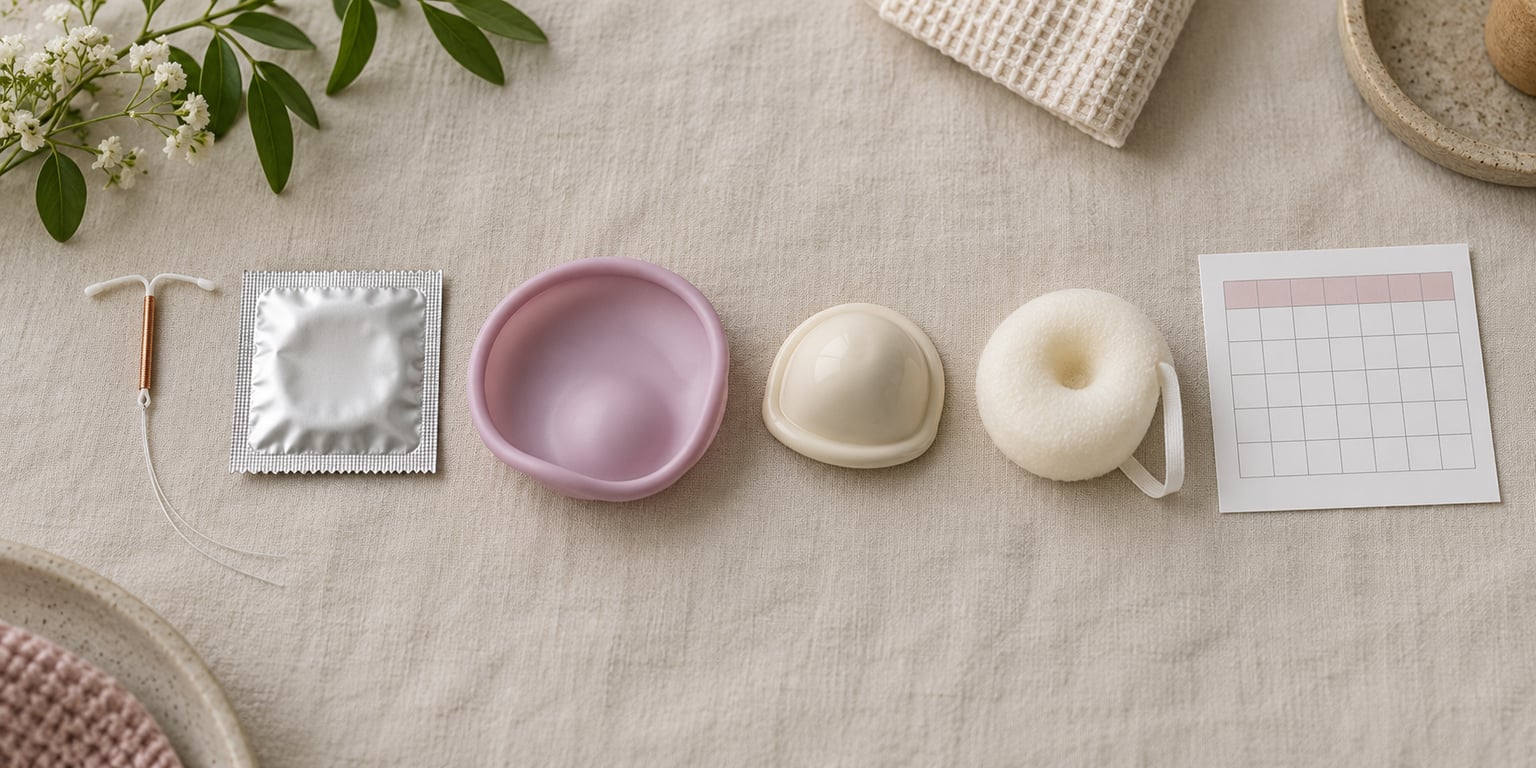
Nonhormonal contraception is any birth control method that prevents pregnancy without putting hormones into your body. Methods work by blocking sperm, using copper to impair sperm movement, changing vaginal chemistry, or avoiding sex during the fertile window. Effectiveness figures for nonhormonal contraception options explained below come from CDC and ASRM guidance, and they vary widely by method.
Nonhormonal birth control is not one thing. It ranges from a device that works for a decade to a condom that costs a few dollars and lasts a single use. The right pick depends on how much risk of pregnancy you are willing to carry, whether STI protection matters, and how much effort you want to put in every time.
This is general health information, not medical advice. A midwife, OB/GYN, or pharmacist can talk through your medical history and help you choose.
Table of Contents
- What counts as nonhormonal contraception?
- Nonhormonal contraception options explained at a glance
- How do nonhormonal contraception options compare?
- How does a copper IUD work?
- What are the benefits and drawbacks of condoms?
- How do diaphragms and cervical caps work?
- What should you know about contraceptive sponges and spermicides?
- How effective is fertility awareness-based contraception?
- How effective is withdrawal as contraception?
- Which nonhormonal method is most effective?
- How do cost, privacy, and access affect the choice?
- What should you do before choosing a method?
- Frequently Asked Questions
- Do any nonhormonal contraception methods protect against STIs?
- Can nonhormonal contraception make it harder to become pregnant later?
- Which nonhormonal birth control methods are available without a prescription?
- Can I use condoms with a diaphragm, cervical cap, sponge, or fertility awareness?
- How do I know which nonhormonal method is right for me?
- The bottom line: what to do first
What counts as nonhormonal contraception?
Nonhormonal contraception prevents pregnancy without hormones entering your bloodstream or changing how your ovaries, uterus, or cervix behave. That sounds simple, but it covers several very different strategies.
Barriers physically stop sperm. The copper IUD releases copper ions that damage sperm so they cannot swim well or fertilize an egg. Spermicide and vaginal gel change the chemistry of the vagina to immobilize or kill sperm on contact. Fertility awareness methods work by timing. Surgical methods block the pathways sperm travel through.
Two things are easy to confuse. First, preventing pregnancy is not the same as protecting against sexually transmitted infections. Only condoms, both external and internal, meaningfully reduce STI risk. Everything else on this list prevents pregnancy only.
Second, typical use is not the same as perfect use. Typical use assumes real people, with missed doses, wrong positioning, and imperfect technique. The CDC publishes both numbers for every method, and the gap is where most unintended pregnancies actually happen.
People look for hormone-free birth control for many reasons: migraine with aura, a personal or family history of blood clots, a history of hormone-sensitive breast cancer, mood changes or weight concerns on hormones, breastfeeding, or simply a preference for something they can stop on any day with no taper.
Nonhormonal contraception options explained at a glance
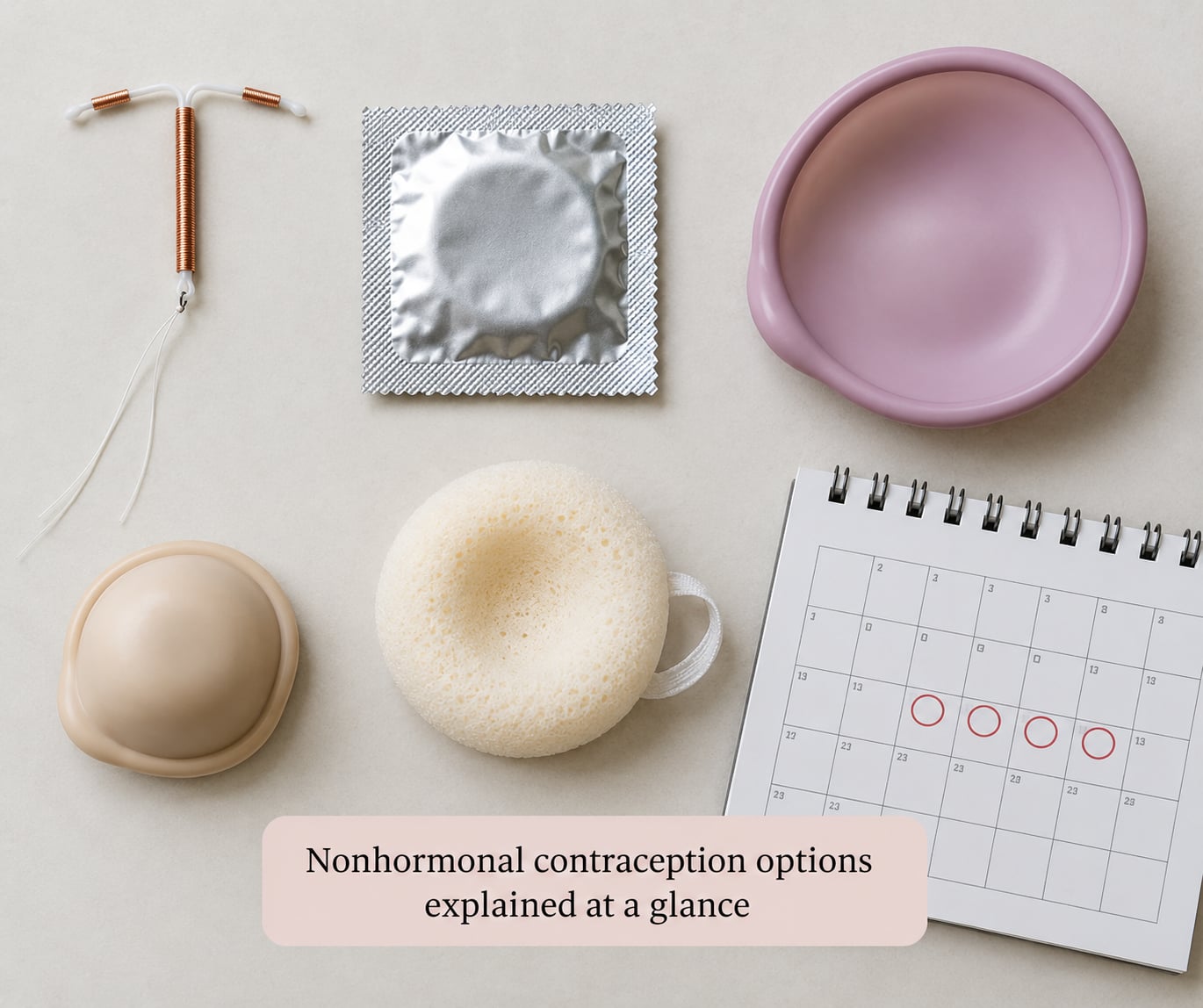
Here is the short version of every hormone-free method, ordered from most to least effective in real-world use. Numbers are pregnancies per 100 users per year, which is how CDC reports them. Lower is better.
- Copper IUD (ParaGard, Miudella): 0.8 typical use, up to 10 years for ParaGard
- Vasectomy: about 2 after clearance testing
- Tubal ligation or salpingectomy: about 2
- Fertility awareness, sympto-thermal method: 2 with perfect use, around 24 in typical use
- Diaphragm: 17 typical use
- Contraceptive sponge: 12 typical use
- External condom: 13 typical use
- Withdrawal: 20 typical use
- Spermicide or vaginal gel (Phexxi): about 21 typical use
- Internal condom: 21 typical use
Only one number should decide this for you if avoiding pregnancy is the priority: the copper IUD. Everything else trades some effectiveness for privacy, low commitment, or no clinic visit.
How do nonhormonal contraception options compare?
| Method | Typical-use effectiveness | STI protection | Reversible | Prescription needed | Main drawback |
|---|---|---|---|---|---|
| Copper IUD | Over 99% | None | Yes, removal restores fertility | Yes | Heavier periods, insertion cramps |
| External condom | About 87% | Substantial | Yes | No | Single use, breaks with oil-based lube |
| Internal condom | About 79% | Substantial | Yes | No | Harder to insert, higher per-use cost |
| Diaphragm | About 83% | None | Yes | Yes, for fitting | Fitting appointment, placement errors |
| Cervical cap | About 83% | None | Yes | Yes, for fitting | Small size, suction seal takes practice |
| Contraceptive sponge | About 88% | None | Yes | No | Single use, less effective after childbirth |
| Spermicide or vaginal gel | About 79% | None | Yes | No for most | Irritation with frequent use |
| Fertility awareness | About 76% | None | Yes | No | Daily tracking, signals shift with life |
| Withdrawal | About 80% | None | Yes | No | Timing mistakes, pre-ejaculate |
| Vasectomy | About 98% | None | Generally considered permanent | Yes | Treated as permanent, needs clearance testing |
| Tubal ligation | About 98% | None | Permanent | Yes | Permanent, surgical recovery |
Condoms are the only row offering real STI protection, and the copper IUD row is the only one where effectiveness barely changes between typical and perfect use, because there is nothing to remember.
How does a copper IUD work?
The copper IUD works by releasing copper ions that are toxic to sperm, so sperm cannot move well enough to reach an egg. It also creates a local sterile inflammatory reaction that makes the lining of the uterus less hospitable to implantation. It does not stop ovulation, and it does not change your hormones.
ParaGard is approved for up to 10 years. Miudella, a lower-dose copper IUD approved by the FDA, is approved for 3 years and was designed to cause less bleeding. Effectiveness is under 1 pregnancy per 100 users per year, and because it is inserted once and works continuously, typical and perfect use are nearly identical.
Insertion is the part people worry about most. On r/birthcontrol, users describe it as a very strong, unusual menstrual cramp that subsides within minutes. Providers typically offer a cervical block, and you can ask for pain medication in advance. For heavy cramping afterward, NSAIDs such as ibuprofen help.
The honest drawback list matters more than reassurance. Expect heavier or longer periods and spotting in the first few cycles, which often settles. Around one in a thousand insertions perforates the uterus. If pregnancy does occur with a copper IUD in place, the chance it is ectopic is higher than average, which matters if that pregnancy is wanted.
Two under-covered facts: the copper IUD can be inserted within five days of unprotected sex as emergency contraception, the most effective emergency contraception available. And it can be used right away while breastfeeding.
A copper IUD is a poor fit if you have unexplained bleeding before your period, active pelvic infection, uterine abnormalities that affect placement, or a history of pelvic inflammatory disease in some situations. It is also harder to remove after several years if the strings have retracted.
What are the benefits and drawbacks of condoms?
Condoms are the only nonhormonal contraception options explained that do two jobs at once: they prevent pregnancy and they substantially reduce STI transmission, including HIV.
External condoms, worn on the penis, run about 87 percent effective in typical use. Internal condoms, inserted into the vagina before sex, run about 79 percent. The internal condom gives the inserter direct control over placement, which helps if the partner wearing the external condom loses an erection or finishes early. Cost per use is higher, and it can feel warmer or more muffled than an external condom.
Both fail in predictable ways. Using oil-based lubricant with a latex condom weakens the latex and can tear it. A condom that is expired, stored near heat, or put on backwards will break or slip. Putting a condom on twice after ejaculation is a genuinely common mistake that people rarely realise they made.
Non-latex options exist for latex allergies, including condoms made from polyurethane or polyisoprene. They cost more and some people notice a thinner feel. Spermicide-coated condoms are not automatically better; the added nonoxynol-9 can irritate and increase friction discomfort for many women.
How do diaphragms and cervical caps work?
A diaphragm is a soft, thin silicone or latex dome with a flexible rim that you fill with spermicide, place over the cervix, and leave in place for about six hours. A cervical cap is smaller, fits snugly over the cervix itself, and can stay in place longer, up to 12 hours in the first cycle. Both are reusable and cost nothing per use after the initial purchase.
Both need a spermicide to work, and both need a fit. Your clinician fits a diaphragm during an appointment, and a diaphragm that has been through childbirth or gained or lost weight should be refitted. Sizing matters more than most people expect.
Typical-use effectiveness for both is about 83 percent, and the failure mode is usually placement. A diaphragm that shifts during sex leaves a gap at the rim. Forum discussions about diaphragms tend to circle the same two points: the fitting session feels awkward, and the method rewards people who already like methodical routines.
Positioning is the other hurdle. You need to be able to reach inside yourself comfortably and stay in the position long enough to insert it. Some people pair a diaphragm with spermicide as their primary method and add a condom for STI coverage, which is a reasonable stacking strategy when pregnancy prevention is the main goal.
What should you know about contraceptive sponges and spermicides?
The contraceptive sponge is a soft, round, absorbent sponge you moisten with water, insert into the vagina, and leave for at least six hours. It works by physically blocking sperm and holding spermicide against the cervix. Typical-use effectiveness is about 88 percent, better than most barrier methods, but it drops considerably after childbirth.
Sponges are single use, sold without a prescription, and easy to get at. The tradeoffs are real: some users find insertion uncomfortable, a sponge left in too long can grow bacteria, and the sponge can be hard to retrieve if it breaks apart.
Spermicide works by damaging or immobilizing sperm on contact. Nonoxynol-9 is the older active ingredient, and it can irritate vaginal tissue with frequent use, which may actually raise infection risk in some people. Phexxi is a prescription vaginal gel that works differently: it keeps the vagina acidic so sperm cannot survive, and it is designed for a single act of intercourse without reapplication.
Whatever you use, follow the product instructions on insertion timing, reapplication, and expiration dates. Spermicide used alone sits near 79 percent effectiveness, so it makes far more sense as a partner to a diaphragm or cap than as a standalone method.
How effective is fertility awareness-based contraception?
Fertility awareness methods identify the fertile window and avoid intercourse during it. The strongest version, the sympto-thermal method, combines daily basal body temperature, cervical mucus observation, and calendar math. With perfect use it runs about 98 percent effective, but in typical real-world use it lands closer to 76 percent.
Basal body temperature is the easiest signal to log. Your temperature rises a few tenths of a degree after ovulation, and that rise confirms ovulation has passed. Cervical mucus is more useful in the other direction: mucus that stretches like raw egg white means you are near ovulation. Calendar methods alone, including standard days methods, are the weakest version because they assume fairly predictable cycles.
The honest limitation is variation. Irregular cycles, breastfeeding, perimenopause, travel across time zones, shift work, and illness all move the signals around. Charts show users struggling with exactly this, noting how hard it is to stay consistent.
Exclusive breastfeeding can work as its own fertility awareness method. Breastfeeding on demand, roughly every four hours day and night, suppresses ovulation, and the ASRM reports it as about 98 percent effective for the first six months under LAM conditions. It requires meeting those criteria closely and is not a plan for someone who wants to become pregnant soon.
How effective is withdrawal as contraception?
Withdrawal, or the pull-out method, is free and needs nothing stored in a drawer. In typical use it prevents about 80 percent of pregnancies, and the gap between typical and perfect use is the whole problem: perfect use effectiveness is around 96 percent, so most failures come from timing decisions made in the moment.
Pre-ejaculate is the other uncertainty. Pre-ejaculate is a small amount of fluid that can contain sperm, and how much sperm it carries varies from person to person and cannot be measured in advance. Timing errors and the presence of pre-ejaculate are the two main reasons withdrawal fails.
Withdrawal can pair well with fertility awareness as a backup on fertile days. As a sole method when the priority is not becoming pregnant, it carries more risk than most people realise, and there are better-fitting options.
Which nonhormonal method is most effective?
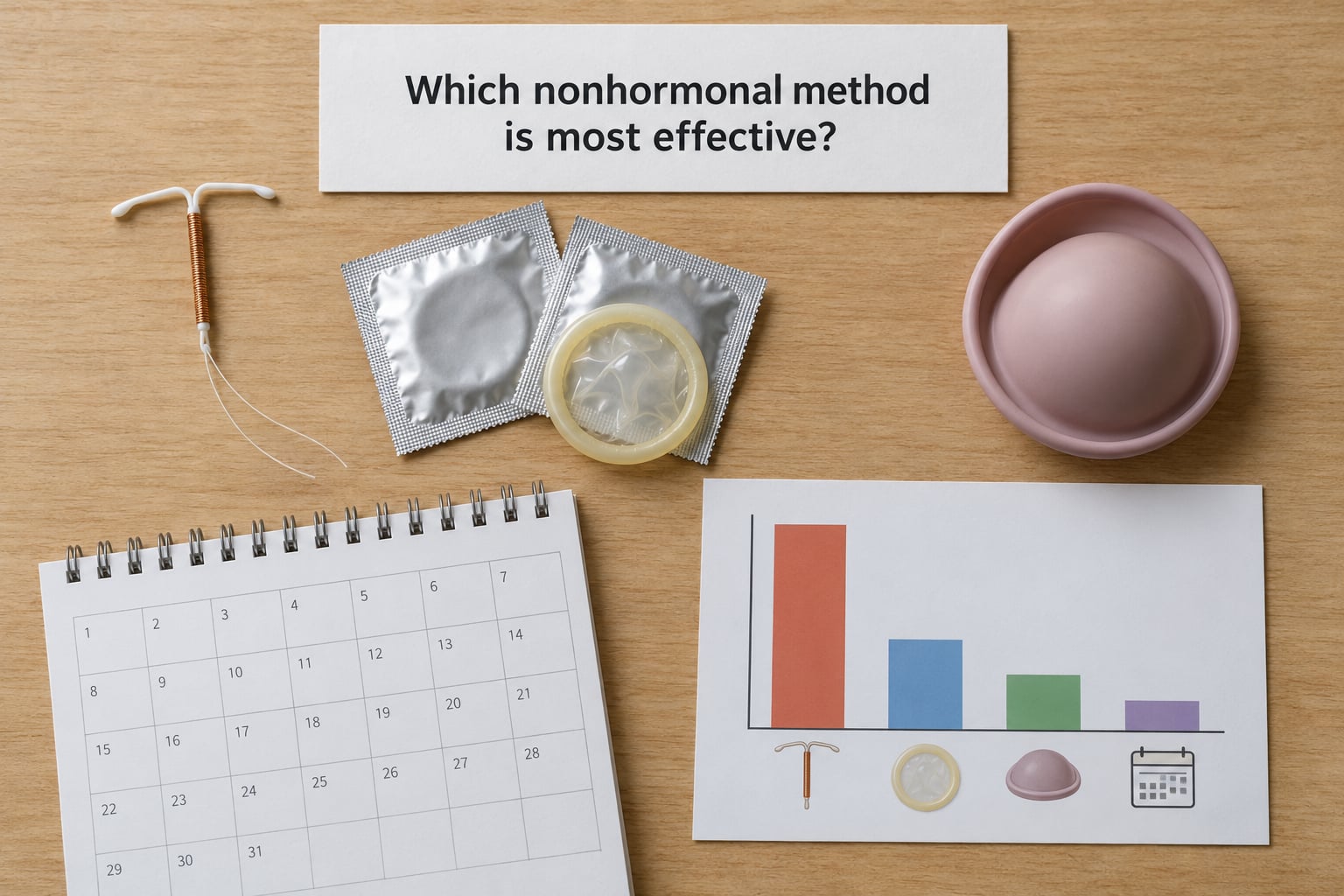
The copper IUD is the most effective nonhormonal method available. At under 1 pregnancy per 100 users per year, it outperforms every barrier, behavioral, and chemical option on the list.
Here is how the field divides.
- Over 99 percent: the copper IUD, because there is no daily action to get wrong.
- About 98 percent: vasectomy and tubal ligation, which are surgical and intended to be permanent.
- 85 to 88 percent typical use: diaphragm, cervical cap, and the contraceptive sponge, all of which depend on correct placement.
- About 80 percent typical use: condoms, spermicide, withdrawal, and fertility awareness, where the gap between typical and perfect use is widest.
These figures describe groups, not individuals. Two people using the same method can have very different experiences, and effectiveness estimates say nothing about how a method will feel for you or how your body will respond to a copper IUD.
How do cost, privacy, and access affect the choice?
Cost patterns differ more than people expect. A copper IUD, a diaphragm, or a vasectomy is mostly a one-time cost, then covered for years or for good. Condoms, sponges, and spermicide repeat as a per-use expense forever, and that adds up over a decade in a way people do not calculate before choosing.
Insurance usually covers prescription methods, including IUD insertion, diaphragms, and sterilization, though copays vary and some plans exclude specific brands. Over-the-counter methods like condoms, sponges, and most spermicides sit outside that coverage. If cost is the deciding factor, ask your insurer about the specific device and about whether the fitting appointment is covered separately from the device.
Privacy matters to a lot of people, and it is a legitimate reason to pick one method over another. Home-use methods such as condoms, sponges, and spermicide leave no clinical record. The copper IUD, diaphragm, and any surgical method all appear in your medical chart, which matters if you share insurance with a parent or partner.
Access is uneven. Planned Parenthood, Title X family planning clinics, public health departments, and student health centers offer contraception at low or no cost and often without a parent’s involvement. Pharmacists can dispense spermicide and, in many states, the vaginal gel. Where you live changes what is realistic far more than most guides admit.
What should you do before choosing a method?
Start by ranking what matters most, because no method wins on every axis.
- Pregnancy prevention first or STI protection first? If preventing pregnancy is the priority, a copper IUD with condoms as backup. If STI risk is the concern, condoms have to be the primary method.
- What is your medical history? Migraine with aura, blood-clot history, hormone-sensitive conditions, breastfeeding, and current medications all narrow the list.
- What can you realistically use correctly? A method you will actually use correctly beats a more effective one you will not. Daily tracking, insertion timing, and appointment-dependent methods each ask something different of you.
- How reversible does it need to be? The copper IUD comes out and fertility returns quickly. Vasectomy and tubal ligation are treated as permanent.
- What about bleeding? Copper IUD users commonly report heavier periods and spotting. If that is already a concern, ask about it before insertion.
Bring specific questions to your visit: what is my realistic typical-use failure rate for this method, what side effects should I expect in the first three months, and what happens if I need to stop or remove it. Ask what pain management is offered for insertion or fitting, not just what the procedure involves.
For anyone with a hormone-sensitive condition, clot risk, or a breastfeeding plan, tell the clinician that directly rather than assuming they will raise it. Many people on r/birthcontrol report frustration at only being offered hormonal options, and a clear explanation of why a nonhormonal method fits your history is reasonable to ask for.
Medically reviewed in October 2026. Sources: CDC contraception effectiveness data, ASRM and ReproductiveFacts patient fact sheets, Planned Parenthood contraception guidance, and ACOG practice guidance. Individual medical decisions belong with a qualified clinician or pharmacist.
Frequently Asked Questions
Do any nonhormonal contraception methods protect against STIs?
Only condoms do. External and internal condoms substantially reduce transmission of HIV and most STIs, which is why they are the standard second layer alongside any other method. Condoms do not cover all skin, so STI risk is reduced rather than eliminated. The copper IUD, diaphragm, cervical cap, contraceptive sponge, spermicide, fertility awareness, withdrawal, and sterilization all prevent pregnancy only. If you have any chance of STI exposure, condoms should be the primary method.
Can nonhormonal contraception make it harder to become pregnant later?
No, not because of the method itself. The copper IUD, diaphragm, cervical cap, sponges, spermicides, condoms, and fertility awareness methods are all reversible, and fertility typically returns to baseline quickly once you stop using them. Two things deserve a conversation with a clinician. A pelvic infection following IUD insertion can rarely affect fertility, and tubal ligation or vasectomy are intended to be permanent. If a pregnancy does occur after a tubal ligation, the chance it is ectopic is higher than average.
Which nonhormonal birth control methods are available without a prescription?
Condoms, both external and internal, contraceptive sponges, and most spermicides are sold over the counter with no prescription at pharmacies and online retailers. Fertility awareness methods need nothing but a chart or an optional app. The copper IUD, the diaphragm, and the cervical cap all require a clinician visit, both for the device itself and for a fitting. Phexxi vaginal gel requires a prescription in the United States. Surgical methods obviously require a procedure.
Can I use condoms with a diaphragm, cervical cap, sponge, or fertility awareness?
Yes, and it is a sensible strategy rather than a wasteful one. A diaphragm, cap, sponge, or fertility awareness method handles pregnancy prevention while the condom handles STI coverage. Putting a condom on before insertion rather than after keeps the two methods separate and avoids the common error of applying twice. If you use a diaphragm or cap, the condom should go on before the spermicide-inserted device is disturbed, which means timing the spermicide insertion for just before sex.
How do I know which nonhormonal method is right for me?
Write down your priorities in order: pregnancy prevention, STI protection, side effects, reversibility, privacy, and cost. Then narrow the list to the methods that meet your top priority, and take that short list to a clinician. Bring your medical history, your bleeding pattern, and any breastfeeding plans, because those details change the answer. Asking about typical-use failure rates, expected bleeding changes, and what removal looks like will tell you more than any general guide.
The bottom line: what to do first
Start by deciding whether your priority is preventing pregnancy, preventing STIs, or both. If pregnancy prevention leads, the copper IUD is the strongest nonhormonal option and the only one that keeps working without daily effort. If STI protection leads, condoms have to be in the picture regardless of what else you choose.
Then be honest about the effort you will actually make. A method used correctly and consistently, every time, beats a more effective one that keeps getting skipped. Bring your shortlist and your medical history to a clinician or pharmacist, and ask the questions about side effects, cost, and removal before you commit.