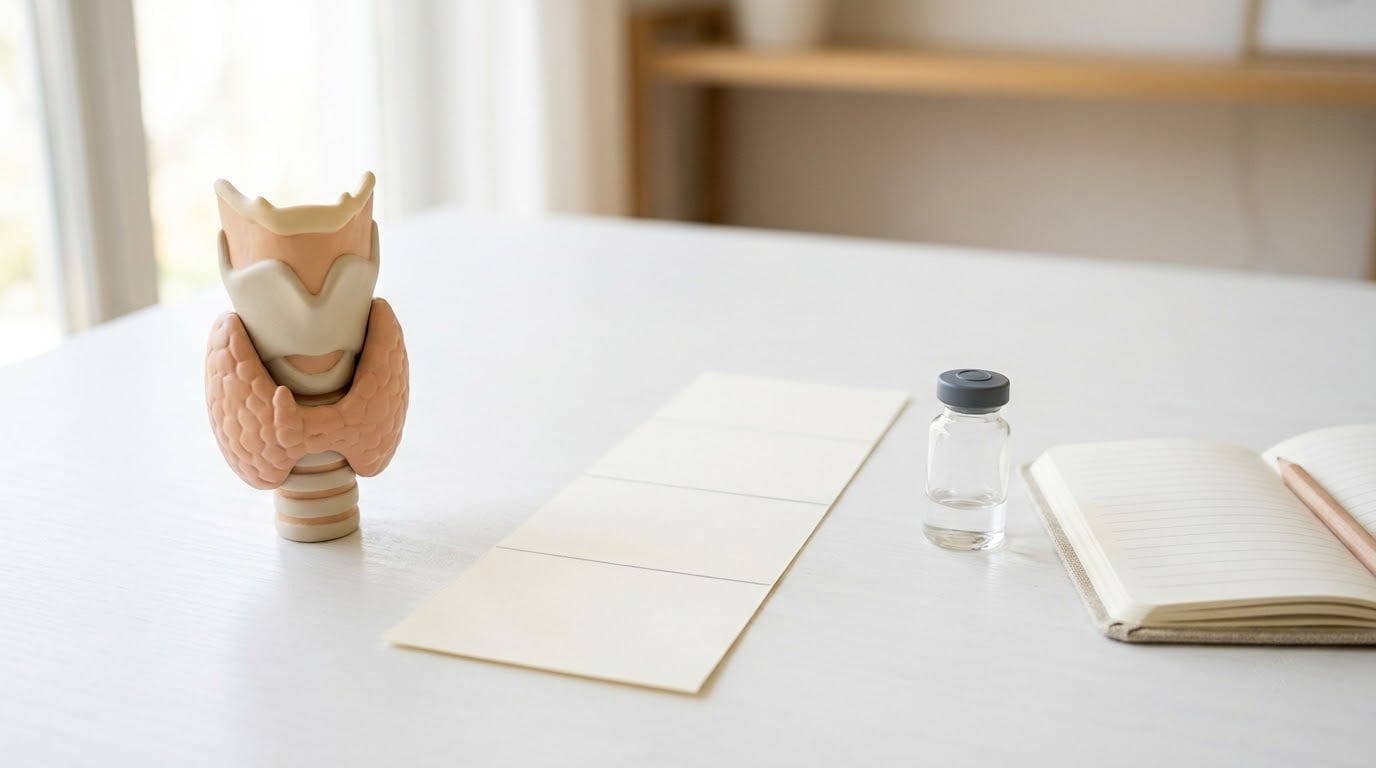
Postpartum thyroiditis is a temporary, painless inflammation of the thyroid gland that happens within the first year after giving birth. It is autoimmune, not infectious, and it is not caused by an unhealthy delivery or by poor recovery. The thyroid controls metabolism, and when it is inflamed it can briefly release too much stored hormone and then, once those stores run out, too little. It is postpartum thyroiditis explained in plain language below, including the phases, the tests, and what recovery usually looks like.
Roughly 5% to 10% of women develop it, and it is more common with type 1 diabetes, a personal or family history of thyroid disease, anti-thyroid antibodies before pregnancy, or a previous episode after an earlier birth or pregnancy loss. Most people recover fully within 12 to 18 months.
Here is the honest difficulty of the early months: exhaustion, hair loss, weight change, shaky moods and brain fog all overlap with normal fourth-trimester recovery. That overlap is exactly why so many cases go unnoticed for months. Nothing below is a diagnosis. It is a map of what clinicians look for, so you know what to mention at an appointment.
Table of Contents
- What Is Postpartum Thyroiditis?
- What Are the Typical Phases of Postpartum Thyroiditis?
- What Symptoms Can Happen After Childbirth?
- What a flare-up feels like in the overactive phase
- What the underactive phase feels like
- Symptoms that point elsewhere
- Postpartum Thyroiditis Explained by Phase
- How Is Postpartum Thyroiditis Diagnosed?
- Which Thyroid Tests May Be Ordered?
- How Long Does Postpartum Thyroiditis Last?
- What Treatment Questions to Ask Your Doctor
- Can Postpartum Thyroiditis Affect Fertility or Future Pregnancies?
- When Should You Contact a Healthcare Professional?
- Frequently Asked Questions
- Can postpartum thyroiditis happen while I am breastfeeding?
- Is postpartum thyroiditis likely to happen again?
- Can I have a healthy pregnancy after postpartum thyroiditis?
- Does postpartum thyroiditis always go away without treatment?
- Should thyroid symptoms be discussed alongside postpartum depression?
- What to Do Next
What Is Postpartum Thyroiditis?
Postpartum thyroiditis is an autoimmune inflammation of the thyroid gland that occurs within the first year after childbirth. During pregnancy the immune system is partly dialed down. After delivery that suppression lifts, and in women who are already prone to it, antibodies begin attacking the thyroid follicles. Damaged follicles leak their stored hormone into the bloodstream, which produces a short overactive phase. Once those stores are depleted, an underactive phase can follow until the gland recovers.
The American Thyroid Association describes it as a short-lived inflammation that happens in roughly 8% of pregnancies after birth. The StatPearls chapter on the NCBI Bookshelf defines it the same way: a destructive autoimmune thyroiditis presenting within one year after delivery.
Two things worth saying plainly. First, most people never develop it, so this is not a condition you should expect. Second, it is treatable, and the parts of it that are hardest to live with — the fatigue, the mood symptoms, the stalled weight loss, the thinning hair — are the parts that improve once the thyroid is handled.
It can also follow a miscarriage, stillbirth or termination, not only a live birth. The trigger is the hormonal and immune shift after the pregnancy ends.
What Are the Typical Phases of Postpartum Thyroiditis?
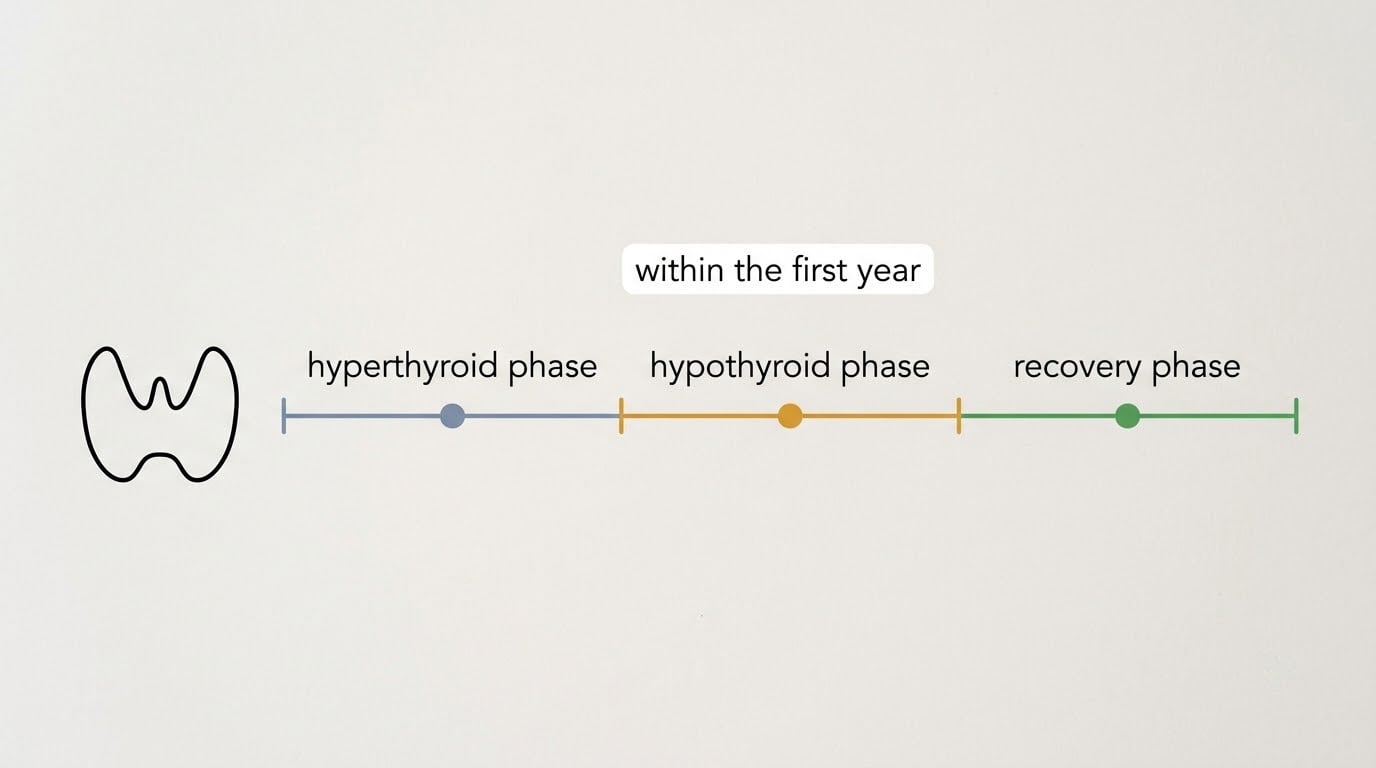
Not everyone goes through all three. Some have only the overactive phase, some only the underactive phase, some go straight through to recovery. But the shape is the same, and knowing it helps you place your own symptoms in time.
| Phase | Typical timing | What happens in the body | Common approach |
|---|---|---|---|
| Hyperthyroid phase | About 1 to 4 months after birth | Damaged follicles leak stored hormone, causing transient thyrotoxicosis | Often monitored; a beta-blocker may help symptoms such as palpitations |
| Hypothyroid phase | About 4 to 8 months after birth, sometimes later | Hormone stores are depleted and the gland is not yet producing enough | Monitoring, or thyroid hormone replacement if symptoms are significant |
| Recovery phase | From around 12 months onward | The gland stabilises, or it needs long-term replacement | Repeat testing, then a plan for long-term monitoring if needed |
The overactive phase is the one most people never notice, because it can feel like relief. Racing thoughts, irritability, sweating at night and losing weight quickly may be read as finally getting your energy back. The underactive phase is what usually brings people in, because feeling worse after months of being told you are healing is hard to explain.
Transient thyroid overactivity is not the same as a thyroid emergency, but a small number of symptoms are never something to wait out. A very fast or irregular heartbeat at rest, chest pain, severe fever, confusion, or a fever with a rash that does not fade under pressure are reasons to seek urgent care rather than to book a routine thyroid appointment.
What Symptoms Can Happen After Childbirth?
Symptoms vary widely, and none of them on its own can tell you whether this is thyroiditis, ordinary recovery, something else, or a combination. What makes thyroiditis worth testing for is the pattern: symptoms that do not follow the usual postpartum curve, that fluctuate, or that settle into a new worse baseline and stay there.
What a flare-up feels like in the overactive phase
Heart palpitations or a pounding pulse, restlessness and difficulty settling, heat intolerance and sweating, tremor or shaking hands, irritability and a shorter fuse, racing thoughts, trouble falling asleep despite being tired, reduced appetite with fast weight loss, and frequent bowel movements. A user in r/thyroidhealth described the hyper phase being labelled anxiety for months before a thyroid panel was ever run, which is a common story rather than a rare one.
What the underactive phase feels like
Heavy, unshakable fatigue, cold intolerance and chills, dry skin and thinning hair, weight gain that resists normal effort, constipation, brain fog and difficulty concentrating, low mood, aches and pains, and heavy menstrual periods. One r/beyondthebump commenter described it as whole-body and mind tiredness with aches, adding that it sometimes felt almost like postpartum depression. That overlap is real and well documented, which is why a thyroid panel belongs in the workup when low mood shows up after a birth.
Symptoms that point elsewhere
A racing heart with anxiety that has no relationship to sleep loss, night sweats that drench bedding, unexplained weight loss with no appetite change, or a neck that looks and feels swollen all deserve a look, but they can also point to Graves’ disease, anemia, iron deficiency, a wound infection or something unrelated. This is the section where guessing is least helpful.
Postpartum Thyroiditis Explained by Phase
The same thyroid gland produces two very different symptom clusters depending on which direction the hormone has moved. Excess hormone speeds everything up: pulse, breathing rate, heat production, bowel transit, mood volatility. Too little slows it down: energy, temperature, digestion, concentration and hair turnover. People often describe the transition from one to the other as losing the anxious, restless energy and landing in something heavier and flatter, usually between four and eight months after the birth.
One detail that confuses a lot of people: because the gland is being destroyed slowly, symptoms can begin months after delivery rather than right away, and the timeline does not match any particular birth story. A C-section or a difficult labour does not predict it, and an easy recovery does not rule it out.
How Is Postpartum Thyroiditis Diagnosed?
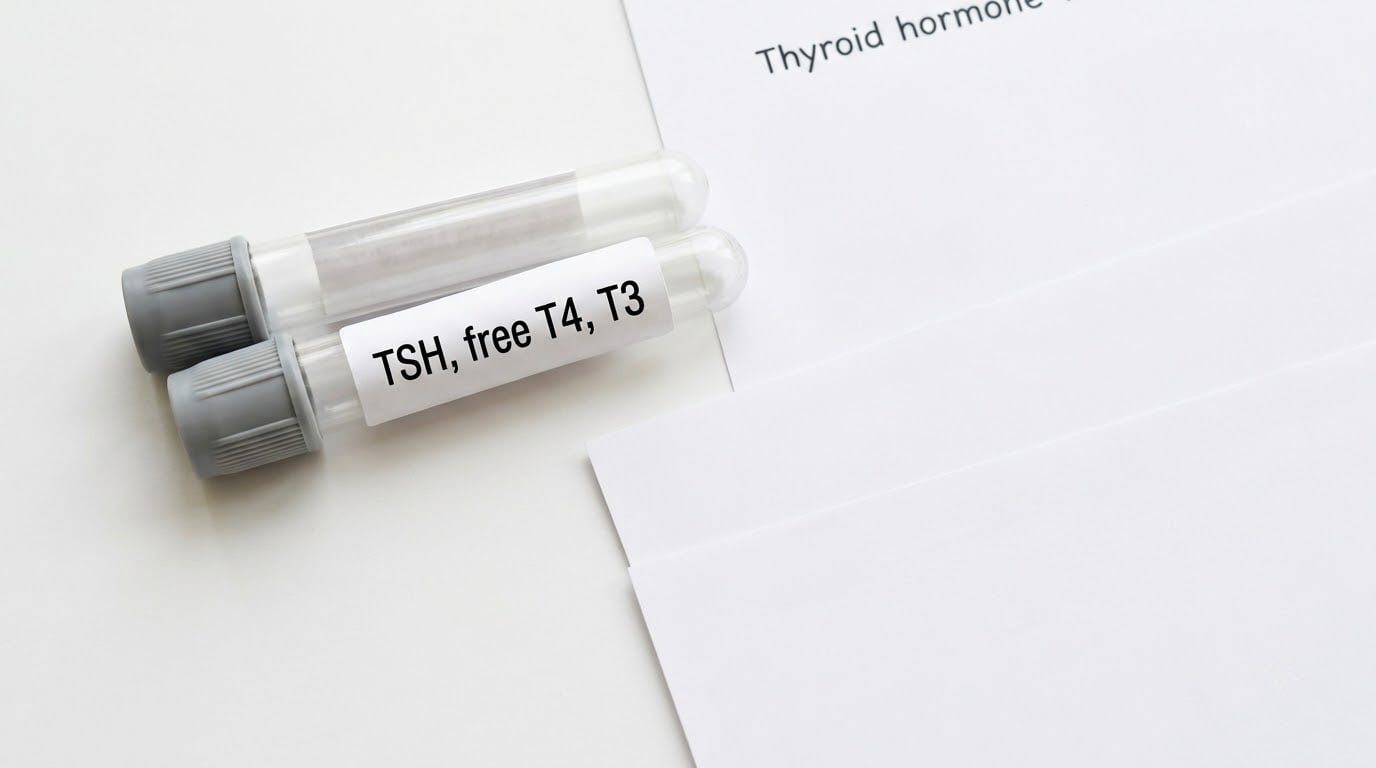
Diagnosis is straightforward in outline: history, physical examination, and thyroid blood tests interpreted by a clinician who knows your birth timeline. There is no single home test and no scan that gives the answer on its own.
What the clinician does first is ask when the symptoms started relative to the delivery and whether they have changed shape over time. That timeline is more useful than a list of symptoms, because the phases have their own windows.
The physical exam is modest. A painless, slightly enlarged thyroid can sometimes be felt, and there is often no tenderness at all, which is why the word painless matters — sore-throat-style pain points somewhere else. Clinicians also look for signs of a racing pulse, tremor, dry skin, puffy features or slowed reflexes.
The blood tests measure thyroid-stimulating hormone, free T4 and usually free T3. In the destructive pattern typical of thyroiditis, TSH runs low while free T4 runs high in the overactive phase, and TSH runs high while free T4 runs low in the underactive phase. Your clinician reads those results next to your symptoms and your history, because a single number out of range does not make a diagnosis, and reference ranges shift slightly by trimester and by laboratory.
One more thing gets checked: whether the overactivity comes from antibodies that stimulate the gland, which would indicate Graves’ disease rather than thyroiditis, since the two are managed differently. A r/thyroidhealth user described being told their very low TSH was thyroiditis rather than Graves’ disease, which is a reasonable distinction to have made explicitly rather than left to a later appointment.
Which Thyroid Tests May Be Ordered?
Not every person needs every test. A clinician picks based on your symptoms, your history and what they are trying to separate from what else is possible.
| Test | What it measures | Why it helps |
|---|---|---|
| TSH (thyroid-stimulating hormone) | The pituitary signal telling the thyroid how much hormone to make | The most useful single marker for picking up dysfunction; moves in the opposite direction to thyroid hormone when the gland underproduces |
| Free T4 and free T3 | The circulating hormone available to the body | Shows how much hormone is actually available, which separates an isolated TSH change from a real hormone shift |
| Thyroid antibodies (anti-TPO, and others as needed) | Antibodies directed at thyroid tissue or its proteins | Confirms an autoimmune process and helps estimate risk, now or in a future pregnancy |
| Thyroid ultrasound | The size and texture of the gland | Used when swelling is present, or to check the structure when the diagnosis is unclear |
Australian Prescriber sets out targeted testing for women at higher risk, recommending thyroid function tests at around three and six months postpartum for those with thyroid antibodies, known autoimmune disease, previous postpartum thyroiditis, or chronic viral hepatitis. That is a conversation to have with your clinician, not a schedule to book on your own.
Worth knowing: about half of women who already carry anti-thyroid peroxidase antibodies early in pregnancy go on to develop postpartum thyroiditis. That single fact is the main reason clinicians test people who feel completely well.
How Long Does Postpartum Thyroiditis Last?
Most cases resolve within 12 to 18 months of the start of the thyroid problem. The overactive phase typically runs one to four months and settles as quickly as a few weeks for some people. The underactive phase is usually the longer one, commonly four to eight months and occasionally stretching to about twelve, with the slowest improvements reported among people who were already more depleted going in.
Recovery can be gradual rather than a switch. People describe a slow climb rather than a morning they suddenly feel fine, and the first thing to come back is usually stamina, then thinking clearly, then hair and skin, then the ability to lose weight. That order can feel backwards for a while, because the energy returns before the weight does.
Persistent or recurring symptoms deserve reassessment rather than an assumption of normal recovery. If you are still hypothyroid at 18 months, or if you need replacement hormone beyond that point, the picture has usually shifted from temporary thyroiditis to permanent thyroid dysfunction, and the follow-up plan should change accordingly. Many women in that group have Hashimoto’s thyroiditis alongside or instead of thyroiditis, and the practical difference is simple: one usually resolves, the other is managed long term.
Long-term monitoring matters even after you feel well. Annual TSH testing for several years after postpartum thyroiditis is recommended, because later hypothyroidism and an enlarged thyroid are more common in women who have had it.
What Treatment Questions to Ask Your Doctor
Treatment is driven by symptoms and duration, not by a number on its own. Many people need nothing more than monitoring, because the condition is temporary and the phases pass. That is a legitimate plan, and you can ask for it to be explicit rather than leaving with a shrug.
Questions worth taking into the appointment:
- Which phase am I in, based on my timeline and blood tests?
- Is monitoring alone reasonable, and how often will we recheck?
- Would thyroid hormone replacement help my symptoms now, and what would we expect to change?
- If I start replacement, how and when would we try tapering it, and what signs would mean it is time?
- Is breastfeeding compatible with the medicines you are suggesting, and how should I time them?
- Should I be screened for thyroid antibodies, and does that change my plan for a future pregnancy?
- What is the referral trigger for an endocrinologist rather than primary care?
On breastfeeding, this comes up constantly and is rarely answered clearly. Thyroid hormone replacement is generally considered compatible with nursing, and clinicians commonly advise separating it from iron and calcium supplements by about four hours, because those minerals block absorption. On timing expectations: levothyroxine has a half-life of roughly seven days, so day-to-day mood and energy swings usually say more about your sleep, your blood count or your stress than about the dose. A commenter in r/Hashimotos put it well — a bad day is not proof the medicine stopped working. There are beta-blockers for the overactive phase, and your clinician will discuss whether they fit your situation.
Give your clinician the timeline, not just the symptom list. Bring dates. Thirty seconds of well-organised history changes what gets tested at an appointment that is likely to be short.
Can Postpartum Thyroiditis Affect Fertility or Future Pregnancies?
Thyroid hormones affect ovulation, and untreated hypothyroidism can make periods irregular or heavy and can interfere with fertility. The good news is that this is usually reversible once thyroid levels are back in range, and many women conceive without difficulty afterwards.
The practical advice is about sequencing. Ideally thyroid function is stabilised before trying to conceive, since untreated thyroid disease in early pregnancy is associated with outcomes that are better avoided when they can be. Ask for thyroid function tests as part of preconception planning rather than waiting until you are already pregnant, and confirm your results are stable on any current replacement before conception.
During pregnancy, thyroid needs and reference ranges both shift, so your care plan and your testing schedule will usually change. That is normal and expected, not a sign that something has gone wrong.
On recurrence, the figure usually quoted is around 20% in a subsequent pregnancy, which is higher than the first-time risk and worth planning for. Recurrence also tends to follow a similar pattern in the same person, and it is often picked up earlier because you already know what to watch for. Someone in r/recurrentmiscarriage only learned the condition can follow a pregnancy loss as well as a delivery, which is worth knowing before you need it.
When Should You Contact a Healthcare Professional?
Book a routine appointment, and ask specifically for thyroid testing, when symptoms persist beyond a few weeks after delivery, when they settle into a worse baseline rather than improving month by month, when they fluctuate and you cannot explain the swings, when your periods become heavy or irregular again, or when low mood, anxiety or panic arrives in the months after the birth rather than immediately after.
Book soon, and ask how quickly you can be seen, if symptoms are worsening steadily, if you cannot sleep despite being exhausted, if your heart rate is racing at rest, or if breast milk supply drops noticeably and does not recover with the usual measures. That last one is worth naming in the room. Thyroid problems can affect milk supply, and while plenty of supply changes are not thyroid-related, a supply drop alongside fatigue is a good reason to ask for a panel.
Seek urgent or emergency care for chest pain, difficulty breathing, a very fast or irregular heartbeat with faintness, a high fever, severe confusion, or thoughts of harming yourself or not wanting to be alive with your baby. The last one matters most here, because thyroid dysfunction and postpartum depression can overlap and both need proper treatment. Postpartum thyroiditis should sit on the list of possible causes when someone is depressed or anxious after a birth, and treating the thyroid does not replace mental health care if it is also needed — it removes one obstacle.
Frequently Asked Questions
Can postpartum thyroiditis happen while I am breastfeeding?
Yes. Thyroiditis can develop and be treated while nursing. Thyroid hormone replacement is generally considered compatible with breastfeeding, and clinicians often advise taking it on an empty stomach and separating it from iron or calcium supplements by roughly four hours, because those minerals reduce absorption. If milk supply drops, ask for thyroid testing rather than assuming supply problems are unrelated to thyroid function.
Is postpartum thyroiditis likely to happen again?
In a later pregnancy, the chance of recurrence is commonly quoted at around 20%. Recurrence often follows a similar pattern to the first episode, and it is more likely if thyroid antibodies were already present. The practical benefit of a previous episode is that you know what to watch for, so ask your clinician about thyroid function tests early in the pregnancy and in the postpartum months rather than waiting for symptoms.
Can I have a healthy pregnancy after postpartum thyroiditis?
Most women do. Postpartum thyroiditis is usually temporary, and once thyroid function returns to normal there is no barrier to conception or to a healthy pregnancy. The useful step is planning: have thyroid function confirmed stable before you conceive, keep testing through pregnancy since requirements and reference ranges change, and expect the monitoring plan to be more active than for someone with no thyroid history.
Does postpartum thyroiditis always go away without treatment?
No, and treatment is not a sign that something has gone badly. Many people are simply monitored, because the phases pass on their own and replacement hormone would not change the outcome. Others are given thyroid hormone because their symptoms are significant, or because the underactive phase is lasting longer than expected. Around 20% to 30% of women remain hypothyroid and need long-term replacement, so follow-up is the part that matters most.
Should thyroid symptoms be discussed alongside postpartum depression?
They should be raised with your clinician, because the two overlap closely and one can mask the other. Fatigue, brain fog, aching, low mood and anxiety all look identical from the outside, which is why some women are treated for mood alone and only later have a thyroid panel run. Ask for thyroid function tests alongside any postpartum mental health assessment, and keep both in treatment if both are needed.
What to Do Next
Write down when things changed: the week your energy dropped, the month your hair started falling, the first period that came back heavy. Bring that timeline to an appointment and ask for thyroid function tests covering TSH, free T4 and free T3, with antibodies if you have not had them checked before.
If you already have a diagnosis, ask when the next recheck is due and what the plan is for tapering or continuing replacement. That is the single question that settles most of the anxiety in the forum threads about this condition.
And treat the fourth-trimester rule as a starting point, not a verdict. Feeling worse at four months postpartum, rather than better, is worth investigating on its own. Get urgent help for chest pain, breathing difficulty, a racing or irregular heartbeat, high fever, confusion, or any thought of harming yourself.