
What embryo grading means is simpler than the notation makes it look: an embryologist looks at an embryo under a microscope and gives it a score describing how it looks and how far along it is. That score helps a clinic rank embryos for transfer, freezing or testing. It is a snapshot of appearance on one day, not a prediction of your outcome.
Most people meet embryo grading in the worst possible moment — sitting in a parking lot with a phone full of numbers and a search bar open. The letters look like a code, and the clinic is closed. This guide is the calm version of that conversation.
Table of Contents
- Key takeaways
- What Embryo Grading Means
- What embryo grading means on a fertility report
- How Embryo Grading Is Done
- Day 3 Embryo Grades Explained
- Blastocyst Grading Explained
- Day 3 and Blastocyst Grades at a Glance
- What Embryo Grades Can and Cannot Tell You
- How Embryo Grade Differs From Genetic Testing
- Questions to Ask Your IVF Team About Grading
- Frequently Asked Questions
- Is a higher embryo grade always better?
- What does a grade A embryo mean?
- Can embryo grading tell me if an embryo is healthy?
- Is a day 3 embryo grade comparable to a blastocyst grade?
- Does the highest-grade embryo always have the best chance of implantation?
- What to Do First When You Receive an Embryo Grade
Key takeaways
- A grade describes what an embryologist saw on one day, under a microscope, from outside the embryo.
- Day 3 grades come from cell number, symmetry and fragmentation. Blastocyst grades come from expansion, inner cell mass and trophectoderm.
- Appearance is not chromosomes. A high grade does not mean an embryo is genetically normal.
- Grading is partly subjective, so two embryologists can reasonably differ, and clinics do not all use identical systems.
- Grades are averages across thousands of cycles. Your own outcome is a person, not a percentage.
This is general information about how IVF embryo grading works. It is not medical advice, and it cannot tell you anything about your own embryos. Decisions about testing, freezing and transfer belong with your IVF clinician and genetic counsellor.
What Embryo Grading Means
An embryo grade is a morphological score. In plain terms, it describes what the embryo’s cells look like at a given stage and how evenly they are dividing — nothing that cannot be seen down a microscope.
Labs grade embryos for three practical reasons: to decide which embryo goes into the transfer catheter first, to decide which embryos are worth vitrifying (freezing), and to decide which embryos are strong enough-looking to send for a trophectoderm biopsy for preimplantation genetic testing. Grade is a ranking tool inside a laboratory workflow.
What it is not is a forecast. A 5AA embryo does not come with a percentage attached, because no clinic can honestly attach one to your individual transfer.
What embryo grading means on a fertility report
Reports vary by clinic, but most list each embryo as a numbered entry with a stage, a grade and sometimes a note. Here is a realistic line you might see:
Embryo 3 — Day 5, Blastocyst, 4BB, 8 cells on day 3, euploid result pending
Read it in pieces. Embryo 3 is its identity for the rest of the cycle, so when your clinic says “embryo 3” on transfer day, everyone means the same one. Day 5, Blastocyst means it reached the blastocyst stage five days after fertilisation. 4BB is the grade: expansion 4 on the 1-6 scale, inner cell mass B, trophectoderm B. 8 cells on day 3 is a historical note from an earlier check. Euploid pending means a biopsy result is still outstanding.
If a line reads differently, the numbers and letters you are most likely to see are 5AA, 4AB, 4BB, 3BC and 3CC. If your clinic gives you only counts — “three embryos frozen, two biopsied” — that is a reporting style, not a judgment about your prospects. You can absolutely ask for the grades, and most labs will provide them.
How Embryo Grading Is Done
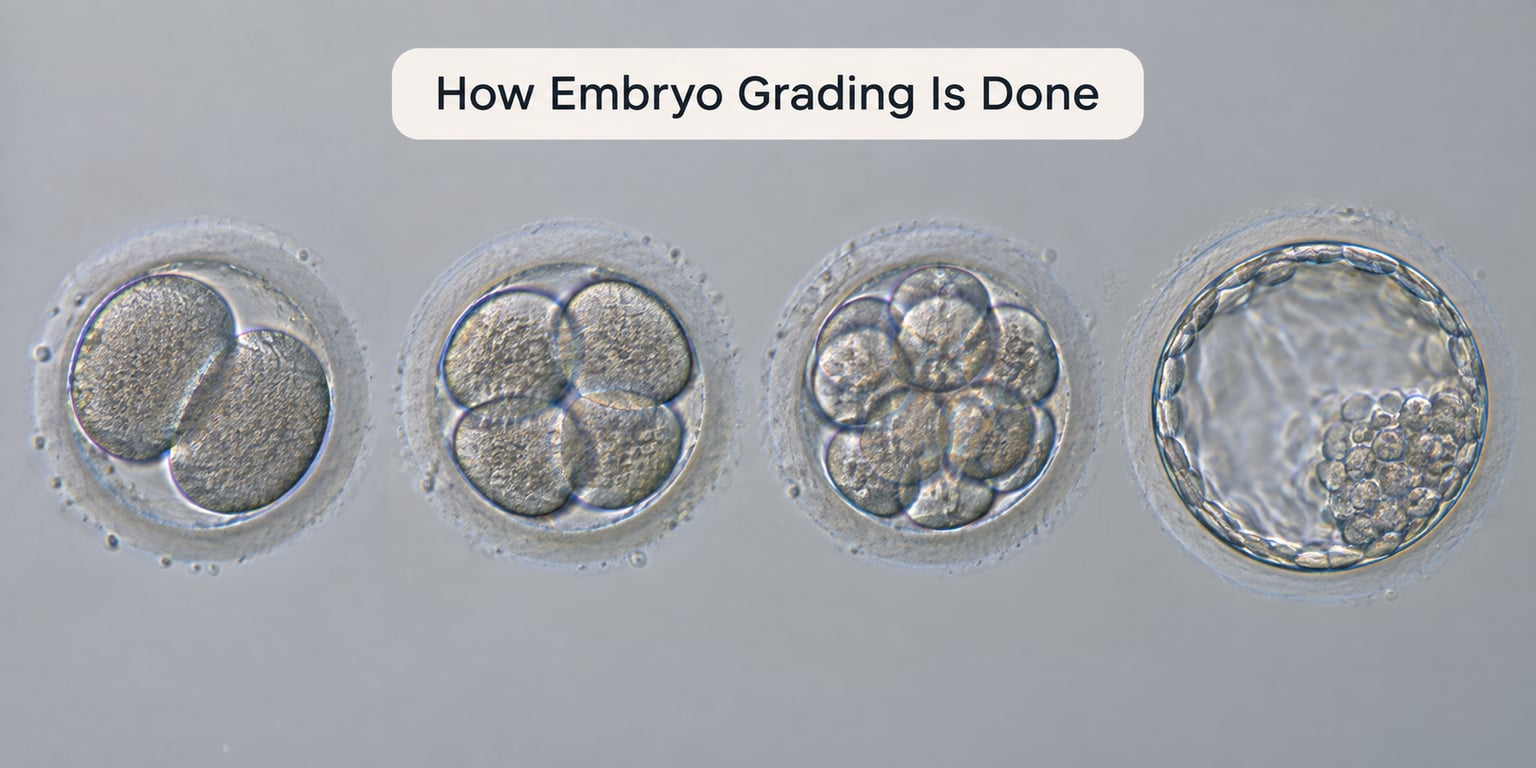
Assessment starts before any grading happens. Around 18 hours after the injection of sperm or intracytoplasmic sperm injection, the embryologist checks for a second polar body or, later, two pronuclei — the visible sign that fertilisation occurred. Only embryos that show fertilisation continue to be graded.
From there the timing depends on the stage:
- Day 1-2: cleavage into 2, then 4 cells. Usually recorded rather than graded.
- Day 3: cleavage-stage grading on cell number, cell size and symmetry, and fragmentation.
- Day 5, 6 or 7: blastocyst grading on expansion, inner cell mass and trophectoderm, if the embryo gets that far.
Grading happens under an inverted microscope with the embryo in a dish, usually at room temperature, and it is done by a person. That last part matters. The major systems in use are published — the Gardner blastocyst grading system and the Istanbul consensus for cleavage-stage morphology — but no system removes human judgement from a subjective observation.
Time-lapse imaging, which films embryos continuously rather than checking them once a day, adds information about division timing. Whether algorithm-assisted selection using that footage improves live birth rates is still debated among specialists.
Day 3 Embryo Grades Explained
Day 3 grades answer three questions: how many cells are there, are they roughly the same size and shape, and how much of the embryo is broken-down fragment rather than intact cell?
| Grade | Fragmentation | Cell size and symmetry | What it usually signals |
|---|---|---|---|
| 1 (A) | Under 5 percent | Evenly sized, well matched cells | Best-looking day 3 embryo |
| 2 (B) | 5-20 percent | Some unevenness | Reasonable, often transferred or frozen |
| 3 (C) | 20-50 percent | Clearly uneven cells | Lower on appearance alone |
| 4 (D) | Over 50 percent | Very few intact cells | Often arrests before blastocyst stage |
Most day 3 embryos that are still viable have 6 to 10 cells. Cell number often carries more information than the letter grade, which is why an 8-cell grade 3 embryo is often treated more seriously than a 4-cell grade 2.
The A/1 versus B/2 confusion you may have read about is real. Most labs describe the same scale in letters or numbers, so A is 1, B is 2 and C is 3. It is the same scale, not two.
Blastocyst Grading Explained

By day 5 an embryo that keeps dividing forms a fluid-filled cavity called the blastocoel, a compact clump of cells called the inner cell mass (ICM), and an outer layer called the trophectoderm (TE). The Gardner grading system scores all three, and the grade reads as a number plus two letters.
The ICM is the group of cells that becomes the baby. The TE is the outer layer that attaches to the uterine lining and forms the placenta. Both matter, which is why the grade has two letters.
Expansion, the number 1-6:
| Stage | What it looks like |
|---|---|
| 1 | Early blastocyst, cavity just forming, ICM and TE hard to distinguish |
| 2 | Blastocoel fills about half the embryo volume |
| 3 | Full blastocyst, cavity fills the whole embryo, cells clearly defined |
| 4 | Expanded, ICM and TE clearly distinguishable and larger |
| 5 | Hatching — the embryo is pushing out through the zona pellucida |
| 6 | Fully hatched, no zona pellucida left |
Inner cell mass, the first letter:
| Letter | ICM appearance |
|---|---|
| A | Many tightly packed cells, clearly defined |
| B | Fewer cells, loosely grouped, still fairly well defined |
| C | Very few or poorly defined cells |
Trophectoderm, the second letter:
| Letter | TE appearance |
|---|---|
| A | Uniform, well-formed cells covering the blastocoel evenly |
| B | A few irregular or loose cells, uneven coverage |
| C | Very few, badly defined cells |
Put together, the common grades read like this:
| Grade | Plain English |
|---|---|
| 6AA | Fully hatched, both cell groups top quality |
| 5AA | Hatching, top-quality ICM and TE |
| 4AB | Expanded well, top-quality ICM, slightly uneven TE |
| 4BB | Expanded well, both cell groups decent |
| 3BC | Full blastocyst, acceptable ICM, fair TE |
| 3CC | Full blastocyst, both cell groups on the weaker side |
If you are wondering whether 5AA is better than 4AA: both are considered top grades, and the difference is expansion stage — how grown the blastocyst is — rather than a different class of embryo. Across large datasets the difference between neighbouring grades is small and inconsistent.
Day 3 and Blastocyst Grades at a Glance
| Day 3 (cleavage stage) | Day 5-7 (blastocyst) | |
|---|---|---|
| When graded | Three days after fertilisation | Five to seven days after fertilisation |
| What is measured | Cell number, cell size and symmetry, fragmentation | Expansion stage, inner cell mass, trophectoderm |
| How it is reported | Grade 1-4 or A-D, often with cell count | Number 1-6 plus two letters, e.g. 5AA |
| What it predicts | Relative appearance at that moment | Relative appearance plus likely ability to keep dividing |
| Typical use | Fresh transfer on day 3, biopsy | Transfer or freeze on day 5 or later |
A day 3 grade cannot be converted into a precise prediction of blastocyst quality, because the embryo’s next several divisions are still ahead of it. A modest-looking day 3 embryo can catch up; a beautiful one can stall. The day 5 grade is a fresher observation for that reason.
That is also why a grade can change between day 5 and day 6. An embryo that was an early 3BC may expand and regrade as a 4BC. The change is not an error and not a verdict — it is a second look at an embryo that is still growing.
What Embryo Grades Can and Cannot Tell You
On average, higher-graded embryos implant and produce a live birth more often than lower-graded ones. That finding is consistent enough that clinics use it for ranking. What it is not is a personal prediction.
Here is the problem with headline success percentages. A figure like “70 percent for 5AA embryos” is a group average drawn from a specific clinic, a specific age range and a specific protocol. Quote it back to that clinic and they will tell you their number is higher or lower than yours. Group averages also flatten the thing patients care about: within any grade band, live birth still ranges from no pregnancy to a healthy baby.
Three honest caveats:
- Grading is partly subjective. Two trained embryologists can grade the same embryo differently, and labs can apply slightly different criteria.
- Age and history are big factors. Embryo quality and ovarian reserve both shift with maternal age.
- A lower grade can still work. Plenty of 3BB and 4BB embryos result in healthy babies. Clinics routinely transfer and freeze embryos that are not beautiful.
Worth saying plainly: a disappointing grade is a rough day. People get upset by a 3BC like it is a verdict on them, and it is not. It is one observation about one embryo on one afternoon, made by someone doing their best with what a microscope can show.
How Embryo Grade Differs From Genetic Testing
Morphology and genetics answer different questions. Grading asks how an embryo looks. Preimplantation genetic testing (PGT-A) asks about chromosome number, using a biopsy from the trophectoderm that is analysed in a genetics laboratory.
Neither tells you everything. A well-graded embryo can be aneuploid, meaning it has an extra or missing chromosome, and an embryo with a poor-looking ICM can turn out euploid, which means its chromosome number is typical. This is the single most common shock in the IVF community: a beautiful embryo returning a PGT-A result that changes the plan.
A mosaic result — some cells typical, some not — is an area of genuine ongoing debate, and how it is interpreted depends on which chromosomes are involved and the clinic’s protocol. Bring those questions to your genetic counsellor rather than to a forum.
Questions to Ask Your IVF Team About Grading
These are the questions that get the most useful answers, and they are reasonable to ask at any appointment or by message.
- Which grading system does your lab use, and do you report day 3 and blastocyst grades or counts only?
- How many embryos received each grade, and how does that compare with my previous cycles?
- Were any embryos biopsied, and is a result pending?
- How does my grade sit alongside my age, my hormone results and my endometrial lining?
- Do you have time-lapse imaging, and does that change anything about how you select?
One more worth adding: ask what your clinic does when a grade does not match the plan. Clinics with a clear embryo-selection policy tend to be easier to work with than those that change direction each cycle.
Frequently Asked Questions
Is a higher embryo grade always better?
Higher grades describe an embryo that looked more like the textbook pattern at the time it was assessed, and across large datasets they implant more often on average. But better-looking is not the same as certain, and not better-looking than every lower grade. Grade is one observation among several, including age, history and embryo number.
What does a grade A embryo mean?
On a day 5 blastocyst report, A means the inner cell mass or trophectoderm looked like the top category: many tightly packed cells for the ICM, or a uniform even layer for the TE. On a day 3 report, A usually means grade 1 — under 5 percent fragmentation with evenly sized cells. Most labs use the letter and number for the same scale.
Can embryo grading tell me if an embryo is healthy?
It cannot. Grading is a visual snapshot from outside the embryo, and it says nothing about chromosomes or single-gene conditions. Only preimplantation genetic testing can look at chromosome number. A high grade tells you the embryo looked well developed, which is useful information, but it is not a health result.
Is a day 3 embryo grade comparable to a blastocyst grade?
Not directly. A day 3 grade scores cell number, symmetry and fragmentation, while a blastocyst grade scores expansion, inner cell mass and trophectoderm — features that do not exist yet on day 3. Clinics increasingly culture to day 5 or 6 so the more informative assessment can be made, but the two scales should not be ranked against each other.
Does the highest-grade embryo always have the best chance of implantation?
On average, yes, which is why embryos are ranked before transfer. But implantation is not a ranking outcome. A single embryo that looks slightly less ideal than its sibling can be the one that works, and lower grades do produce healthy babies. Your clinic weighs the grade together with your age, history and the rest of your report.
What to Do First When You Receive an Embryo Grade
Read the whole report, not one letter. The first useful step is to confirm which system your clinic used and what stage each embryo reached, then book a call with your IVF team to go through it properly rather than interpreting 4BB at eleven at night.
Bring the rest of the report to that conversation — your age, cycle history, testing results and any pending genetic results. A grade on its own is a sentence without context. Add the context and it becomes information your clinician can actually use to plan what happens next.