
To choose a fertility clinic using success rate data, look up each clinic’s report on SART CORS Online or the CDC ART Success Rates database, then compare the live birth rate per intended egg retrieval for your own age band, treatment type, and whether you’re using your own eggs or donor eggs. Read the denominator, not just the headline percentage, and confirm the reporting year is the same on both reports. Here is the process I would walk any patient through, and the questions to ask once you have the numbers in front of you.
The reason this matters: IVF success rate headlines look interchangeable and are not. A clinic that says 65% and a clinic that says 52% may be describing completely different things, and both numbers can be accurate. A per-transfer figure counts only the cycles where an embryo made it to the uterus. A per-retrieval figure counts every cycle where you started injections, including the ones where retrieval yielded nothing. The gap between those two numbers is often the single most revealing number in the whole report.
This guide is educational, not medical advice. Rates change annually, patient populations differ, and only a reproductive endocrinologist who has examined your own history can tell you what any of it means for you. Data current as of the most recent SART and CDC reporting cycle available in 2026; both registries update once a year, so re-check before you commit.
Table of Contents
- What You Need Before You Compare Clinics
- Step-by-Step: How to Choose a Fertility Clinic Using Success Rate Data
- 1. Decide what counts as success for your treatment
- 2. Check whether the clinic reports the patient group that matches you
- 3. Compare live birth rates, and read the denominator
- 4. Look for transparent methods and recent data
- 5. Ask how the clinic handles patients like you
- 6. Weigh cost, communication, and service alongside results
- 7. Build a shortlist and get a second opinion
- Common Mistakes When Comparing Fertility Clinic Success Rates
- Frequently Asked Questions
- Is there a 100% success rate for IVF?
- Which IVF clinic has the best success rate?
- What fertility treatment has the highest success rate?
- Does IVF success rate depend on age?
- Why is PGT testing controversial?
- Can I sue a fertility clinic?
- Conclusion
What You Need Before You Compare Clinics

Gather these five things first. Without them, a clinic report is just a number on a screen with nothing to attach it to.
1. The treatment you are actually considering. IVF with your own eggs, IVF with donor eggs, IUI, egg freezing, embryo freezing, and PGT-A cycles are reported separately and have wildly different outcomes. A clinic can post an outstanding donor egg number and a modest own-egg number, and both be true.
2. Your insurance and network status. Whether a clinic is in-network changes what you pay by an order of magnitude, and it changes which clinics you can realistically choose. Do this check before you fall in love with a particular physician.
3. Your relevant medical history. Age, AMH or FSH, diagnosis (PCOS, endometriosis, male factor, diminished ovarian reserve), prior cycles, and any history of recurrent pregnancy loss. This is what lets you find the row in a report that looks like you instead of the overall average.
4. A written question list. People routinely freeze and forget half their questions in the consultation. Ten written questions, ranked, is the difference between a useful meeting and a brochure.
5. Access to the registries themselves. Go to SART CORS Online and the CDC ART Success Rates database directly. Patients on Reddit’s r/IVF consistently treat those two sources plus FertilityIQ reviews as the independent check against clinic marketing language, and they’re right. A clinic’s website is marketing; a registry is a reporting obligation.
Step-by-Step: How to Choose a Fertility Clinic Using Success Rate Data
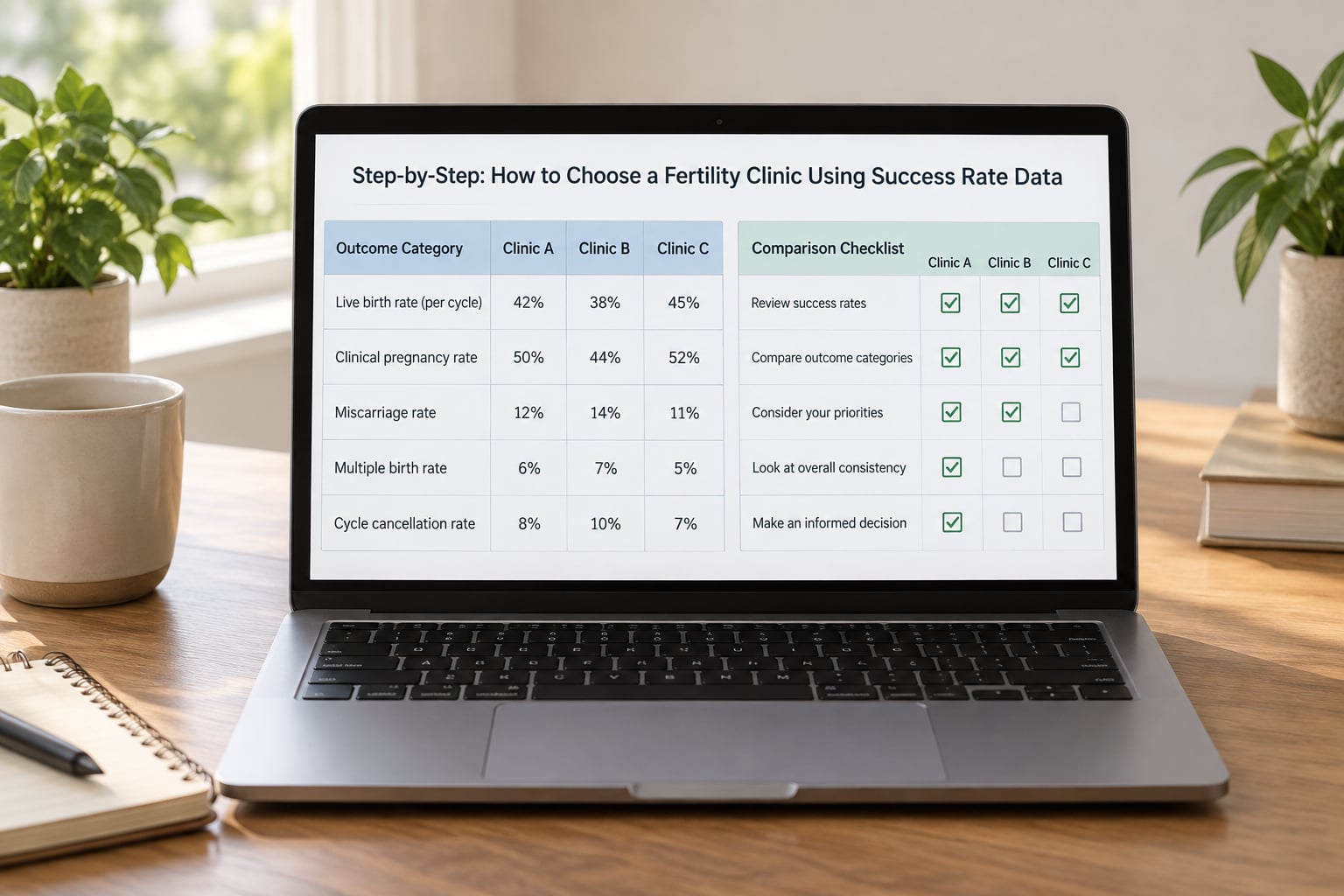
Seven steps, in order. The first three are pure data work and should take an evening. The last four involve people, and they matter at least as much.
1. Decide what counts as success for your treatment
Clinical pregnancy, implantation, and live birth are three different measurements, and clinics sometimes lead with the one that looks best. Live birth is the one that should drive your decision, because it is the only one that represents the outcome you actually want. Implantation rate and pregnancy rate both count pregnancies that may not continue, and a pregnancy rate quoted without a denominator can be made to look very impressive by counting early losses as wins.
Decide your endpoint before you look at any clinic. For most people starting IVF, it is a live birth from your own eggs, singleton if possible, per intended retrieval, in your age band.
2. Check whether the clinic reports the patient group that matches you
This is where most comparisons go wrong. Registries report outcomes stratified by age because age is the dominant driver of outcomes with own eggs, and SART states plainly that the age of the woman using her own eggs is the most important factor. If a clinic publishes one blended number across ages 24 to 44, that number tells you almost nothing about what will happen to you.
Look for breakdowns by age band, by treatment type, by own eggs versus donor eggs, and by fresh versus frozen embryo transfer. If a clinic’s report only shows its all-ages total, treat that number as a screening tool rather than a decision tool.
3. Compare live birth rates, and read the denominator
Here is the comparison table most clinic websites never give you. Use it to normalize two reports before you compare anything.
| Metric | What the denominator includes | What good looks like |
|---|---|---|
| Live birth rate per cycle started | Every cycle begun, including ones cancelled before retrieval | Lowest of the three rates; the most conservative read |
| Live birth rate per intended egg retrieval | Every retrieval that was intended, including those that yielded no eggs | Preferred comparison metric; excludes retrievals cancelled before the procedure |
| Live birth rate per embryo transfer | Only cycles where an embryo was actually transferred | Highest of the three; flattering on its own and misleading alone |
| Cumulative live birth rate | All transfers from one stimulation across a full treatment | Closest to the per-patient view; partly dependent on how many cycles a clinic pushes |
| Multiple birth rate | Births involving more than one baby, as a share of all live births | Lower is better; twin and higher-order pregnancy carries real obstetric risk |
| Single embryo transfer rate | Transfers of one embryo, as a share of all transfers | Higher is better; evidence of safety discipline, not timidity |
A worked example makes the distortion concrete. Clinic A reports 68% live birth per transfer. Clinic B reports 49% per intended retrieval. On a headline chart, Clinic A looks far better. But if Clinic A transfers fewer embryos per cycle and refers more patients, and Clinic B is counting the full intention to treat including difficult retrievals that produced no eggs, then the honest comparison is Clinic A’s per-retrieval number, which may sit much closer to Clinic B than the first comparison suggested. Both clinics reported accurately. The comparison was the error.
Never place a per-transfer figure next to a per-retrieval figure in the same spreadsheet column. It is the most common mistake I see patients make, and it is the one the registry’s own materials exist to prevent.
4. Look for transparent methods and recent data
A report is only as useful as its method. Check whether the clinic or registry states how the data were collected, whether canceled cycles are counted or quietly removed, and which outcomes are excluded. All three of those choices can move a published number by many points.
Check the reporting year and make it identical on both reports you are comparing. A clinic that has improved for three consecutive years will still look worse than a declining clinic if you compare its current year to the other one’s best year. Three years of trend is more informative than one number, and a clinic moving in the right direction deserves more weight than a clinic flat at a high number.
SART and CDC data can also differ for the same clinic. CDC collects from all reporting clinics as a matter of federal regulation, while SART membership and reporting have their own scope and thresholds, so a clinic can appear in one registry and not the other, and the aggregates will not match exactly. If the numbers disagree, look at the reporting year and the age bands before assuming one of them is wrong.
5. Ask how the clinic handles patients like you
Published averages tell you what happened to a population. Your question is what will happen to you. Ask the physician directly, with your own numbers on the table.
Useful questions: What is the live birth rate per retrieval for my exact age band with my own eggs? How many of those cases had my diagnosis? What protocol would you start me on, and why? How many cycles do you do in a year, and how many of those are in my situation? Who would actually do my egg retrieval and my transfer? What happens if a cycle is cancelled mid-way, and does that change my per-retrieval denominator?
Two more that get skipped: how do you handle PGT-A, and what do you do with a euploid embryo that does not implant? PGT is genuinely contested, and understanding a clinic’s stance on it tells you more about how they counsel than any brochure does.
Note how they respond. A physician who says “our overall number is excellent, we will talk about your specific numbers at your consult” is telling you the report will not help you. That is a normal answer, but it is an answer.
6. Weigh cost, communication, and service alongside results
Outcomes data is one column of a much wider worksheet, and the other columns determine whether you can actually complete treatment. Ask for a written estimate covering the full arc: consultation, retrieval, transfer, medications, PGT, and frozen storage, plus what happens to the estimate if you need a second cycle. Ask specifically what is covered by insurance and what is not, since pharmacy and lab fees are the usual surprises.
Then look at the human logistics. Who answers the phone on a Sunday? How long is the wait for a return call, and what is the protocol for an urgent one? How many patients does your physician carry? How quickly do they respond to an email with a question? Patients on r/IVF describe the core tradeoff plainly: large group practices offer higher cycle volume and broad lab resources, while smaller practices offer more physician facetime, and the right clinic on paper is not always the right clinic logistically.
Volume is a legitimate data point in its own right. More than roughly 200 IVF cycles a year is a commonly cited threshold for maintaining lab skill, and clinic blogs that rank themselves are not a neutral source for that number. Lab benchmarks are more checkable than outcome rates, and you can ask for them directly: fertilization rate, blastocyst conversion rate, thaw survival rate, and how many cycles the embryologist handles.
7. Build a shortlist and get a second opinion
Narrow to two or three clinics and score them on the same criteria in writing, so you are comparing records rather than memories. Weight treatment-specific live birth rate highest, then transparency about methods, then communication and access, then logistics. Ask each finalist the same questions in the same order, and write the answers down while you are still in the parking lot.
Then get a second opinion from a clinic you are not considering, and specifically ask that physician to review the first clinic’s data with you. A second opinion is also the natural answer if you are reconsidering mid-cycle, though moving clinics mid-stimulation usually means restarting, so ask about preserving anything transferable before you decide.
If a clinic discourages you from pulling its registry data or comparing it to a competitor, that reaction is itself data. Transparency is the norm, not the exception.
Common Mistakes When Comparing Fertility Clinic Success Rates
Comparing percentages without denominators. Two numbers, two completely different questions. The fix is mechanical: before anything else, write the denominator next to every number you copy down.
Chasing the highest single figure. The clinic with the highest per-transfer rate is not the clinic most likely to get you a baby, and is often not the clinic you want. Use the conservative metric first, then see whether the flattering metric adds anything.
Reading an all-ages blend. An average across a 20-year age span tells you about a fictional patient. Read the age band, the treatment type, and the egg source.
Ignoring patient selection. A clinic that declines patients above an age cutoff or with complex diagnoses will post excellent numbers precisely because of who it turns away. Ask what they do not treat, and how that shapes the denominator.
Trusting a single year. Small clinics swing hard year to year. If a clinic runs 40 IVF cycles a year and gets 24 live births, one extra birth moves the rate by about four points; the same single birth at a clinic running 2,000 cycles barely registers. A 5-point difference between two low-volume clinics is noise, not signal.
Treating a clinic’s rate as your forecast. Even a well-matched, honestly reported number describes a group. Your outcome depends on your age, your diagnosis, your protocol, and things nobody has published.
Skipping the UK data if you are outside the US. If you are in the UK, the HFEA publishes per-clinic comparison data calculated in a standardized way across the whole network, and it is the equivalent resource to SART or CDC. The habit of checking an independent registry is the same; only the name changes.
Frequently Asked Questions
Is there a 100% success rate for IVF?
No. No treatment produces a guaranteed result, and any clinic or source claiming 100% is either describing a single patient, quoting a rate for a narrow and flattering subgroup, or not measuring outcomes the way registries do. What you can evaluate is how a clinic performs in a patient group that resembles you, reported through an independent registry using standardized definitions.
Which IVF clinic has the best success rate?
There is no single best clinic, and any ranking that names one is telling you about patient selection rather than care. SART is an outcome registry built for reporting and for identifying clinics that fall outside expected ranges, not for crowning a winner. Compare clinics on treatment-specific live birth rates per intended retrieval, in your own age band, for the same reporting year.
What fertility treatment has the highest success rate?
Outcomes are reported per treatment, and they are not comparable without an age breakdown. Own-egg IVF in younger patients generally reports the highest live birth rates, while donor egg IVF reports high rates across a wider age range because egg age is constant. IUI and egg freezing report on entirely different bases. Compare like with like: same treatment, same age band, same denominator.
Does IVF success rate depend on age?
Yes, and age is the single strongest predictor when you are using your own eggs. SART identifies the age of the woman using her own eggs as the most important factor in outcomes. The effect is large enough that an all-ages clinic average tells you little about your own odds, which is why you should read the age band rather than the headline.
Why is PGT testing controversial?
The controversy centers on evidence. Preimplantation genetic testing for aneuploidy can identify embryos that appear chromosomally abnormal, but studies have not consistently shown that transferring fewer embryos this way improves cumulative live birth, and some analyses suggest it may reduce it. A clinic that can explain its indication criteria, its laboratory accreditation, and its evidence base is a clinic that has thought carefully about it.
Can I sue a fertility clinic?
Patients do bring claims, and outcomes alone rarely support one. Suits more often concern informed consent, negligent handling of donors or specimens, billing disputes, or a treatment decision made without disclosure of known risks. Keep every consent form, invoice, and written communication, and raise concerns with the clinic and your state medical board before pursuing legal advice.
Conclusion
Start with the treatment-specific live birth rate per intended egg retrieval, in your own age band, from the same reporting year on both reports, and write the denominator next to every number. Compare two or three clinics on those figures plus transparency, then weigh cost, access, and communication with the same seriousness. Finally, ask a reproductive endocrinologist to review the data with you, because no published percentage predicts your individual result. This article is for education only and is not a substitute for medical advice from your own physician.