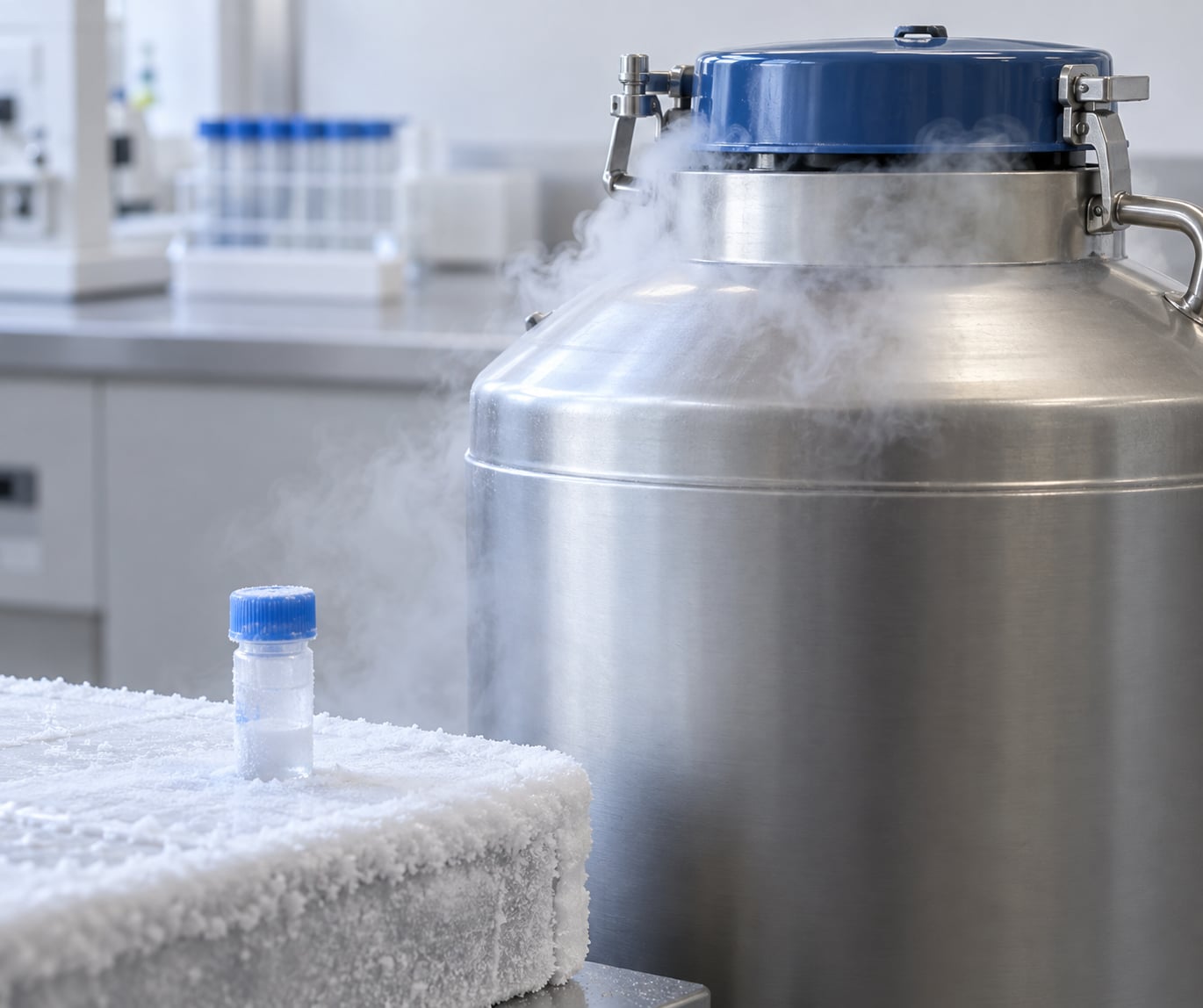
Frozen eggs that were vitrified and stored in liquid nitrogen can stay viable for years, and the time they spend in storage is not what decides your odds. What decides them is your age when the eggs were frozen, how many eggs you stored, and the quality of those eggs on the day they were retrieved. Here is the short version of how long frozen eggs last and success odds in practice.
The rest of this guide breaks the answer into the pieces people actually need: survival after thaw, fertilization and embryo development, implantation, and the live birth rate that ultimately matters. It also explains why a 90 to 97 percent survival figure and a much lower live birth figure are both accurate, and what to ask a clinic before you spend money on storage.
Table of Contents
- How Long Frozen Eggs Last and Success Odds at a Glance
- How Long Do Frozen Eggs Last?
- Does Freezing Eggs Make Them Last Indefinitely?
- What Are the Success Odds for Frozen Eggs?
- Why Does Age Matter More Than Storage Time?
- What Can Affect Frozen-Egg Success Rates?
- How Clinics Report IVF With Frozen Eggs
- What Questions Should You Ask Your Fertility Clinic?
- Frequently Asked Questions
- Can frozen eggs be stored for 10 years or more?
- Are frozen eggs less likely to succeed than fresh eggs?
- What is the usual survival rate after frozen eggs are thawed?
- Does the age of the egg matter more than how long it is frozen?
- What is the live-birth success rate using frozen eggs?
- How many frozen eggs should I have for one child or more than one?
- What to Do First
How Long Frozen Eggs Last and Success Odds at a Glance
| Question | Short answer |
|---|---|
| How long can frozen eggs be stored? | Years. Properly vitrified eggs show no meaningful quality loss from storage duration alone. |
| Does storage time change viability? | No measurable effect, as long as the tank, the records, and the freeze protocol are sound. |
| Do all eggs survive thawing? | Meta-analyses put survival in the 90 to 97 percent range with modern vitrification. |
| Does a surviving egg become a baby? | Not automatically. Roughly 18 percent of frozen eggs result in a live birth. |
| What drives success odds most? | Age at freezing, number of mature eggs stored, sperm quality, and uterine health. |
| Are frozen eggs as good as fresh ones? | Published randomized trials say vitrified eggs perform on par with fresh eggs. |
| Realistic outcome range? | About 70 percent live birth when eggs are frozen under 38 with 20 or more eggs, dropping to roughly 33 percent at 41 and older. |
One number to keep in mind while you read the rest: a survival rate is a laboratory measurement, and a live birth rate is the outcome you care about. Mixing them up is how people end up with a very wrong picture of their own chances.
How Long Do Frozen Eggs Last?
They can be stored for as long as you are willing to keep paying the annual storage fee. Vitrification flash-freezes each egg so quickly that ice crystals never form inside the cell, and the egg is then held at minus 196 degrees Celsius in liquid nitrogen. At that temperature, the biological processes that degrade cells essentially stop.
Clinics do not promise indefinite viability, and that is a reasonable position rather than a marketing dodge. Storage agreements usually run in one to five year terms, because that is how liquid nitrogen systems, backup power, and laboratory staffing are actually organized. Some countries cap how long eggs can be held. Switzerland, for example, has a ten-year legal limit, and after that stored eggs are typically discarded.
Four practical factors shape how long your specific eggs remain useful.
- Freeze quality. Egg maturity, the protocol used, and how quickly the embryologist works after retrieval all matter more than the calendar.
- Storage conditions. Liquid nitrogen levels, temperature monitoring, and power redundancy are the laboratory’s job, and worth asking about.
- Laboratory records. Accurate inventory, consent documentation, and chain-of-custody records determine whether your eggs are findable and usable years later.
- Thaw handling. Thawing is the moment most of the risk lives, and it happens in the laboratory on the day of your cycle, not during storage.
Storage fees accrue annually whether or not you use the eggs, so the practical deadline is often financial rather than biological.
Does Freezing Eggs Make Them Last Indefinitely?
Indefinitely in the technical sense, yes. Indefinitely as in a 100 percent chance of a healthy embryo, no, and never was.
Being technically viable means the cell survived the freeze and thaw and can be fertilized. Producing a healthy baby requires much more: the egg has to carry a normal chromosome set, fertilize, divide cleanly for five days into a blastocyst, implant into a receptive uterine lining, and sustain the pregnancy.
Two factors do most of the damage before an egg ever reaches the freezer. The first is age, which is covered in more detail below. The second is egg quality at the time of retrieval, which depends on ovarian reserve, stimulation response, and how many mature eggs came out of the retrieval rather than how many follicles were counted on the scan.
What Are the Success Odds for Frozen Eggs?
Success is a chain, and each link is a separate percentage with its own denominator.
- Thaw survival. The share of eggs that come through warming intact and fertilizable. Meta-analyses of modern vitrification put this in the 90 to 97 percent range.
- Fertilization. Fertilization after intracytoplasmic sperm injection, where a single sperm is injected into each thawed egg, is typically high but not universal.
- Blastocyst development. The share that grow for five days in culture. This is where egg quality starts showing.
- Implantation. Whether the embryo embeds in the uterus. Age at freezing influences this step heavily.
- Clinical pregnancy. A heartbeat-confirmed pregnancy. Clinics often quote this one because it sounds better than the next number.
- Live birth. The outcome that actually matters, and the one to compare against your own decision.
| Factor | Effect on thaw and fertilization | Effect on implantation and live birth |
|---|---|---|
| Age at egg freezing | Minor | Strong |
| Number and maturity of stored eggs | Sets the ceiling for how many attempts you get | Strong, through cycle count |
| Pre-freeze egg quality | Moderate | Strong |
| Sperm quality, own or donor | Strong | Moderate |
| Embryo testing | None directly | Moderate, by selection |
| Uterine health and transfer protocol | None | Strong |
| Laboratory and clinic experience | Moderate | Moderate |
Notice the pattern. Storage and thawing sit at the top of the chain and are largely solved. Almost everything that moves your real chances sits further down.
Why Does Age Matter More Than Storage Time?
Because aging changes the egg itself, and a frozen egg pauses that clock rather than reversing it.
Chromosome separation becomes less reliable as a woman ages, so a rising share of eggs and embryos carry an abnormal number of chromosomes. Aneuploidy is the main reason eggs stop producing viable embryos, and it is also the main reason pregnancy loss increases with maternal age.
The sequence is consistent. Older eggs produce fewer blastocysts, fewer of those embryos implant, and more of the pregnancies that do begin do not continue. The age you were when you froze is the age written into those eggs permanently.
That makes freezing earlier a materially better starting point than freezing later, even for the same person with the same ovarian reserve. It is also why many specialists push AMH blood testing and antral follicle counting before anyone commits to a retrieval, since those results estimate how many eggs a retrieval is likely to yield.
What Can Affect Frozen-Egg Success Rates?
Beyond age, here is the list worth taking into a consultation.
- Number of mature eggs retrieved. This sets how many transfer attempts you can realistically make. A retrieval that yields 6 mature eggs and one that yields 15 are very different propositions.
- Stimulation protocol. Individualized dosing tends to produce better-quality cohorts than one-size-fits-all protocols.
- Thaw method. Vitrification and thawing protocols vary between laboratories, and thaw survival is a real laboratory skill.
- Sperm source. Both partner and donor sperm affect fertilization and embryo development, and sometimes genetic testing is recommended.
- Embryo testing. Preimplantation genetic testing can identify chromosomal issues before transfer, though it adds cost and requires discussion of what you would do with the information.
- Transfer strategy. Single embryo transfer versus transferring more, and whether the transfer is fresh or frozen, both change reported rates.
- Uterine health. The age of the person carrying the pregnancy affects implantation and loss rates on its own terms, separately from the eggs.
- Whether a second retrieval makes sense. If the first cycle underperformed, some people do a second stimulation before using anything.
One number clinics rarely lead with: only about 5 percent of people who freeze eggs ever use them. Many get pregnant naturally, change their minds, or simply never need them. That is a reasonable outcome, but it is worth pricing into the plan.
How Clinics Report IVF With Frozen Eggs
Published success statistics are useful, and they are also easy to misread. The denominator is everything.
A rate quoted per thawed egg answers a different question than a rate quoted per transfer, and a per-transfer rate answers a different question than a per-cycle rate. Clinics often lead with clinical pregnancy rate, which is higher than live birth rate. National registries such as SART in the United States and HFEA in the United Kingdom publish age-banded figures that use consistent denominators, and those are the ones to compare across clinics.
Two habits help. Ask for the denominator every single time, and ask for live birth rate rather than pregnancy rate when both are offered. A 39 percent overall success rate across all ages sounds very different from a 51 percent best-case figure for one narrow group, and both can appear in the same study.
None of these percentages is a prediction about you. They describe groups of people, and the individual spread inside any group is wide.
What Questions Should You Ask Your Fertility Clinic?
A good consultation is short and specific. These are the questions that get you useful answers.
- What is my expected number of mature eggs per retrieval, based on my AMH and antral follicle count?
- What are your thaw survival rates for your own laboratory, broken down by my age group?
- Given my age at freezing, how many eggs would you want stored for one child, and for two?
- Do you offer preimplantation genetic testing, and what would you recommend for my situation?
- What does a full cycle cost including medication, monitoring, retrieval, and annual storage?
- What happens to eggs I never use, and what are my options under local law?
- Which of your numbers would you be comfortable putting in writing?
If a clinic cannot answer the first two with specific figures, that tells you something useful.
Frequently Asked Questions
Can frozen eggs be stored for 10 years or more?
Vitrified eggs stored in liquid nitrogen can remain technically viable for a decade or longer, and storage duration alone has not been shown to reduce egg quality. Practical limits are financial and legal rather than biological. Annual storage fees accumulate, and some countries cap storage periods, such as the ten-year limit in Switzerland. Ask your clinic about storage terms and local law before committing to a long plan.
Are frozen eggs less likely to succeed than fresh eggs?
No, not with modern vitrification. Published randomized trials comparing vitrified eggs with fresh eggs have found comparable clinical and live birth outcomes, closing the gap that existed with older slow-freezing methods. The results still reflect the age at freezing. An egg frozen at 38 performs like an egg from 38 whether it was thawed that month or five years later.
What is the usual survival rate after frozen eggs are thawed?
Meta-analyses of modern vitrification report survival rates in the 90 to 97 percent range, though individual laboratories vary more than the headline figure suggests. Ask your clinic for its own thaw survival data by age group, and ask what it counts as a survival: an intact cell, or a fertilized embryo that went on to form a blastocyst.
Does the age of the egg matter more than how long it is frozen?
Age matters considerably more. The age at which eggs are frozen affects chromosome quality, which influences embryo development, implantation, and miscarriage risk. Storage duration does not meaningfully change a vitrified egg. Two identical eggs frozen from the same retrieval will behave the same way whether one is used in a year and the other in a decade.
What is the live-birth success rate using frozen eggs?
It depends heavily on age and egg count. Around 70 percent is often cited for women under 38 who stored 20 or more eggs, dropping to roughly 33 percent at 41 and older. Across all ages, studies report about 39 percent overall. Per frozen egg, the figure is far lower, around 18 percent, which is why the number of eggs stored matters so much.
How many frozen eggs should I have for one child or more than one?
Specialists commonly suggest somewhere around 20 to 30 eggs for one child if you freeze before 35, and considerably more if you freeze later or want more than one child. Because per-egg live birth rates fall with age, later freezing means needing a larger number. Your AMH and antral follicle count results are the best starting inputs for estimating your own realistic target.
What to Do First
Book a consultation with a reproductive endocrinology clinic and ask for individualized counseling built around your own numbers. Bring your age, your family history, and any prior AMH or antral follicle count results, and leave with the clinic’s own age-banded outcome data rather than a general statistic.
When you do that, plan around the age and quality of the eggs in storage, not around a universal storage deadline. There isn’t one. Storage time barely appears in the equation; age at freezing, egg number, and the health of the uterus carrying the pregnancy do nearly all of the work. This article is general information, and your own numbers and options are a conversation for your care team.