To figure out if you have diastasis recti, lie on your back with your knees bent and feet flat, place two fingers vertically on your belly button, and lift your head and shoulders a few inches. If your fingers sink into a soft gap between the two halves of your abdominal muscle, you have found a separation along the linea alba, the connective tissue strip running down your midline.
That check takes about two minutes. It tells you what your fingers can feel, which is useful information, but it is a screening step and not a diagnosis. A clinician watches how your midline behaves under load before anyone can tell you what it means for your body.
Below is the five-step version I would want a new postpartum client working through, what to write down at each step, and the moments when a home result should send you to an exam room rather than a search bar. It takes five minutes of setup and about two minutes of checking, and you can do it while the baby naps.
Table of Contents
- What You Need
- Step-by-Step: How to Tell If You Have Diastasis Recti
- Get Into the Right Position
- Prepare Your Hands and Abdomen
- Measure the Gap at Multiple Points
- Check Your Breathing and Core Engagement
- Record and Interpret the Result
- Common Mistakes
- When a midline bulge is not diastasis recti
- Frequently Asked Questions
- How many fingers wide is diastasis recti?
- Should I check diastasis recti at the navel or above it?
- Does doming mean I have diastasis recti?
- Can diastasis recti go away after giving birth?
- Should I stop exercising if I think I have diastasis recti?
- When should I see a doctor or physical therapist about diastasis recti?
- Conclusion
What You Need
You need a flat surface and your own hands. That is genuinely the whole list.
- A flat surface. A bed, a floor mat, or a firm couch cushion all work, as long as you can lie flat and stay still for two minutes.
- A pillow. One under your head and one under your knees takes the arch out of your lower back and makes the midline easier to feel.
- Two clean, dry fingers. Your index and middle finger become the measuring unit. Most people stop at two, so you cannot go wider than your reference.
- Something to write on. A phone note or a scrap of paper, because you will check three points and you will want to remember the widest one.
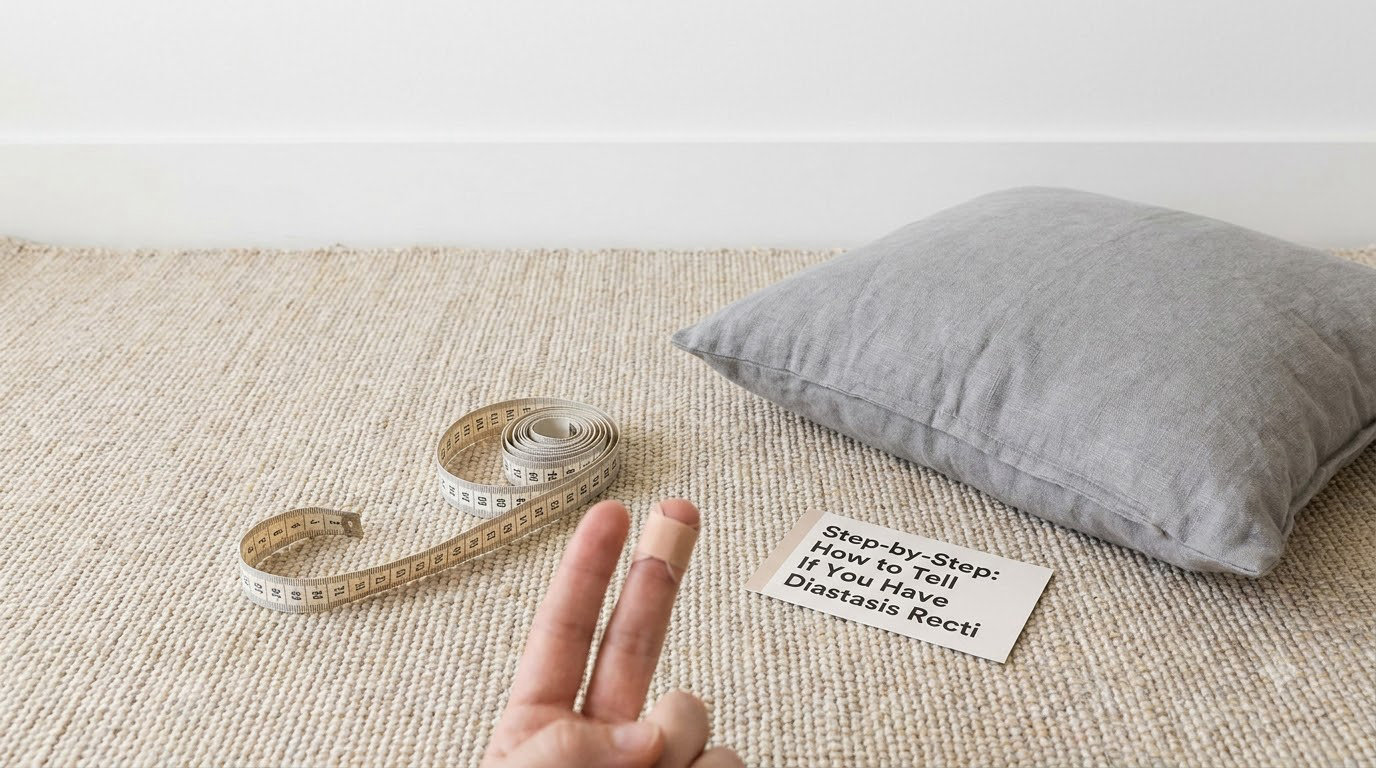
- Optional: a measuring tape. If you want the gap in centimetres so you can compare it side by side with an ultrasound later.
Two things this check is not. It is not a pelvic floor assessment, and it does not grade severity. A lot of the confusion people find online comes from treating a finger-width as a verdict, when the same gap feels very different depending on how deep it is and whether the tissue can create tension when you engage.
This check is also not limited to new parents. Abdominal surgery, rapid weight change, chronic constipation or coughing, and years of heavy lifting can all create the same separation, and it is worth knowing the steps if you have had any of those.
Step-by-Step: How to Tell If You Have Diastasis Recti
Get Into the Right Position
Lie on your back with your knees bent and your feet flat on the surface, roughly hip-width apart. Rest the pillow under your head and the second pillow under your knees so your spine settles into a comfortable neutral position rather than arching upward.
Keep your neck long. Looking down at your own belly while craning is the thing that makes this check uncomfortable for most people, and if the position is working, your neck and jaw stay relaxed. If the set-up feels like a lot, the test is still valid, it is just less pleasant.
Prepare Your Hands and Abdomen
Wash and dry your hands. Lay your index and middle finger together, point your fingertips straight down at the midline, and rest them on your belly button with the pads of the fingers vertical to the skin, not along it.
Before you press anywhere, pause and notice what your belly feels like on its own. Is there a ridge, a soft channel, a bulge? Is the area tender, numb, or just unfamiliar? Writing that down first means you are comparing two things later, instead of trying to remember how it felt after you have been pressing for a minute.
Measure the Gap at Multiple Points
Press down gently into the midline and move your fingers side to side, the way you would feel for a seam in a pair of trousers. Count how many fingers fit into the channel before you hit firm muscle on either side. That count is your width.
Do this in three places: at the belly button, about two inches above it, and about two inches below it. Most people assume the navel is the worst point, and roughly a third of the time it is not. The widest measurement of the three is the one worth writing down, and the location matters as much as the number.
While your fingers are there, note two more things: how deep they sink, and what the tissue feels like. A shallow dip that stops quickly feels different from a narrow channel that swallows your fingertips to the second knuckle.
Check Your Breathing and Core Engagement
Keep your fingers in place and breathe out slowly and gently. As you exhale, draw the midline inward by a small amount, the way you would brace very lightly before someone hands you a full mug of coffee. Not a hard brace, and do not hold your breath.
Notice what happens to the gap. If it narrows and the tissue underneath feels firmer and more springy, your abdominal wall is generating tension across the midline. If the channel stays exactly the same width and just as soft while you engage, that is useful information, and it is the finding most often missed by people who only measure width.
Then release, curl your head and shoulders up a few inches with your fingers still resting on your belly, and look down at your midline. A ridge running up the centre is called coning or doming, and it happens when the line of tissue between the muscles bulges outward under pressure.
This step tells you how your midline behaves, not how your pelvic floor is working. The two systems share load with your diaphragm and your back, and only a trained clinician can assess the whole picture.
Record and Interpret the Result
Write down four things for each of the three points: the width in finger-widths, the depth, the feel of the tissue at rest and under gentle engagement, and whether coning appeared when you curled up. Then add the symptoms you have noticed over the past weeks, not just today.
| What you found | What it usually suggests | What to do next |
|---|---|---|
| Under one finger, feels firm when you engage, no coning | Within the range most clinicians consider typical | Nothing to chase. Keep training as you are. |
| One to two fingers, tissue still responds to engagement | A small separation that is managing pressure | Worth mentioning at your next clinical visit, especially with symptoms. |
| Two fingers or more, or the gap stays open and deep under engagement | A wider or deeper separation that deserves a proper assessment | Book a pelvic health physical therapy evaluation. |
| Any width, with leaking, pelvic pressure, pelvic pain, or back pain | Function matters more than the number | Do not use the finger count to decide whether your symptoms are real. |
| Any width, with a lump near the belly button that pushes in and comes back | Possible umbilical or ventral hernia rather than diastasis recti | See a clinician rather than re-testing at home. |
Depth is the number people skip. A narrow gap that lets your fingers sink in deeply and stays there while you engage tells a different story from a wide, shallow one that closes the moment you brace. That is why pelvic health physical therapists usually measure both and write down what the tissue can do, not only how many fingers fit.
If you are not postpartum, the same log still works. Note what your abdominal surgery or loading history was, and take the log to your clinician rather than searching for a number online.
Common Mistakes
Almost every confusing result I have seen came down to one of these six.
Pressing too shallow. If your fingers only dimple the skin, you will measure almost nothing and then doubt a real finding. Sink until you feel the firm edges of the muscle on both sides, using a light, slow pressure rather than a shove.
Only checking at the belly button. The navel is the easiest point to find and not always the widest one. Measure above and below it before you decide anything.
Turning a finger count into a severity grade. A two-finger gap is not automatically a serious one, and a one-finger gap that stays soft and deep while you have pelvic pressure symptoms is not automatically fine. Width alone is a screening data point, not a diagnosis.
Fingers along the midline instead of across it. Laying your fingers flat along the belly gives you a number of centimetres and tells you almost nothing about the channel. Point the fingertips down into the seam.
Confusing pelvic floor symptoms with an abdominal gap. Leaking when you cough, pelvic heaviness, painful sex, and tailbone pain are pelvic floor problems, and they can be present with a perfectly normal abdominal check. Equally, a big gap and a pelvic floor problem are two separate findings that two separate specialists may need to look at.
Treating a home check as a diagnosis. You cannot assess tension under real load, you cannot see fascia, and you cannot rule out a hernia by feel. The test tells you whether it is worth booking an appointment.
When a midline bulge is not diastasis recti
If your fingers find a distinct lump rather than a channel, that is a different conversation. Forum threads mix these two constantly, and the difference matters because a hernia is assessed medically rather than rehab-style.
| Feature | Diastasis recti | Umbilical or ventral hernia | Linea alba thinning |
|---|---|---|---|
| What you feel | A channel between two muscle edges | A localised bulge or lump, often at or near the navel | A flat or slightly soft midline, no distinct edges |
| Location | Anywhere from above the navel to the pubic bone | Usually at or just above the belly button, or at a surgical scar | Along the midline between the muscle borders |
| Pain | Often none | May be painless, or ache, burn, or drag | Usually none |
| On coughing or straining | Channel may widen | Lump may push out further and return afterwards | Little change |
| Next step | Pelvic health PT, exercise modification | Clinician review, sometimes imaging or surgical opinion | Often monitored alongside core function |
Red flags that mean stop self-testing and get seen: a lump that cannot be pushed back in, one that is growing, one with pain, bleeding, or discharge, or any midline bulge that appears alongside a surgical scar. Those are not questions for a finger test.
Two practical follow-ups close out the check. Re-test on the same surface, in the same position, at roughly the same time of day, so the numbers mean something next month. And write the log down, because a number in a notes app is far more useful to a pelvic health physical therapist than a sentence of memory.
Frequently Asked Questions
How many fingers wide is diastasis recti?
Most clinicians draw the line at roughly two finger-widths. A channel that stays under one or two fingers and feels firm when you engage gently is usually within the range they consider typical. What changes the picture more is depth and tone: a narrow gap that stays soft and deep while you engage is worth discussing, even when the finger count is low.
Should I check diastasis recti at the navel or above it?
Check all three points: at the belly button, about two inches above it, and about two inches below it. The navel is simply the easiest landmark to find, and for a lot of people the widest part of the separation sits above or below it. Record each point separately with the width, the depth, and whether the tissue responded to gentle engagement.
Does doming mean I have diastasis recti?
Doming, or coning, is a ridge or bulge that runs up the midline when you load your abdominal wall, such as sitting up or lifting your head and shoulders. It tells you the tissue between the muscles is bulging under pressure. It can happen with a modest gap or with a small one, so it is a useful sign to record rather than a diagnosis on its own.
Can diastasis recti go away after giving birth?
Many separations narrow on their own in the first year as the abdominal wall adapts and you rebuild tolerance for pressure. In one frequently cited study, roughly a third of women still had a measurable gap a year after birth, and many of those had no symptoms at all. A gap that persists alongside leaking, pressure, or pain is a different situation and deserves an assessment.
Should I stop exercising if I think I have diastasis recti?
No. Movement is not the cause, and stopping usually costs more than it gains. The more useful move is to adjust loading: ease off the exercises where the midline cones or bulges, keep breathing through lifts, and build up gradually. If you want clearance for running, heavy lifting, or impact work, a pelvic health physical therapist can test you properly rather than you guessing.
When should I see a doctor or physical therapist about diastasis recti?
Book an assessment if you have pelvic pressure, leaking, pelvic or back pain, or a midline lump, if your symptoms are not improving, or if you want to return to heavy lifting or running with confidence. A postpartum visit is also a reasonable moment to ask for a check, since many people are never screened. A lump that pushes in and returns needs a medical opinion, not a home test.
Conclusion
Run the check once, gently, on a flat surface with two fingers and a note to write on. Measure above, at, and below the navel, and write down the width, the depth, what the tissue felt like when you engaged, and whether anything coned.
Then treat that log as a prompt rather than a verdict. If your symptoms are settled and nothing bulged, you have your baseline. If you have leaking, pelvic pressure, pain, or a lump that pushes in and comes back, book a clinician and take the log with you.