If you have ever printed a CDC milestone checklist and watched your child fall just past the printed age, you know the knot in your stomach that follows. The short answer to why milestone ranges are wide and what that means: children reach the same skill on wildly different schedules, so charts draw a band around the middle of that spread instead of a single line. The upper endpoint is set deliberately at the 75th percentile, the age by which three quarters of children have done the thing. Nothing about that endpoint is a deadline your child was supposed to meet.
That distinction matters more than it sounds. A milestone chart is a screening tool, built from how groups of children behaved. It is not a test your child sits, and it cannot tell you about your child in particular. Understanding the mechanics is the fastest way to stop reading a chart as a verdict.
Table of Contents
- Why Milestone Ranges Are Wide and What That Means
- What Makes Children’s Milestones Differ?
- How are milestone ranges created?
- How Should Parents Use a Milestone Range?
- What Does a Milestone Range Not Tell You?
- When Should Parents Raise a Concern?
- What to do when your child sits outside the range
- How Can Parents Track Development Without Comparing?
- Frequently Asked Questions
- What are the signs that a baby might be developmentally delayed?
- What should I do if my 2-year-old is not meeting milestones?
- Are milestone ranges a deadline or a guideline?
- What does 75th percentile mean on a milestone chart?
- What is the 3-6-9 rule for babies?
- How do you tell a late bloomer from a real delay?
- What to Do First
Why Milestone Ranges Are Wide and What That Means
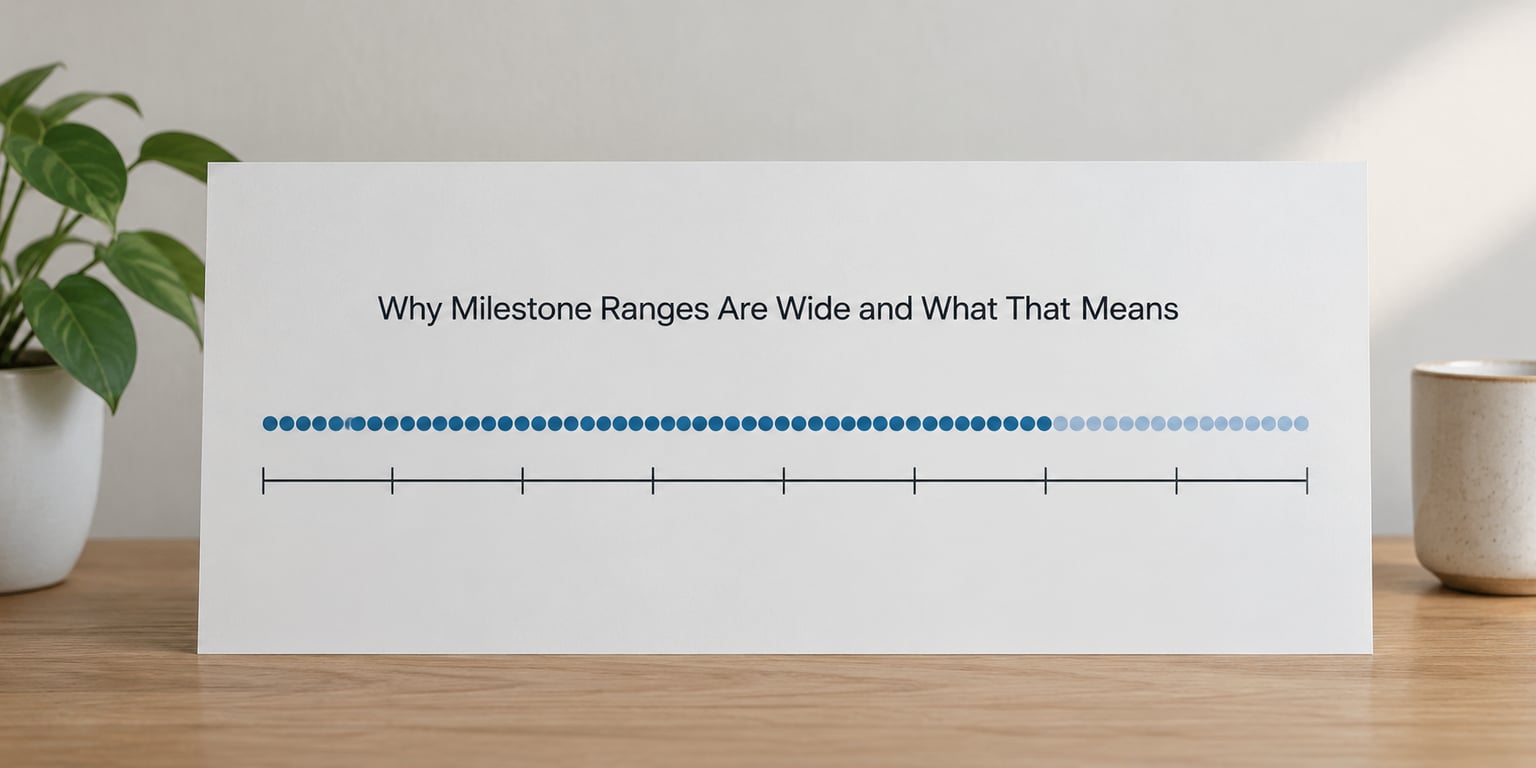
Three things combine to produce a band that spans several months. The first is plain biological variation in when a skill shows up. The second is the shape of the data: skill attainment is crowded toward certain ages and thins out at the edges, so any cut point leaves children on both sides of it. The third is a design choice. In 2022 the Centers for Disease Control and Prevention and the American Academy of Pediatrics revised the milestone checklists so that the listed age now means the point by which 75% of children have accomplished the skill, rather than 50%.
Picture 100 children at one age. Under the old standard, 50 of them were expected to have the skill, and the chart named the age where the middle child stood. Under the current standard, 75 of them are expected to have it. Twenty-five children are still working on it at that moment, and those 25 are not delayed, they are simply early. Raising the target from the median to the 75th percentile necessarily pushes the printed age later, which is why some milestone ages moved up when the revision landed.
| What the age endpoint means | Old standard | Current standard |
|---|---|---|
| Percentile of children expected to have the skill | 50th percentile | 75th percentile |
| Children still developing the skill at that age | About 50 of 100 | About 25 of 100 |
| How the age reads to a parent | The average child | Most children |
| Effect on the printed age | Earlier | Later |
| Implication for a child at the late end | Often a false alarm | Less often a false alarm |
One thing did not change: the revisions were not a response to pandemic-era delay. The evidence review behind the 2022 guidelines, published by Zubler and colleagues in Pediatrics as “Evidence-Informed Milestones for Developmental Surveillance Tools,” was completed in 2019. A lot of parents read the later ages online as proof that children were falling behind. They were not reading the source.
What the two endpoints can tell you is this: the early end of a band describes children who moved quickly through that skill, and the late end describes children who are still within the common range. What they cannot tell you is whether your child is on the early side of normal, the late side of normal, or outside it. That question needs a pattern, not a single line item.
What Makes Children’s Milestones Differ?
Development is not a single engine with one output shaft. It moves along several partly independent tracks, and the tracks run at different speeds in the same child. A toddler may have a large vocabulary and still be unsteady on stairs, and that mismatch is usually just a mismatch.
- Individual pace. Some children move quickly through early motor skills and slowly through language. Others show the reverse.
- Temperament. A cautious, watchful child often takes longer to try a new physical skill than a bold one who falls often and laughs about it.
- Environment and opportunity. Children get more practice at what is offered to them. Time on floors and open space supports movement; back-and-forth conversation supports language.
- Health and prematurity. Premature infants are usually assessed against a corrected age until roughly two years, which is the single biggest reason a family’s own chart looks off.
- How the skill is observed. Milestones are things adults can see or hear. A shy child who understands more than they say can look late on a checklist without being behind.
How are milestone ranges created?
Two sources feed the current checklists. The first is normative data: researchers observe large groups of children, record the age at which each skill appeared, and look at the distribution of those ages. The second is expert judgment. For social-emotional and cognitive items, the empirical data is thin, so panels of clinicians reviewed the evidence and set the age where a majority of experts agreed. That gap is real and it is worth knowing, because those domains are the ones most likely to shift in a future revision.
Panels then apply two rules of thumb. Where normative data exists, the age is placed at the 75th percentile. Where it does not, experts use judgment and consensus. The result is a practical tool, not a law of nature, and the AAP’s own materials describe the checklists as conversation starters for a well-child visit rather than instruments for diagnosing a child.
The revision also added 15-month and 30-month checklists, gave the youngest age bands more social and emotional items such as responding to a familiar name, and paired each age band with activities caregivers can use. The CDC material sits under Learn the Signs. Act Early, the AAP’s ongoing program on developmental surveillance.
How Should Parents Use a Milestone Range?
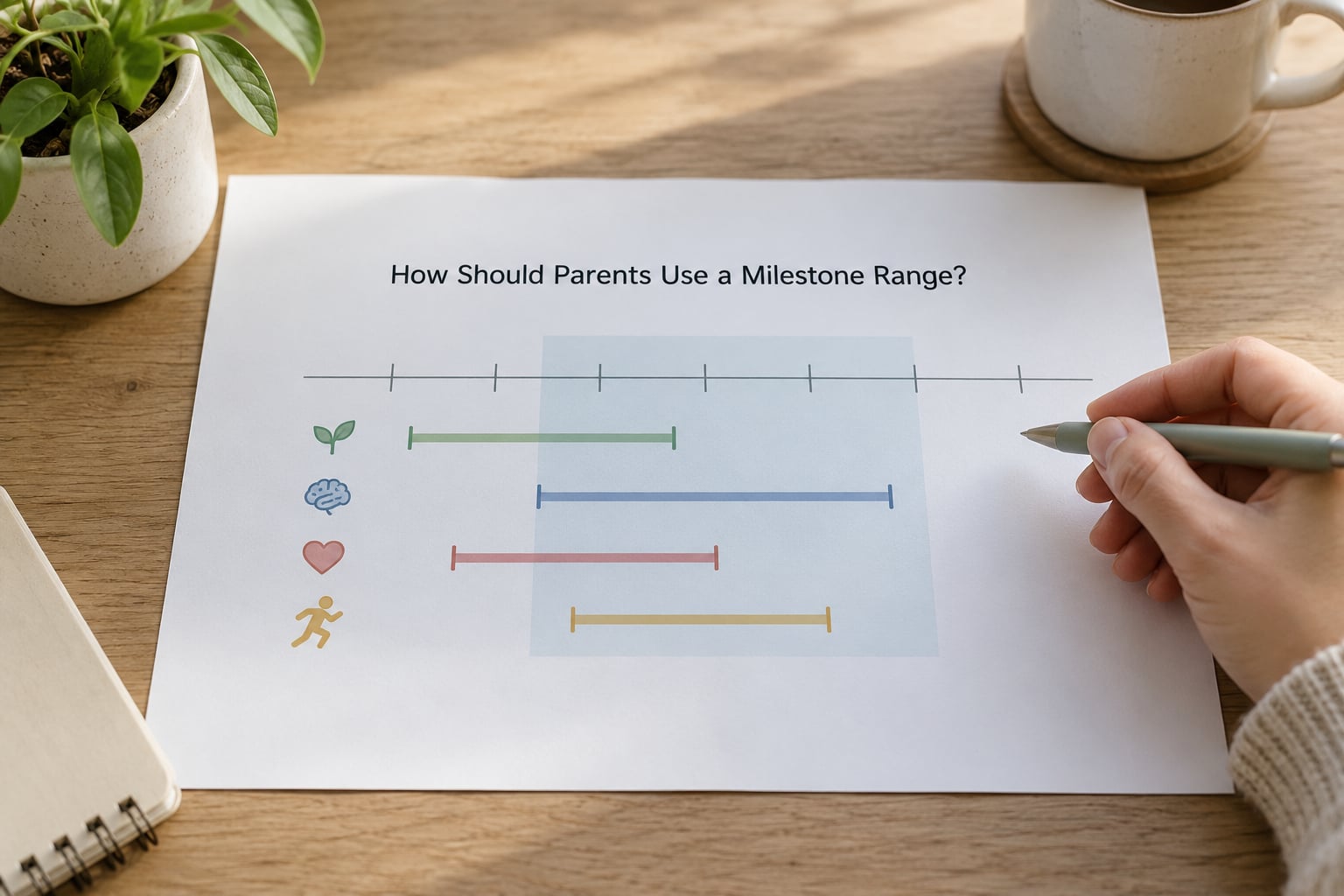
Treat a range as context, not as a target line. Here is the approach that works best after a sleepless night of chart-reading.
- Look at the trend, not the tick. A child who is adding words, gestures and new motor skills every month is moving, even if the chart says not yet.
- Judge the whole child. Look across all four areas, social-emotional, language and communication, cognitive, and movement. Concern rises when several areas stall at once, not when one item lags.
- Use corrected age if your child was premature. Count from the due date rather than the birth date when judging milestones, and keep doing so through the second year.
- Expect charts to disagree. Books, apps and clinic handouts are built from different sources and different years. The current CDC/AAP checklists are the reference; older charts will show earlier ages.
- Bring observations, not a verdict. A pediatrician finds a two-minute video far more useful than a parent reciting a checklist from memory.
What a wide range buys you is fewer false alarms. If the top of the band already includes three quarters of children, sitting near it is statistically unremarkable. What it costs you is sensitivity: a genuinely slow-moving child can hide inside a wide band, which is one reason clinicians use standardized screening in addition to checklists.
It also explains a confusing experience. Two families can read the same line, one child at the early end and one at the late end, and both are inside the range. Parents ask, reasonably, why development is tied to age at all when children clearly do not move on a single schedule. The honest answer is that age bands are the most practical unit a public-health system has for describing a group, not a claim about your child.
What Does a Milestone Range Not Tell You?
A checklist does not measure intelligence. It does not predict reading ability, math, temperament, or how a child will do at eight. It does not diagnose anything, including autism, speech delay, or ADHD, and a normal result on a checklist does not rule those conditions out either. It does not rank children against each other, because the charts were not built to do that.
It also does not capture asynchronous development, the very common pattern where one area runs ahead of another. A checklist item that is technically not met may simply describe the child’s slower track while ignoring the faster one.
Three different activities get conflated in this area, and keeping them straight helps. Developmental surveillance is the ongoing conversation at every well-child visit, where the clinician watches your child and listens to you. Developmental screening is a brief standardized check, usually at set visits such as 9, 12, 18 and 30 months, designed to catch children the conversation might miss. A diagnosis comes from a full evaluation and only a qualified clinician can make one. The milestone chart is part of the first, and it feeds the second when a concern appears.
When Should Parents Raise a Concern?
Concern is warranted when the pattern changes, not when a chart disagrees with you. Signs that deserve a conversation with your child’s doctor include a skill your child had and no longer does, little or no new progress over two to three months, difficulty with feeding or swallowing that is new, or a difference across several areas at once rather than a single lagging item. These are general patterns for parents to notice and raise, not criteria a parent should diagnose against.
Worry about timing is common enough that it has been surveyed repeatedly, and the surveys keep finding a large share of parents unsure whether their child is on time. The parent who reads that and then checks the chart is exactly the reader this guide is for.
What to do when your child sits outside the range
- Write down what you see. Specific behavior, date and setting beats a memory of a checklist three weeks later.
- Check for corrected age. If your child was premature, this alone may explain the gap.
- Give it two to four weeks of observation. Most skills arrive in bursts, and a short plateau is common. Set a reminder date rather than an open-ended wait.
- Raise it at the well-child visit, or sooner. A pediatrician can add a standardized screen such as an autism-specific or general developmental screener, which is more sensitive than a checklist.
- Ask about early intervention if needed. In the United States you can contact your state’s early intervention program directly without a physician’s referral, and in most states evaluation is available from birth to age three at no cost. Waiting is a legitimate choice for a child who is progressing, but it is not a requirement.
Ask for an evaluation rather than negotiating with a chart if a skill disappears, if you find yourself waiting several more months on your own, or if something about your child’s communication or interaction worries you steadily. Pediatricians would rather hear a concern that turns out to be nothing.
How Can Parents Track Development Without Comparing?
Keep a short written record or a private folder of short videos. Once a month, note one new thing your child did and one thing you offered them: a new word, a song, blocks, a chance to climb. This gives a pediatrician a real picture and gives you one too, which is more useful than any chart because it describes your child, not a group.
Development runs on ordinary, repeated interaction. Narrate what you are doing while diapering, dinner, and bath time, leave space for your baby to answer, and give floor time rather than always carrying. Caregivers with questions about specific activities can use the activities that come with the CDC checklists, and a parent who wants a second opinion can ask the practice for a developmental-behavioral pediatrics referral or a speech and language evaluation.
For anything specific to your child, talk with your pediatrician or another qualified clinician. This guide is general information about how milestone charts work, and it cannot assess an individual child.
Frequently Asked Questions
What are the signs that a baby might be developmentally delayed?
Look for changes in pattern rather than a single chart item. Signs that merit a conversation with a pediatrician include losing a skill your baby once had, little new progress over several weeks, new feeding or swallowing difficulty, limited eye contact or response to their name, and no gesture such as pointing or waving by around a year. A checklist is a screening tool, so only a clinician can assess an individual child.
What should I do if my 2-year-old is not meeting milestones?
Write down the specific behaviors you are not seeing, check whether your child was premature and therefore due a corrected age, and observe for another two to four weeks while offering plenty of play and language. Then bring it to your pediatrician rather than waiting for the next well-child visit. Ask whether a standardized developmental screen is warranted, and contact your state early intervention program directly if you want an evaluation, which does not require a physician referral.
Are milestone ranges a deadline or a guideline?
A guideline, and a statistical one. The upper age on a current CDC and American Academy of Pediatrics checklist means that 75 out of 100 children have that skill by then. About 25 children at that age are still working on it, which is normal variation rather than delay. A missed line item on a checklist is not a diagnosis, and it is not a reason to assume something is wrong.
What does 75th percentile mean on a milestone chart?
It means 75% of children in the reference group had that skill by the listed age. Since the 2022 revision, CDC and American Academy of Pediatrics checklists are set so that three quarters of children are expected to have the milestone, up from half under the old standard. That is why some printed ages became later. Roughly one child in four is still developing the skill at that point, which is why the range looks generous on either side.
What is the 3-6-9 rule for babies?
It is a popular parenting heuristic suggesting a schedule of adding play activities at three, six, and nine months, not an official CDC or American Academy of Pediatrics rule. Use it as a prompt to pay attention to what your baby is ready for, and to keep talking, singing, reading, and giving floor time. The checklists themselves pair each age band with activities, which is the guidance the organizations publish.
How do you tell a late bloomer from a real delay?
Look at whether skills keep arriving, even slowly. A late bloomer adds new words, gestures, or motor skills steadily across several areas, and responds to you. A concerning pattern is a plateau lasting more than about a month or two, a skill that disappears, or lack of progress in several areas at once. Only a pediatrician can make that judgment, and early evaluation is available without a referral, so there is little cost to asking.
What to Do First
Stop measuring your child against the printed age and start watching the pattern. A milestone range is wide because development is a distribution, not a schedule, and the age at the top of the band is a statistical line three quarters of children cross, not a finish line for your child.
Write down what you see, month by month, in a sentence or two. If skills keep arriving, keep offering play, talk, and reading, and raise the topic at the next well-child visit. If a skill disappears, if progress stalls, or if you simply cannot shake the feeling that something is off, contact your pediatrician sooner, and ask about screening and early intervention. The chart was never designed to answer those questions, and no parent should have to wait for it to.