
Birth equity means making sure every person can have a safe, healthy and respectful pregnancy, birth and postpartum period, no matter their race, income, immigration status, disability or zip code. It is not about individual choices. It is about repairing the systems that decide who gets listened to, who gets believed and who gets left waiting for care. That is what birth equity means, and here is why it matters now.
The phrase gets used loosely, so it helps to have a working answer before anything else. Below is the short version, then the longer explanation.
Table of Contents
- What Birth Equity Means and Why It Matters
- How Birth Equity Differs from Equal Treatment
- What Birth Equity Looks Like in Everyday Practice
- Prenatal care that reaches people before a crisis
- Labor and delivery where support is actually available
- Postpartum and fourth-trimester care
- Language access, disability accommodations and continuity
- Why Birth Equity Matters for Families and Communities
- What Birth Equity Does Not Mean
- How Individuals, Hospitals, and Policymakers Can Help
- What patients and support people can do
- What hospitals and care teams can change
- What policymakers and community organizations can do
- Frequently Asked Questions
- Is birth equity the same as giving every pregnant person the same care?
- Who experiences birth inequity, and why can it be hard to measure?
- How is birth equity related to maternal and infant mortality?
- What can a patient do if they experience disrespectful or discriminatory care?
- Does birth equity mean that hospitals should stop using race at all?
- How can communities support birth equity beyond individual healthcare choices?
- What to Do First
What Birth Equity Means and Why It Matters
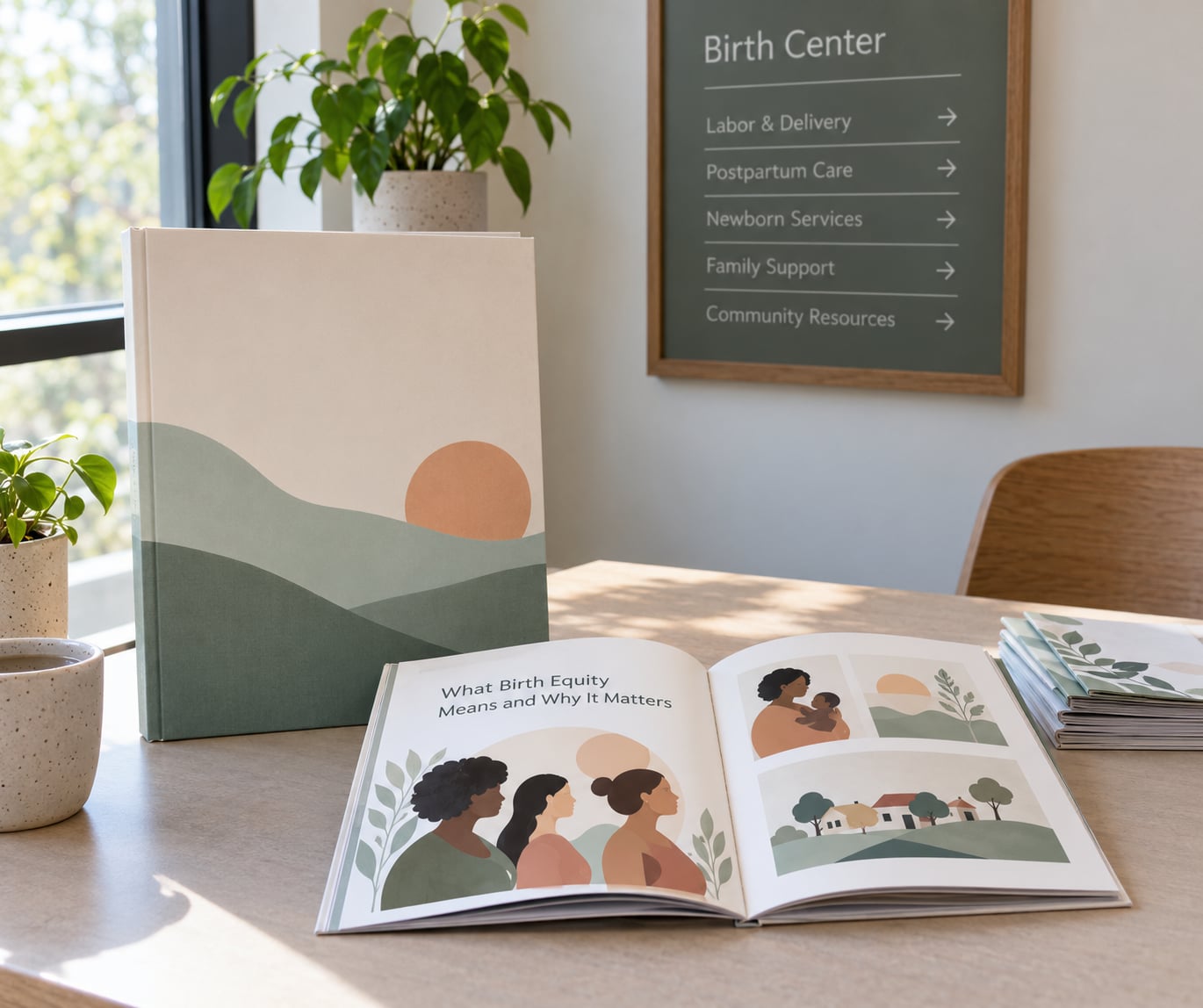
Birth equity is the condition in which pregnancy, childbirth and the postpartum period are safe, dignified and well supported for everyone. It asks a blunt question: if two people arrive at the same labor and delivery unit with the same medical need, why do they not get the same outcome? When the answer traces back to race, money, language, housing or who is believed, that is a system problem, and birth equity is the work of fixing it.
The term took shape in 2015, when Dr. Joia Crear-Perry founded the National Birth Equity Collaborative. The organization framed it as work on Black maternal, infant, sexual and reproductive wellbeing, and deliberately used the word equity rather than equality. That distinction turned out to be the whole argument. Giving everyone the same pamphlet does not give everyone the same chance.
Groups use the term with slightly different emphases. Some center autonomy and the right to birth without coercion. Some center access to a midwife or a birth center. The common thread is that outcomes should track the conditions a family is born into rather than their identity.
Several factors shape pregnancy and childbirth experience, often overlapping:
- Race and ethnicity, and how racism inside institutions shapes how symptoms are treated
- Income and insurance coverage, including how many postpartum visits are paid for
- Geography, especially distance from a delivery unit and public transit
- Housing and food security
- Immigration status and fear of interacting with systems
- Language access, whether a qualified interpreter is actually present
- Disability and the physical accommodations a hospital can or cannot provide
- Gender identity and whether a care team will treat a trans or nonbinary patient respectfully
Equitable conditions and inequitable conditions sit side by side in the same building, which is why the gap is easy to miss. The table below is the simplest way I know to show it.
| Dimension | What an equitable condition looks like | What an inequitable condition looks like |
|---|---|---|
| Communication | Symptoms are taken seriously and the plan is explained in plain language | Rough behavior is explained away as anxiety or stress |
| Support during labor | A doula, partner or trained support person can stay | Support people are removed or not allowed in at all |
| Language | A qualified medical interpreter is present in the room | A family member, often a child, is used to interpret |
| Postpartum coverage | Coverage continues for a full year after birth | Coverage ends at a few weeks with one visit included |
| Disability | Accommodations are arranged in advance | Accessibility is improvised during an emergency |
| Where you live | Care within a reasonable distance, with transport support | A two-hour drive with no ride and no way to pay for one |
How Birth Equity Differs from Equal Treatment
Equal treatment means everyone receives the same resource, the same instruction or the same policy. Equity means each person gets what they need to reach a comparable outcome. Those are different things, and pretending otherwise is how well-intentioned programs miss.
Consider pain support in labor. A hospital that tells every patient a support person may stay has applied equal treatment. A family in a small town who cannot afford a sitter, a night shift worker who cannot lose the hours, or an incarcerated patient who has no support person at all does not benefit from that equal policy. Equity asks a further question: can we fund a doula program for the patients who would otherwise be alone?
Postpartum care is the same story with harder numbers. Roughly one in five birthing people in California report prenatal or postpartum anxiety or depression, and rates are higher among Black birthing people and among Medi-Cal enrollees. Screening alone does not help if the referral list is empty or the appointment is a two-hour round trip. Equitable follow-up means transport, evening appointments and a therapy slot that exists before the patient is discharged.
Language access shows the same gap. Handing a patient an English discharge sheet is equal. Having a qualified interpreter call them at home the next day is equitable.
Neighboring terms cause plenty of confusion, so here is how the four differ:
| Term | Core question it answers | Typical focus |
|---|---|---|
| Birth equity | Is pregnancy, birth and postpartum safe and dignified for everyone? | Outcomes and access in maternity care specifically |
| Health equity | Does the whole health system work for everyone? | Every specialty, plus insurance, workforce and infrastructure |
| Birth justice | Who has power over the conditions of birth? | Autonomy, consent, freedom from coercion and civil rights |
| Reproductive justice | Can people decide if and when to have children? | The full span from contraception to parenting |
The four overlap heavily. Birth equity is the maternity-care slice, health equity is the umbrella, birth justice is the rights frame and reproductive justice is the longest view. A hospital can post a birth equity plan that scores well on health equity and still fail birth justice if nobody can refuse an induction without pressure.
What Birth Equity Looks Like in Everyday Practice
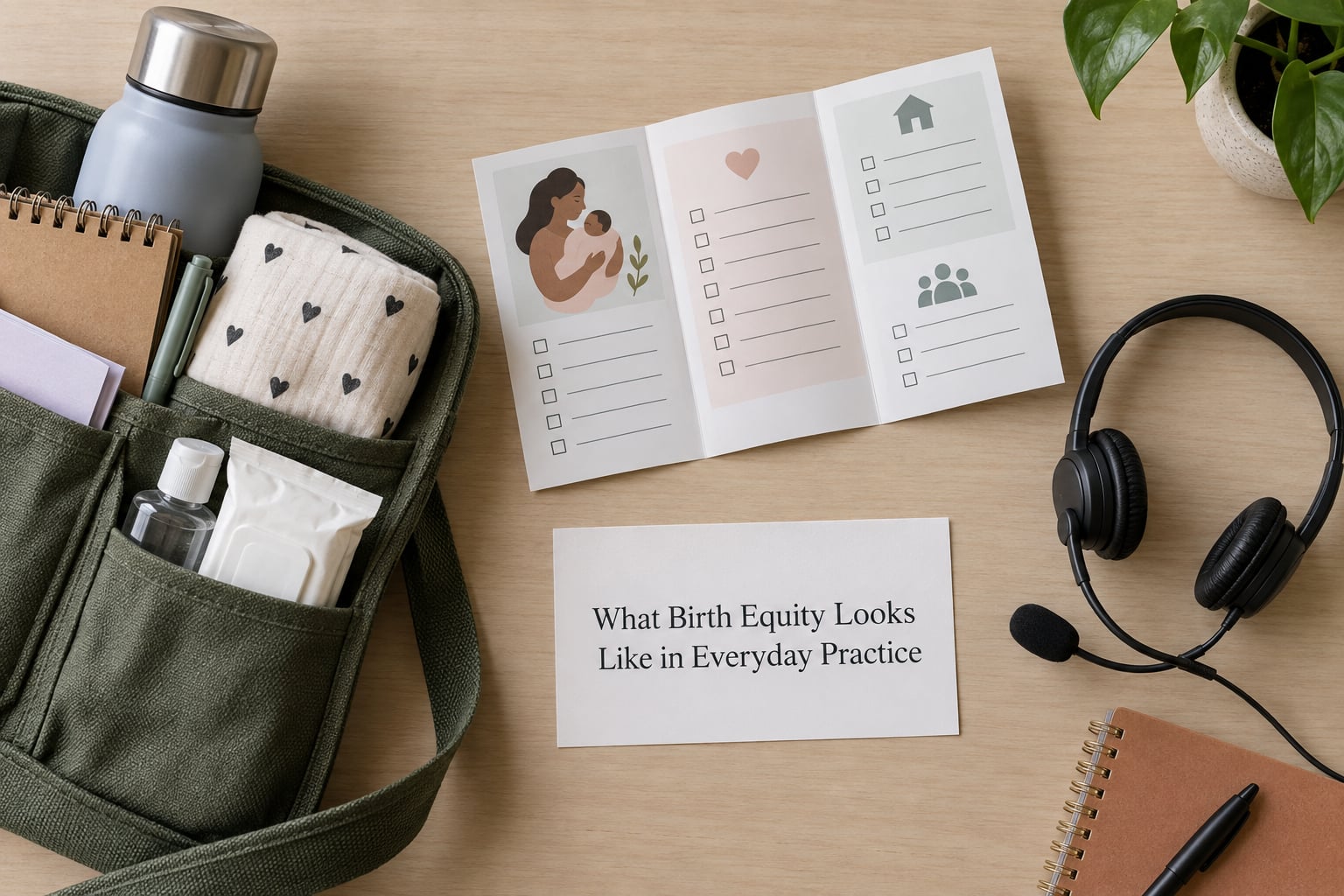
A concept is only useful if you can point at it. These are the conditions I would expect to see in a system that takes birth equity seriously.
Prenatal care that reaches people before a crisis
Late prenatal care is usually a logistics problem before it is a motivation problem. No car, no paid time off, a clinic that closes before the shift ends, a previous visit where someone was rude. Community health workers, home visiting programs and outreach text systems address those reasons directly, and they reach people before something goes wrong rather than after an emergency admission.
Labor and delivery where support is actually available
Doulas are one of the clearest examples. Continuous support during labor is associated with shorter labors and fewer interventions, and doula programs give that support to patients who could not otherwise pay for it. The problem funders keep returning to is cost: most people in these programs are unpaid volunteers, which makes the model fragile. Paying for the model is a policy question, not a clinical one.
Postpartum and fourth-trimester care
The fourth trimester is the first twelve weeks after birth, and it is where a lot of preventable harm happens. Extending Medicaid coverage to a full year postpartum matters because many deaths occur in that window, long after the paperwork ends. A single six-week checkup is not continuity of care.
Language access, disability accommodations and continuity
A qualified interpreter in the room, not a child translating. A wheelchair-accessible room arranged before arrival, not during an emergency. The same nurse or midwife at the next visit who was there at the first one. Each of these is unglamorous and each of them changes whether a person can participate in their own care.
Why Birth Equity Matters for Families and Communities
The reason to care is straightforward: the gaps are large, persistent and mostly preventable. Black birthing people are several times more likely to die in pregnancy and in the year after birth than white birthing people, and public health reviews judge a large share of maternal deaths preventable. Hemorrhage, infection and hypertensive disorders such as preeclampsia are conditions that respond to fast, competent treatment.
Severe maternal morbidity tells the same story without the deaths. Near-misses track the same unequal pattern, and they happen more often, which means more people are living through harm that should never have occurred. That is not a rounding error in a bad year. It is the system showing where it fails while it has a second chance.
Perinatal mental health adds a quieter layer. Untreated prenatal and postpartum depression and anxiety affect bonding, healing and a person’s ability to care for themselves. The reported rates are highest among Black birthing people and among people covered by public insurance, and the drivers are the same ones: cost, access, hours, stigma and being dismissed.
Then there is trust. In national research published in 2012, about 21% of Black mothers reported poor treatment from hospital staff tied to race, ethnicity or cultural background. Experience like that does not stay in the delivery room. It decides whether someone seeks prenatal care at nine weeks or at thirty, whether they call the clinic when something is wrong, and whether they describe the birth afterward as safe or as something to survive.
Communities feel the downstream effects too. Untreated postpartum illness means missed work, lost income and housing pressure, and newborn complications mean longer neonatal stays and transport between hospitals. When avoidable harm clusters in the same neighborhoods for the same reasons, the effect compounds across generations.
What Birth Equity Does Not Mean
Misunderstandings show up constantly, and they slow the work down.
It does not mean ignoring clinical evidence. Evidence-based protocols apply to every patient regardless of identity, and equity is usually about applying them reliably instead of selectively.
It does not mean every person should have an identical experience. Some patients want an epidural at the first sign of pain and some want an unmedicated water birth. Equitable care respects the preference and makes sure every option is genuinely available.
It does not mean putting the work on patients. Telling someone to eat better and get to appointments ignores why the appointments were hard to reach. Accountability belongs to the institutions that control access, staffing and coverage.
It does not mean race is the only measure of need. A white patient in rural isolation with no transport has the same access problem as a Black patient facing implicit bias. Equity frameworks usually name several axes at once, because people carry more than one at a time.
How Individuals, Hospitals, and Policymakers Can Help
Three levels of action, starting with what is in a person’s control today.
What patients and support people can do
You are allowed to ask who will be in the room, what happens if a symptom is reported, and what support is available. You can ask for an interpreter instead of relying on a relative. Ask for a written plan of what happens after discharge and who to call at two in the morning.
Write down questions before appointments, because pain and stress make memory unreliable. Bring one person with you if you can, and confirm the visitor policy in advance rather than at the door. If you feel dismissed, name what you observed in factual terms and ask what will happen next, and request a written summary of the conversation.
If a situation feels unsafe, a patient advocate, a doula or your state or local health department can help you navigate it. For anything about your own health, talk with your midwife, obstetric clinician or family doctor rather than relying on general reading.
What hospitals and care teams can change
Hospitals can stratify their own outcome data by race, language and Medicaid status to see where they are failing, publish the results, and tie them to leader accountability. They can fund paid doula and community health worker programs instead of relying on volunteers, hire and promote a workforce that reflects the communities they serve, and build interpreter access into the workflow rather than treating it as an exception.
Training matters less than the metrics around it. Implicit bias training on its own rarely changes outcomes; pairing it with a change in how triage escalates reported symptoms does.
What policymakers and community organizations can do
Coverage rules move outcomes more than any single program. Extended postpartum coverage, paid family leave, reliable transportation to appointments, and reimbursement for midwifery, birth centers and home visiting all change who can actually receive care. Community organizations fill what policy leaves out, from reentry support to housing navigation to interpreting.
Note that rules and funding vary by state and change over time, so check the specifics where you live.
Frequently Asked Questions
Is birth equity the same as giving every pregnant person the same care?
No. Equal treatment means identical resources for everyone, which often leaves people with unequal outcomes. Equity means matching support to need: a free doula for someone who cannot afford one, an interpreter for someone whose first language is not English, a home visit for someone who cannot drive. The goal is comparable safety and dignity, not identical experiences. Respecting a patient’s own preferences still matters, and equity is what makes those preferences real choices.
Who experiences birth inequity, and why can it be hard to measure?
It shows up most sharply among Black, Indigenous, Asian, Hispanic and migrant birthing people, LGBTQ and gender-diverse patients, people with disabilities, and anyone facing poverty, housing instability, immigration uncertainty or limited English. Measuring it is hard because race and ethnicity are often recorded inconsistently in medical records, small population groups get statistically unstable numbers, and many inequities appear as indirect signals such as a missed appointment or a declined request rather than a recorded complaint.
How is birth equity related to maternal and infant mortality?
Very directly. Black birthing people die in pregnancy and the postpartum period at several times the rate of white birthing people, and public health reviews judge a large share of these deaths preventable through timely recognition and treatment. Birth equity targets the conditions behind that gap, including delayed prenatal care, dismissed symptoms, unequal access to insurance and follow-up. It also affects infant outcomes, since prematurity and low birth weight are more common in the same groups facing the same barriers.
What can a patient do if they experience disrespectful or discriminatory care?
Say plainly what you observed and ask what happens next, in factual terms rather than as an accusation. Ask for a written summary and the name of the person coordinating your care. You can bring an advocate, doula or support person, and request a qualified interpreter rather than a relative. Hospitals have patient relations offices and ombudspeople, and public health departments and advocacy groups can help you file a complaint or find a birth center you trust.
Does birth equity mean that hospitals should stop using race at all?
No. Using race as a measure of need is how quality improvement teams find the gaps at all, and equity frameworks typically consider several factors together, including income, language, disability, geography and insurance status. The goal is not to assign race to an individual patient but to use group-level data to spot and fix systemic problems, while still assessing each person on their own clinical findings.
How can communities support birth equity beyond individual healthcare choices?
Communities act through programs rather than referrals. Free or sliding-scale doula services, community health worker and home visiting programs, interpreting networks, food and housing support, and local advocacy groups all remove practical barriers that a referral alone cannot. Some groups also run birth centers and freestanding midwifery clinics where none exist locally. Local and state health departments publish community health needs assessments, which is a practical starting point for finding which gaps are already documented.
What to Do First
If you take one thing from this: name the specific barrier, then name who can remove it. Missing transport is not fixed by encouragement. A support person barred at the door is fixed by a policy at one hospital. Medication that gets prescribed and never fills is fixed by a pharmacy benefit or a community program.
Write down which of those you are dealing with and who owns the fix, then take it to a midwife, obstetric clinician, patient advocate or local health organization for guidance. Birth equity moves one barrier at a time, and the first one is usually the one you can name.