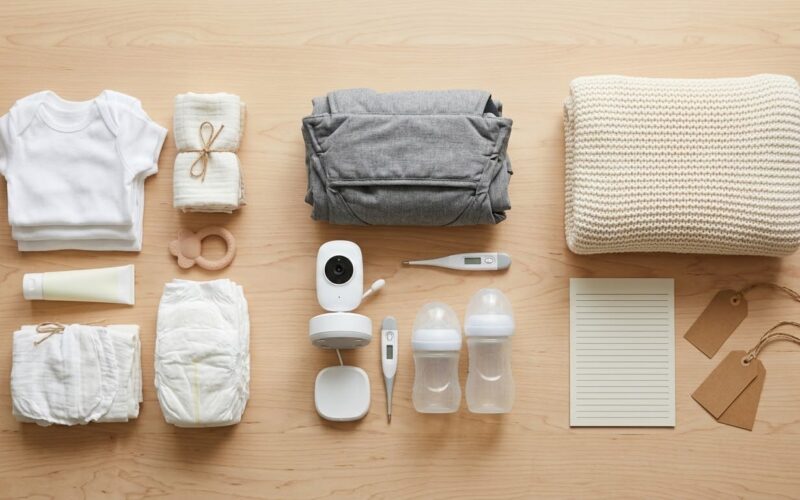
Most families need roughly a dozen things in the first weeks: diapers, a properly installed rear-facing car seat, a flat and firm sleep surface, a small quantity of clothes, feeding supplies matched to the plan you will actually use, and a few health and safety basics. What to buy for a newborn and what to skip is mostly a question of timing.
The rest of the list — the wipe warmer, the sterilizer, the nest, the changing table, the twelve-piece bottle set — is optional, and much of it is bought with a use window measured in weeks. Parents I work with tend to use ten to sixteen core items daily and let the remainder collect dust in a closet.
A few principles run through this guide. Buy for the version of your baby that arrives this month, not the one who walks at twelve months. Buy the safety-critical item and economize on the convenience item. And when a product claims to prevent a scary outcome, check whether the pediatric guidance actually supports it before you spend anything.
Guidance here follows mainstream pediatric recommendations, including the American Academy of Pediatrics safe sleep policy. Where a medical decision is involved, your own midwife, OB, or pediatrician should make the call, not a shopping list.
Table of Contents
- What to Buy for a Newborn and What to Skip at a Glance
- 1. Buy a Reliable Supply of Newborn Diapers
- What to Buy for a Newborn First: Diapers and Skin Care Basics
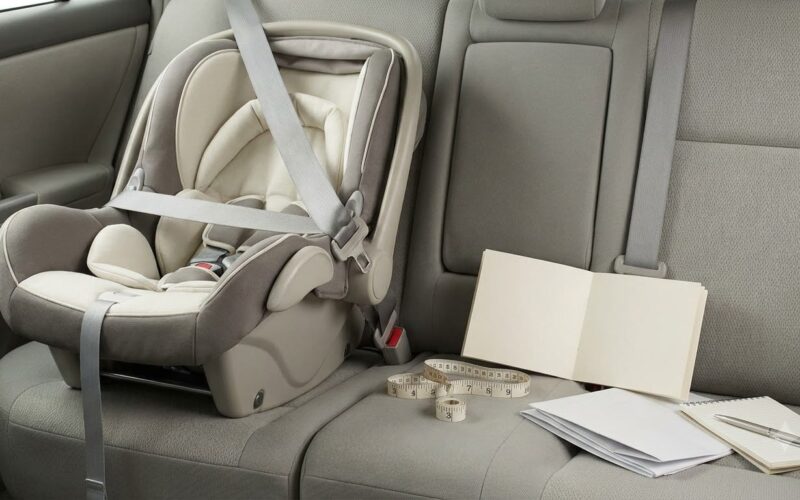
- 2. Buy a Rear-Facing Infant Car Seat
- 3. Buy a Safe-Sleep Setup, Not Extra Sleep Gadgets
- 4. Buy Only the Size and Quantity of Clothes You Need
- 5. Buy Basic Bathing and Diaper-Changing Supplies
- 6. Buy Feeding Supplies Only for the Feeding Plan You Need
- 7. Buy Basic Health and Safety Items for Home
- 8. Skip the Wipes Warmer
- 9. Skip Bottles, Pumps, and Sterilizers You Do Not Yet Need
- 10. Skip the Infant Positioner, Nest, and Other Sleep Aids
- 11. Skip Premium Duplicates and Fancy Feeding Gadgets
- 12. Skip Oversized Gifts Until the Baby Actually Needs Them
- Frequently Asked Questions
- What do most families need to buy for a newborn first?
- How many newborn diapers and clothes should I buy before the baby arrives?
- Do I need a bottle sterilizer, wipes warmer, or bottle warmer?
- Is it necessary to buy every item on a baby registry?
- What newborn products are unsafe to buy?
- Should I buy baby gear before knowing the baby’s size or needs?
- What Newborn Essentials to Prioritize First
What to Buy for a Newborn and What to Skip at a Glance
This table classifies each item as a priority purchase, a conditional purchase, or something to skip, with the deciding factor that settles it. Conditional means buy only when a specific condition applies to your family.
| Item | Verdict | Deciding factor |
|---|---|---|
| Diapers, wipes, barrier cream | Buy | Used every few hours from day one; no substitute exists |
| Rear-facing infant car seat | Buy | Legally and safely required for any car ride |
| Flat firm sleep surface and fitted sheet | Buy | Current safe sleep guidance depends on a flat, firm surface |
| Clothing in 0-3 month size | Buy, small quantity | Newborn size is worn briefly; buy a few, then 0-3 months |
| Bath basin, mild cleanser, towels | Buy | Bathing needs are real and simple; the equipment can be minimal |
| Feeding supplies | Conditional | Match the supplies to your chosen feeding plan and nothing more |
| Thermometer, smoke and CO alarms | Buy | Home safety basics, inexpensive, no substitutes |
| Wipes warmer | Skip | Adds waste and a cord for a problem solved by a warm damp cloth |
| Sterilizer and specialty bottles | Skip | Not needed for healthy full-term babies under standard guidance |
| Positioners, nests, loungers | Skip | Conflict with pediatric safe sleep guidance for infants |
| Duplicate gadgets and premium versions | Skip | A second device rarely solves a problem the first one did not |
| Oversized gifts and gear | Skip for now | Wait for a demonstrated need rather than a wish list |
Two items on this list are not really optional at all: the car seat and the safe sleep surface. Everything else on the buy side can be bought in stages.
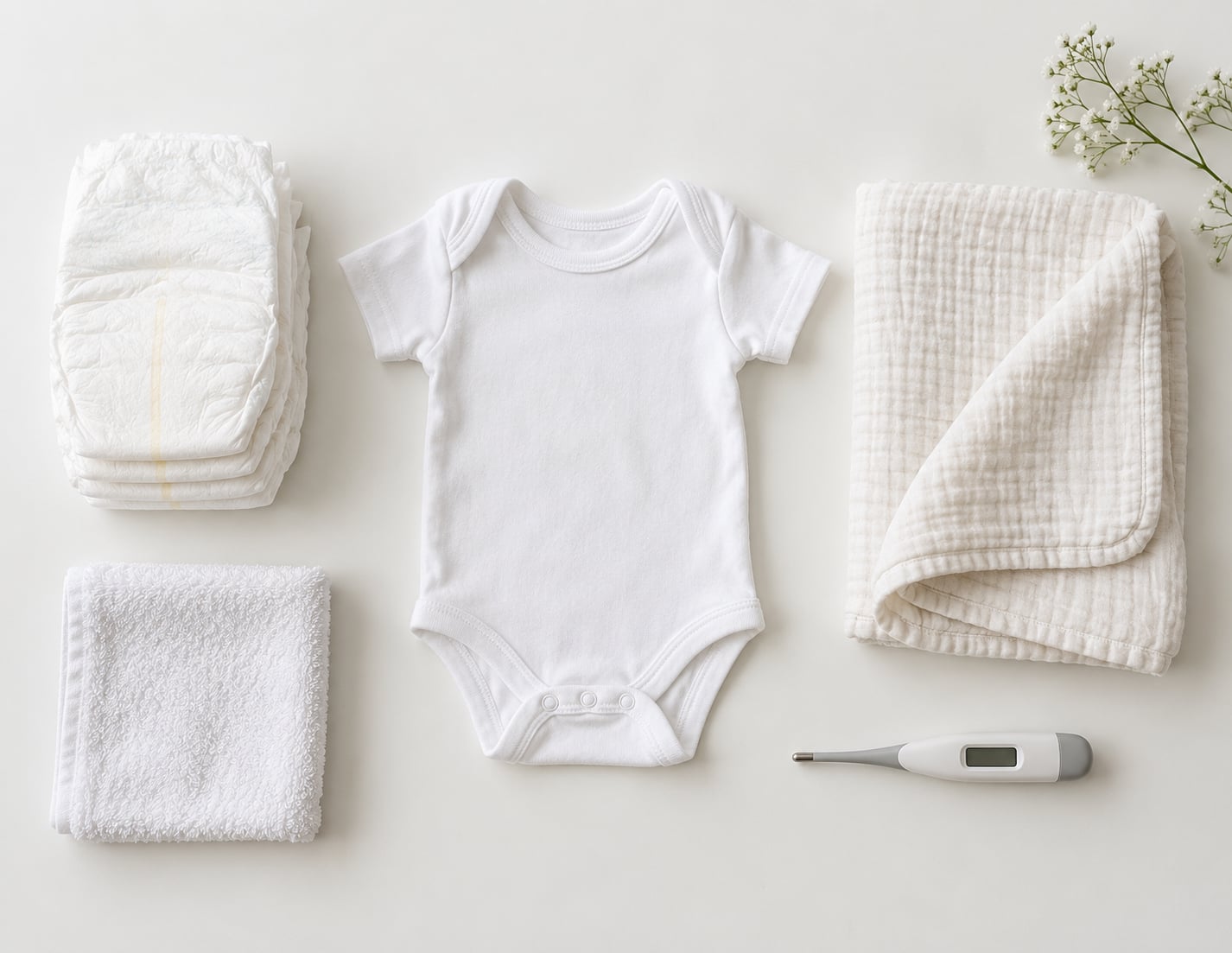
1. Buy a Reliable Supply of Newborn Diapers
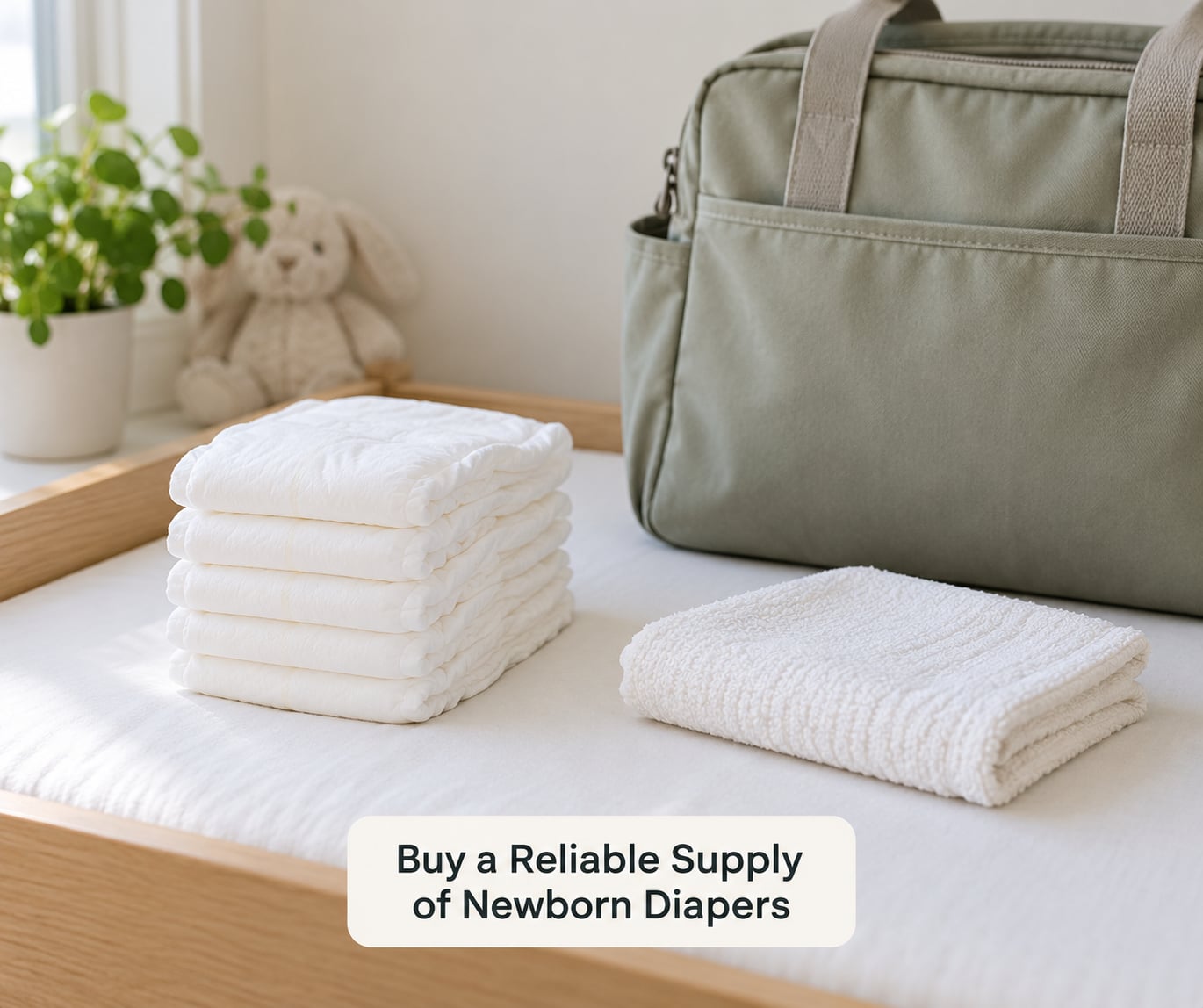
Diapers are the clearest example of a purchase with no substitute and no waiting period. A newborn typically needs a change every few hours around the clock, which works out to roughly eight to twelve a day in the first weeks.
Newborn sizing means the smallest disposable size, usually labeled for babies under about five pounds, plus a small number of the next size up. Many babies outgrow the smallest size within two to four weeks, so buying a large share of the smallest size is how families end up with a stack of unused diapers. If you know your baby’s birth weight from prenatal records or a growth scan, buy accordingly.
Disposables are simpler in the middle of the night. Cloth diapers save money over a year and reduce waste, but they add a real laundering routine in the early months when you are already short on sleep, so choose based on your household capacity rather than on principle.
A practical starting point before delivery: two small packs of the smallest size, one larger pack of the next size, plain water or fragrance-free wipes, and one tube of barrier cream recommended by your baby’s clinician. A small open container of wipes at the changing spot, refilled from the big pack, saves the 2 a.m. fumbling.
Reorder on a rhythm rather than on panic. Check what is actually in the diaper pail each Sunday morning and reorder when you are down to roughly a week’s supply. Signing up for a subscription from the beginning usually costs less than buying small packs in a hurry, and most services let you set the cadence or skip a delivery.
What to Buy for a Newborn First: Diapers and Skin Care Basics
Start with the four items used in the first hour: diapers sized for the birth weight, wipes with no added fragrance, barrier cream your pediatric clinician recommends, and one clean flat surface for changes. If your baby has a clinician-recommended barrier product already in place, keep using it rather than switching early in case something is being treated.
Everything else on the diapering list can wait a week. A wipe warmer, a dedicated hamper, a stocked changing caddy with twenty products in it, and a decorative changing pad are additions, not essentials.
2. Buy a Rear-Facing Infant Car Seat
A rear-facing infant seat is the one piece of gear with no substitute and no exception. Every ride home from the hospital needs one, and rear-facing positioning is what current safety guidance recommends for infants.
Buy from a source that lists the seat’s compliance information, expiration date, and current recall history, and expect to spend real time on installation. Read both the seat manual and the vehicle owner’s manual first, because the manuals frequently disagree on the same step, and the vehicle manual is the one that describes your specific car.
The common mistakes are a loose installation at the belt path, a headrest adjusted too high for a small newborn, and an aftermarket base used in a vehicle position that the base does not list. If your community offers a certified child passenger safety technician inspection, an hour of that is worth more than any accessory.
Skip the extras. Most parents never use a head support insert or a neck pillow, because a correctly installed seat already positions the head. Skip organizer trays, snack shelves, and replacement covers. Buy the seat, install it correctly, and let a technician check the work.
3. Buy a Safe-Sleep Setup, Not Extra Sleep Gadgets
A newborn’s sleep setup should be small: a firm, flat, level sleep surface, a fitted sheet, and the baby on their back for every sleep. That is the core of current pediatric safe sleep guidance, along with keeping the sleep space clear of everything else.
What to buy is modest. A firm flat surface that meets current safety standards, a fitted sheet with no loose fabric, and a place for the surface that is not a sofa, an adult bed, or a chair. If your baby is small enough that you worry about rolling, follow your clinician’s advice about swaddling and about stopping swaddles as soon as your baby shows signs of rolling.
What to leave out of the sleep space: pillows and pillow-like loungers, crib bumpers, loose blankets, stuffed toys, weighted sleep products, positioners or wedges, and inclined or curved sleep products. Products marketed for soothing are the ones most likely to be used in the middle of the night by an exhausted adult, which is exactly when the instructions get skipped.
On developmental readiness, keep in mind that your baby does not need to be asleep in a device for the first months. Supervised floor time while you are in the room is more useful, and it costs nothing.
4. Buy Only the Size and Quantity of Clothes You Need
Newborn-size clothing is the most common place expecting parents overspend, because registries default to it and the photos look wonderful. In practice, newborn size is often outgrown in two to four weeks and many babies barely wear it at all, especially those born at heavier birth weights.
Buy the small quantity you need for the hospital and the first week, then concentrate on 0-3 month size. A workable starter set is about six to eight snap-closure or zip-up bodysuits, four to six pairs of pants or footed sleepwear, two or three sleepers for warmer nights, one or two hats, and a pair of socks. Sleepers with a zipper down the front are a real convenience at 3 a.m., because they open flat for a change.
Materials matter more than brand. Breathable cotton is comfortable against skin and easy to wash; avoid items with stiff necklines, loose buttons, ties, or decorative cords, and skip sleepwear marketed as loose-fitting for crib use.
Hand-me-downs make a small wardrobe workable, especially from a family whose babies were similar sizes. Check for worn elastic, missing snaps, and stains before you rely on anything, and wash everything once before it goes near your baby. The same is true of a used car seat: never buy one secondhand because the crash history is unknown.
5. Buy Basic Bathing and Diaper-Changing Supplies
Bathing supplies are genuinely useful and genuinely simple. You need a clean basin or tub, a mild fragrance-free cleanser used sparingly, a soft washcloth, one or two soft towels, and a place to change your baby that you can reach safely.
A digital thermometer is the bathing-adjacent item most parents end up relying on, and your clinician can tell you which type they want you to use. Have it ready before you need it, along with the number for your pediatrician and for after-hours urgent care.
Skip the separate sterilizer for bath gear, the bath support with a sling and a plastic hood, and the folding step stool. Many parents bathe with a hand supporting the head and a folded towel under the shoulders, and skip the whole tub once the baby can sit more comfortably. Change your baby on a firm surface with a hand on them at all times.
The changing table itself is the item I most often see bought and then ignored, because parents end up changing on the floor, the bed, or a pad on a dresser. That is fine. Buy a washable waterproof pad, keep it on whatever surface you actually use, and save the furniture.
6. Buy Feeding Supplies Only for the Feeding Plan You Need
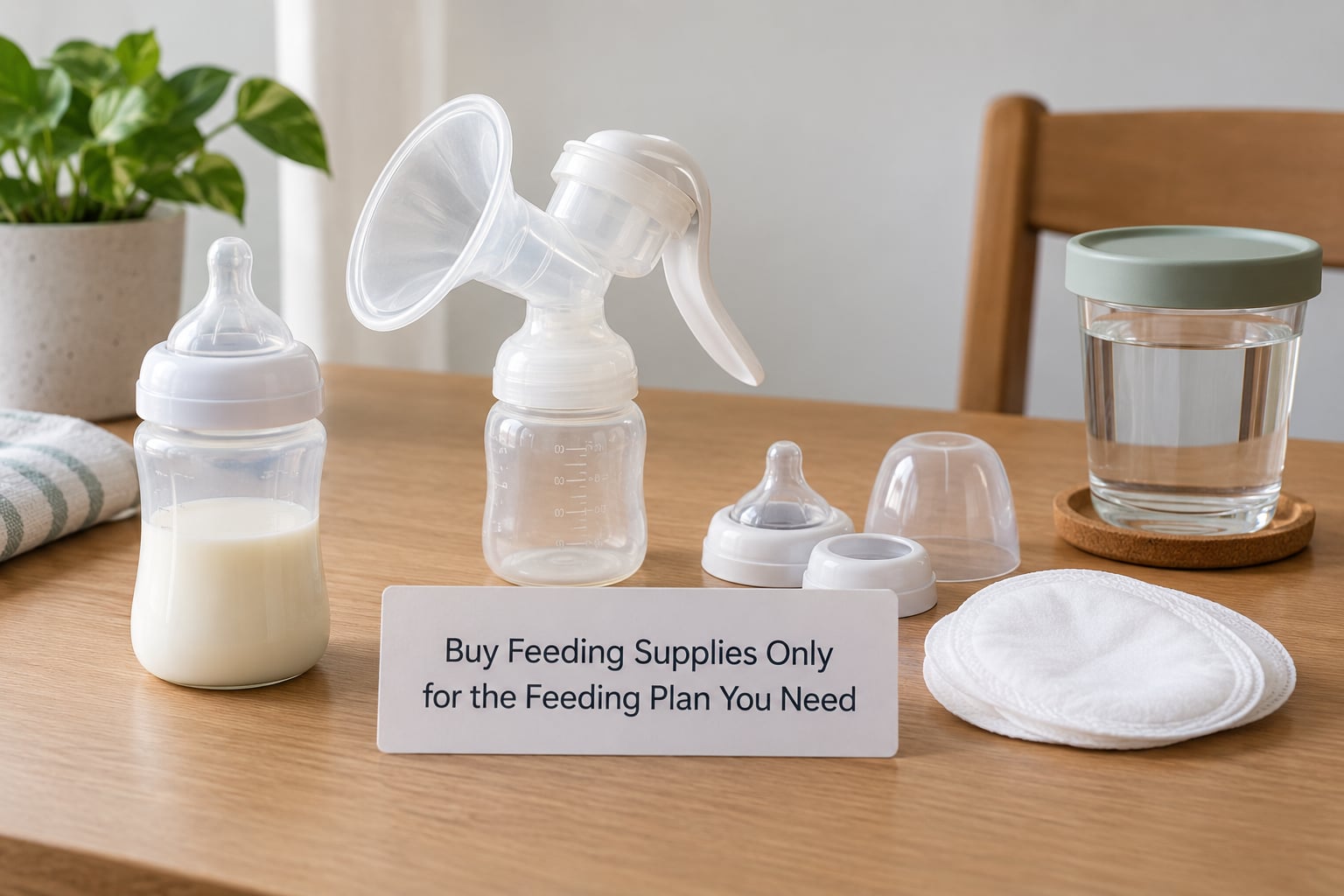
Feeding supplies are conditional, because the correct list depends entirely on your plan: direct breastfeeding, pumping and feeding expressed milk, combination feeding, formula feeding, or a medically guided plan set by your clinician. Buy for the plan you have, and buy the version of it that is realistic for a household with a newborn.
For direct breastfeeding with no expressed feeds, a small kit is enough: nursing pads, a few plain burp cloths, and access to an IBCLC lactation consultant through your insurance or a local program. Formula or expressed milk adds a small number of standard bottles with nipples matched to your baby’s feeding stage, a bottle brush, and a drying rack or a place to air dry.
A manual pump is a reasonable first purchase for occasional pumping or for building supply while away from your baby, and it doubles as a backup. An electric pump only becomes necessary when you are pumping regularly or returning to work. If you do want an electric pump, many US health plans include one at no cost under the preventive care benefit; parents report that ordering around 28 to 35 weeks, rather than after delivery, avoids paperwork delay, because the order usually needs a prescription and arrives through a durable medical equipment supplier.
What is not a must-buy: a full bottle set across every size and brand, a specialty bottle marketed for colic or reflux without clinician advice, a sterilizer, and a warmer. Start with six to eight bottles in one standard type and add when a real need appears.
7. Buy Basic Health and Safety Items for Home
A working smoke alarm and carbon monoxide alarm on every level with sleeping areas is the highest-value safety purchase in the list, and inexpensive. Test them monthly, replace batteries on the schedule the manufacturer gives you, and place a carbon monoxide detector within range of where the baby sleeps.
Keep the air smoke-free and vape-free, including around the nursery and the car. If anyone in the home smokes, that is a conversation about the house and the car, not about gear.
For bathing, set the water heater so the tap cannot exceed about 100 degrees Fahrenheit, and check the temperature with your hand or the thermometer rather than trusting the dial. Outlet covers are worth having if your home has uncovered outlets within reach, and a small gate matters once your baby starts crawling, which for most babies arrives before parents expect it.
Have your clinician’s number, an after-hours line, and the nearest urgent care written down before delivery. For postpartum recovery for the person giving birth, add pads, a peri bottle or bidet sprayer, any comfort products your clinician recommended, and support for sleep and mental health. Those needs are real, and they get crowded out of every baby list.
8. Skip the Wipes Warmer
Skip the wipes warmer. The reason it feels necessary is that a cold wipe can startle a sleepy baby, and a startled baby who is not yet awake can become a crying baby. That is a real problem, so the solution just needs to be cheaper and simpler.
Most warming units use an electrical heating element, and the ones that work consistently also hold moisture for hours, which is not something you want sitting warm near a newborn’s skin for a week. Parents who keep one report the cord and the counter space as the bigger irritation than the feature itself.
Instead, store wipes at room temperature in a closed container so they do not feel cold, and keep one slightly damp soft cloth in a sealed bag for simple cleanups between changes. If your baby strongly dislikes cool wipes, warming the single wipe in your hands for a moment before use takes the edge off just as well. Here is the honest takeaway: several parents call it the first unused purchase they made.
9. Skip Bottles, Pumps, and Sterilizers You Do Not Yet Need
Skip the sterilizer and skip specialty bottles for a healthy full-term baby under standard pediatric guidance. Standard guidance is that clean equipment is sufficient for healthy full-term babies, with sterilization reserved for equipment used for preterm, immunocompromised, or otherwise medically vulnerable babies, or when a clinician has said so.
For most households, running parts through the dishwasher sanitize cycle or boiling them for five minutes once a day meets the standard, and air drying on a clean rack does the rest. If your plan is direct breastfeeding with no expressed milk, you may need no bottles at all in the first months.
On pumps, distinguish three situations. Preparing to feed means you have nothing yet and need no pump. Actively pumping means you are building or maintaining supply, and that is where a pump earns its place. Feeding expressed milk or formula means you need bottles and nipples matched to the baby’s stage, which is a different purchase from a pump.
The expensive mistake is buying a second, higher-spec pump before the first one has been used for a month. Flange sizing matters far more than the category a pump sits in, so get the basic pump, work with a lactation consultant on fit, and only step up if supply or schedule truly requires it.
10. Skip the Infant Positioner, Nest, and Other Sleep Aids
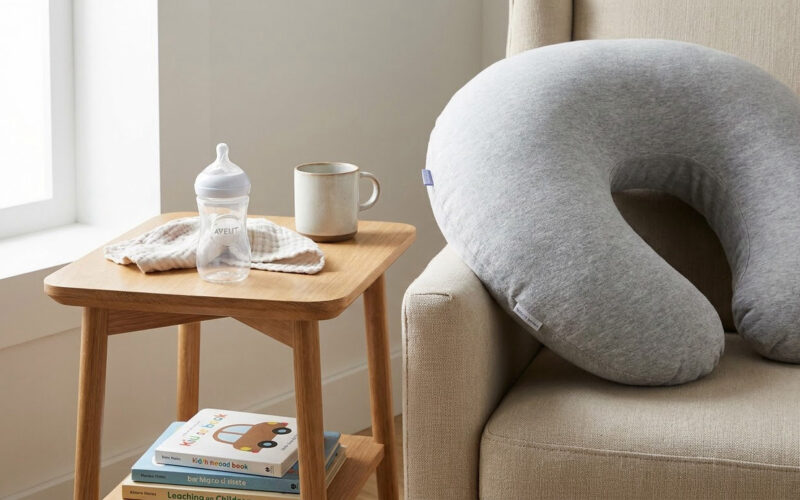
Skip positioners, nests, loungers, pillow-like sleep products, weighted sleep aids, and inclined or curved sleep surfaces for infant sleep. This is not a budget judgment. It is a direct conflict with current pediatric safe sleep guidance, which recommends a flat, firm surface and a clear sleep space, and guidance on inclined sleep products has tightened as evidence accumulated.
These products sell on a reasonable-sounding promise: better head shape, calmer sleep, longer stretches, safer reflux positioning. The reason to skip them is that the design feature doing the selling is the same feature the guidance warns against, and the products are most appealing at exactly the age when babies sleep longest and parents are most exhausted.
What to buy instead for those long stretches: a white noise machine, which parents repeatedly name as one of the most useful low-cost purchases they made, and a simple routine for day and night. Some parents also tell me a rocking or gliding chair and a partner taking a turn carried more of the load than any device they owned.
11. Skip Premium Duplicates and Fancy Feeding Gadgets
Skip the category where a second device replaces a perfectly good first one: two pumps of the same class, a sterilizer alongside a dishwasher sanitize cycle, an elaborate bottle warmer with temperature settings, a temperature-controlled cabinet for formula or expressed milk, a multi-device drying rack, and sanitizer systems that replace a bottle every day.
The pattern is recognizable. Each product solves a problem a simple version already solves, then adds a routine. Once you own two of something, you also own parts, tubing, adapters, and a troubleshooting question, and that is real friction in the first three months.
Compare any candidate against its plain version: a standard bottle, a heatproof dish, a clean dish towel, a drying rack, a bottle brush. Most parents who have used both end up back at the plain version for the year of heaviest use, and they say so unprompted. If money is not tight, spend the surplus on the car seat, the white noise machine, or help with meals, which is where families report the actual relief.
12. Skip Oversized Gifts Until the Baby Actually Needs Them
Skip large purchases made because a product looks impressive or appears on a gift list rather than because your baby needs it now. A large newborn wardrobe, a full changing table, a bath seat, a bouncer, a breast pump, and a baby monitor all fall into this bucket, and each one assumes a stage your baby has not reached.
Developmental readiness is the useful test. A bouncer and an exersaucer are only pleasant once your baby can hold their head steady and control their neck, often somewhere around three to four months. Solids, a high chair, and most of the floor-time toys become relevant around six months when your baby sits without support and shows interest in what you are eating. Shoes, a walker, and anything marketed for sitting before sitting can wait far longer, and a walker in particular is worth researching before anyone buys one.
On monitors, basic audio or video covers what most families need, and parents who added movement monitors often report more anxiety than useful information. Decide with your own sleep plan in mind rather than with the fear that comes with it.
The better version of a generous gift is small and specific: a stack of 0-3 month sleepers, a set of bottles in one standard type, a gift card toward postpartum help, or a meal dropped off in week two when nobody is asking for anything. If you are building a registry yourself, keep it to consumables, sizes you will use this month, and services such as a lactation consult or a car seat technician check.
Frequently Asked Questions
What do most families need to buy for a newborn first?
Most families need a small number of things in the first days: diapers in the right sizes, plain fragrance-free wipes, a barrier cream your clinician recommends, a correctly installed rear-facing infant car seat, a firm flat sleep surface with a fitted sheet, and feeding supplies that match your chosen plan. Add a thermometer and working smoke and carbon monoxide alarms. Everything else can wait weeks or months.
How many newborn diapers and clothes should I buy before the baby arrives?
Plan on roughly eight to twelve diapers a day at the start, and buy only a small share of the smallest size since most babies outgrow it within a few weeks. For clothes, buy six to eight 0-3 month bodysuits, four to six pairs of pants or sleepers, one or two hats, and a couple of sleepwear pieces. Wash everything once before use and check hand-me-downs for worn elastic and missing snaps.
Do I need a bottle sterilizer, wipes warmer, or bottle warmer?
Usually none of them. Standard pediatric guidance says clean equipment is sufficient for healthy full-term babies, with sterilization reserved for preterm or medically vulnerable infants on clinician advice, and a dishwasher sanitize cycle or boiling water covers most families. A wipe warmer solves a problem with room-temperature storage or a warm damp cloth. A plain heated dish replaces most bottle warmers.
Is it necessary to buy every item on a baby registry?
No. A registry is a wish list, not a checklist, and the biggest cost is usually newborn-size clothing that is outgrown before it is worn twice. Register for consumables, the car seat, sleep basics, and the size you will use this month, then add larger sizes later as group gifts. What to buy for a newborn and what to skip is easier to decide when you sort each item by the week you would actually reach for it.
What newborn products are unsafe to buy?
The products to avoid are sleep aids: positioners, nests, loungers, pillow-like items, crib bumpers, weighted sleep products, and inclined or curved sleep surfaces, since each conflicts with current pediatric safe sleep guidance. Also avoid secondhand car seats because crash history is unknown, cribs older than the current safety standard, and drop-side sleep furniture. Use new car seats and current-standard sleep surfaces.
Should I buy baby gear before knowing the baby’s size or needs?
Buy only what depends on the baby before birth: diapers, a few 0-3 month outfits, and the car seat you will install in your actual vehicle. Wait on feeding gear until your plan is settled, and wait on bouncers, high chairs, solids gear, and shoes until your baby shows the readiness signs for them. Expecting sizes vary widely, so a large newborn wardrobe often fits nobody at the moment it is needed.
What Newborn Essentials to Prioritize First
Start with diapers and skin care, because the first need arrives hours after the birth. Install the rear-facing car seat in the car you actually drive and get it checked. Set up a firm, flat, clear sleep surface and nothing more. Buy six to eight outfits in 0-3 month size rather than a wardrobe in newborn size. Choose feeding supplies once your plan is decided, and keep the quantity small.
Add a thermometer, working smoke and carbon monoxide alarms, and your clinician’s contact details. Then pause. Everything else on the list of baby things to buy can wait until a real need shows up, and several items that look essential are better crossed off the list entirely.
If you want more context on how a birth unfolds and what support looks like, read about what a doula does during labor and delivery, how informed consent works in maternity care, and what birth equity means and why it matters. Those conversations tend to surface the decisions about feeding, birth location, and newborn care that this shopping list leaves open.