
The fastest way to get a developmental evaluation for your child is to start the request yourself. If your child is under 3, contact your state early intervention program (Part C). If they are 3 or older, contact your school district and ask for a special education evaluation. A pediatrician referral helps, but in both systems you can refer your own child.
That distinction trips up a lot of families, because most advice online stops at the doctor’s office. The process actually has three parts: you describe what you have observed, a trained team measures your child across developmental areas, and you get a written report that explains strengths, delays, and what happens next. This guide walks that whole path, including what to gather, what to say, what it costs, and what to do while you wait.
This is general educational information, not medical advice. Talk with your child’s pediatrician about any concern, and confirm procedures with your own state early intervention lead agency or school district, since rules vary by state and district.
Table of Contents
- What You Need
- Step-by-Step: How to Get a Developmental Evaluation for Your Child
- Step 1: Document Your Child’s Development
- Step 2: Talk With Your Child’s Pediatrician
- Step 3: Contact Your State or Local Early Intervention Program
- Step 4: Schedule the Evaluation and Ask What It Covers
- Step 5: Prepare Your Child and Gather Records
- Step 6: Attend the Evaluation and Ask for the Written Results
- Step 7: Review Recommendations and Choose Next Steps
- Common Mistakes
- Frequently Asked Questions
- What is a developmental evaluation for a child?
- How do I know if my child needs to be evaluated?
- Can I request a developmental evaluation without a pediatrician referral?
- Where can I go to get my child evaluated?
- How long does a developmental evaluation take, and what does it cost?
- What should I do if my pediatrician says to wait and see?
- Conclusion
What You Need
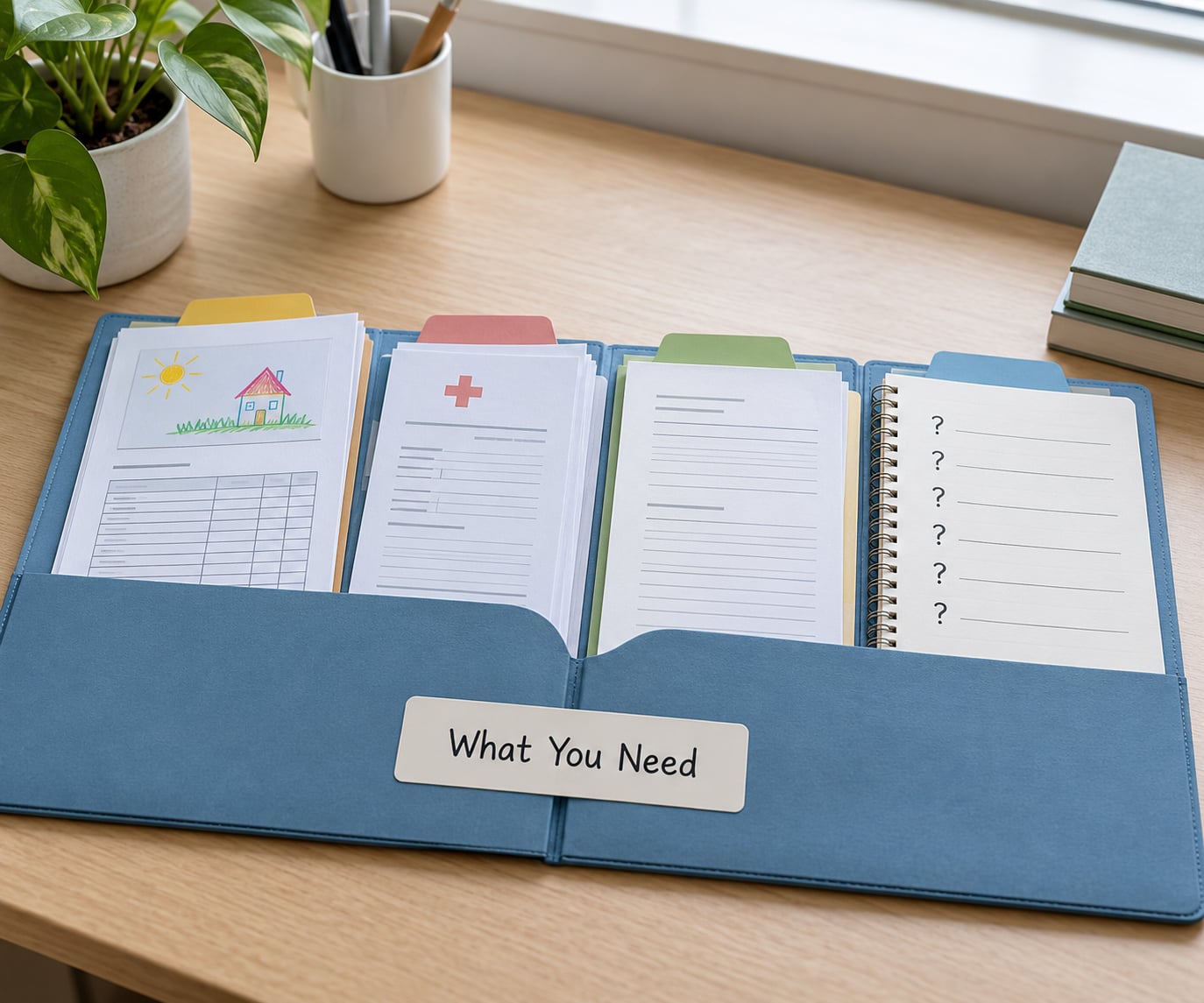
Most parents arrive at an evaluation with a folder full of receipts and worry they have not brought the right thing. In practice, the useful material is simple: specific observations, whatever records exist, and a short list of questions. None of it needs to be formatted or professional.
- A written list of your concerns, with examples and dates. Not “he is behind in speech” but “he says about 20 words at 26 months and has not added new ones since his second birthday.” Specifics survive the wait list; labels do not.
- Milestone checklists you’ve completed. The CDC Act Early milestone tracker at cdc.gov/act-early offers free checklists by age, and the American Academy of Pediatrics recommends that all children be screened at 9, 18, and 30 months.
- Medical records. Visit notes, the immunization record, birth and hospital records, and any lab results. If hearing or vision has not been checked recently, note that, because sensory loss can look like a developmental delay.
- School, preschool, or daycare reports. Teacher observations about attention, behavior, peer play, and independence carry weight during an evaluation, and for school-based evaluations they are required input.
- Short videos. A minute or two of your child speaking, playing with a peer, drawing, or walking shows more than a paragraph of description. Bring it on your phone and also on a backup device.
- Your list of questions. Write them down. You will forget half of them while someone is talking.
- Insurance and Medicaid information. Bring the card, because the early intervention team may ask about other providers your child sees.
One more thing to gather is a contact name. Whoever takes your request will assign you a person, usually called a service coordinator or case manager. Get their name, direct number, and email the day you start, because that person is now the one who moves your appointment.
Step-by-Step: How to Get a Developmental Evaluation for Your Child
Step 1: Document Your Child’s Development
Write down what you see, not what you think it means. For two weeks, keep a short dated note of new words, play behavior, tantrum patterns, motor milestones, and how your child responds to your voice.
Note the setting for each observation. A skill that appears at the park but not at home, or with a parent but not at daycare, is a useful pattern rather than a contradiction. If your child has lost a skill they previously had, put that at the top of the list and mark it clearly. Loss of skills is treated more urgently than a slow pace of gaining them.
How you know it worked: when you read the list back, you can point to a moment in time. “He stopped answering his name about six weeks ago” is a starting point an evaluator can build on. “Something feels off” is not.
Step 2: Talk With Your Child’s Pediatrician
Bring the list to a scheduled visit rather than saving it for a sick visit, and ask for developmental screening in plain terms. A useful framing is: “I’m worried about his speech and I’m not sure it’s just a late bloomer. I’d like him screened and, if needed, referred for a full evaluation.”
Ask whether hearing and vision should be checked first, since those are common causes of apparent delay. Ask for the referral in writing, and ask the office to send it to you as a document so you can forward it to the early intervention program or school district yourself.
If the pediatrician says to wait and see, you do not have to. Parents can self-refer to early intervention and, in most states, request a school evaluation directly. If you would rather try again first, ask what specifically they would want to see change, by what date, and ask them to note the concern in the chart. Then follow up on that date.
Step 3: Contact Your State or Local Early Intervention Program
Find your state early intervention lead agency through the CDC directory or by searching your state’s name with “Part C early intervention.” Call rather than emailing, and say you are requesting an evaluation for your child.
Ask four things: who is the assigned service coordinator, what documents do you need to send, how long is the wait, and what happens during the visit. Under IDEA Part C, the program serves eligible children from birth to age 3, evaluation is free, and you can refer yourself. If your state runs it through a county or regional office rather than the state level, they will transfer you.
How you know it worked: you have a case number, a name, and a date. If you only have a voicemail, call again the next business day.
Step 4: Schedule the Evaluation and Ask What It Covers
For a child under 3, the evaluation is usually done by a team that can include a developmental-behavioral pediatrician, a psychologist, a speech-language pathologist, an occupational therapist, a physical therapist, and a social worker. For a child 3 and older in school, a school psychologist and a team run it, often in the classroom and at a table rather than in an office.
When you schedule, ask who will be present, how long it takes, whether you will be in the room, and whether you can bring a teacher. Ask for the assessment in writing before the day arrives.
| Route | Who evaluates | Cost | Typical wait | What you receive |
|---|---|---|---|---|
| State early intervention (Part C), birth to 3 | Multidisciplinary team, coordinated by a service coordinator | Free | Weeks to a few months, varies widely by state | Eligibility decision and a written individualized family service plan (IFSP) |
| School special education, ages 3 and up | School psychologist and team, in the school setting | Free | Often the quickest route; timing depends on the district | Evaluation report and eligibility for an IEP or 504 plan |
| Developmental-behavioral pediatrician | Medical doctor specializing in development | Billed to insurance; Medicaid generally covers | Commonly months | Medical diagnosis, medical plan, and recommendations for further testing |
| Child psychologist or neuropsychologist, private | Licensed psychologist | Insurance may bill; otherwise self-pay | Commonly months | Cognitive, behavioral, and adaptive testing with a written report |
| Private or telehealth evaluation | Varies widely by provider | Usually self-pay | Often weeks | Varies. Ask about credentials and whether the report is accepted by your school |
These two systems are not the same thing, and this trips parents up. Early intervention services can start on the basis of an evaluation without any diagnosis attached. A formal diagnosis, such as an autism evaluation, follows its own queue and can take far longer. You do not have to wait for one to finish before starting the other.
Step 5: Prepare Your Child and Gather Records
Send your records ahead if the office allows it, and bring copies. Do not coach your child. Practicing phrases, or training your child to perform for the evaluator, produces a result that does not describe your real child and can send the evaluation in the wrong direction.
Instead, keep the day ordinary. A familiar snack, a comfort item, and a normal nap schedule do more good than rehearsal. Tell your child in simple terms that some adults are going to play and ask them some questions, and let them know you will be nearby if the office allows a parent in the room.
Bring the videos, the milestone checklist, teacher notes, and your question list. Ask in advance whether a parent stays in the room, because practices differ and knowing ahead of time settles one worry.
Step 6: Attend the Evaluation and Ask for the Written Results
Expect a parent interview, direct observation of your child at play and in conversation, review of records, and sometimes brief standardized testing. The evaluator may test hearing and vision referrals, adaptive behavior, or language. Children do not need to “pass” anything, and there is no right way to behave.
Your job is to give examples. When they ask about communication, describe a typical morning: how many words, whether they point, whether they respond to their name, how they ask for things. Quantities and situations are more useful than adjectives.
Before you leave, ask when the written report will arrive, how it will be delivered, who will explain it, and what it does and does not cover. Then write the date down in front of the person you ask. How you know it worked: you leave with a delivery method and a date, not just a handshake.
Step 7: Review Recommendations and Choose Next Steps
A screening result and an eligibility decision are not the same thing, and neither is a diagnosis. A screening says a child looks like they may need a closer look. An evaluation says what the strengths and delays are. A diagnosis names a specific condition, and it is not required to receive early intervention or school services.
Read the report with your questions next to it, and ask for anything written in a way you do not understand. If it recommends services, ask which ones start soonest, who provides them, and what it costs you in time. If the recommendation is that nothing is needed but you still see concerns, ask what specifically you should watch for and when to come back.
Then act while the report is fresh. If it leads to services, there is usually a meeting within weeks to build the plan, and that plan is where the daily schedule, the goals, and the funding decisions get made. If you disagree with the conclusion, you can request a second opinion, and in the school system you have formal procedural safeguards available in writing.
Common Mistakes
Waiting because the doctor said to wait. Set the follow-up date on the calendar the day you leave the office, and write down what specifically should change. Waiting without a defined checkpoint usually becomes waiting without an end.
Relying on one observation. A single bad afternoon means little. A pattern across weeks, shown in more than one setting, is what changes a clinician’s mind.
Describing your child instead of documenting them. “He is behind” is an opinion. “He has used the same 20 words since his second birthday” is a finding. Write the second kind.
Treating a screening as a diagnosis. Screening tools are designed to be quick and to over-refer, so many children who screen positive are completely typical. Do not rehearse a conclusion before you have one.
Forgetting to ask for the report in writing. If you leave with only a verbal summary, you will be reconstructing it from memory months later when you need the exact wording. Ask for the date and the delivery method before you leave.
Assuming a diagnosis is the door to services. It often is not. Early intervention and school services are based on an evaluation of need, and you can pursue those in parallel with a longer diagnostic queue.
Letting the appointment slip. Families report repeatedly that appointments fall through the cracks for want of one phone call. Confirm a day or two beforehand, every time.
Frequently Asked Questions
What is a developmental evaluation for a child?
A developmental evaluation is a thorough assessment of how your child is developing across speech and language, motor, social, and behavioral areas. A trained professional, usually a developmental-behavioral pediatrician, child psychologist, or an early intervention or school team, combines a parent interview, direct observation of your child at play and in conversation, review of records, and sometimes standardized testing. You receive a written report describing strengths, delays, and recommended next steps.
How do I know if my child needs to be evaluated?
The clearest signal is a gap between your child and peers in two or more developmental areas, such as speech, movement, or social interaction. Also worth acting on: your child is not responding to their name, has limited or no eye contact, shows no pointing or gesturing, has lost a skill they previously had, or has a persistent gut feeling that something is different. Use the CDC milestone checklists at cdc.gov/act-early to check by age, and trust the pattern over a single skill.
Can I request a developmental evaluation without a pediatrician referral?
Yes. Under IDEA Part C, families can refer their own child to the state early intervention program if the child is under 3, and most families can request a school special education evaluation directly for a child 3 or older. A pediatrician referral is helpful because it adds a medical record and a hearing and vision check, but it is not a legal prerequisite. Many families contact the program and the pediatrician on the same day so both tracks move in parallel.
Where can I go to get my child evaluated?
It depends on age. Under 3, go to your state or local early intervention program, which is free and serves birth to age 3. At 3 and up, request a special education evaluation from your school district, also free and often faster than outside providers. A developmental-behavioral pediatrician or child psychologist can evaluate privately, usually with insurance or Medicaid covering the medical route. Start with the free public route and add a private medical opinion if you need one.
How long does a developmental evaluation take, and what does it cost?
Early intervention and school evaluations are free, and the appointment itself is usually one to three hours, sometimes split across two visits. A private medical or psychological evaluation is generally billed to insurance, with Medicaid typically covering the medical route, and self-pay is the main cost when coverage does not apply. Wait times vary enormously by location and by provider type, so ask for the expected timeline in writing when you request the appointment and ask to be placed on the cancellation list.
What should I do if my pediatrician says to wait and see?
Ask for specifics: what they would want to see change, by what date, and ask them to document your concern in your child’s chart. Then set a reminder for that date. You do not have to wait, because you can self-refer to early intervention under 3 or request a school evaluation at any age. A developmental-behavioral pediatrician can give a second opinion, and early intervention services can begin based on an evaluation of need, with no diagnosis required at all.
Conclusion
Start with a dated list of what you have actually seen, then make two calls in the same week: one to your pediatrician to ask about screening and hearing and vision, and one to your state early intervention program or your school district to request the evaluation. Keep the case number, the coordinator’s name, and the appointment date somewhere you will see them, and confirm the appointment a couple of days beforehand. If you are worried about a specific concern such as autism, raise it directly at both calls so the right screening tools and the right wait list are used from the start.