
If you are searching for what early intervention services do, you are probably trying to picture what actually happens after you make the call. In the United States, early intervention services are free public supports for infants and toddlers from birth through age three who have a developmental delay, a disability, or an emerging concern. A team evaluates your child, writes a plan with you, and then provides therapy, coaching, and practical help where your child already spends time. This guide covers the whole U.S. process under Part C of the Individuals with Disabilities Education Act (IDEA). Last reviewed for October 2026.
The word “intervention” makes a lot of parents imagine a clinic, a schedule of appointments, and a child being pushed through exercises. That is one possible setting, but it is not the only one, and it is not the starting point. Early intervention is built around play, daily routines, and you. I have talked with parents who assumed they would be handed a bill and instead found out the first visit was a conversation in their own kitchen.
A note before we start: this is general information about how the program works, not medical advice about your child. For anything specific to your child’s health, growth, or development, talk with your child’s doctor and your local early intervention program. Eligibility rules, fees, and timelines differ by state, so treat everything below as the general framework, then confirm the details where you live.
Table of Contents
- What Early Intervention Services Do
- What early intervention is and is not
- Who Qualifies for Early Intervention Services
- What Early Intervention Services Can Include
- Early Intervention Professionals and Home Supports
- Assistive Technology, Communication Tools, and Caregiver Support
- How to Start the Early Intervention Process
- How to Prepare for an Early Intervention Evaluation
- What Parents Can Ask at the First Meeting
- Do Early Intervention Services Cost Anything in the U.S.?
- What to Do While Waiting for Early Intervention Services
- Frequently Asked Questions
- What is the difference between early intervention and early childhood services?
- How old must my child be to request early intervention services?
- Do I need a diagnosis before requesting an evaluation?
- Can early intervention services be provided at home?
- What should I do if my child is not eligible for early intervention?
- Conclusion
What Early Intervention Services Do
Early intervention services help infants, toddlers, and young children with developmental delays, disabilities, or emerging concerns by giving the child and the whole family the tools to learn, communicate, move, and participate. A multidisciplinary team assesses your child, builds a plan with you, and provides therapy, parent coaching, and supports in your child’s natural environment at no charge to eligible families. This is support, not a diagnosis, and it is not the same thing as preschool special education.
That last distinction matters. IDEA Part C covers birth through age two, turning three, and it centers on the family. Once your child turns three, early intervention ends and services move to Part B, which is special education administered by the school district, built around an Individualized Education Program, or IEP. Some families notice the shift in atmosphere. Part C asks what your family needs; Part B asks what the child needs to be taught.
Early intervention also is not a diagnosis program. A therapist may notice patterns and share observations, but a medical diagnosis comes from your child’s doctor or a specialist. Some conditions create automatic eligibility, and many children qualify on the basis of a delay alone with no label at all.
What early intervention is and is not
It is a state-run or state-contracted program, funded under Part C of IDEA, that provides developmental and family support services free of charge to eligible children under three. Every state and territory has a lead agency and a network of local programs, so the phone number you need exists somewhere in your state.
It is not a program you have to buy your way into, and it is not a trial run for private therapy. It is also not a place that guarantees a particular outcome. What the research supports is more modest and still meaningful: early, consistent support during the years when the brain is most changeable can help close gaps in communication, movement, and daily participation, and it hands parents strategies they keep using long after services stop.
Who Qualifies for Early Intervention Services
Eligibility under Part C is deliberately broad. The federal standard is that a child is eligible if there is a substantial delay in one area of development, or an established condition known to be likely to lead to a delay. Some states add an “at-risk” category for infants and toddlers who have concerning circumstances even without a clear delay yet.
A diagnosis is often assumed to be required, and it is not. You can request an evaluation on your own, without a doctor’s note, in every state. Plenty of families get started because of a missed milestone rather than a label.
Concerns that commonly prompt a call include:
- Not reaching a milestone the child previously reached, or losing a skill already gained
- Little or no speech, or very limited gesture use, for age
- Limited eye contact, pointing, or joint attention
- Difficulty with movement, muscle tone, balance, or sitting and walking skills
- Feeding trouble, gagging, or difficulty handling different textures of food
- Hands flapping, spinning, or other repetitive behaviors that occupy most of the day
- Persistent tantrums, extreme sensory reactions, or marked changes in behavior
- A medical history that raises questions, such as prematurity, a low birth weight, or a genetic condition
States define the threshold differently. Some use a percentage of delay, some use standardized testing, some use both, and some require a very specific pattern. That is why a child eligible in one state may not be eligible in the next one over the line, and it is worth asking your program how they decide.
Children with a confirmed chromosomal or genetic condition, or a condition the program has identified as automatically qualifying, may be found eligible without a full evaluation. Ask about this if it applies to your child, because it can move things along faster.
What Early Intervention Services Can Include
There is no standard package that every child receives. IDEA Part C lists the service categories a program may fund, and the team picks from that list based on what your child needs. In practice, most families receive a smaller set, often two to four kinds of support on a weekly schedule.
- Speech and language services from a speech-language pathologist, addressing how your child understands and uses words, gestures, and sounds.
- Occupational therapy focused on everyday activities such as dressing, eating, holding utensils, playing, and tolerating daily sensory input.
- Physical therapy for gross motor skills, posture, muscle tone, balance, and safe movement.
- Early instruction or developmental services, which support learning, play, and pre-academic skills in a group or one-to-one setting.
- Medical services, usually coordination and consultation with your child’s doctor rather than hands-on care.
- Nursing services, which can support health monitoring, positioning, and safety for children with complex needs.
- Nutrition services, including help with feeding, oral motor skills, and safe textures.
- Assistive technology, from low-tech picture boards to communication devices, switches, seating, or adapted toys.
- Audiology services, including hearing screening, hearing aids, and support for hearing loss.
- Psychological services, which may include behavior assessment and parent support.
- Counseling and family training, which supports parents, siblings, and the family’s adjustment and daily routines.
If your child turns three while in the program, some services, such as early instruction and assistive technology for school needs, may continue through the school district under a different plan.
Early Intervention Professionals and Home Supports
Who shows up depends on your child’s needs. A typical team might include a speech-language pathologist, an occupational therapist, a physical therapist, a developmental specialist, a nurse, a dietitian, and a mental health professional. Some families also get a social worker or an interpreter for meetings.
Every family is assigned a service coordinator, and that person is the one to call. The coordinator schedules visits, helps you understand the paperwork, chairs the plan meeting, and is usually the person who tracks whether services are actually happening. Parents on parent forums consistently describe the coordinator as the relationship that decides how the experience feels, which is a fair thing to weigh when you are choosing between programs.
The delivery model is what surprises most people. Sessions are play-based and naturalistic, usually 30 to 60 minutes, and they happen wherever your child already spends time: the kitchen table, the living room floor, the backyard, or daycare. The therapist follows your child’s lead rather than drilling skills, watches what your child does naturally, and coaches you on what to do differently during the week. Parent coaching is not an add-on. It is often the part families say they still use years later.
Assistive Technology, Communication Tools, and Caregiver Support
Assistive technology in early intervention means whatever helps your child communicate, move, or take part in daily life, at the simplest level that works. That can be a laminated picture board on the refrigerator, a single-switch toy, a wobble cushion for sitting, a spoon with a built-up handle, or a speech-generating device with recorded words.
Communication tools often start low-tech on purpose, because a picture your child can move through during a meltdown is more useful than a sophisticated device nobody can pull out in time. The team may also build visual schedules, first-then boards, or social stories so your child knows what is coming next.
Caregiver support covers the whole household, not just the child. A parent who has spent months feeding a child who gagged at every texture may need feeding strategies that make mealtimes calmer. A sibling who never gets a turn may need help. A parent with a work schedule and three therapy appointments a week may need help scheduling and advocacy more than another worksheet.
Programs also connect families to community resources: food assistance, parent support groups, respite care, Medicaid, housing help, and sibling supports. Ask your coordinator for a list, and ask for it in writing.
How to Start the Early Intervention Process
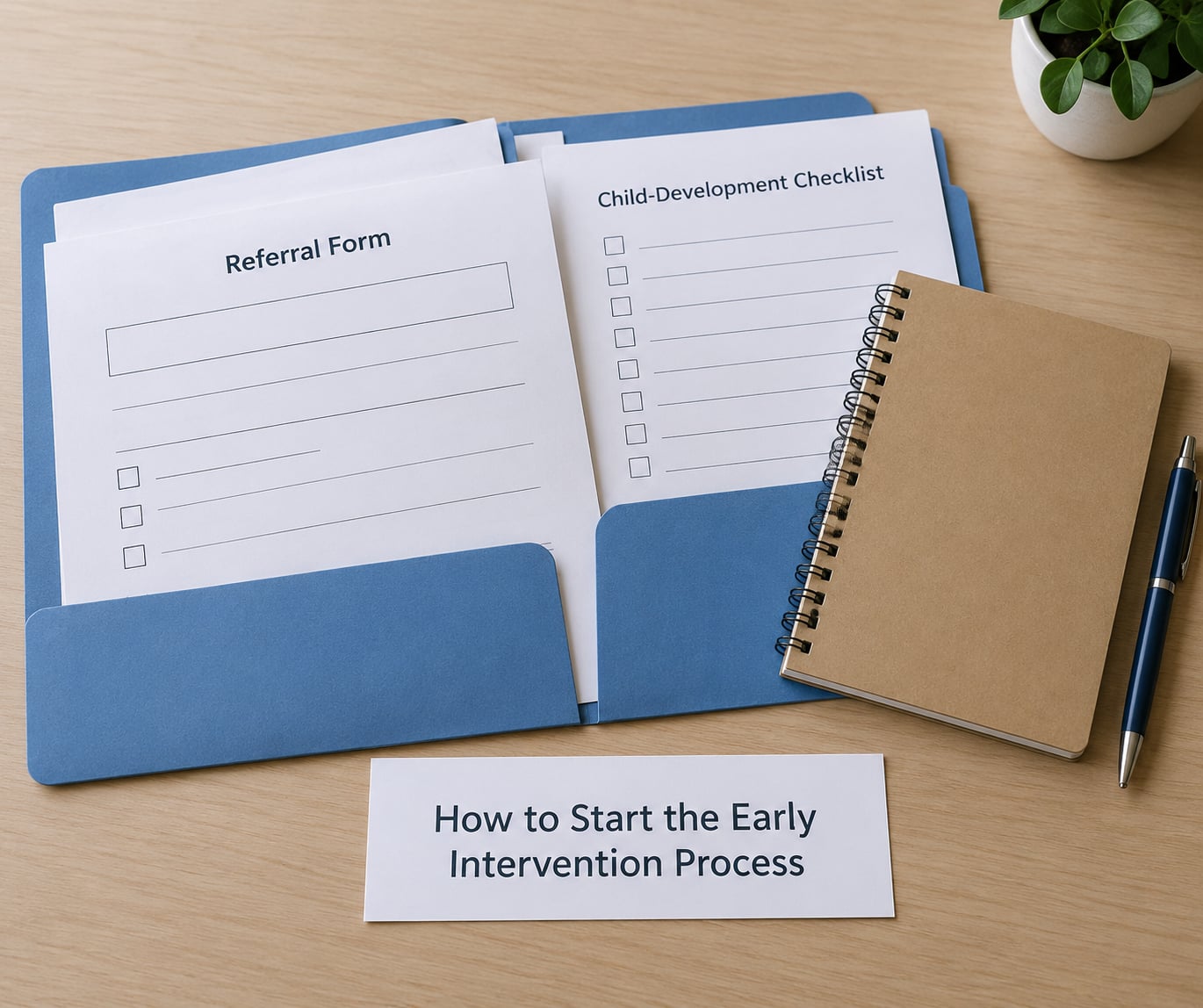
The path runs from referral to a written plan, and the whole sequence has a federal clock attached. From the date you give consent for the evaluation, you have 45 days to have an eligibility decision and a written plan, or 45 days from the date of your child’s first evaluation. Some states move faster, so ask yours for the exact timeline.
Step one is the referral. Anyone can refer, including you. Your child’s doctor, daycare, or hospital can refer too, but parents should know that a self-referral is legal everywhere and does not put you behind a doctor’s queue. Many families make the call in one evening after a milestone does not happen.
Step two is intake. The program assigns a service coordinator, collects your paperwork, and asks a handful of questions about your child, your family, and your concerns. Give your real reason for calling, not a polite one. Saying “he does not use words at all” gets you a different response than “he is progressing nicely.”
Step three is the evaluation. A multidisciplinary team looks at the child across five areas: cognitive, physical, communication, social or emotional, and adaptive. They typically use observation, parent interview, standardized screening tools, and sometimes a hearing check. The team also wants to hear from you, and your daily observations carry real weight here.
Step four is the eligibility determination. Within the 45-day window, the team decides whether your child meets the state’s definition of eligible. You receive the decision in writing, along with the reasons and the data behind it. If you disagree, you are entitled to a due process hearing, and you can also ask for an independent evaluation at the state’s expense. Parents rarely do this, and it is worth knowing the option exists.
Step five is the IFSP meeting, and it is the most important half hour of the whole process. The Individualized Family Service Plan is a written document you write together with the team. It lists what your child is working on, the services chosen, who delivers them, how often, and where. It also has to describe the supports your family needs, which is a part many parents forget to bring up.
Step six is services beginning. You sign only the services you want. Declining a service is allowed and does not take the rest away, though the team will want to talk through the reasons first.
How to Prepare for an Early Intervention Evaluation
Write things down before the visit. A short notebook, used weekly, beats a hazy memory at a conference table.
- What your child can do now, in plain descriptions. “Uses two-word phrases about 20 times a day” beats “speech is behind.”
- What worried you and roughly when you noticed it.
- What your child used to do and no longer does. Loss of a skill is one of the most important things to report.
- How a typical day runs: meals, naps, play, bath time, bedtime, and how your child handles each.
- How your child communicates right now: words, sounds, gestures, signs, or a device.
- Medical history, including prematurity, hospital stays, hearing screening results, and any diagnoses.
- What you have already tried, and what helped or did not.
Bring the notebook and ask to keep it. You are allowed to ask questions beforehand, and you are allowed to know who is evaluating your child and what they are looking at. Also ask what outcome is possible, because none is guaranteed. An evaluation describes where a child is on a given day and supports a plan. It does not predict a future.
One more thing. Bring your questions about the child’s doctor. If you suspect hearing loss, a feeding problem, or a medical condition driving the delay, ask the early intervention team to help you line that up. They see developmental needs, not medical ones.
What Parents Can Ask at the First Meeting
The first meeting is usually paperwork and logistics, and families leave it without knowing what to do next. Bring a list, or use these as the list.
- Which goals are the top priority for the next six months, and which can wait?
- How many visits per week, how long each one, and in what setting?
- Which natural settings are you using: home, daycare, a relative’s home, community?
- How much of the visit is hands-on work with my child versus coaching me?
- What are the credentials of each person coming to my home?
- How often will progress be reviewed, and who writes it down?
- Can I see the written plan before services start, and can I request changes?
- How do I request a service I think my child needs and was not offered?
- What happens at my child’s third birthday, and who will help with the transition?
- If I disagree with a recommendation, what is the process for that?
- If you change therapists, coordinator, or schedule, who do I contact?
Take notes or bring someone with you. You can record the meeting if you ask everyone in advance. And if a service is offered that you do not want, you can decline it on the IFSP without losing the rest of the plan.
One question that catches people off guard: how do I get more hours. Recommended frequency often comes out lower than parents expect, partly because programs are working within staffing limits. Parents on parent forums frequently report pushing for more in writing, keeping their own record of every visit, and tracking progress with dates attached. A dated record of what was recommended, what was delivered, and what changed is the strongest document you can have in that conversation.
Do Early Intervention Services Cost Anything in the U.S.?
For eligible children, services are provided at no charge. That is not a marketing line. It is what Part C requires, and it is the single fact most parents find surprising.
What that covers varies by state, so it is worth knowing the split.
| Cost | What it usually means |
|---|---|
| Always free | Evaluation, eligibility determination, the IFSP meeting, and the early intervention services listed on the plan, for eligible children |
| Possibly chargeable | Additional services beyond what Part C funds, such as a device, a specialized durable item, or services a state has the option to bill for |
| May trigger a fee | Some states assess a sliding-scale fee or seek reimbursement from Medicaid or private insurance for items beyond the Part C benefit |
| Your choice | Private therapy and other services you pursue on your own, which insurance may or may not cover |
A sliding-scale fee, when a state has one, is based on family income, and public agencies usually cannot bill for the services themselves and still hold a child eligible. Insurance and Medicaid coordination is common for devices and medical equipment. Ask three specific questions: is there any fee for my family’s situation, is there a sliding scale, and will anything be billed to my insurance.
Cost is one of the top worries parents raise, and it is nearly always less bad than they feared. The far larger practical issue is waitlists, which vary by state and provider, and which no article can promise away. Ask about the typical wait when you call, ask for a spot on the list in writing, and ask what happens if your situation changes.
What to Do While Waiting for Early Intervention Services
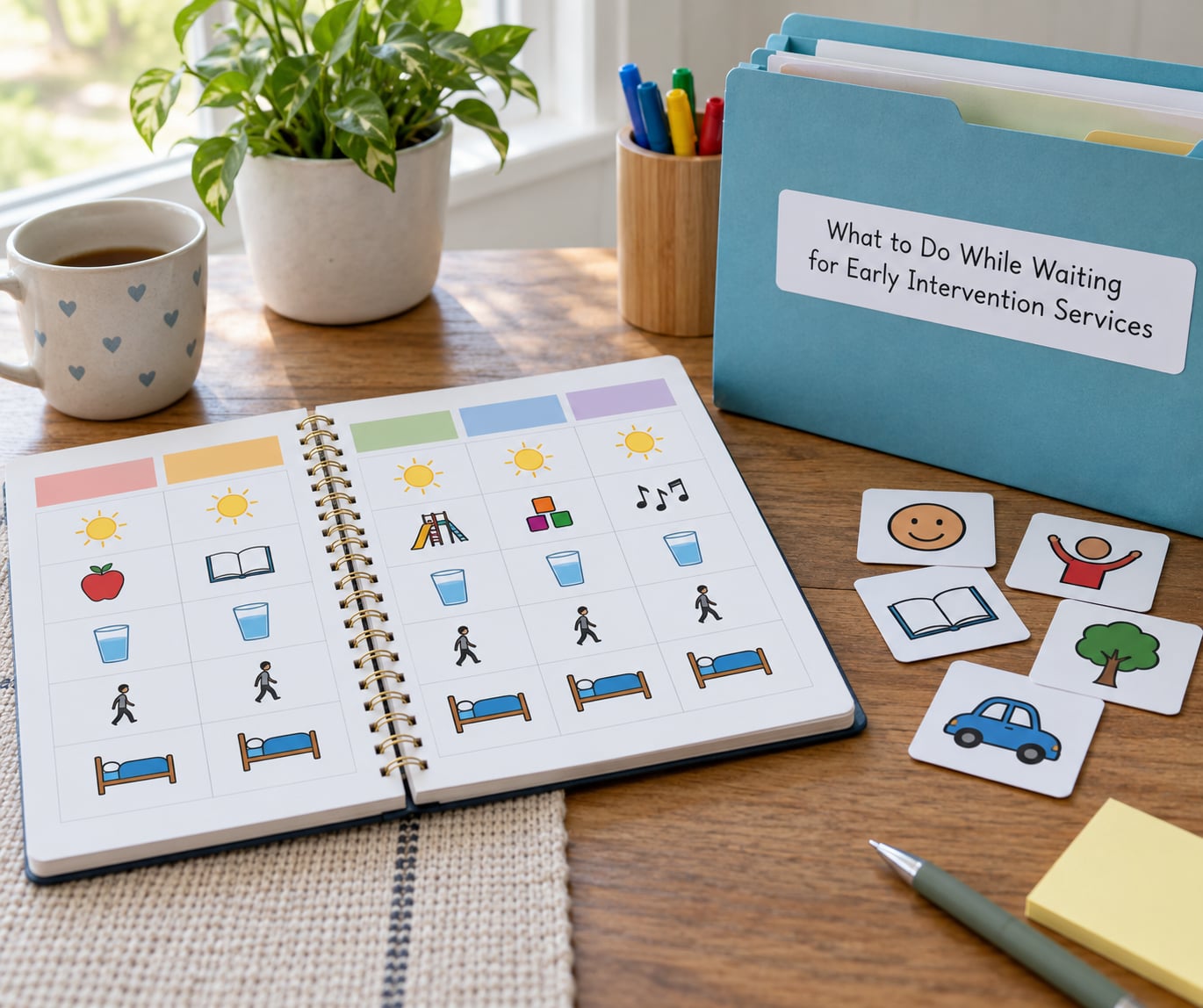
Waiting is the hardest part, and it is where most of the useful groundwork happens. None of this substitutes for evaluation or therapy, and all of it is safe, free, and reasonable.
Keep your observations written down with dates. A notebook or a note on your phone is enough. When the evaluation comes, this is the most valuable thing you will hand over, and it becomes your own record for advocating later.
Build a simple daily routine your child can predict. Same order, same rough times, with a visual you point to each step. Predictability lowers the number of meltdowns you have to manage, which gives you more energy for the work that matters.
Support communication in every way available. Narrate what you are doing, name the object before you hand it over, pause and wait, respond to any sound your child makes, and add two or three signs or gesture words. Follow your child’s focus. Waitlists are a good time to build these habits, because they carry over into therapy.
Protect your own well-being. Caring for a child with delays is hard work on a normal week’s schedule, and it is harder when a waitlist is stretching in front of you. Parent support groups, respite programs, and siblings’ services exist for exactly this, and using them is not a failure to cope.
Keep asking your child’s doctor about medical questions, especially hearing, vision, sleep, and feeding. And do not wait to raise urgent concerns. Loss of a skill, a change in behavior, poor growth, breathing trouble, or a feeding safety concern are reasons to call a doctor now, not reasons to wait for a developmental evaluation.
If you are outside the United States, the name of the program and the age range change from country to country. Some systems use different labels for the same kind of support, and funding is national or regional rather than state-run. The service categories described here map onto most international systems even when the paperwork does not. Ask your health service or local authority about developmental services for infants and toddlers and treat this guide as background reading.
Frequently Asked Questions
What is the difference between early intervention and early childhood services?
Early intervention in the U.S. is a specific federal program under Part C of IDEA, serving infants and toddlers from birth through age two with delays or disabilities, delivered at no charge with the family at the center. Early childhood services is a broader term that covers everything from infant care and Head Start to preschool classrooms and special education. Some states fold early intervention into a wider early childhood system, so the label you hear may be either one.
How old must my child be to request early intervention services?
In the United States, Part C serves children from birth until their third birthday. You can refer at any point before that, and you can refer a child you are worried about before you have a diagnosis or even before you are certain something is different. If your child turns three before services begin, ask your program about evaluation timelines, because the evaluation itself usually can continue under Part B.
Do I need a diagnosis before requesting an evaluation?
No. Parents can self-refer in every state, and eligibility is based on delay or an established qualifying condition, not on a diagnosis. A doctor can refer you, and their concern carries weight with the team, but it is not a requirement. Some children with a confirmed chromosomal or genetic condition are found eligible without a full evaluation, which is worth asking about if it applies.
Can early intervention services be provided at home?
Yes, and home visits are the standard under Part C. The program must provide services in natural environments, which means where your child actually lives and plays, not only in an office. That can include your kitchen table, a daycare, a relative’s home, or a community program. If a setting such as daycare is where your child spends most of the day, ask for services to happen there.
What should I do if my child is not eligible for early intervention?
First ask for the decision in writing with the reasons and the data behind it. You are entitled to an independent evaluation at the state’s expense and to a due process hearing. In the meantime, keep tracking your child, ask your doctor about medical or hearing causes, and consider private therapy if you can afford it. Ask the program to keep monitoring, since a child found ineligible now may qualify later.
Conclusion
Early intervention services exist to give a young child developmental support and to give a family the skills to support them every day, at no cost to eligible families. You do not need a diagnosis, you can refer your own child, and services happen in the rooms where your child already plays.
Here is the short version of what to do next. Find your state’s early intervention program or its IDEA Part C coordinator and ask how to request an evaluation for your child. Start a short notebook this week and record what your child can do, what has changed, and what your daily routines look like. Then bring that notebook to the first meeting, alongside your list of questions about goals, hours, and setting.
For anything about your child’s specific health or development, your child’s doctor is the right first call. And if you are waiting, waiting is a reason to write things down and keep talking, not a reason to stop looking.