
There are five main routes, and the right one depends on your body, your partner’s body, your ages, your finances, and where you live.
LGBTQ parents build families today through assisted reproduction with donor gametes, gestational surrogacy, adoption, foster care, or raising children from earlier relationships. According to the Williams Institute at UCLA, 78% of LGBTQ parents became parents through a current or previous sexual relationship, 20% through stepparenthood, and 6% through adoption. Those numbers describe how families actually form; they are not a menu of what is allowed.
What has changed most is the legal scaffolding underneath those choices. Marriage equality, adoption law reform, and a larger network of affirming clinics and agencies mean more options exist than a generation ago. It also means the hard parts have moved: cost, insurance gaps, paperwork, and finding professionals who will actually treat you like a future parent. This guide walks through each pathway honestly, including where it breaks down.
Nothing here is medical or legal advice. For decisions about your body, your contract, or your rights, you need a licensed clinician and a family-building attorney in your state, not a general web page.
Table of Contents
- What Family-Building Options Do LGBTQ Parents Have?
- How LGBTQ parents build families differently by body, identity, and location
- How Do LGBTQ Parents Choose Between Adoption, Surrogacy, and Donor Conception?
- How Do Donor Insemination and IVF With Donor Gametes Work?
- What Does LGBTQ Adoption or Foster Care Involve?
- What Legal Documents Do LGBTQ Parents Need?
- How Can LGBTQ Parents Find Inclusive Healthcare and Support?
- What Does It Cost to Build a Family as an LGBTQ Parent?
- How Can LGBTQ Parents Build a Supportive Family Community?
- Frequently Asked Questions
- Can LGBTQ parents adopt children in the US?
- What is the difference between surrogacy and donor insemination for LGBTQ parents?
- How can LGBTQ parents establish legal parentage?
- Do LGBTQ couples need IVF to have a child?
- How do you find an LGBTQ-friendly fertility or adoption provider?
- What support is available for LGBTQ parents and chosen families?
What Family-Building Options Do LGBTQ Parents Have?

LGBTQ parents build families through five pathways, and they are more different from each other than the word “family-building” suggests.
- Assisted reproduction with donor gametes. Intrauterine insemination (IUI) places donor sperm directly into a uterus. In vitro fertilization (IVF) creates an embryo outside the body and transfers it into a uterus. This is the most common biological route for two dads and for some two-mom couples.
- Reciprocal IVF. One partner donates eggs, the other carries the pregnancy. It is sometimes called shared egg donation, and it lets two women in a couple each contribute biologically.
- Gestational surrogacy. A third party carries the pregnancy. Genetically, the baby belongs to the intended parents. This is the standard route for two dads who want a child genetically related to them.
- Adoption. Adoption from foster care, through a private agency, or internationally. Same-sex couples can also adopt a child conceived through donor insemination, then complete a second-parent adoption to secure both parents’ rights.
- Foster care and stepparenting. Raising a partner’s child from a previous relationship, or becoming a foster parent with the possibility of adoption later. Both are real family-building routes, not consolation prizes.
Transgender and nonbinary parents may use any of these, plus some options the rest of this article does not cover. Some trans men carry pregnancies with their own eggs. Some trans men use testosterone and then pause it to carry. Some nonbinary people use their uterus, some do not, and some plan to stop using it. In r/ftm threads, this range comes up constantly, and the practical answer is always the same: a clinician who works with gender-diverse patients and understands your specific plan.
How LGBTQ parents build families differently by body, identity, and location
Two couples with identical incomes can face completely different menus depending on their bodies. Where one pair needs a clinic and a donor, another may need only an adoption home study. State and country matter as much as biology: some jurisdictions extend second-parent adoption automatically, others still require a court process with a social worker involved.
Access is also geographic. Fertility clinics that are genuinely affirming concentrate in large metro areas. In smaller towns and rural areas, many intended parents end up travelling for appointments or working through telehealth for the counseling portions of a cycle, then travelling for the transfer or the birth.
How Do LGBTQ Parents Choose Between Adoption, Surrogacy, and Donor Conception?
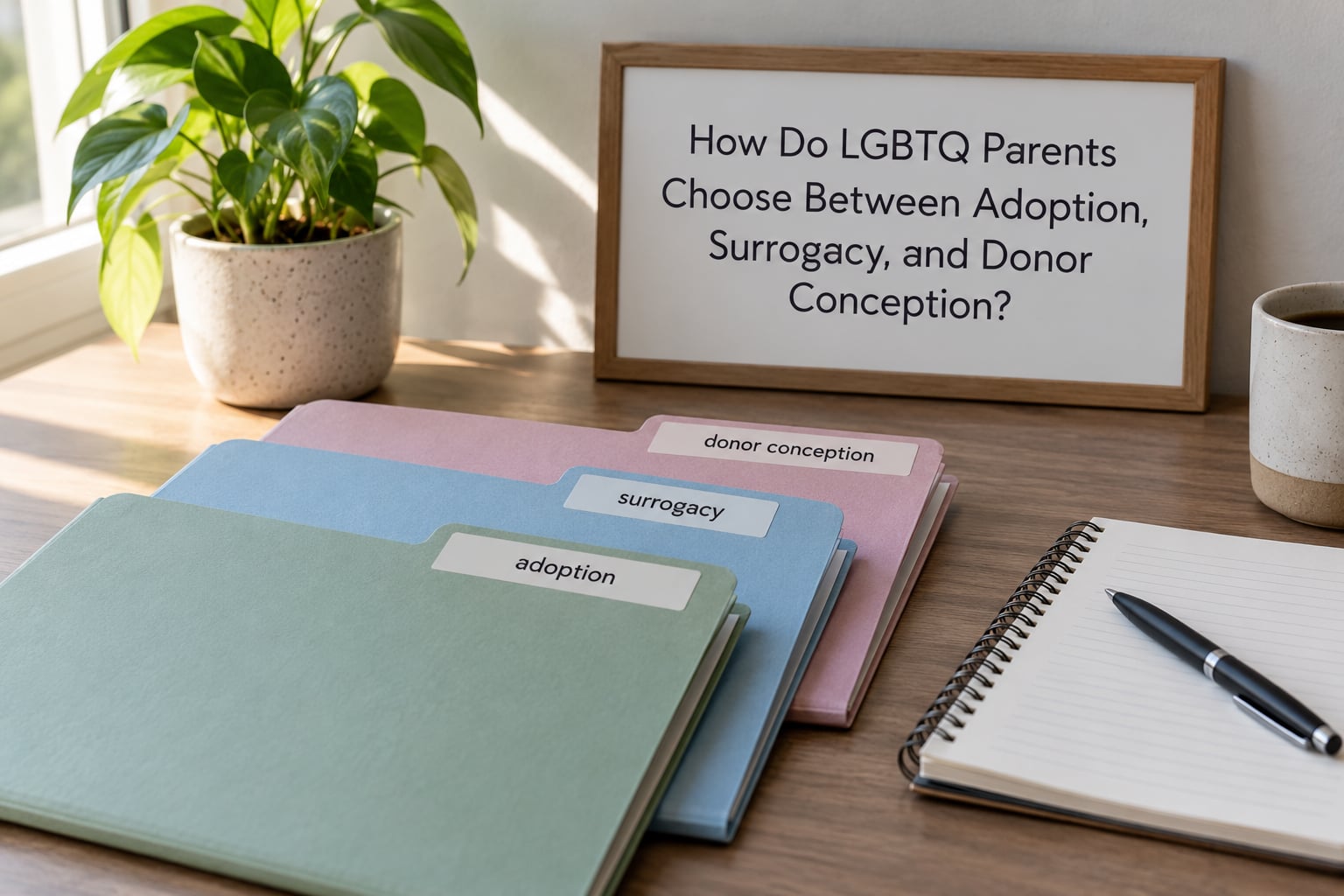
Compare the three routes on seven things: how long they take, how much medical involvement you want, how much control you have over the pregnancy, what legal paperwork is required, what the emotional load looks like, what it costs, and who is eligible.
| Pathway | Typical timeline | Medical involvement | Key legal step | Main barrier |
|---|---|---|---|---|
| Donor insemination (IUI) | Several months to over a year | Ongoing, cycle by cycle | Donor consent and parentage paperwork | Success rates vary widely |
| IVF with donor gametes | Roughly 10 to 14 weeks for one cycle | High, including egg retrieval | Parentage order at transfer | Cost and repeated cycles |
| Reciprocal IVF | About a year end to end | High, two coordinated procedures | Embryo transfer agreement | Scheduling two bodies |
| Gestational surrogacy | About 12 to 24 months | Moderate for intended parents | Surrogacy contract and parentage order | Cost and agency vetting |
| Adoption from foster care | Months to several years | None | Licensing, home study, finalization | Agency rules and placement timing |
| International adoption | Often 1 to 3 years | Travel required | Home country and US federal review | Country-specific restrictions |
Adoption gives you no control over prenatal environment or medical decisions. Surrogacy gives you a say in the clinic and the contract but not in the biology, and it is the most expensive route by a wide margin. Donor conception puts you in charge of the medical timeline, but the odds of success per attempt can be the hardest number to sit with.
Before committing to a path, ask yourself some sharper questions. Do you want a child biologically related to you, and does that need to be true for both of you? How much uncertainty can your relationship absorb? What happens to the plan if the first cycle does not work, or if the adoption agency says no? Who will handle the paperwork, and are they a lawyer or a clinic coordinator?
The last question comes up constantly in r/gaybros threads, and the answer is consistent: hire a reproductive or family-building attorney who works with LGBTQ+ families. Clinics hand you paperwork for the medical side. They usually do not handle the legal side, and a mismatch there is how intended parents end up in a courtroom they did not plan for.
How Do Donor Insemination and IVF With Donor Gametes Work?
IUI is the simpler option. A sperm donor’s sample is prepared, then placed into the uterus during ovulation. No egg retrieval, no anesthesia, and it can sometimes be repeated over several cycles. It requires a uterus, and it is not appropriate for every body or every medical history.
IVF is more involved. One partner undergoes ovarian stimulation and egg retrieval, eggs are fertilized in a lab, and an embryo is transferred to a uterus, either a partner’s or a surrogate’s. When one woman donates eggs and the other carries, that is reciprocal IVF.
Donors are not anonymous blanks. Clinics match on things like blood type and genetic screening, and reputable programs collect detailed family medical histories. Consent documents vary enormously: some donors are anonymous, some are semi-open, and some are known donors who plan to be involved.
That last category deserves care. Forum discussions about second-parent adoption often begin with a known donor whose rights did not get terminated properly. A written agreement, handled by a lawyer, before conception does more to prevent that mess than anything afterward.
Medical parenthood and legal parenthood are separate systems. The person who carries the pregnancy is the legal mother in nearly every US state, regardless of who donated the egg. That is why intended parents secure a parentage order or second-parent adoption. A reproductive attorney drafts it, and a judge signs it, and that document is what you show a school, a doctor, or an airline.
Ask your clinic what it does and does not coordinate. If the answer is nothing about parentage, that is a gap to fill with a lawyer before you transfer, not after.
What Does LGBTQ Adoption or Foster Care Involve?
Adoption and foster care share a front end: licensing, training, a home study, and matching. The difference is the destination. Foster care is a placement that may become permanent. Adoption is permanent by definition.
The sequence usually looks like this. You complete orientation and training, submit documents including your partnership or adoption agreement and a birth certificate, submit fingerprints and a background check, then host a home study with a social worker who visits. After approval you enter a matching period, receive a placement, and move to finalization, where a judge terminates the previous parents’ rights and names you legal parent.
Home study preparation comes up often enough that it deserves its own answer. Social workers want to know how you handle disagreement, how you plan on childcare and health coverage, how you would explain your family to a child at different ages, and whether your relatives are supportive or hostile. Honest answers beat polished ones, and a social worker can tell the difference.
Some agencies with religious affiliations may decline same-sex applicants under religious exemptions, which expanded after Fulton v. City of Philadelphia. r/Adoption members are blunt about this: ask about policy on the first call, before you send a single document. Ask whether unmarried couples are accepted, whether a same-sex couple can adopt regardless of gender, and whether the agency has placed children with LGBTQ+ families before.
On foster care, several states restrict or pause placements by sexual orientation. The John Lewis Every Child Deserves a Family Act was introduced to bar that discrimination, and its status has shifted. Ask your state child welfare agency directly, in writing, what its current policy is.
What Legal Documents Do LGBTQ Parents Need?
Four documents cover most situations: a second-parent adoption or parentage order, a donor conception agreement, a surrogacy agreement, and a co-parenting agreement. Which one you need depends on the pathway, and none of them is optional paperwork you can skip for convenience.
Second-parent adoption lets a second adult without a biological or gestational tie become a legal parent without ending the first parent’s rights. In some states it is a streamlined administrative process. In others it runs through family court with a social worker, a home study, and a judge. This was the workaround when adoption law assumed two parents of different genders; it is now the standard tool.
Donor agreements set terms for the donor’s role, contact, genetic information, and rights. Surrogacy agreements cover compensation, medical decisions, confidentiality, and intended parentage, and they work best when drafted by a lawyer who does this work regularly rather than borrowed from a clinic template.
The federal backdrop helps but does not do the work. Obergefell v. Hodges established marriage equality nationwide, and Bostock v. Clayton County extended employment nondiscrimination protections on the basis of sexual orientation and gender identity. Those rulings are not the same as a right to adoption, to fertility coverage, or to medical decision-making authority, all of which vary by state and by institution.
Treat this as general information. Laws change, and an attorney in your jurisdiction should confirm your specific options before you sign anything.
How Can LGBTQ Parents Find Inclusive Healthcare and Support?
You can vet a clinic or agency without being polite about it. The questions below are the ones that actually predict whether a provider is safe to hand your care to.
- Do you work routinely with same-sex couples, and with trans and nonbinary intended parents specifically?
- Who is listed on the birth certificate, and how do you handle parentage orders?
- Is the second parent’s name on all paperwork, or only the gestational parent’s?
- What happens if staff misgender me or misname my partner? What is your policy?
- What are your privacy practices, especially for records involving gender history?
- Do you offer telehealth or remote counseling for clients who travel for appointments?
- Do you accept my insurance, and what is genuinely covered versus self-pay?
The HRC Healthcare Equality Index is a useful starting point because it scores major healthcare systems on things like bedside visits and staff training. It is a coarse filter, not a guarantee, so treat it as a shortlist builder rather than an answer.
Beyond clinical care, look for mental health support from therapists who work with gender-diverse and queer families. Expectant parents in this group tend to carry more questions about discrimination, disclosure, and their child’s future than the average patient, and that deserves real clinical time rather than a standard intake form.
Ask to speak with the person who would actually be in the room with you. A receptionist being affirming means very little if the attending physician has never been through a trans patient delivery.
What Does It Cost to Build a Family as an LGBTQ Parent?
Cost is the largest single barrier for most LGBTQ+ intended parents, and it varies by an order of magnitude between pathways. Rather than quote figures that change month to month, here are the categories to ask providers about, and what drives them.
- Medical: cycle fees, medications, genetic testing, and the number of attempts. Repeat cycles multiply this quickly.
- Donor: sperm or egg donor compensation and agency fees, which depend heavily on how much profile information and contact you buy.
- Surrogacy: compensation, agency fee, legal fees, IVF costs, and travel. This is the highest-cost pathway by a wide margin.
- Adoption: home study, legal, and agency fees. Foster-to-adopt is often far cheaper than private domestic or international adoption.
- Ongoing: childcare, health insurance for a newborn, parental leave coverage, and school costs that arrive later.
Insurance is where the frustration concentrates. Coverage for donor gametes and surrogacy is inconsistent, and same-sex married couples sometimes pay more than a comparable couple with different conception circumstances. Ask your insurer directly about fertility coverage, donor conception, and surrogacy, and get the answer in writing.
The financial picture is not evenly shared. Williams Institute data found that about 33% of LGBTQ parents live in poverty, which is why a plan that works in a large metro area can collapse somewhere else. Black LGBTQ adults parent at higher rates than white LGBTQ adults, 23% compared with 17%, and they tend to start from a thinner financial base to do it.
Get current estimates directly from the providers and organizations you are considering. Grant programs, nonprofit fertility funds, and employer benefits can also shift a large share of a budget, and they are worth asking about before you assume a number.
How Can LGBTQ Parents Build a Supportive Family Community?
Connection to other LGBTQ+ families is the protective factor parents mention most often. Gay Parents To Be runs donor conception and surrogacy support groups, GWK Academy offers cohort-based education for intended parents, and Family Equality brings families together through local chapters and an annual gathering. Local and regional groups are often the most practical.
Chosen family works the same way friendship and blood family does, with more intention. Pick the people who show up to the hard year, agree on who does what, and say the quiet part out loud before you need it.
School communication deserves its own plan. Know your district’s anti-bullying policy and how it names protected groups, introduce yourself early to a teacher or counselor rather than after an incident, and decide together as a couple what your child is told about why they have two dads or two moms and when. There is no perfect script.
Set boundaries on unsolicited questions. Whether you have a partner, are single, used donor conception, or are adopted yourself, you are allowed a short honest answer that ends the conversation. Prepare it in advance and agree on it as a couple so you are not improvising under pressure.
And protect your marriage and your friendships from the process itself. Surrogacy, in particular, gets described as emotionally rewarding and logistically brutal, with complications nobody budgeted for. Build slack into the timeline and into the relationship.
Frequently Asked Questions
Can LGBTQ parents adopt children in the US?
Yes. Same-sex couples can adopt through foster care, private domestic agencies, and international adoption, and they can adopt a child conceived through donor insemination and then complete a second-parent adoption. Requirements vary by state and by agency, and some agencies with religious affiliations may decline applicants under religious exemptions. Ask about your specific profile on the first call, before sending paperwork.
What is the difference between surrogacy and donor insemination for LGBTQ parents?
Donor insemination is a medical procedure where donor sperm is placed into a partner’s uterus, so the partner carries the pregnancy. Gestational surrogacy uses a third party who carries a pregnancy created from your gametes, so you are the genetic parent but not the one who is pregnant. Surrogacy costs far more and takes longer. The right choice depends on bodies, goals, and finances.
How can LGBTQ parents establish legal parentage?
Most often through a second-parent adoption or a parentage order filed at the time of transfer or birth. In some states this is an administrative process; in others it runs through family court with a home study. Donor conception agreements and surrogacy contracts usually need to be drafted by a family-building attorney before conception, so that both intended parents’ rights are clear from the start.
Do LGBTQ couples need IVF to have a child?
No. IVF is one option, not a requirement. IUI is simpler and less involved. Reciprocal IVF lets one partner donate eggs and the other carry. Two dads generally need either a surrogate or a partner with a uterus. Two moms may carry, use reciprocal IVF, or choose adoption. The right path depends on your bodies, your age, and whether you want a child genetically related to you.
How do you find an LGBTQ-friendly fertility or adoption provider?
Start with the HRC Healthcare Equality Index for a rough screen, then ask direct questions: do you work with same-sex and trans intended parents, who is listed on the birth certificate, how do you handle parentage orders, and what is your policy on misgendering or misnaming a partner. Ask to speak with the clinician who would actually be involved, not just the intake coordinator.
What support is available for LGBTQ parents and chosen families?
National nonprofits such as Family Equality and GWK Academy run support groups, mentorship, and local chapters, and Gay Parents To Be offers groups for intended parents by pathway. Affirming therapists, local LGBTQ+ family groups, and parent advocacy networks add practical support on school climate and healthcare advocacy. Parents consistently say connection to other LGBTQ+ families is the strongest protective factor.
If you take one step this month, make it a shortlist call to an affirming clinic or agency rather than more reading. Ask the seven vetting questions, get a current cost estimate in writing, and get your name in front of a family-building attorney before you sign anything.