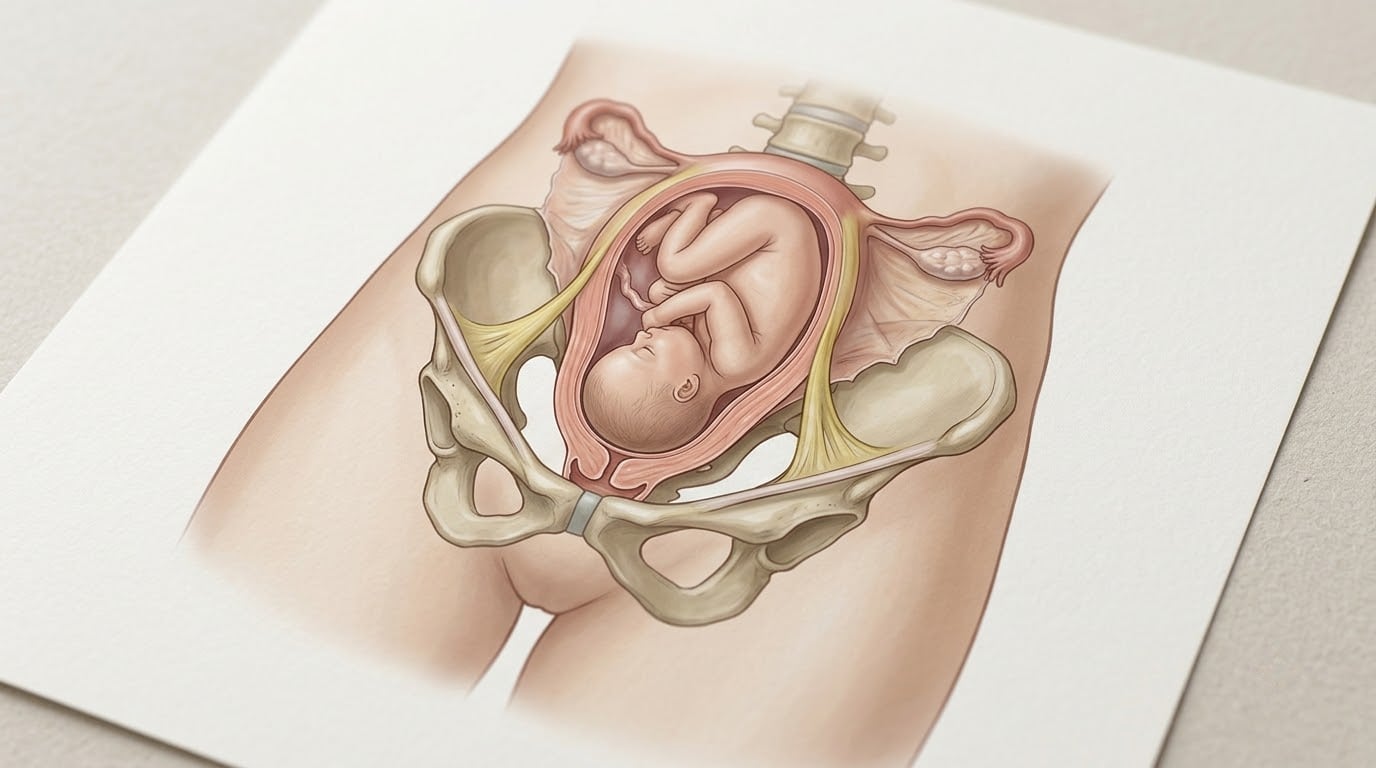
Round ligament pain in pregnancy is a sharp, brief stab or a dull ache in the lower belly or groin, caused by the supporting ligaments that hold your uterus in place as it grows. It shows up most often in the second trimester, and it usually settles within seconds to a few minutes. This guide covers what causes it, what it feels like, what helps, and which symptoms mean you should call your clinician.
The word “explained” in the search phrase matters here, because most of the anxiety around this symptom comes from not knowing whether a twinge is ordinary stretching or something that needs attention. Once you know what the ligaments do and what typical pain looks like, the guessing gets easier.
Table of Contents
- What Is Round Ligament Pain in Pregnancy?
- Why Does Round Ligament Pain Happen?
- Uterine growth outpaces the ligaments
- Hormones make everything looser
- Sudden movement is the trigger
- Blood flow and pressure changes add to it
- Posture and daily mechanics
- When Does Round Ligament Pain Usually Start?
- Can round ligament pain start in the first trimester?
- Does round ligament pain go away before delivery?
- What Does Round Ligament Pain Feel Like?
- Round ligament pain or something else?
- Is round ligament pain a good sign?
- What Can Help Relieve the Pain?
- Slow every movement down
- Roll over in bed with your hips stacked
- Support the weight
- Use gentle warmth
- Bend with your knees, not your back
- Keep water and activity steady
- Ask about acetaminophen before you take it
- When home measures are not enough
- When Should You Contact a Healthcare Professional?
- Frequently Asked Questions
- Is round ligament pain normal during early pregnancy?
- How can I tell round ligament pain from cramps or other pregnancy pain?
- Does round ligament pain happen on both sides or only one side?
- What activities should I avoid if round ligament pain is uncomfortable?
- When is round ligament pain a reason to call a doctor?
- Conclusion
What Is Round Ligament Pain in Pregnancy?
Round ligament pain is the sensation of the two cord-like ligaments that run from the upper uterus down to each side of the groin being stretched and tugged. Each one is roughly 10 to 12 centimeters long, and they act like guy wires that keep the uterus anchored in the pelvis. As the uterus enlarges, those ropes get longer, thicker and more reactive, and they can spasm.
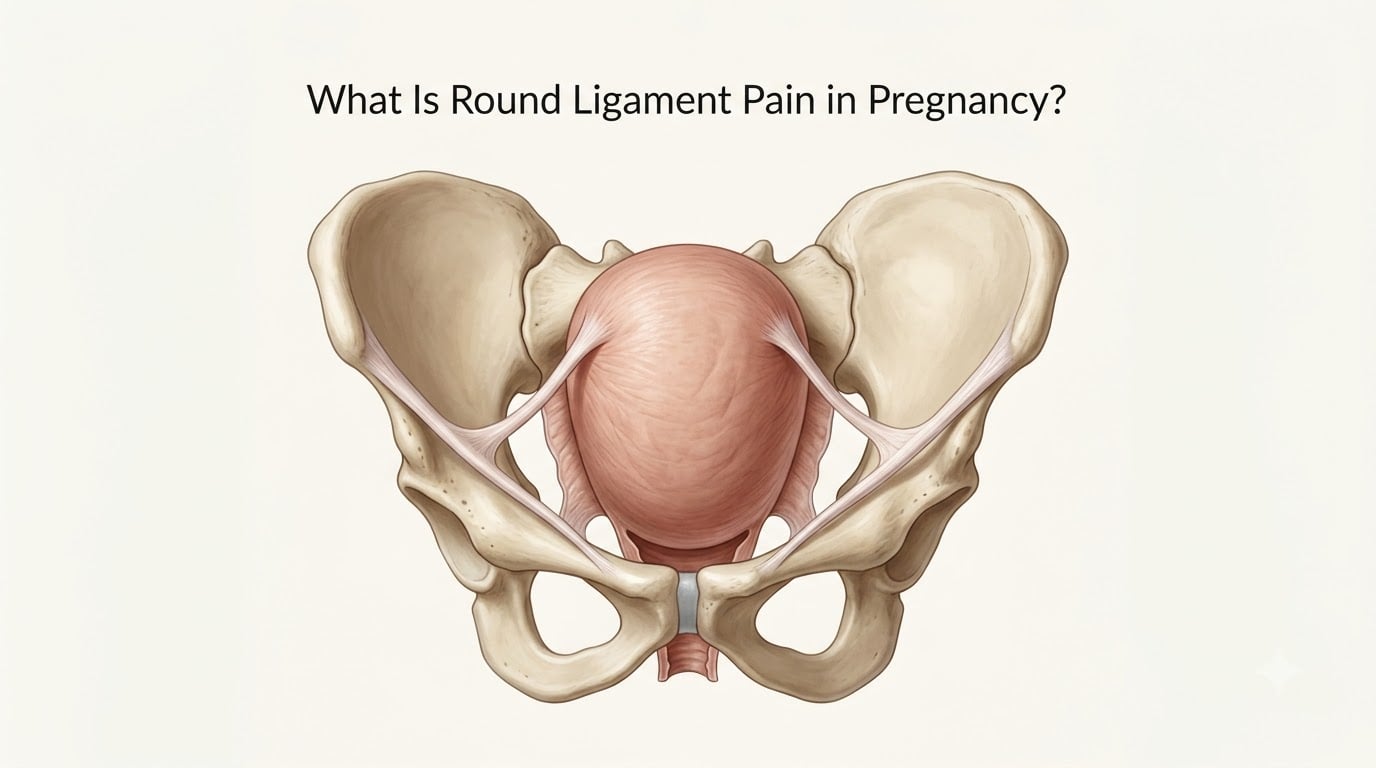
Roughly three in ten pregnant people report some version of this pain, which makes it one of the more common causes of lower abdominal discomfort in pregnancy. It is not a sign that something is broken, and it does not mean your body is failing. It means connective tissue under new load is doing its job.
One honest note about the name: “round ligament pain” is a convenient label rather than a precise diagnosis. If your pain is constant, centered low in the pelvis, or concentrated in the pubic bone, you may be looking at a different structure altogether, such as the pubic symphysis joint. Your midwife or OB-GYN can sort that out with an exam.
Most people first notice it between about 10 and 14 weeks, when the uterus starts rising out of the pelvis. After that it comes and goes based on how you move, how your baby is positioned and how your ligaments happen to be coping that day.
Why Does Round Ligament Pain Happen?
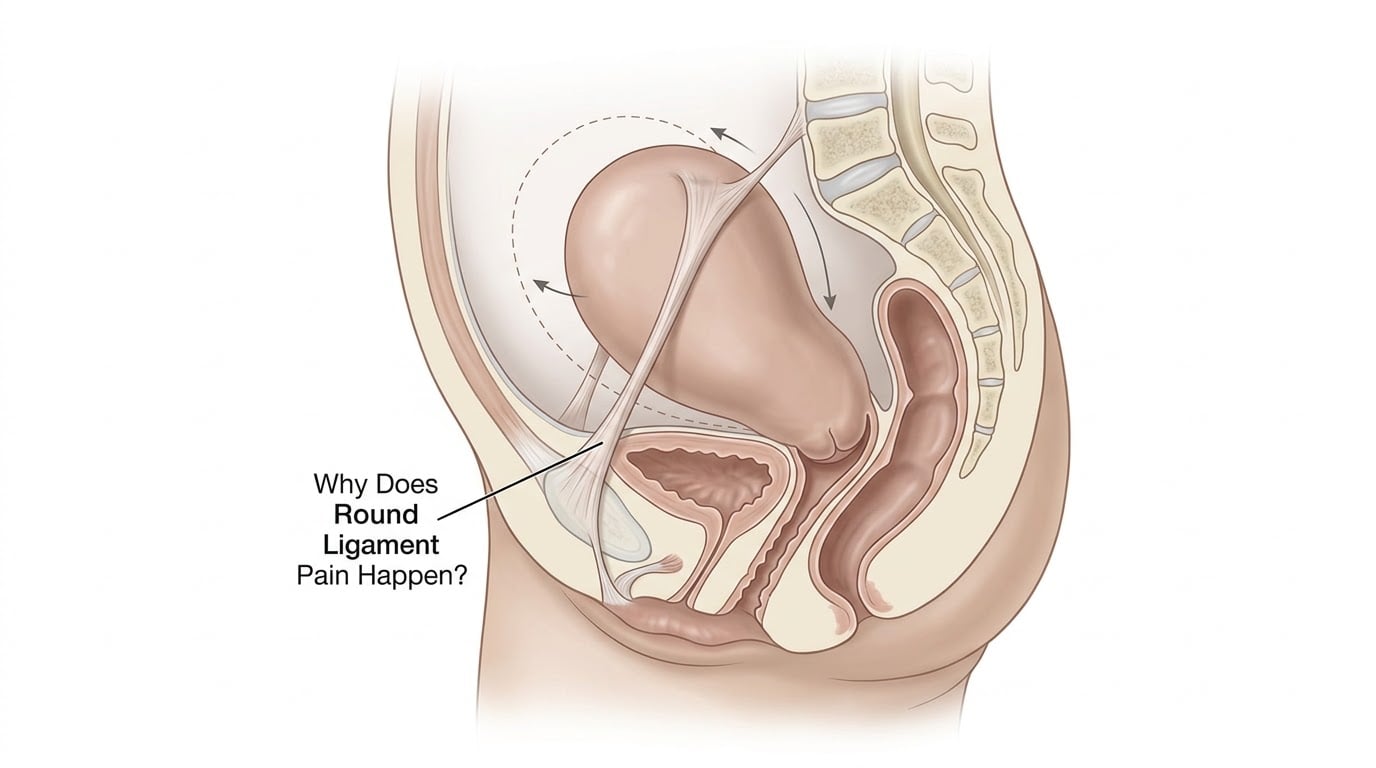
The short answer is stretch, in four directions at once: the uterus grows, the ligaments lengthen, the joints soften, and your center of gravity shifts forward.
Uterine growth outpaces the ligaments
A non-pregnant uterus is roughly the size of a fist. By late pregnancy it holds several pounds of baby, placenta and fluid, and it moves up and out of the pelvis as it grows. The round ligaments have to lengthen to allow that, and tissue under tension that is suddenly asked to move will send a very clear signal: pain.
Hormones make everything looser
Progesterone, estrogen and relaxin change how your connective tissue behaves. Joints and ligaments become more mobile, which is helpful for childbirth and mildly annoying on a staircase. That extra give also means the ligaments absorb movement less efficiently, so the same bend or twist tugs harder than it used to.
Sudden movement is the trigger
Ligaments fire when they are stretched quickly, not when they are stretched slowly. That is why a slow roll onto your side is fine and a fast sit-up from a chair is not. Sneezing, coughing, laughing hard, blowing your nose, standing up quickly, getting out of bed, walking up stairs and rolling over in bed are the movements people name most often.
Blood flow and pressure changes add to it
Blood volume rises through pregnancy, and more blood moves through the pelvis. Combined with an expanding uterus pressing against the bladder and bowel, this adds a heavy, full feeling to the lower belly that can be hard to tell apart from ligament pain on its own.
Posture and daily mechanics
Your belly grows forward and your lower back takes on more of the load. Many people start walking with their pelvis tipped forward and shoulders rolled back, which tightens the front of the pelvis and pulls on the ligament attachments. A few days of that, then a cough, is usually when the pain announces itself.
When Does Round Ligament Pain Usually Start?
For most people, round ligament pain starts between weeks 10 and 14 of pregnancy, right at the end of the first trimester, and it is most frequent through the second trimester. Not everyone follows that pattern, though, and plenty of people notice nothing until much later.
Timing varies because the ligaments stretch at whatever rate your body sets, not at a rate the calendar decides. Growth spurts, a previous pregnancy, carrying more than one baby, and how active you are all shift the window earlier or later.
Can round ligament pain start in the first trimester?
It can, though the wording of your own timeline matters. Pain described as round ligament pain at five or six weeks may really be uterine cramping, gas or constipation, which are common early and often feel similar. The ligaments themselves are still relatively slack at that point, so the uterus rising out of the pelvis is usually what brings the first clear twinges.
If you are trying to pin down how far along you are, how ultrasound dating works in early pregnancy is worth reading before you compare symptoms to a week number. Dates from the last period and dating scans do not always agree, and symptom timing is not a reliable way to re-date a pregnancy.
First-visit planning happens in the same stretch of weeks, and it is a good moment to ask about anything you are feeling. Carrier screening before pregnancy is one of the things people want explained before they book, alongside the questions about pain and nausea.
Does round ligament pain go away before delivery?
Often it quiets down. Once the uterus has risen above the pelvis and the ligaments have adapted, many people notice much less of it, sometimes for weeks at a time. It can return in the late third trimester as the uterus enlarges again and as the pelvis starts to shift in preparation for birth. Some people feel it right through to delivery; others barely notice it after 20 weeks.
Some people also feel it in the weeks after birth, particularly when recovering from a caesarean section. Forum posts on r/BabyBumps include accounts of pain that showed up only after delivery and never during pregnancy. Postpartum tissue is still healing and still lax, so it is not surprising, and it is worth mentioning at your six-week visit if it continues.
What Does Round Ligament Pain Feel Like?
It feels like a sharp, jabbing or stabbing pain low on one side of the abdomen or in the groin, often described as a pulling, stretching or cramping feeling. It tends to arrive suddenly, peak within seconds, and ease off just as fast, and it is usually worse on one side at a time. The four attributes people look for are location, sensation, duration and trigger.
- Location: lower abdomen, the side of the belly between the belly button and the hip, the groin, or sometimes the hip crease. Often one side at a time.
- Sensation: sharp, stabbing, jabbing, shooting, a pulling or stretching, or a dull ache. Some people describe a bruised or kicked feeling in the crotch that lasts hours.
- Duration: a few seconds to a few minutes per episode. Episodes can repeat over hours or days.
- Triggers: rolling over in bed, getting up, standing from a chair, coughing, sneezing, laughing, walking, stairs, exercise, sex, or holding your bladder too long.
The phrasing people actually use is worth repeating, because it is more useful than a textbook sentence. A Flo community member described it as “something inside is being stretched beyond the possible limit,” and another at 13 weeks said it “feels like being kicked in the crotch” and “feels bruised.” A reader on r/BabyBumps at 16 weeks put it this way: “It’s usually sharpest for a few minutes, but it doesn’t fully go away for hours or days.”
That last description is the one that worries people most, because most articles say “a few seconds.” The gap is real, and it usually means irritated, inflamed or simply overworked tissue rather than a new problem. What matters more than length is whether the pain is settling between triggers and whether anything else is going on.
Round ligament pain or something else?
Location and trigger pattern do most of the work in telling these apart. This table is a starting point for a conversation with your clinician, not a way to diagnose yourself.
| Condition | Where it hurts | What it feels like | What sets it off |
|---|---|---|---|
| Round ligament pain | One or both sides of the lower belly, groin | Brief sharp stab, pulling, cramping | Sudden movement, rolling over, coughing, sneezing |
| Symphysis pubis dysfunction (SPD) | Front of the pelvis, pubic bone, sometimes inner thighs | Aching or grinding that lingers | Weight-bearing, stairs, getting dressed, standing up, walking |
| Sacroiliac joint pain | Lower back, one side, sometimes into the buttock | Dull ache, sometimes radiating to hip or groin | Standing long, uneven load, rolling over in bed |
| Braxton Hicks | Front or sides of the abdomen | Irregular tightening, like a mild wave | Activity, dehydration, a full bladder, sex |
| True labor | Lower back and front of the abdomen | Regular, wave-like, progressively stronger | Comes on its own on a regular rhythm, does not settle with rest and hydration |
One distinction people search for constantly: Braxton Hicks contractions build and release, while ligament pain stabs and stops. Ligament pain is also usually tied to a specific movement, while contractions tend to arrive on their own schedule. If the pain is constant, worse with everything, or concentrated at the pubic bone, that points more toward SPD than toward the ligaments.
Is round ligament pain a good sign?
No, it is not a sign of anything beyond a growing uterus. It is not a sign of labor, it is not a sign that the baby is doing well, and it does not mean your body is ready to deliver. It is a mechanical symptom of tissue under load, which is why it comes and goes with movement rather than following a pattern your provider could read on a monitor.
That said, it is not a sign to ignore either. The useful version of the question is not “is this good or bad,” it is “does this match the pattern I described, and is anything else going on.” Those are different questions, and only the second one changes what you do next.
What Can Help Relieve the Pain?
Relief comes down to three things: slow the movement down, take the load off the ligament, and let irritated tissue settle. These measures are comfort measures, so treat them as a way to feel better rather than a treatment for anything.
Slow every movement down
The cheapest thing that works is also the hardest one. Sit up before you stand, hold the bed rail when you get up, take stairs one at a time, and stop twisting through your waist when you reach for something. Most episodes people call unpredictable are really a surprise movement.
Roll over in bed with your hips stacked
Rolling is the most reported trigger, and most people do it badly without meaning to. Keep your knees together and your hips stacked, and move as one unit rather than flinging your top leg across. The shift to your side is a small thing to learn once, and it saves a lot of 3 a.m. pain.
Support the weight
A hand on the underside of your belly when you cough, sneeze or laugh takes pressure off the attachment point. A well-fitted maternity belt or support band worn during activity can do something similar for longer stretches, and it is one of the few aids people consistently report back as useful. A pregnancy pillow between the knees or under the belly takes pressure off the front of the pelvis at night.
Use gentle warmth
A warm bath, a warm shower or a heating pad on a low setting for short periods feels good because the heat relaxes muscle around the ligament. Skip the heating pad while you are asleep, and keep it on low and against clothing, not directly on bare skin. Ice does not help everyone, but a cool pack can settle a hot, sharp episode just as quickly.
Bend with your knees, not your back
Getting out of the car, picking something off a low shelf or reaching into a bottom drawer is far kinder to the ligament when you hinge at the hips with your knees bent. A hands-and-knees position, resting on all fours and letting the belly hang, also takes pressure off for a minute or two.
Keep water and activity steady
Staying hydrated matters for a reason that is not ligament specific: dehydration makes Braxton Hicks more frequent, and a Braxton Hicks episode is easy to misread as ligament pain. Staying hydrated was the first thing r/BabyBumps readers mentioned, with the added habit of lying on the painful side with a heating pad. Gentle, regular movement such as walking, swimming or prenatal yoga generally helps more than rest alone, but the intensity that works in your second trimester may be too much by the third.
Ask about acetaminophen before you take it
If you want a pain reliever, ask your midwife, OB-GYN or pharmacist first. Acetaminophen is generally regarded as the first-line option in pregnancy, but dosing, duration and your own history are your clinician’s call, and it will not take the edge off a ligament spasm the way rest and support will. Nothing else, including anti-inflammatory pain relievers, is generally used in pregnancy without specific instruction.
When home measures are not enough
Persistent pain that is limiting your sleep, your walking or your work deserves an appointment rather than another month of coping. A pelvic floor physical therapist can assess how you move, treat trigger points in the surrounding muscle and build you a plan for positions and activity, and some midwives and OB-GYNs offer targeted support or referral. A chiropractor or other manual therapist trained in pregnancy can be another option within your care team.
When Should You Contact a Healthcare Professional?
Call your midwife, OB-GYN or maternity unit if any of the following show up, and do not wait to see whether they settle on their own.
- Vaginal bleeding or spotting that is new or heavy.
- Fluid leaking from the vagina, or a sudden gush.
- Fever or chills, especially alongside abdominal pain.
- Pain that is severe, one-sided, constant, or getting worse over hours rather than easing between triggers.
- Contractions or cramping that come on a regular rhythm before 37 weeks.
- A noticeable change in your vaginal discharge, especially if it smells unusual.
- Painful or difficult urination, or back pain with fever.
- Vomiting that keeps you from keeping fluids down.
- Lightheadedness, fainting, or pain with sudden movement that makes you feel unwell.
- Reduced or changed fetal movement, if you are far enough along to notice a pattern.
- Pain that is new after a fall, a bump or an abdominal injury.
Very early in pregnancy, a one-sided pain that comes with bleeding, shoulder-tip pain, dizziness or fainting needs urgent assessment rather than a routine appointment, because ectopic pregnancy is time-sensitive. If you are unsure whether something counts, call. Nobody minds a phone call about pain, and a clinician hearing your description can often tell from the pattern alone whether it sounds typical.
It also helps to describe the pain in specifics when you call: which side, sharp or aching, how long each episode lasts, what triggered it, and whether anything else is happening alongside it. That short list is more useful than trying to describe a feeling in general terms.
Frequently Asked Questions
Is round ligament pain normal during early pregnancy?
Yes, in most cases. It is one of the most common pregnancy discomforts and usually shows up between weeks 10 and 14, as the uterus rises out of the pelvis. Before that point, what feels like round ligament pain is often uterine cramping, gas or constipation instead. If pain is severe, one-sided or constant, or comes with bleeding, contact your clinician rather than treating it as typical.
How can I tell round ligament pain from cramps or other pregnancy pain?
Ligament pain arrives as a sharp stab tied to a specific movement and settles within seconds to minutes. Uterine cramping feels more like a dull wave that builds and releases. Braxton Hicks come in irregular tightenings, often after activity or a full bladder. Pain at the pubic bone that stays with you through standing and stairs is more typical of symphysis pubis dysfunction. Your provider can confirm which one you have.
Does round ligament pain happen on both sides or only one side?
Either, and it can switch sides from day to day. Each side has its own round ligament, and one is often more reactive than the other, so most people feel it on one side at a time even though both are under load. Pain that is always the same side, constant, and paired with bleeding or lightheadedness is a different picture and should be assessed by your clinician.
What activities should I avoid if round ligament pain is uncomfortable?
Avoid the movements that trigger a spike rather than stopping activity altogether: fast sit-ups, single-leg stair climbing, twisting while standing, high-impact exercise, and rolling over in bed without stacking your hips. Deep lunges, planks and any exercise that pulls the belly strongly to one side tend to be uncomfortable in the second trimester. Walking, swimming and prenatal yoga modified for pregnancy usually remain fine, if your clinician agrees.
When is round ligament pain a reason to call a doctor?
Call if the pain is severe, constant, one-sided, or worsening rather than easing between triggers. Call straight away for vaginal bleeding, leaking fluid, fever, painful urination, repeated vomiting, fainting, contractions before 37 weeks, or a change in fetal movement. Round ligament pain on its own, in a pattern that matches movement, is not a reason to be worried, but your clinician would always rather hear from you.
Conclusion
Round ligament pain in pregnancy comes from two small ligaments doing a large job, which is why it shows up as a brief stab whenever you move quickly. Start with the free things: slow your movements down, roll over with your hips stacked, support your belly with a hand, use gentle warmth, and keep water and gentle activity steady.
Then pay attention to the pattern rather than the sensation. Sharp and movement-linked, easing between triggers, is the usual picture. Severe, constant, one-sided or worsening pain, or anything alongside bleeding, leaking fluid, fever, contractions, fainting or reduced fetal movement, is a reason to contact your midwife, OB-GYN or maternity unit the same day.