
The rebozo technique in labor is a hands-on comfort measure: a midwife, doula, or partner wraps a long woven shawl around the belly, hips, or back of a person in labor, then lifts and gently rocks it to ease pressure and help them relax. It is a support tool rather than a medical procedure, it is entirely optional, and a laboring person can change their mind at any point, including in the middle of a contraction.
Because it is a traditional practice rather than a clinical one, a lot of what circulates online is either vague or contradictory. This guide sets out what the technique actually involves, what the research does and does not show, and how to talk it through with a care team before labor starts. It is written for expectant parents, doulas, and birth professionals, and it is general information, not medical advice. Your own midwife, obstetrician, or nurse is the right person to tell you whether it suits your situation.
Table of Contents
- What Is the Rebozo Technique in Labor?
- Where the rebozo technique in labor came from
- What the names mean
- How Is a Rebozo Used During Labor?
- Counterpressure and containment
- Supported movement
- The sifting sequence
- Consent throughout
- What Does the Evidence Say About Rebozo Techniques?
- Is the Rebozo Technique Safe During Labor?
- Who Can Use a Rebozo During Childbirth?
- How Does a Rebozo Differ From Other Labor Support Techniques?
- What a rebozo does that a birth ball does not
- How to Try a Rebozo Technique Safely
- Questions to Ask Your Care Team About a Rebozo
- The Rebozo Technique in Labor Explained: Key Takeaways
- Frequently Asked Questions
- What is a rebozo used for in labor?
- Is the rebozo technique safe with an anterior placenta?
- How does rebozo sifting work, and how long should it last?
- Can my partner do rebozo sifting, or does it need a trained doula or midwife?
- What is the difference between rebozo sifting and The Jiggle?
What Is the Rebozo Technique in Labor?

A rebozo is a traditional Mexican shawl or wrap, hand-woven and long enough to drape around an adult body, usually about 2.5 metres in the medium size most people buy for a birth bag. Mexican and Indigenous women have worn them for carrying babies, for work, and for warmth for centuries.
The rebozo technique in labor borrows that cloth and uses it as a support. A support person places the fabric under the belly, around the hips, or across the lower back, takes some of the weight, and moves it slowly and rhythmically. The aim is comfort: less pull on the lower back and pelvic girdle, more ease between contractions, and a sense of being held while the person stays mobile and upright.
What it is not matters just as much. A rebozo is not a medical device, it does not diagnose or treat anything, and it does not change how labor is managed. Nobody can promise that it will turn a baby, shorten labor, or spare someone an epidural. When people describe it as helping a baby rotate into a better position, that is a claim about a gentle change in how the pelvis and ligaments move, not a guarantee about outcome.
Where the rebozo technique in labor came from
The practice belongs to Mexican and Indigenous midwifery, including the partera tradition, where midwives attended births at home for generations. Much of what is now taught in birth classes in North America and Europe was learned from those practitioners, sometimes with credit and sometimes without it. That history matters for more than credit. It means the technique is being borrowed out of a specific cultural and clinical context, and the people it came from have strong views about how it should be used.
Spinning Babies, the organization that once taught rebozo work widely, stopped teaching the technique in 2019 and replaced it with a version that does not require the cloth, sometimes called The Jiggle. Their stated reason was to make room for Indigenous practitioners in a practice their own training had shaped. If your doula talks about rebozo work, it is fair to ask which tradition they trained in and who taught them.
What the names mean
Search results mix several words for related but distinct movements, which is where most confusion comes from.
- Manteada means a rocking or swaying movement of the body. Used on its own it describes the slow lift-and-rock motion a support person makes with the cloth.
- Sifting is the common English description of the same thing: the cloth is held at both ends and moved in a small, steady side-to-side motion, like sifting sand.
- Acomodada means accommodated or settled. Practitioners use it for wrapping and holding work intended to give the pelvis room to reorient.
- Shake the Apples is a Spinning Babies term for jiggling the hips and buttocks in active labor to release tension around the pelvic floor and surrounding fascia.
- The Jiggle is the cloth-free version of the same gentle vibration, taught after Spinning Babies moved away from rebozo instruction.
How Is a Rebozo Used During Labor?
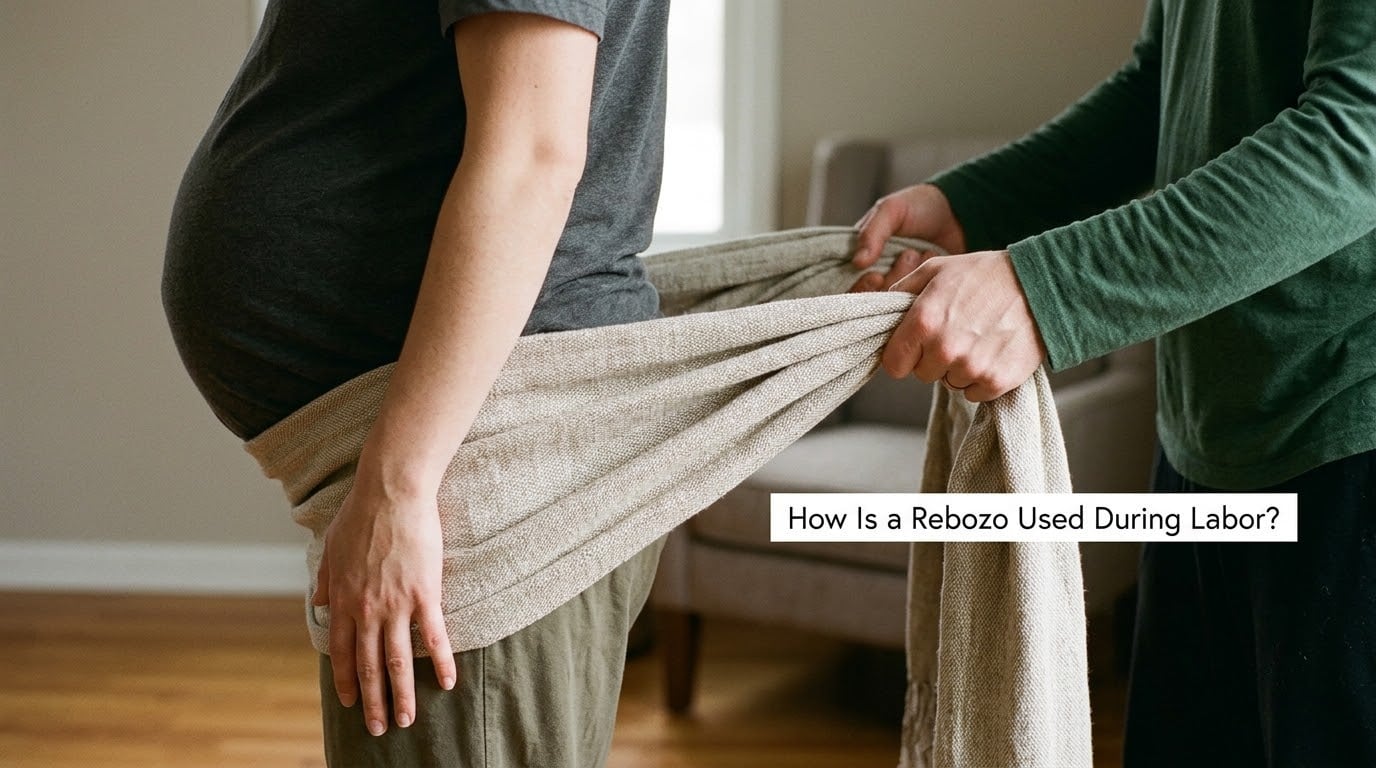
In practice the cloth shows up in four ways: as counterpressure, as a way to keep someone comfortable while they move, as a way to relax the back and hips during a contraction, and as something that lets a partner give useful help without doing it badly.
Counterpressure and containment
Wrapping the cloth around the hips and pulling gently inward gives a laboring person something to push against, which many people find steadying. It also reduces the sense of being uncontained during a contraction, which is a common complaint in early and active labor.
Supported movement
Someone who wants to stand, walk, or lean forward often tires of being the only person holding their own weight. A rebozo held at both ends by a partner gives them a handhold and light upward or backward support while they keep moving, and it lets a doula watch their face and breathing closely.
The sifting sequence
The version most widely described starts with the person kneeling on hands and knees or leaning forward over a ball or the edge of a bed, with the cloth wrapped around the hips or lower belly. The support person takes one end in each hand, combs the fabric so it lies flat, then lifts gently so the weight of the belly comes off the lower back. From there the movement is a small, slow, rhythmic shake, kept going only through the contraction. The cloth is lowered slowly and the person rests between contractions.
Two details get repeated in the teaching and are worth keeping. The motion is vibration, not swinging: a visible jerking or tossing motion is not the technique. And the pressure stays gentle enough that the person can keep talking and breathing normally throughout.
Consent throughout
Agreement before labor is not agreement during it. The useful habit, and the one people in birth communities point to most often as reassuring, is checking in constantly and treating a yes that turns into a no as a real no, whether it comes between contractions or halfway through one. The cloth comes off immediately, without discussion. That is not a special courtesy of this technique; it is part of your rights to refuse a medical procedure during labor, and it holds in a hospital, a birth center, and at home.
What Does the Evidence Say About Rebozo Techniques?
The honest answer is that the direct evidence is small, recent, and narrower than the enthusiasm around the technique suggests.
A randomized controlled trial by Tandoğan and colleagues, published in Medicine in 2024 and titled The effect of Rebozo technique on perceived labour pain and childbirth experience, is currently the main primary study. It examined how people in labor rated their pain and their birth experience when rebozo support was offered. That is a real contribution, because it moved the question out of practitioner anecdote and into a trial design. It is still a single study, and anyone quoting specific pain scores or satisfaction figures to you should be able to point you to the published paper rather than to a summary of it.
A 2017 qualitative study by Iversen and colleagues, published in Sexual & Reproductive Healthcare, looked at Danish women’s own accounts of rebozo use during labor and birth. Qualitative work like this cannot measure effectiveness, but it is useful for describing what the experience actually feels like and what people valued, which the numbers do not capture.
Further back, a Cochrane review by Pitrou and colleagues on continuous support during childbirth (2017) assessed a broader category: whether having a continuous companion changes outcomes such as satisfaction, spontaneous birth, and the need for pain medication. Continuous support is not the same thing as rebozo work, but it is the closest thing to a robust evidence base for the broader idea that hands-on help during labor matters.
What has not been established is equally worth stating. No large trial has shown that rebozo work reliably changes a baby’s position, shortens labor, or reduces medical interventions. Nobody has studied whether the cloth works better than a bedsheet, a rolled towel, or a well-placed hand. The claims in circulation about fascia and vibration are physiologically plausible and drawn from musculoskeletal and fascia research, but they have not been tested as a rebozo protocol in labor.
That does not make the technique useless. It means it belongs to the category of things people commonly report finding helpful, with a plausible mechanism, modest direct evidence, and no guarantees attached.
Is the Rebozo Technique Safe During Labor?
Generally, yes, when it is used gently and by someone the laboring person trusts. It involves no needles, no medication, and no equipment, and it can be removed in seconds. The risks come from pressure that is too strong, from working around a clinical situation where the pelvis should be left alone, and from continuing after someone has said stop.
Stop signals worth agreeing on in advance: sharp or localized pain, any cramping across the front of the belly, a pulling sensation in the lower abdomen, numbness or tingling in the legs, breathing that becomes shallow or difficult because the cloth is too tight, skin being pinched under a fold, panic, or simply a flat no.
Situations where the care team may advise against it, or want it modified:
- Placenta previa or any unexplained vaginal bleeding, because pressure against the lower uterus is avoided.
- A suspected placental abruption, or bleeding of unknown cause.
- An anterior placenta, where the placenta is attached to the front wall of the uterus. Guidance here is genuinely mixed, with some sources advising avoidance and others saying gentle support is acceptable. Treat that disagreement as a reason to ask your provider directly rather than a reason to guess.
- Tight, cramping, or painful round ligaments across the front of the abdomen, which can be aggravated by lifting and compression.
- Reduced sensation after an epidural block, or any restriction on movement from monitoring, lines, or a care plan, where the support person may not be able to move the person safely.
Common sense also covers the rest. No forceful shaking, no twisting, nothing while someone is dizzy or unsteadily standing, and nothing that pulls on a leg or an arm. If you are unsure in the moment, stop and ask a nurse.
Who Can Use a Rebozo During Childbirth?
A rebozo is a support tool that anyone present can be trained to use with clear instructions, but the quality of the instruction matters more than the job title. Midwives and doulas are the most likely to use it. Nurses may use it in a hospital setting where a policy allows. Partners and chosen support people can do the work well, particularly the counterpressure and supported-standing versions, which need a few minutes of rehearsal rather than a certification. If you are not sure what a doula is actually for at your birth, our guide to what a doula does during labor and delivery sets out the roles clearly.
The honest difficulty is that plenty of people say they know rebozo work after watching videos, and the difference between a gentle vibration and an enthusiastic shake is obvious to the person in labor and invisible to the person doing it. If you are hiring a doula specifically for this, ask what they were trained in, by whom, and how many births they have used it in.
Settings differ more than people expect. A birth center will often have rebozos on hand and a culture that supports them. A hospital may allow it and may not, depending on the unit, the stage of labor, monitoring requirements, and room layout. A home birth usually has more freedom and fewer monitors. A written birth plan that names the technique, says that you consent to it, and states what you want instead if you change your mind is the most reliable way to get a clear answer in advance rather than in the middle of labor.
Consent still holds even with a plan on file. A care plan is a starting point, not a substitute for asking again during labor.
How Does a Rebozo Differ From Other Labor Support Techniques?
Most people who like the rebozo technique also use other tools, and stacking them works better than choosing one. Here is how the named variations compare, followed by where a rebozo sits against the alternatives you already know.
| Technique | Position | Main purpose | Watch out for |
|---|---|---|---|
| Sifting, or manteada | Hands and knees, or leaning forward | Relieve low back pressure and relax the pelvis between contractions | Too much swing rather than vibration; pressure over a sensitive anterior placenta |
| Shake the Apples | Hands and knees | Release tension in the hips, buttocks and pelvic floor during active labor | Fatigue in the support person; stop at any sign of front-of-belly cramping |
| Hip wrapping, or acomodada | Standing, kneeling, or side-lying | Support the pelvic girdle and give a sense of containment | Tight wrapping that restricts breath or pinches skin; not a substitute for treating pelvic girdle pain |
| Belly lift | Standing or leaning forward | Take the weight of a heavy uterus off the lower back and round ligaments | Any sharp pain under the wrap; not for unexplained bleeding |
| The Jiggle | Any position | The same gentle vibration without a cloth, useful where a rebozo is not allowed | Same care around sensitive areas, plus coordination with any monitoring |
What a rebozo does that a birth ball does not
A birth ball changes your position, which is valuable on its own: it lets a person sit, lean, or circle their hips while the pelvis has room to move. A rebozo changes what is happening around the position. Ball plus rebozo, or standing plus rebozo, gives a laboring person both movement and hands-on support from the same person, which is a manageable combination when contractions are long.
Massage, hip squeezes, and counterpressure with hands deliver many of the same physical effects without any cloth, and they work better than a badly fitted wrap. Walking and position changes remain the most studied comfort measures of all. Water immersion is a different category entirely, with a good evidence base of its own and different practical requirements.
None of these replace medical pain management, and they do not need to compete with it. People use a rebozo to get through a contraction, an epidural to get through a labor, or both.
How to Try a Rebozo Technique Safely
This is preparation advice, not a substitute for a hands-on demonstration from someone qualified.
- Choose a broad, sturdy cloth. It needs to be long enough that two people can each hold an end with room to spare, wide enough to spread pressure rather than dig it in, and woven tightly enough to grip without slipping. Cotton holds a washable, breathable fibre well. An improvised cloth such as a flat bedsheet works in a pinch, which is genuinely how it gets done in some birth stories, but a purpose-bought wrap is easier to handle.
- Agree on words for pressure before labor. Decide together what light, firm, and too much feel like in your body, so nobody is guessing during a contraction.
- Rehearse once, briefly. Ten minutes before labor, on a firm surface, teaches more than an hour of reading. Practise lowering, not just lifting.
- Keep hands and voices in the loop. Stay in front of the person so you can see their face, keep the conversation going, and slow down or stop the moment breathing or tone changes.
- Follow the place’s approved methods. Where a hospital or birth center has its own guidance for hands-on support, follow it. That guidance usually exists for a reason and it is not negotiable without a conversation with the team.
- Source the cloth respectfully. If you buy one, buying from Indigenous or Mexican makers rather than a costume supplier keeps more of the value with the people whose practice this is. It is a small thing, but it is the difference between borrowing a tool and participating in a tradition.
Questions to Ask Your Care Team About a Rebozo
Asking these at a prenatal visit gives you clear answers while there is still time to think.
- Does this hospital or birth center allow rebozo use in labor, and at which stages?
- Are there restrictions when I am on continuous monitoring, have an IV, or have an epidural?
- Given my placenta position, is there anything you would want me to avoid or modify?
- How many people are allowed to work with me at once, given the room and the staffing?
- If I say no mid-labor, what alternatives can you offer instead?
- Which of you have been trained in this, and can you show my support person how to do it?
Bring the answer back to your partner and doula. The conversation is genuinely useful even when the answer is yes, because it turns the technique from a video into something your team has agreed to.
The Rebozo Technique in Labor Explained: Key Takeaways
The rebozo technique in labor is a simple, low-risk support measure built on one idea: take some of the weight of the uterus and hips into a cloth, then move it slowly and rhythmically until the person feels more comfortable.
It is optional, it is not appropriate for every person or every stage of labor, and it never replaces medical care or an individualized assessment. Ask your care team before labor, practice the pressure beforehand, and keep checking in during. If the answer turns out to be no, or simply no thank you, the labor goes on with other options that work just as well.
Frequently Asked Questions
What is a rebozo used for in labor?
A rebozo is used to support and steady the body during labor. A support person wraps the cloth around the belly, hips, or lower back, then lifts and moves it slowly. People use it for counterpressure, to take weight off an aching lower back, for a sense of being held while standing or leaning forward, and for relaxation between contractions. It is a comfort measure with modest research behind it, not a treatment, and it cannot be relied on to change a baby’s position or the length of a labor.
Is the rebozo technique safe with an anterior placenta?
Guidance is genuinely mixed. Some sources advise avoiding any pressure over the lower belly when the placenta is attached to the front wall of the uterus, while others say gentle support that the person reports as comfortable is acceptable. Because the sources disagree, this is a question for your midwife or obstetrician rather than a question to settle from a website. Avoid lifting, wrapping, or shaking if you have unexplained bleeding, placenta previa, or front-of-belly cramping, and stop immediately if any of those appear.
How does rebozo sifting work, and how long should it last?
For sifting, the laboring person kneels on hands and knees or leans forward, and the cloth is wrapped around the hips or lower belly. The support person holds one end in each hand, lifts gently to unload the lower back, and makes a small, fast, rhythmic side-to-side vibration. The motion is a vibration, not a swing. It is usually kept up for the length of one contraction, then lowered slowly so the person can rest. More than one session is fine as long as the person wants it and shows no signs of strain.
Can my partner do rebozo sifting, or does it need a trained doula or midwife?
A partner can do it well, and in practice partners often do the counterpressure and supported-standing versions. What matters is a short rehearsal before labor: where to stand, how to lift, how to keep the motion small, and how to stop. That is where a midwife or experienced doula helps most, by showing the position once. The person in labor feels the difference between a gentle vibration and a jerking swing immediately, so the support person should ask often and follow the answer rather than pressing on.
What is the difference between rebozo sifting and The Jiggle?
They are the same underlying movement, and the difference is the cloth. Sifting uses a long rebozo held at both ends, which adds counterpressure, warmth, and a sense of being held. The Jiggle is vibration applied directly with the hands, with no fabric, and Spinning Babies moved toward it in 2019 to make room for Indigenous practitioners in a practice they had helped shape. The Jiggle is useful in settings where a rebozo is not permitted, though it offers less support and less counterpressure.
If you take one thing from this, take the prenatal conversation. Ask your care team whether the technique fits your situation, have your support person rehearse it once before labor, and leave the decision with the person in labor, who can change it whenever they want.