
Preparing questions for a prenatal visit means writing down what you want to know, sorting it so safety-critical items come first, and bringing the list with you. Most prenatal appointments run 10 to 15 minutes, so the goal is not more questions. It is the three or four answers that actually change how you care for yourself this week.
A 20-minute bit of prep the night before turns a short, slightly rushed appointment into a conversation you can act on. You catch the thing you forgot, you leave knowing which warning signs to watch for, and you stop replaying the drive home trying to remember what she said.
This guide is general information about how to prepare questions for a prenatal visit, written to match widely published ACOG and American College of Nurse-Midwives guidance. It cannot replace your own care provider’s advice, and every plan here is individual. When something feels off, call your provider, your midwife, or a nurse line rather than waiting for the next appointment.
Table of Contents
- What You Need
- Step-by-Step: How to Prepare Questions for a Prenatal Visit
- Review What Has Changed Since Your Last Visit
- Turn Concerns Into Clear Questions
- Prioritize Questions by Urgency
- Bring the Right Records and a Question List
- Ask for Clear Next Steps
- Common Mistakes
- Frequently Asked Questions
- How many questions should I bring to a prenatal visit?
- What if I cannot remember all my questions during the appointment?
- Should I write down every symptom or medication I have?
- How can I make sure I understand my prenatal test results?
- What should I do if my provider says there is not enough time to answer everything?
- How do I know which questions need an answer right away?
- Start With Three Questions Tonight
What You Need
You need very little: a place to write and roughly 20 minutes. What matters is having the raw material in front of you, because a vague worry turns into a good question the moment you attach a detail to it.
Before you start writing questions, gather these five things:
- Notes on anything that changed since your last visit. New symptoms, a number that moved, something that happened at work or at home.
- Every medication and supplement, with dosage. Prescriptions, over-the-counter pain relievers, prenatal vitamins with folic acid, iron and DHA, herbal products, and anything you took before you knew you were pregnant.
- Recent test results and paperwork. Lab printouts, imaging reports, referral forms, and records from any other clinician you are seeing.
- Insurance card, photo ID, and the office’s own forms if they asked you to complete them ahead of time.
- Your own priorities. The two or three things you most want answered in this pregnancy, whether that is nausea, work, sleep, sex, mental health, money, or how birth goes.
One more item worth adding: your questions from the last visit that never got answered. I keep a running list in my phone notes titled “ask at next visit,” and about a third of it survives to the appointment. The rest get deleted, which is its own kind of answer.
Step-by-Step: How to Prepare Questions for a Prenatal Visit

Review What Has Changed Since Your Last Visit
Start by scanning backward through the weeks since you were last seen. Write down anything that is different now: a symptom that started, one that got worse, one that stopped, a new ache, a change in appetite or sleep, a medication you started or stopped, a new job, a move, a flight, a family illness.
Be specific about the pattern, because that is what turns into a usable answer. “Is the cramping normal?” gets a general answer. “Cramping started Tuesday, about six times a day, worse when I stand up, no bleeding” gets a real one.
Also check what came back since you were last there. If a blood test or a scan report landed in your patient portal and you have not had a chance to ask about it, that belongs at the top of the page, not the bottom.
Turn Concerns Into Clear Questions
Most prenatal questions fail because they are too big to answer. A question like “what is going to happen” is really four questions wearing a coat. Split it.
Instead of worrying that your back pain is serious, ask what symptoms would mean you should call today and which are expected at this stage. Instead of asking about exercise, ask whether your current routine is fine and what signs would mean you should stop. Instead of asking whether a test is required, ask what it looks for, what happens if you skip it, and when you would decide to have it.
A useful test: could your provider answer this in a sentence or two? If not, it is really two questions. Splitting it means you get an answer to both halves instead of a general reassurance that covers neither.
Prioritize Questions by Urgency
Sort what you wrote into three piles. This is the step that saves the most time, because the list you bring should be short enough to actually get through.
Must ask today. Anything about a current symptom, a result that came back, a medication you are taking, or a decision due at this appointment. Ask these first, before you are mid-conversation and running out of room.
Good to know. Useful, not urgent. Ask next if the appointment has space, or send it through the patient portal afterward and expect a reply within a few days.
Ask later. Bigger topics that deserve their own time: a birth plan, choices about screening, switching providers, finances, or a second opinion. Write down when you will raise it so it does not evaporate.
Mark your top three with a star. If the visit is short, chaotic, or interrupted, those three are the ones that survive, and you will not leave wondering which thing you were supposed to ask about.
Bring the Right Records and a Question List
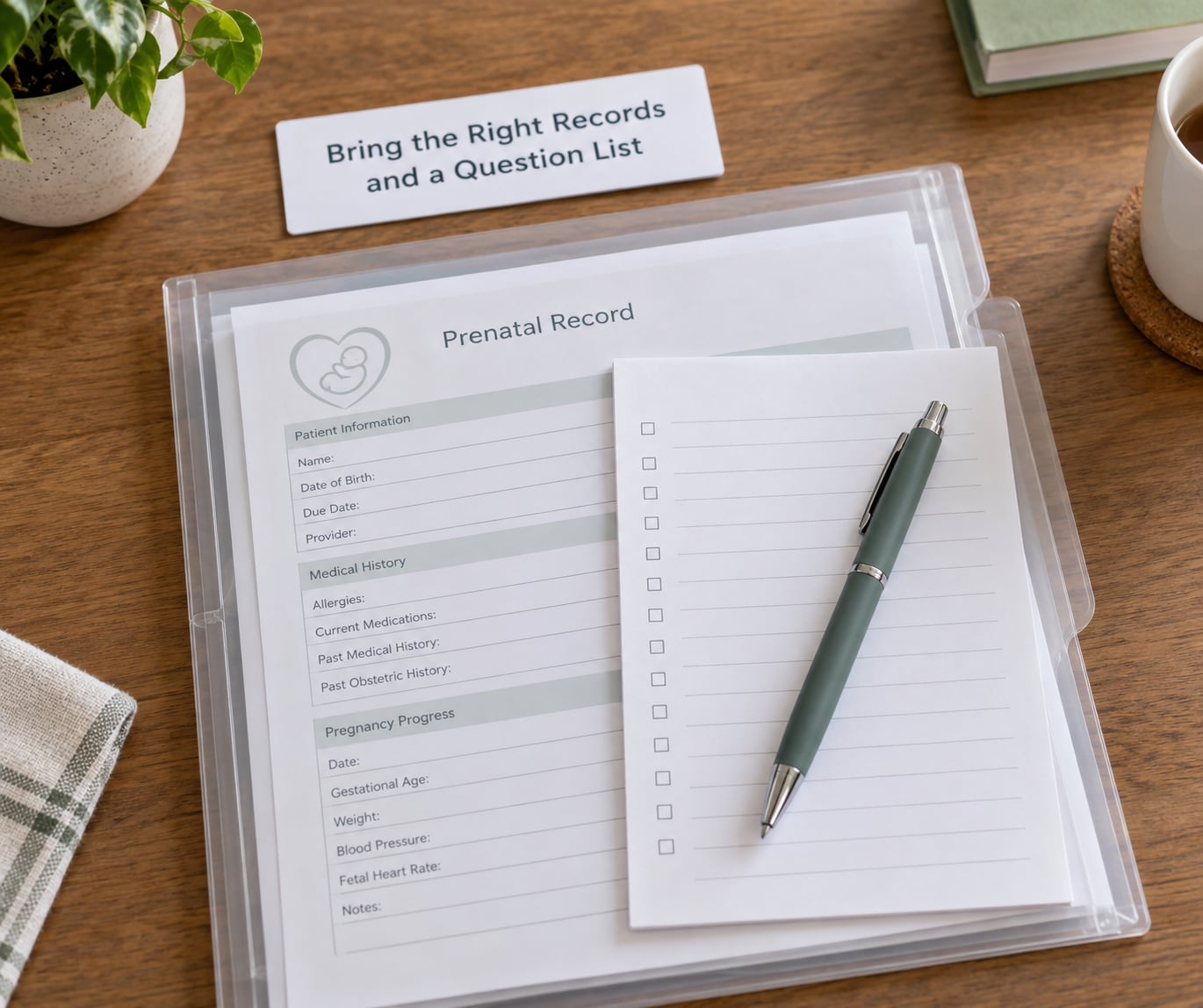
Paper is more reliable than a phone in the room, since you will not want to unlock it mid-conversation. Put your starred questions on the first page and everything else underneath, and leave a blank column for answers.
Bring the practical things too: your insurance card and photo ID, referral paperwork, your medication and supplement list with dosages, and any records your provider asked for but has not seen. If bloodwork is planned, ask in advance whether you need to fast, because you cannot eat retroactively once you are in the chair. If an ultrasound is on the schedule, ask whether you need a full bladder.
Knowing what happens in the room also helps. Routine checks usually include blood pressure, weight, a urine sample, measuring the fundal height (the distance from your pubic bone to the top of the uterus) later in pregnancy, listening for the fetal heartbeat, and bloodwork at certain points. Nothing on that list is a surprise if you have read about it beforehand.
Ask for Clear Next Steps
The last five minutes of the visit decide how the next three weeks go. Before you stand up, ask: what should I watch for, what is normal for me right now, what needs monitoring, and how will you tell me about results?
Ask each test or referral question three times, in three different ways: what is being ordered, when will it happen, and how will I hear about it. Results that arrive without an explanation are results you will not know what to do with.
Ask how to reach someone after hours and which number to use for a concern that cannot wait. Write it down rather than trusting you will remember it at midnight with stomach pain.
Before you leave, say the answer back in your own words and ask if you have it right. That is not rudeness. It is the fastest way to catch a misunderstanding while the person who can fix it is still sitting in front of you.
Common Mistakes
Waiting until the end of the visit to ask. The appointment feels rushed, you settle in, and the questions arrive when you are already standing. Ask your starred three at the start, right after the provider asks how you are.
Trusting memory. You will not recall the dosage change, the instruction to fast, or the name of the test they ordered. Write answers as you hear them, or ask permission to record the visit on your phone and listen back later.
Holding back symptoms because they seem small. Spotting, a headache that will not shift, swelling in your face or hands, a fever, painful urination, leaking fluid, or a feeling that something is simply wrong all deserve a phone call. Nobody has ever been judged for reporting a change early.
Not mentioning a medication. The full list matters, including the prenatal vitamin, the herbal tea, the sleep aid you bought yourself, and anything taken before the pregnancy test turned positive. Say what you have already taken. That is the question providers most want answered.
Leaving without knowing what happens next. If you cannot say what is being ordered, when it happens, and how you will hear back, you have not finished. Ask those three things every single time.
Apologizing for having questions. You are not being difficult. You are the only person holding the full picture of your body and your life, and your provider cannot guess what you need. It is fair to ask for something to be explained a second time, in plain language.
Forcing a big decision into a short visit. If a topic needs more time, say so: can we schedule a separate appointment for this, or can I send you a message and get a considered answer? Declining a test or an exam to buy yourself time is allowed, and it is a reasonable thing to ask about at all.
Frequently Asked Questions
How many questions should I bring to a prenatal visit?
Bring three you must ask, three you would like answered, and everything else in a separate list. Appointments of 10 to 15 minutes cannot hold twenty questions, and a short list you actually reach is worth more than a long one you never get to. Send the rest through the patient portal or the nurse line, and expect a reply within a few days.
What if I cannot remember all my questions during the appointment?
That is the normal case, which is why the list is written down and lives in your bag rather than in your head. If you blank out, say that out loud and ask: is there anything you would like to review with me before I go? Many providers will run through their own list at the end, which prompts the memory. Everything left over goes straight to the portal before you close the app.
Should I write down every symptom or medication I have?
Write down every medication, supplement and herbal product, with the dose, and include anything you took before you knew you were pregnant. For symptoms, note when each one started, how often it happens, what makes it better or worse, and whether anything else is happening alongside it. That detail is usually the difference between a general answer and one that tells you whether to call today.
How can I make sure I understand my prenatal test results?
Ask what the test looks for, what a typical result looks like, and what happens if yours is outside that range. Ask when results will be available, how you will receive them, and who will explain them. When a result arrives, read it with the reference range in front of you and send a portal message rather than sitting alone with a number you found at midnight.
What should I do if my provider says there is not enough time to answer everything?
Do not skip the starred questions. Say: I have three that I need answered today, and the rest can wait. Ask for the after-hours line and the portal, and offer to send the remainder as a written message, which usually gets a more careful answer than fifteen rushed seconds in the room. If a topic is genuinely important, ask directly for a separate appointment.
How do I know which questions need an answer right away?
Anything about a current symptom, a result that came back, a medication you are taking, or a decision due at this visit goes first. So does anything that would change what you do today. If you are unsure, ask the question and ask how urgent the answer is. And for anything alarming, call rather than wait: heavy bleeding, severe headache or vision changes, chest pain, difficulty breathing, fever with chills, or leaking fluid are emergencies, not list items.
Start With Three Questions Tonight
Open your notes app, write down everything that has changed since your last visit, star the three that matter most, and put the list in your bag with your insurance card. That is the whole method.
Nobody has a complete set of questions at ten weeks. The list grows with the pregnancy, and each visit is a fresh page rather than a final exam. What changes is the habit of walking in prepared, asking the safety questions first, and leaving knowing what happens next.
And if you are ever unsure whether something needs attention today, call. A question that turns out to be nothing is a very cheap question.