
Reading a medical consent form before signing is simple once you know the order to read it in: confirm the exact procedure, find the risks and benefits, check that real alternatives are listed, look for anything the form quietly authorizes beyond what you discussed, and read the financial clauses before you sign. You are allowed to read it slowly, ask questions, and take time. Nobody can require you to sign a form you do not understand.
Most people get handed these documents in the worst possible conditions. A nurse appears in a hospital gown an hour before surgery. A midwife brings a clipboard to the labor room. Someone with a stack of forms asks you to initial nine pages while anesthesiologist waits outside. Forum threads on Reddit are full of people describing shaking hands and regretting that they signed without asking one question.
This guide is general information about how these documents are usually structured and what questions patients commonly raise. It is not legal or medical advice, and consent rules vary by state and country. Your own care team is the right place to ask what applies to your situation. In an emergency, clinicians may treat you under implied consent, so nothing here is a reason to delay urgent care.
Table of Contents
- What You Need
- Step-by-Step: How to Read a Medical Consent Form Before Signing
- How to read a medical consent form before signing: start by identifying the procedure
- Check who is giving consent and whether the form is current
- Read the benefits, risks, and likely alternatives
- Look for limits on what the form authorizes
- Understand financial and legal statements
- Ask questions and make the decision before signing
- Common Mistakes
- Frequently Asked Questions
- Can I refuse to sign a medical consent form?
- Can I change my mind after signing a consent form?
- Who is allowed to sign a consent form on my behalf?
- Do I have to read the consent form before surgery?
- Can I get a copy of the consent form I signed?
- Do I need a lawyer or patient advocate to read a consent form?
- Conclusion
What You Need

You need four things, and only one of them is the form itself.
Something to write on. A pen and a phone, or a small notebook. The habit that changes everything is marking the page as you read: circle the procedure, star the risk list, flag every clause about money. Ten seconds of marking now saves you from re-reading twenty pages later in a parking lot.
Your own information to check against. Your full name, date of birth, allergies, current medications, and your insurance information. Consent forms carry identifiers, and a form that names someone else is not your form. Having your own details in front of you is how you catch a mismatched name before the signature line.
The plan the form refers to. Whatever your care team gave you about the proposed procedure, whether that is a one-page handout, a visit summary, or a conversation you wrote down afterward. If you are being asked to consent to a new option that was not part of the plan you discussed, you want the comparison in front of you.
A second person, when one is allowed. A support person, your partner, a doula, a parent, or a patient advocate can help you hear what you miss and ask the follow-up question. Tell the staff in advance that you want someone in the room, because some conversations happen in a hallway without the person you chose.
One last thing to bring: time. For an elective procedure, you can ask when the form was prepared and how long your team has been waiting, and you can ask for the conversation to happen when you are not mid-prep in a gown.
Step-by-Step: How to Read a Medical Consent Form Before Signing
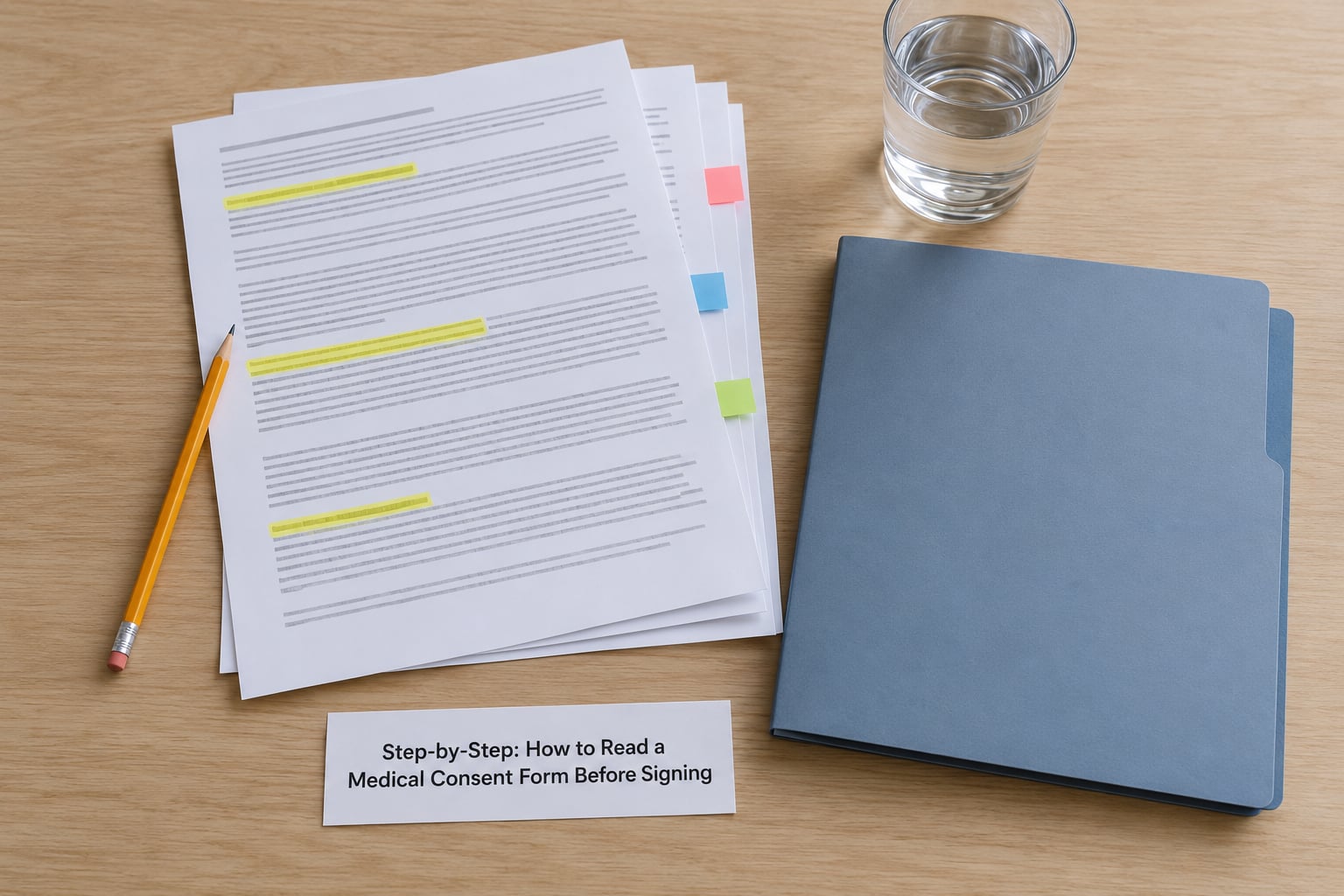
Read any consent form in the same six passes, in this order. The order matters because the later sections only make sense once you know what is being consented to. It takes about ten minutes on a form of ordinary length, and you can stop at any pass to ask.
How to read a medical consent form before signing: start by identifying the procedure
Start at the top and find the section that names the procedure, the test, or the treatment. Check the name of the procedure and make sure it matches what was actually discussed with you, word for word where you can. Check who will perform it, whether your name or your case is filled in correctly, and whether the form applies to a specific date, a specific facility, or a specific body area.
Look for three things most people skip: whether this is urgent or elective, what the stated purpose is, and whether the form is broad enough to cover procedures you have not agreed to. Forms that list a menu of possible procedures, from the least to the most invasive, are common in some settings. That is a question, not a decision: ask which one is planned and under what circumstances the others would happen.
You have done this pass correctly if you can say in one sentence what is about to happen, who is doing it, and what happens instead if you decline.
Check who is giving consent and whether the form is current
Confirm the patient identity, the person obtaining consent, the person signing, and any witness. Ask directly who is qualified to obtain your consent, because in many settings that conversation belongs to the treating clinician rather than to whoever happens to be holding the clipboard.
Check the date. Some forms are prepared weeks ahead and handed over on the day, and a stale form is a reason to ask for the current one rather than a reason to refuse. If there is a time limit, find it: forms often include a line about consent expiring or a plan of care changing, and that line tells you how quickly a decision is expected.
If you are not the person named on the form, stop and sort that out first. A parent, a legal guardian, a health care proxy, or someone with a power of attorney for health care will usually need to be the one to sign, and the paperwork that proves that authority varies. Ask the facility what it needs and in what form. A form signed by the wrong person is a problem you want to find in the waiting room, not in the record afterward.
Finishing this pass should leave you certain that you know who is signing, for whom, and on what date.
Read the benefits, risks, and likely alternatives
This is the core of the document. A complete consent discussion names what the procedure is expected to achieve, the material risks, the benefits, and the reasonable alternatives, including the option of doing nothing. If the alternatives section is missing or thin, that is worth raising on its own.
Not every risk listed deserves the same conversation. Small risks that are common and usually mild, such as bruising or a temporary headache, are usually listed for completeness. Material risks are the ones that could change your decision if you knew about them in advance: a serious complication, a risk to a body function, a risk that changes recovery, or an outcome that is hard to reverse. Ask about those by name.
These are the clause phrases you will meet most often, and what each one is actually doing.
I acknowledge that. You are confirming something is true or was discussed. It is not the same as agreeing to the procedure itself.
I have been informed of the risks, benefits, and alternatives. Someone explained them to you. Ask who, when, and whether you can get that in writing.
I voluntarily consent. You are agreeing by your own free choice, with no pressure, and you can still change your mind.
Material risks or significant risks. The uncommon outcomes that would matter to a reasonable person deciding whether to proceed.
Alternatives including no treatment. Doing nothing or choosing a different approach is a real option you are entitled to hear explained.
By signing, I authorize additional procedures deemed necessary. Blanket permission for things you did not specifically discuss. Always ask what this covers.
Financial responsibility for charges incurred. You agree to pay for services. The amount is usually set by a separate notice.
A copy of this form will be provided on request. Ask for the copy before you leave, not after.
Two phrasings make people uneasy and are worth a question rather than a signature. A clause about releasing liability or signing as a no-fault acknowledgment reads far more sweeping than what it usually means, and patients often assume it waives everything. And a long list of risks with no frequency attached leaves you guessing. You are allowed to ask how often each serious risk happens.
Look for limits on what the form authorizes
Most forms authorize a defined procedure. A good one keeps you inside that boundary, and a weak one lets it expand. Scan specifically for language that permits things you did not discuss.
Additional procedures. Language letting the team extend or change the plan during or after the procedure. Ask what specifically it allows and who would approve it.
Blood products. Consent to transfusion, and separately the option to decline it. If you have a religious or personal reason to refuse, ask how that is recorded on the chart and the chart note, and ask whether an advance directive or a refusal form needs to be on file before you arrive.
Anesthesia and sedation. Often a separate form. Check whether it names the type of sedation, who administers it, and what happens if you decline it during a procedure you otherwise want.
Specimen testing. Consent for the procedure often includes permission to test tissue or blood samples, and in some settings those samples may be stored or used for research. Separate research consent is supposed to be a distinct choice, and a line on a treatment form is worth questioning.
Recording, teaching, and data use. Photographs, video, teaching cases, and electronic record sharing are usually separate acknowledgments. Decide about each on its own rather than accepting them as part of the surgical consent.
You have done this pass correctly if every authorization on the page is one you would be comfortable explaining to a friend tomorrow.
Understand financial and legal statements
Consent to treatment and agreement to pay are two different things, and they often arrive as two different forms. A financial responsibility notice, a separate waiver of financial responsibility, or an out-of-network acknowledgment is where the cost terms live, and it deserves its own reading time rather than a scrawled signature.
On a treatment consent form itself, look for estimated charges, an acknowledgment that quoted amounts are estimates, references to your insurance and to out-of-network billing, and any reference to arbitration. Read the estimate against your insurance information rather than assuming a coinsurance figure is what you will pay. If the form and your insurer’s documents seem to describe different amounts, that is a question for the billing office before the procedure, not afterwards.
A word on scope. A consent form records that an information conversation happened. It is not a waiver of every legal right, and it does not prevent you from later asking questions, requesting your record, or raising a concern. People often assume signing has given something away permanently. It has not, and knowing the difference is part of reading the document calmly.
Requirements and required disclosures vary by jurisdiction, so a form that looks bare-bones in one state may look thorough in another. Judge the document by what your own team is required to discuss with you rather than by comparison with a form someone else showed you.
Ask questions and make the decision before signing
This is the pass where the reading turns into a decision, and the method is simple: mark, pause, ask, get the answer, then sign.
Mark anything unclear as you go rather than trying to hold it in your head. When you hit a word you do not recognize, circle it. When a sentence covers a lot of ground, underline it. By the time you reach the signature block you will have a short list instead of a vague feeling.
Then go through the list with the person who obtained the consent. Useful questions to have ready include: what exactly is being done today; which risks would change my decision if I knew more about them; what happens if I do nothing; what is the expected recovery and follow-up; what does this form authorize that we have not discussed; what is not on this form that I will be asked to sign later; is it possible to have the main points of this in writing; and can I have a copy of the signed form today.
If an answer arrives in more jargon, ask for it a different way. Sometimes the second explanation of the same thing, in different words, is the one that lands. If you want it in a language you read more comfortably, or in large print, or read aloud, ask for an interpreter or a translated form, and ask for those to be documented on the form.
Sign only when the page matches your conversation. If anything is blank, has a stray option you did not agree to, or has a date that is wrong, ask for a clean copy. Signing a form with empty lines is how blanket authorization sneaks in, and those empty lines are also the part a form is most likely to be interpreted against later.
Common Mistakes
These are the errors that patients describe most often, with the correction for each.
Signing because the team is waiting. A waiting room is not a reason. For elective procedures, ask to talk with the clinician before the anesthesia and prep timeline starts, and ask what the actual time pressure is. Often the schedule is built around the room, not around a medical deadline.
Treating consent as routine paperwork. A pre-printed surgical consent is a template, not a conversation. Ask to go through the procedure-specific parts, and ask what is different about your case.
Skipping the alternatives section. Not doing the procedure, doing a smaller version, or doing it later are all real options. If the form does not list them, ask what the team would recommend if you chose to wait, and for how long waiting stays safe.
Signing while in pain, medicated, or distressed. Pain medication and sedatives affect how well people process information. If you are uncomfortable or have just been given medication, ask to complete the form before the medication takes effect or after you have a clear moment, whichever your clinician prefers.
Assuming a nurse or technician cannot discuss consent. Ask who is authorized to obtain your consent and who performed the explanation. You can ask anyone on the team for clarification, and you can ask for the responsible clinician to join the conversation.
Confusing consent with a financial agreement. Signing to receive treatment is not the same as agreeing to every charge. Read the estimate and the out-of-network language, and take it to the billing office or your insurer before you sign.
Not asking for an interpreter or a plain-language explanation. A signature in a language you read poorly is not informed agreement. Ask for a professional interpreter and for a translated or plain-language copy, and ask for that to be noted on the form.
Signing blank or partially completed forms. Every line that should be filled in should be filled in, and any line you do not agree with should be struck through and initialed. Ask for a fresh form if that is easier.
Two-minute review before the pen moves: read back the procedure in your own words, read back the serious risks you were given, and read back every limit and dollar figure you noticed. If all three match your understanding of the conversation, you are signing an informed document rather than a stack of paper.
Frequently Asked Questions
Can I refuse to sign a medical consent form?
Yes. Signing is a choice, and you may decline or delay a non-urgent procedure while you get answers. Talk with your care team first, because refusing can have real clinical consequences and they may know of options you do not, such as a smaller procedure, a different timing, or a second opinion. In an emergency, clinicians may treat under implied consent, so declining is not a tool for urgent situations. Ask for a written explanation of what declining would mean for you specifically.
Can I change my mind after signing a consent form?
Usually yes, for anything that has not happened yet. Tell the care team as soon as you change your mind, and ask them to note it on your chart and on the consent record. A signed form is not a permanent agreement to proceed, and it does not need to be destroyed to be revised. What has already happened cannot be un-consented to, and you can always ask for a copy of what you signed plus a copy of your record to see how it was documented.
Who is allowed to sign a consent form on my behalf?
If you can make your own decisions, you sign. If you cannot, a legally authorized representative signs, which may be a parent, a legal guardian, a court-appointed surrogate, or a health care proxy or power of attorney for health care, and the order is set by local law. Facilities require proof of that authority and will tell you what form they need. In a true emergency where nobody is available, clinicians may act under implied consent, which is why advance directives and proxy documents are worth arranging before you need them.
Do I have to read the consent form before surgery?
There is no general rule that forces you to sign without reading, and the form exists to record that an information conversation happened. The realistic constraint is scheduling: elective procedures move on a prep and anesthesia timeline. Ask when the form was prepared, how long your team has actually been waiting, and whether the clinician can speak with you before prep starts. If you sign without understanding something, you are the one living with the outcome.
Can I get a copy of the consent form I signed?
Ask for it before you leave, and ask for it again later if you do not get it. A copy of the signed form and a copy of your own medical record are two different things, and patients often want both. The signed form shows what was disclosed; the record shows what was done and when. A practical reason to request it early: it tells you before surgery whether the procedure listed matches what you understood you were agreeing to.
Do I need a lawyer or patient advocate to read a consent form?
Usually not for routine forms. Most people just need time, a marked-up page, and a clinician willing to answer questions in plain language. An advocate, a patient navigator, or a doula can be genuinely useful when you are in labor, when you are managing a complex condition, when the form is long, or when a decision is weighing on you emotionally. For elective surgery with a significant complication rate or a large financial commitment, an independent second opinion is a reasonable step, and you can ask the facility or your insurer about resources.
Conclusion
Slow down and do the first thing before anything else: read the procedure line and say back what is about to happen. Then read the benefits, the material risks, and the alternatives, check what the form authorizes beyond your conversation, read the financial clauses on their own, and ask about every circled word.
For anything elective, taking an hour is reasonable and asking for a copy, an interpreter, or a written summary is normal practice rather than an unreasonable request. When the situation is urgent, follow your medical team’s instructions, because they are working with facts you do not have. Whatever you decide, your care team is the right person to tell you what your specific choices would mean.