
Carrier screening before pregnancy is a blood or saliva test that checks whether you carry a working-change in a gene for an inherited condition you could pass to a child. Carriers usually feel completely healthy, which is exactly why the test has to look at the DNA rather than at symptoms.
Most of the value of doing this test early is timing. A result before pregnancy gives you time to have your partner tested, talk it through with a genetics professional, and look at your options calmly instead of in a hurry. Nothing is required, and nothing is a verdict.
Here are the short versions worth carrying with you:
- Almost everyone is healthy and completely unaffected by being a carrier.
- Results only matter for a pregnancy if both partners carry a change in the same gene.
- When that happens, each pregnancy has a 25% chance of an affected child, a 50% chance of a healthy carrier child, and a 25% chance of a child who neither carries nor is affected.
- Expanded panels look at many more genes than the small standard panels, so they find more carriers by chance.
- A negative result is reassuring, not absolute, because no panel covers every genetic condition.
- Insurance coverage, panel choice and timing are all worth discussing with a clinician before the test is ordered.
What follows is general information to help you walk into that conversation prepared. It is not a diagnosis, and nobody can interpret your specific result for you but a qualified genetics professional or your own clinician.
Table of Contents
- What Is Carrier Screening Before Pregnancy?
- How Does Carrier Screening Work?
- Who Should Consider Carrier Screening?
- When Should You Get Screened?
- What Do the Results Mean?
- What a negative result tells you
- What a positive result tells you
- What a variant of uncertain significance means
- What your results are not
- What Should You Do If You Are a Carrier?
- How Much Does Carrier Screening Cost?
- What Are the Benefits and Limitations of Screening?
- Questions to Ask Your Doctor or Genetic Counselor
- Frequently Asked Questions
- Does carrier screening tell me if I will have a child with a genetic condition?
- Can carrier screening be done before trying to conceive?
- What happens if my partner is not tested?
- Is carrier screening the same as prenatal screening or diagnostic testing?
- What should I do if my carrier screening result is uncertain?
- A Clear First Step for Prospective Parents
What Is Carrier Screening Before Pregnancy?
Carrier screening is a test, usually from a blood draw or a saliva sample, that looks for inherited changes in genes tied to specific disorders. It tells you whether you carry one copy of a change that could cause a condition in a child, not whether you have the condition yourself. Carriers generally have no symptoms at all.
It helps to hold three different things apart, because they get mixed up constantly. Carrier screening looks at your genes before pregnancy to learn about risk. Prenatal screening, such as NIPT, looks at the developing pregnancy to estimate the chance of certain conditions. Diagnostic testing, such as chorionic villus sampling or amniocentesis, gives a yes-or-no answer about a specific condition. Only the last one is definitive, and only the first one is the subject of this guide.
Why do carriers not feel sick? Because a single altered copy of a gene is usually enough for the body to function normally. Most recessive conditions only appear when a child inherits an altered copy from each parent. Being a carrier is closer to carrying an unlit match than to being on fire.
How Does Carrier Screening Work?
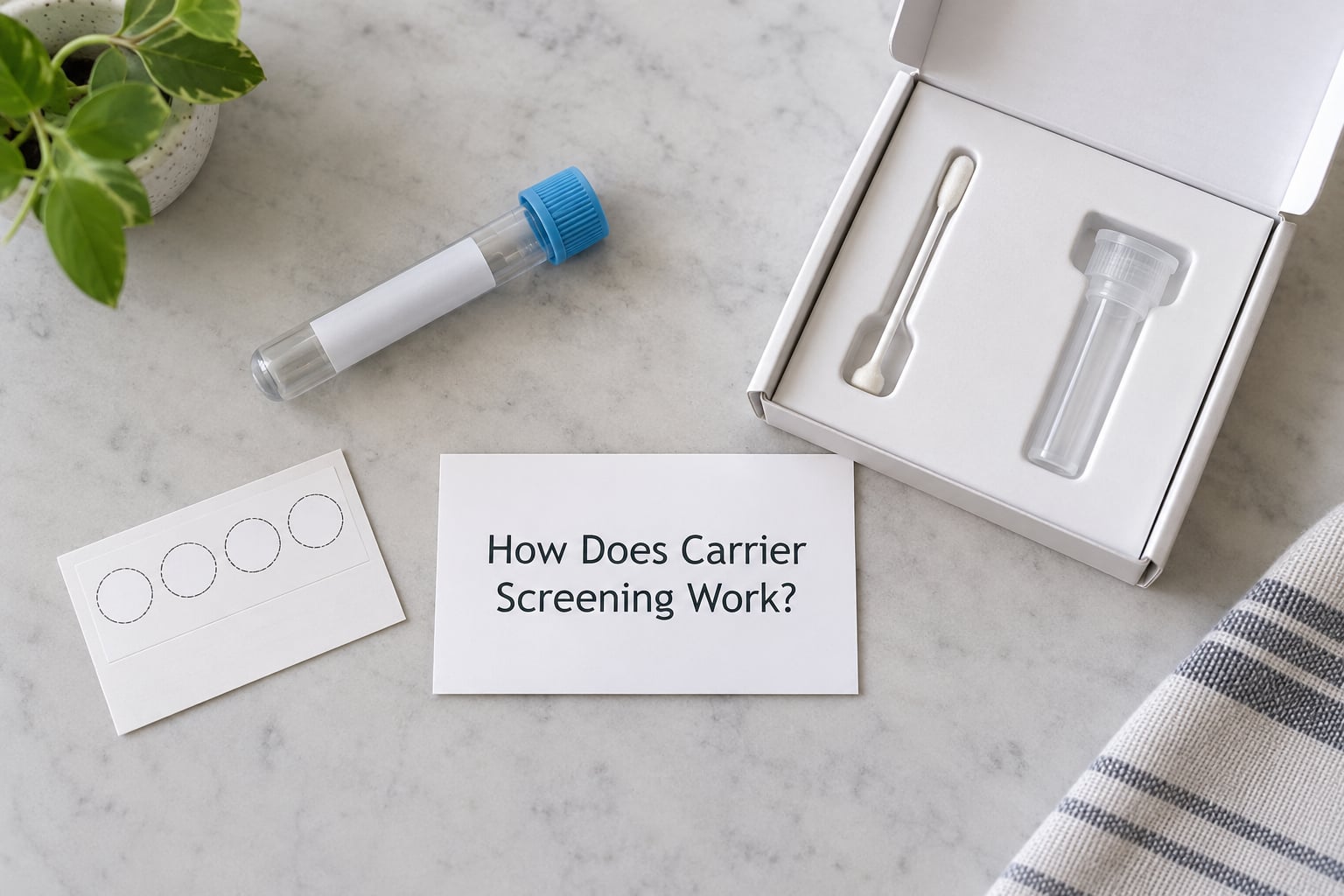
Every person has two copies of almost every gene, one from each parent. The laboratory reads the DNA in your sample and looks for specific changes, called variants, in genes known to cause inherited conditions. If a relevant change is present on one of your two copies, you are reported as a carrier of that condition.
Testing methods differ, and this is the part worth understanding before you order anything. Targeted testing checks a handful of specific variants in a small number of genes, and it is fast and reliable for those exact changes. Expanded carrier screening analyses many more genes and a much wider set of variants, so it is more likely to identify a carrier status a targeted test would miss. Sequencing-based approaches read the full sequence of selected genes and are the most thorough, though they also produce more findings that need interpretation.
For X-linked conditions such as fragile X syndrome, the picture is different. A father passes his X chromosome to daughters and his Y to sons, so a father’s carrier status does not affect a future child. A mother’s carrier status can, which is why these conditions are included in screening panels that are ordered for all patients rather than only for people with a relevant family history.
| Commonly screened condition | Inheritance pattern | Why it is on the panel |
|---|---|---|
| Cystic fibrosis | Autosomal recessive | One of the most common recessive conditions in people of European ancestry, and included in most standard panels |
| Spinal muscular atrophy | Autosomal recessive | Leading genetic cause of infant death; requires carrier parents of the same type |
| Sickle cell disease | Autosomal recessive | More common in people with African, Caribbean, Mediterranean, Middle Eastern or South Asian ancestry |
| Beta thalassemia | Autosomal recessive | More common in people with Mediterranean, African or Asian ancestry |
| Tay-Sachs disease | Autosomal recessive | Classic panel inclusion, with a markedly higher carrier frequency in people of Ashkenazi Jewish, French Canadian and Cajun ancestry |
| Fragile X syndrome | X-linked | The most common inherited cause of intellectual disability; maternal carrier status is the one that matters |
Turnaround is usually around two weeks for a standard panel, and sample collection itself takes minutes. Results arrive as a report listing each condition tested, whether a change was found, and a classification for any change that is present. Interpretation is where the skill lies, which is why most labs include a genetic counselor’s review with the results.
Who Should Consider Carrier Screening?
Current professional guidance points toward offering carrier screening to anyone planning a pregnancy, regardless of ethnicity, ancestry, or family history. The reason is straightforward: a family history is a weak filter. A large share of children with a genetic disorder are the first in a family to be affected, because most carriers have no symptoms and no one thought to test.
That said, recommendations vary between professional bodies, and the right answer for you depends on your situation. Groups most often advised to consider it include people with a known family history of an inherited condition, people whose ancestry has a higher carrier frequency for specific conditions, and people planning to use donor eggs or sperm, where a single person’s result changes the donor’s eligibility for certain panels.
Two other situations come up often. People who already have a healthy child sometimes wonder whether they still need testing, and the answer is yes for many conditions, because a healthy first child tells you very little about a different gene. And people with a second pregnancy after a previous loss often want testing that was not available or not offered at the time.
Planned fertility treatment is another common reason. Knowing carrier status before an IVF cycle begins can change how cycles are set up and how embryos are evaluated, which is much simpler than sorting it out midway.
When Should You Get Screened?
Screening can be done before conception, during early pregnancy, or at the point when a family history becomes known. The useful part is not the test date itself but the amount of time between the result and the decisions that follow it.
Before pregnancy, a positive result leaves the full range of options open: partner testing, genetic counseling, IVF with preimplantation genetic testing, use of donor eggs or sperm, prenatal diagnostic testing, or continuing a pregnancy with a plan. Once a pregnancy is underway, some of those options narrow sharply as gestational age advances, and by the later weeks most of them are closed. This is the single strongest argument for preconception carrier screening, and it is why a genetics team will usually try to move quickly once a result comes back.
Testing during pregnancy is still worthwhile, and many people find out this way for the first time. It is simply a more compressed timeline, and the counseling conversation tends to happen under more pressure. If you are already pregnant, ask your provider how long results take with the specific lab they use before deciding when to order the test.
Timing and test selection are medical decisions. A clinician or genetic counselor can weigh your family history, your stage of trying to conceive, and insurance coverage before anything is ordered, which avoids paying twice for overlapping tests.
What Do the Results Mean?

Most results are reported as negative, positive for one or more conditions, or a third category that is neither of those. Each needs a different response, and none of them should be read without a conversation with someone trained in genetics.
What a negative result tells you
A negative result means no relevant change was detected in the genes and variants the panel covers. What it does not mean is that you cannot be a carrier of a condition that was not on the panel, or a carrier of a change the laboratory’s methods do not detect. Panels are updated over time, so a test done years ago may be worth repeating if a much larger panel is now available and you want current information.
What a positive result tells you
A positive result means you carry a change in a gene tied to one of the conditions on the panel. It is a genetic fact about you, not a prediction about a child, and it says nothing about your own health in the overwhelming majority of cases. What it does change is the arithmetic for a future pregnancy, and it is the reason partner testing usually follows.
What a variant of uncertain significance means
A variant of uncertain significance, or VUS, is a detected change that is not clearly disease-causing and not clearly harmless. Labs classify these as VUS to avoid labelling someone based on a finding nobody fully understands. A VUS on its own is not a diagnosis, it is not a reason to make reproductive decisions, and the classification is frequently reclassified as science improves.
Other panels use a second category, sometimes called an inconclusive enzyme test, which happens when a blood-based test for a specific condition cannot be interpreted cleanly, often in people who have recently transfused blood or donated an organ. The usual next step is to repeat the test after an appropriate interval, on the advice of your clinician.
What your results are not
A carrier result never means you have an affected child, and it never means you have the condition yourself. It also does not forecast a child’s health, development or future. Carrier screening is a risk calculation for a specific set of conditions, nothing more.
Anyone with a positive, uncertain or confusing result should be referred to a genetics professional for interpretation, family testing, and a discussion of what the finding does and does not change.
What Should You Do If You Are a Carrier?
Start with the part that surprises people: in almost every case, carrier status does not affect your own health. You do not need treatment, monitoring or lifestyle changes because of it. It is inherited information, and its relevance is about a shared gene in a partnership.
If you are a carrier for an autosomal recessive condition, the next question is whether your partner is also a carrier of that same condition, and testing your partner is usually the logical next step. If they are not, the risk for a child drops close to background levels for that condition. If they are, the standard probability for each pregnancy is a 25% chance of an affected child, a 50% chance of an unaffected carrier, and a 25% chance of a child who neither carries nor is affected.
When both partners do carry the same condition, the options are set out neutrally here, because the right choice belongs to you and your partner, not to an article:
- Genetic counseling to understand the specific condition, its severity range, and what life with it looks like, which many people find is the step that turns a scary result into a manageable one.
- Preconception IVF with preimplantation genetic testing, which tests embryos before transfer. It is invasive, expensive and not without uncertainty, and it does not guarantee a result.
- Donor eggs or donor sperm, which removes the risk from the two contributing genetic sources but changes questions about family history and identity that deserve their own conversation.
- Prenatal diagnostic testing, such as chorionic villus sampling or amniocentesis, which can answer definitively during a pregnancy, at the cost of a small procedural risk that should be discussed honestly.
- Continuing a pregnancy with knowledge, which is a legitimate choice that many families make deliberately once they understand the condition.
- Adoption, which some couples consider as part of a broader plan for building a family.
None of these is the default, and no counselor who is doing their job properly will push you toward one. Non-directive counseling means the information is laid out, your questions are answered, and the decision stays yours.
How Much Does Carrier Screening Cost?
There is no single US price for carrier screening, and any number you find published online is a snapshot that may not match what your laboratory charges tomorrow. What is worth understanding is the structure of the pricing, because the variables are few and knowable.
Three things drive the cost. First, panel size: a targeted single-gene test is cheaper than an expanded panel that analyses hundreds of genes, and a sequencing-based panel costs more than either. Second, the laboratory, since companies price differently and each publishes its own current rates. Third, who interprets the result, because some labs bundle genetic counselor review into the test and others bill it separately, and it is common for people to be surprised by the counselor line rather than the lab line.
On insurance, the general US pattern is that a screening test ordered by a clinician as part of family planning is more likely to be covered than one ordered directly, and that coverage is often limited to a specified panel with a defined condition list. Tests ordered outside that list, or ordered by the patient directly, are more likely to be self-pay. The specifics depend on your plan, and insurers differ in how they treat expanded panels, so the reliable move is to get a written estimate from both the laboratory and your insurer before the sample is drawn.
A few practical steps help. Ask the ordering clinician to obtain prior authorization if your plan requires it, since a denial after the fact is far more expensive than a phone call before. Check whether your plan has a preauthorization number or a laboratory network requirement, because going outside the network can cost several times more. Ask about financial assistance programs, which most major laboratories offer and which are income-based rather than diagnosis-based. And if you have a flexible spending or health savings account, lab fees and counselor visits are usually eligible expenses, which is worth confirming against your plan documents.
For a current, individual estimate, the laboratory and your insurer are the only accurate sources, and both will give you one in writing.
What Are the Benefits and Limitations of Screening?
The case for screening rests on time and information. Screening before pregnancy means partner testing can be arranged, counseling can happen in an unhurried setting, and reproductive options are still open. It also reaches people whose family history is silent, which is where the largest gap in case-finding has always been. And it gives extended family, including siblings, a reason to consider testing for the same condition.
The limitations deserve equal space. Panels miss conditions they do not include, and a negative result is bounded by the panel’s contents and by the methods the laboratory uses. A positive result can arrive without any family history behind it, which is disorienting in a way people are rarely warned about. A variant of uncertain significance can cause real distress while telling you very little. Large expanded panels generate more findings overall, some of which are medically uncertain and none of which should drive a decision on their own.
There is a screening and counseling debate worth knowing about if you read widely. One camp favours offering large expanded panels to everyone, on the reasoning that carrier status is common and panels are now cheap enough to be practical. Another favours a tiered approach that prioritises conditions by severity and treatability, so that people are not asked to process dozens of results for conditions they would never change a pregnancy over. Your clinician may take either position, and asking which panel they are recommending and why is a reasonable question.
Two framing points matter more than the debate. Informed consent means you know the limitations of the test before you order it, not after the result arrives. And non-directive counseling means no one has an agenda about what you should do with the information.
Questions to Ask Your Doctor or Genetic Counselor
A short list in your appointment or in your inbox makes a real difference, because these are the questions that get skipped in a ten-minute visit. Ask which specific conditions and which genes are on the panel you are being offered, and whether a different panel size makes sense for your family history. Ask what a negative result from that panel would and would not rule out, so you are not left with a false sense of certainty.
Ask whether partner testing would be needed if your result is positive, and whether it can be arranged at the same time to save a round trip. Ask who interprets the results and whether a genetic counselor reviews them, and how you will be contacted. Ask about privacy: what happens to your results, whether they become part of your medical record, and what the limits are. GINA, the Genetic Information Nondiscrimination Act, protects health insurance and employment, but it does not cover life, disability or long-term care insurance, which is a nuance worth raising yourself before you buy such a policy.
Finally, ask which reproductive options are realistic for your specific situation, what each involves in time, cost and risk, and who to return to when you want to talk it through again. Asking about all of this is not a demand for action. It is a reasonable use of an appointment.
Frequently Asked Questions
Does carrier screening tell me if I will have a child with a genetic condition?
No. Carrier screening tells you whether you carry a change in a gene for a specific inherited condition. It says nothing about whether a child would be affected, and a carrier result carries no meaning for your own health. The information only becomes relevant if your partner carries a change in the same gene, which is why partner testing usually follows a positive result.
Can carrier screening be done before trying to conceive?
Yes, and doing it beforehand is usually the more useful timing. A result before conception leaves time for partner testing, genetic counseling and a considered look at every reproductive option, several of which close or narrow as a pregnancy progresses. Many people test while already pregnant and still benefit, but the timeline is tighter and the conversation tends to happen under more pressure.
What happens if my partner is not tested?
A carrier result on its own has limited meaning, because risk for most recessive conditions depends on both parents carrying a change in the same gene. Without partner testing, the possibility stays open and the risk figures cannot be narrowed down, which is a common source of ongoing worry. If your partner declines testing, a genetics professional can still help you interpret what is known and what remains uncertain.
Is carrier screening the same as prenatal screening or diagnostic testing?
No, they answer different questions. Carrier screening looks at your DNA before pregnancy to learn about inherited risk. Prenatal screening, such as NIPT, estimates the chance of certain conditions in the current pregnancy. Diagnostic testing, such as chorionic villus sampling or amniocentesis, gives a definitive yes-or-no answer about a specific condition and carries a small procedural risk.
What should I do if my carrier screening result is uncertain?
An uncertain result, often reported as a variant of uncertain significance, means a change was found that is neither clearly harmful nor clearly harmless. It is not a diagnosis and on its own should not drive a reproductive decision. Ask for referral to a genetics professional, who can review the laboratory report, discuss whether family testing would clarify anything, and explain how often these findings are reclassified.
A Clear First Step for Prospective Parents
Book a preconception visit and bring two things: your family history and your questions. The family history means the conditions on both sides, however distant the relative and however healthy they are, and the questions mean the list in the section above, which you can hand to the clinician if you forget half of it.
From there, the conversation usually covers which panel makes sense, what timing works with your plans, what your insurer will and will not cover, and whether partner testing should be arranged at the same time. Screening is optional at every step, and a good clinician will say so and then give you the information anyway. The right outcome is not a particular test result. It is a decision you made with the facts in hand and without a clock running against you.
This article was reviewed for accuracy in 2026. It is general information, not medical advice; for anything specific to your situation, talk with your own clinician or a genetic counselor.