
Short answer: a DNA test can tell you which genetic variants you carry, whether you are a carrier for certain inherited conditions, and roughly how your DNA compares with reference populations. What DNA test results cannot tell you is whether you are healthy, whether you will develop a disease, or what you should do next. Everything a consumer report says about your future sits on a statistical estimate, not a diagnosis.
That distinction matters more than most reports make it sound. A saliva kit and a clinical laboratory can run the same chemistry on the same machine, and the difference between a useful result and a frightening one is often just how carefully it was read. This guide walks through what was actually measured in your sample, what was estimated from published studies, and where a reasonable reader should stop and bring in a professional.
Table of Contents
- What DNA Test Results Can and Cannot Tell You About Health
- The four levels hiding in one report
- What Is a DNA Health Risk Report?
- How Do Health DNA Tests Analyze Your Information?
- What Can DNA Test Results Tell You?
- What DNA Test Results Cannot Tell You About Your Future Health
- Why Can Two DNA Tests Give Different Results?
- How to Interpret a Health DNA Test Report
- When Should You Discuss DNA Results With a Health Professional?
- What About Privacy, Consent, and Relatives?
- Frequently Asked Questions
- Does a positive DNA health result mean I will develop the disease?
- Can a negative DNA test rule out a genetic condition?
- Does DNA testing tell me which diet or exercise plan is best for me?
- Why does my DNA report show a higher risk for a condition?
- Should I share my DNA health results with my family?
- Can my doctor or genetic counselor explain a consumer DNA report?
- What to Do With Your DNA Results First
What DNA Test Results Can and Cannot Tell You About Health
The honest framing is that a DNA report contains four different kinds of information, and they carry very different weight. Mixing them up is the single most common source of both false reassurance and unnecessary alarm.
The four levels hiding in one report
- Raw data. The genotype calls at the positions the laboratory actually read. This is the most concrete layer and the only one that is a direct measurement of your sample.
- Laboratory finding. A variant that has been classified as pathogenic or likely pathogenic in a clinical laboratory. This is a real finding about your DNA, still not a statement about your future.
- Statistical estimate. A relative risk figure, polygenic score, or trait association derived from large population studies. It describes a group, and you are one person standing somewhere inside that group.
- Diagnosis. Something only a clinician, working with your history, examination, imaging and lab work, can give you. A consumer report never reaches this level.
A positive finding at level two and a slightly elevated risk score at level three can look identical on screen. They are not remotely the same kind of statement.
What Is a DNA Health Risk Report?
A DNA health risk report connects genetic variants you carry with conditions such as hereditary disease, cardiovascular risk, cancer susceptibility, or how your body may respond to certain medications. The wording matters: it reports an association drawn from reference populations, expressed as relative risk, meaning how your odds compare with a baseline group rather than a prediction of what will happen to you.
That is also why two people with identical results can have completely different outcomes. Genes set a range of possibilities, and everything else in your life moves the outcome within that range.
How Do Health DNA Tests Analyze Your Information?
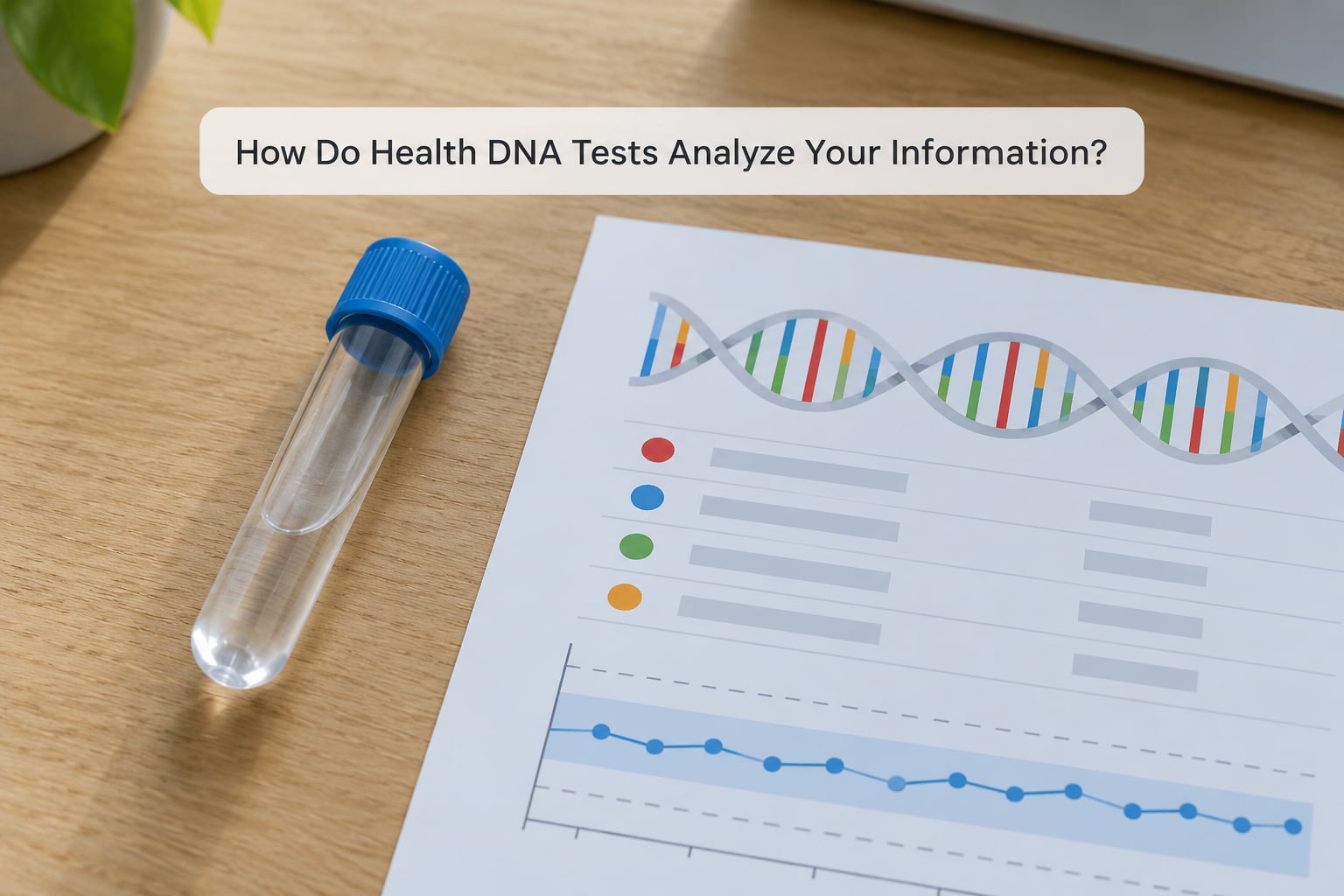
Most consumer tests follow the same path. You spit into a tube, the saliva stabilises your DNA in the lab, and a genotyping array reads hundreds of thousands to millions of specific locations on your genome. Most consumer arrays target single nucleotide polymorphisms, the single-letter differences that are common enough to be measured reliably at scale.
Whole genome sequencing reads the entire sequence, including the large stretches between those known positions, and is usually filled in statistically by a process called imputation. Sequencing tends to catch rare or private variants that an array never looks for, which is exactly why clinical suspicion of a rare condition leads a doctor toward sequencing rather than a consumer kit.
Every laboratory then runs quality checks: sample concentration, call rate, contamination estimates. Your report may even show its own genotyping quality score, which is a readout of how complete and how clean the measurement was, not how much it can tell you about your health.
| Report type | Typical evidence level | What it can establish | What it cannot establish |
|---|---|---|---|
| Wellness trait report | Association, weak to moderate | A tendency for a trait within a population | Your individual outcome or a diagnosis |
| Hereditary disease risk (single gene) | Pathogenic or likely pathogenic variant | That you carry a variant linked to a condition | Whether you will develop it, or when |
| Carrier status | Pathogenic variant, one copy | That you carry and can pass on a variant | Whether your own health is affected |
| Polygenic risk score | Statistical, ancestry-dependent | How your combined score ranks in a study group | A prediction for you as an individual |
| Pharmacogenomics | Guideline-supported for some drugs | Genotype-guided prescribing hints for certain medications | The right dose for you without clinical context |
| Clinical genetic test | Ordered and interpreted by clinicians | Findings tied to a specific clinical question | A diagnosis on its own, without clinical workup |
The consumer and clinical distinction is less about science than about the question being asked and who reads the answer. Regulated health risk tests in the US have gone through FDA review and are authorised to report on specific conditions with defined evidence behind them. Wellness reports have not, and they are not permitted to make disease claims.
What Can DNA Test Results Tell You?
Several categories of result are genuinely useful, provided you read them at the right level.
Certain single-variant risks. For conditions caused by one gene, or by one gene’s copy count, a pathogenic finding is actionable and worth discussing with a clinician. Hereditary breast and ovarian cancer genes, familial hypercholesterolemia, some cardiomyopathy genes, and a handful of others fall into this group because the clinical pathway is well defined.
Carrier status. If you carry one copy of a recessive variant, you may be entirely unaffected while being able to pass it to a child. This is one of the more useful results for family planning, and one of the most frequently misunderstood. People often read a single reported variant as a personal diagnosis when it means something quite different.
Ancestry estimates. Useful for genealogy, and a reasonable way to think about which reference populations your results can be compared against. Less useful as a shortcut to health conclusions, because most risk studies were built on people of European ancestry and apply unevenly elsewhere.
Family relationships. Comparing your DNA with other people’s can confirm or rule out relationships you already suspected, and sometimes surface biological parentage you did not expect. That last part deserves thought before you upload anything.
Well-established genotype-phenotype links. A handful of variants genuinely carry strong evidence: caffeine metabolism speed, lactose tolerance, and a few others with reproducible effects. These are genuine, small, and worth exactly as much as their size suggests.
One thing to keep in mind while reading any of this: a report can only describe the variants it looked for. Anything not on the panel is not absent from your DNA, it is simply unread.
What DNA Test Results Cannot Tell You About Your Future Health
This is the half of the report that deserves more attention than it usually gets.
Polygenic scores do not predict individuals. A polygenic risk score adds up the effect of thousands of small variants across your genome. The math works on groups. Applied to one person, the confidence intervals are wide enough that the score usually tells you something you could have learned from your family history and your own bloodwork.
Penetrance is not certainty. Penetrance describes how often a variant leads to disease in people who carry it. It is rarely 100 percent, and for many conditions it is far lower. Two carriers of the same pathogenic variant can have entirely different outcomes, which is why a finding and a prognosis are different sentences.
Expressivity varies. Even when a condition appears, severity ranges widely between carriers of the same variant.
A negative result rules almost nothing out. This is the point users on r/genetics and r/rarediseases raise most often, and it is correct. A negative report means the tested variants were not found. It does not mean the condition is excluded, because most disease is polygenic, environmental, or both. People frequently read “I don’t have this gene” as “I don’t have this disease,” and that reading is simply wrong.
Ancestry averages are not individual forecasts. When a risk estimate comes from a population study, it inherits that study’s composition. People whose ancestry is under-represented in the research get less reliable numbers.
Most lifestyle outcomes are not genetic. Diet, movement, sleep, smoking, alcohol, stress, and access to care shape the conditions these reports discuss far more than any single variant does. Behaviour also switches genes on and off through epigenetics, which is one reason identical twins with identical DNA diverge over a lifetime.
None of this makes a test useless. It makes it a snapshot of inherited baseline, which is one input among many.
Why Can Two DNA Tests Give Different Results?
Conflicting results are common and usually explainable. When two reports disagree, the difference is nearly always in method rather than in your body.
| Cause of disagreement | What actually happened | Question to ask the company |
|---|---|---|
| Different coverage | One panel tests 500,000 positions, the other 700,000 | How many positions did you actually read? |
| Different technology | Genotyping array versus sequencing plus imputation | Was my sample sequenced or genotyped? |
| Variant reclassification | A finding was upgraded or downgraded after your report was issued | Do you re-notify customers when classifications change? |
| Reference population | Ancestry estimates and trait scores use different comparison groups | Which reference data did you use? |
| Sample quality | Degraded saliva or a low call rate produced dropped readings | What was my sample’s genotyping quality score? |
| Different variant lists | Each company reports its own curated set of health variants | How many health variants does my report cover? |
Ancestry percentages are the usual source of the surprise, because each company weights its reference panel differently. If two companies disagree on whether you are 22 percent or 31 percent from a particular region, neither is wrong, and neither is a statement about you as an individual.
How to Interpret a Health DNA Test Report
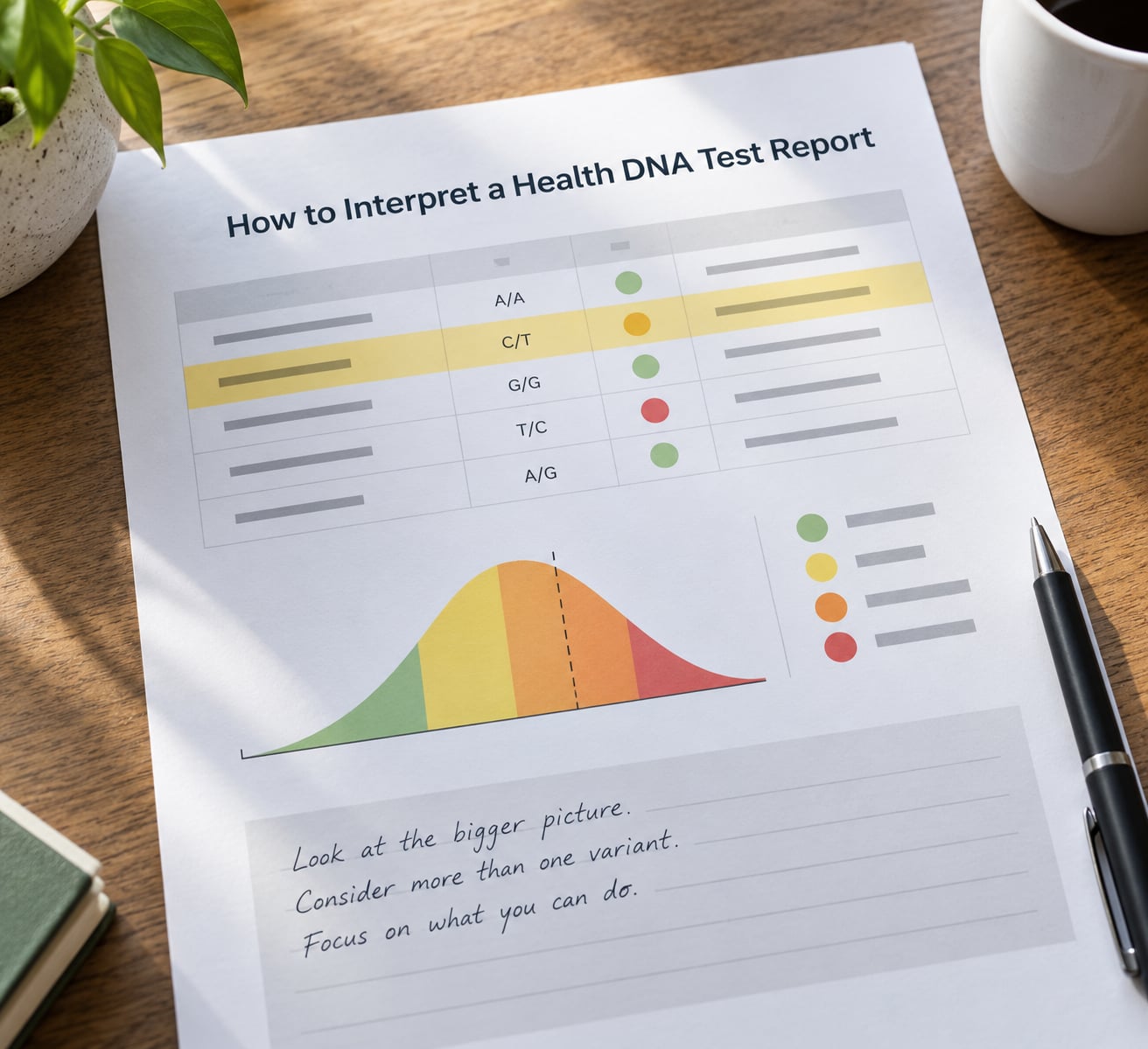
Work through the report in this order, and resist reading the risk scores first.
- Check what was tested. Find the number of health variants covered and the technology used. A panel of a few hundred targeted variants answers a much narrower question than sequencing.
- Identify the evidence level for each finding. This is the single most useful habit. Not every row on the page carries the same weight.
- Separate relative from absolute risk. A “2 times higher than average” figure can sound alarming while describing a condition that is uncommon to begin with. Always ask for the underlying numbers before you react.
- Read the limitations section. Most companies publish one. It usually names exactly the conditions the report should not be used for.
- Compare with family history. On r/genetics, the most common reason people test at all is a parent, sibling, or child with a condition. That history usually carries more weight for your own risk than a consumer score does.
- Decide whether a professional needs to read it. If the finding involves a pathogenic variant, cancer, reproductive planning, or medication choices, it does.
The variant classification table is the piece most readers never open.
| Classification | Plain meaning | What to do |
|---|---|---|
| Pathogenic | Established as disease-causing | Discuss with a clinician or genetic counselor promptly |
| Likely pathogenic | Strong evidence, some uncertainty remaining | Treat as a real finding and seek professional review |
| Variant of uncertain significance | Not enough evidence to interpret either way | Do not act on it; re-check the classification later |
| Likely benign | Probably not disease-causing | No action needed |
| Benign | Not disease-causing | No action needed |
A variant of uncertain significance is the most misunderstood label in consumer testing. People often read it as a warning. It means the data is insufficient, and the honest response is to wait, because laboratories do reclassify variants as evidence accumulates.
One more thing to know when you read a relative risk figure: it is usually expressed as a comparison to people with no family history of the condition. If your family history already puts you in a higher baseline, the report may genuinely understate your risk rather than alarm you.
When Should You Discuss DNA Results With a Health Professional?
Book a genetic counselor or raise it with your doctor when any of these apply.
- A result is reported as pathogenic or likely pathogenic, or as a variant of uncertain significance in a gene with strong clinical relevance.
- The report flags cancer susceptibility of any kind.
- You are pregnant, planning a pregnancy, or considering prenatal screening.
- A relative carries a variant and you are being asked to consider testing.
- You have a strong family history of a heart, metabolic, or neurological condition that the report shows as negative.
- You are taking a long-term medication and a pharmacogenomic result contradicts what you have been prescribed.
- The result is prompting a decision about preventive surgery, screening schedules, or major life changes.
Users in genetic communities consistently name access to a counselor as the thing they wanted most from these services. A genetic counselor reads the report alongside your family history and your actual clinical picture, which is the context a consumer report structurally cannot supply.
This article is general information and not medical advice. Decisions about screening, treatment, and medication belong with a qualified health professional who can see your full history.
What About Privacy, Consent, and Relatives?
Your DNA is close to permanent information, and the consent question gets less simple the moment someone else is involved.
Consumer test companies typically store raw genotype data, allow you to download it, and let you request deletion through account settings. Policy on research participation varies widely: some companies treat participation as opt-in, others bundle it into the terms you accepted at signup. Read the consent language at the point of purchase, not afterwards.
In the US, GINA covers genetic information for health insurance and employment, but its scope has limits. It does not cover life insurance, disability insurance, or long-term care insurance, and state laws differ. If that matters to you, ask directly rather than assuming.
Raw data uploads to third-party interpretation tools add another layer. Uploading your file to a separate service extends the number of organisations holding your genotype and puts it outside the protections you negotiated with the original company.
And relatives did not choose. A finding you carry came from a parent, and it says something about their DNA too, without their consent. That is worth weighing before you share results in a family group chat.
Frequently Asked Questions
Does a positive DNA health result mean I will develop the disease?
No. A positive result means you carry a variant that has been linked to the condition, not that you will develop it. Penetrance, meaning how often carriers actually develop disease, is rarely 100 percent and can be much lower. Environment, age, lifestyle, and chance all shape the outcome.
Can a negative DNA test rule out a genetic condition?
No, and this is the most common misunderstanding in consumer testing. A negative result means the specific variants the panel tested were not found. Most conditions are polygenic or involve factors a DNA test does not measure, so a negative report says very little about whether you are free of the condition.
Does DNA testing tell me which diet or exercise plan is best for me?
Only in a very rough way. A handful of variants, such as those affecting caffeine metabolism, do have reproducible effects, but most wellness traits are influenced by many small variants plus habits, sleep, and environment. Treat these reports as a nudge toward experimenting on yourself, not as a prescription.
Why does my DNA report show a higher risk for a condition?
Usually because your combined score sits above the study group used for the estimate, which is often people with no family history of the condition. Higher relative risk describes a shift within a range, not a prediction. Compare the figure against your family history and your own blood pressure, cholesterol, and screening results before reacting.
Should I share my DNA health results with my family?
Often yes, because a pathogenic finding has real implications for relatives who may want testing of their own. Share with care, though. Results say something about the DNA you inherited from parents who never consented to that information existing or being stored, so decide deliberately rather than forwarding a screenshot.
Can my doctor or genetic counselor explain a consumer DNA report?
Yes, and it is worth doing. A genetic counselor is trained to read variant classifications, penetrance figures, and polygenic scores in the context of your family history and clinical picture. Bring the full report, including the limitations section, rather than a summary screenshot, and write down your questions beforehand.
What to Do With Your DNA Results First
Four steps, in order. Find the evidence level for each finding, because a pathogenic result and a modest risk score do not belong in the same mental bucket. Read the limitations section, which names what the report is not for. Compare everything with your family history, which usually tells you more about your own risk than a consumer estimate does. Then take any pathogenic finding, cancer signal, reproductive question, or medication contradiction to a genetic counselor or your doctor.
Coming back to the original question, what DNA test results can and cannot tell you about health: they tell you what you carry and how you compare with a reference group. They cannot tell you what will happen to you, and a result is one source of information rather than a verdict on your body.