The egg freezing process and timeline explained in short: one cycle takes roughly two weeks, running from the first days of your period through stimulation, monitoring, the trigger injection and egg retrieval. Add the consultation, fertility testing and result discussion either side, and you are looking at two to three months of calendar time per cycle.
That two-week window is the part everybody describes, and it is real. It is also only the middle of the story. Plenty of people spend longer on the waiting, the early-morning monitoring appointments and the decisions afterwards than they do on the injections.
This guide walks through what actually happens at each stage, how long each stage usually takes, and what tends to derail the plan. It is general information rather than medical advice, and a reproductive endocrinology clinic can give you numbers specific to your own situation.
Last medically reviewed: October 2026
Table of Contents
- Egg Freezing Process and Timeline at a Glance
- What Happens During Egg Freezing?
- How Long Does the Egg Freezing Process Take?
- What the Egg Freezing Process and Timeline Looks Like Step by Step
- Can You Speed Up the Timeline?
- How Much Recovery Time Should You Plan?
- What Can Affect the Number and Quality of Frozen Eggs?
- What Questions to Ask Before Starting
- Frequently Asked Questions
- Is egg freezing painful?
- How many days after starting medication is egg retrieval?
- Can you freeze eggs without hormone injections?
- How many eggs should you expect to freeze?
- How long can frozen eggs be stored?
- Does freezing eggs guarantee a future pregnancy?
- What to Do First
Egg Freezing Process and Timeline at a Glance
The table below sets out the typical sequence. Timings are averages, and individual cycles can run shorter or longer.
| Stage | Typical time | What happens |
|---|---|---|
| Consultation and testing | 1 to 3 weeks | Blood tests for AMH, FSH and estradiol, a transvaginal ultrasound for antral follicle count, and a review of your medical history |
| Pre-cycle suppression check | One visit, late in the cycle before you start | Ultrasound and hormone check to confirm no cyst and that your ovaries are quiet, sometimes followed by a few days of bridging medication |
| Ovarian stimulation | 8 to 12 days | Daily hormone injections, usually starting on cycle day 2 or 3, to grow several follicles at once |
| Monitoring | Every 2 to 3 days, then daily near the end | Blood tests for estradiol and progesterone plus transvaginal ultrasound to count follicles and measure their size |
| Trigger injection | About 36 hours before retrieval | An hCG injection that completes egg maturation on a predictable schedule |
| Egg retrieval | About 30 minutes | Transvaginal ultrasound-guided retrieval under sedation, followed by an hour or two in recovery |
| Vitrification and storage | Same day | Mature eggs are frozen in the laboratory and moved into liquid nitrogen storage |
| Result discussion | A few days later | Your clinic explains how many eggs were frozen, their maturity grade, and what happens next |
Most retrieval appointments happen early in the morning, and monitoring visits often land before 9am. That is a scheduling fact people rarely see coming, and it matters more to some jobs than the injections do.
What Happens During Egg Freezing?
Egg freezing, medically called oocyte cryopreservation, is elective fertility preservation. Instead of releasing a single egg as your body normally would each cycle, hormone medication encourages many follicles to mature together. Those eggs are then collected, frozen in the laboratory and kept for a future IVF cycle.
The process breaks into six parts. Ovarian stimulation is the injection phase. Monitoring is the repeated bloodwork and ultrasound. The trigger injection finalises egg maturity. Retrieval is a short surgical procedure under sedation. Vitrification is the rapid-freezing technique that prevents ice crystals forming inside the egg. Storage is the long-term hold in liquid nitrogen.
One thing to hold onto: no two cycles behave the same. Follicle response varies, egg counts vary, some cycles get delayed or cancelled, and a retrieval can turn up fewer mature eggs than the scans suggested. Anyone who promises a specific number is guessing.
Eggs also do not pause the ageing process entirely. Freezing arrests the biological clock at the age you froze, which is the point, but it does not remove age-related risk entirely. An egg frozen at 38 still carries the chromosome patterns typical of an egg produced at 38. That is why timing matters as much as the decision to freeze at all.
How Long Does the Egg Freezing Process Take?
You will hear two weeks, 12 to 14 days, and two to three weeks quoted for the same thing. None of those numbers is wrong; they are measuring different parts of the same process. Two weeks is the stimulation-to-retrieval stretch. Twelve to 14 days is where retrieval usually falls counted from the start of injections. Two to three weeks covers a full cycle if you count the recovery days and the days either side.
Here is how the full calendar tends to work.
Before the cycle. The consultation is usually booked around the start of a period so the results can be read alongside your cycle. Testing, results and planning can take a couple of weeks. Then there is the wait for your next period, because stimulation has to begin on cycle day 2 or 3. On a busy calendar that wait alone can be a month.
The cycle itself. Injections start on day 2 or 3 and run for 8 to 12 days. Monitoring sits alongside them, every two to three days at first and daily in the last stretch. The trigger injection goes in 34 to 36 hours before retrieval, and the retrieval itself is about half an hour.
After the cycle. Most people are back to normal activity within one to two days, and a light week of caution is common. Your period usually arrives about one to two weeks later, roughly on its own schedule. The result conversation typically happens within a few days of the procedure.
So the honest answer to how long egg freezing takes from start to finish is somewhere between two and three months for the first cycle, mostly waiting, and considerably longer if you freeze more than once. People who do two cycles usually plan for them at least one full menstrual cycle apart, which stretches the calendar into many months.
What the Egg Freezing Process and Timeline Looks Like Step by Step
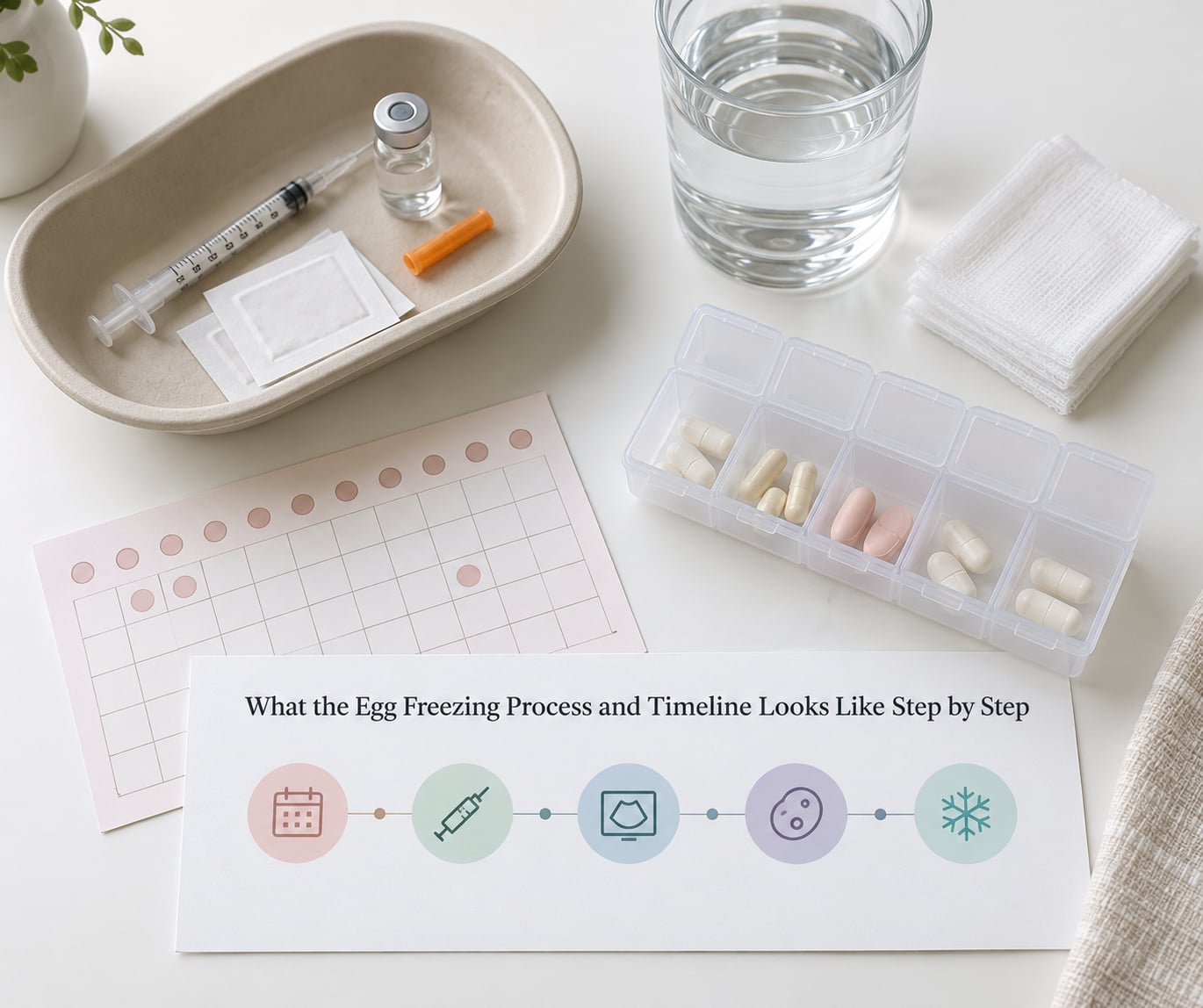
Here is the sequence most patients actually follow, from the first phone call to the result conversation.
1. Choosing a clinic. Compare published success figures and be suspicious of clinics that do not publish them. Ask what protocol they use, how many retrievals their laboratory handles, and whether they offer a stimulated or unstimulated cycle. The most useful question is how they define their numbers.
2. Consultation and fertility testing. You will typically have an AMH blood test, FSH and estradiol, and a transvaginal ultrasound to count antral follicles. These describe your ovarian reserve, meaning how many follicles are currently available to respond. They are a snapshot, not a prediction, and they are the numbers that shape your protocol.
3. The pre-cycle check. Late in the cycle before your next period, most clinics run a suppression check. If a cyst is present, the cycle is often paused for several days to let it resolve. This is one of the most common reasons a timeline slips, and it can feel deflating when it happens.
4. Stimulation, days 2 to 12. You self-inject, usually in the evening, following a schedule the clinic gives you. The injections are small subcutaneous needles rather than the intramuscular ones many people picture. Expect tiredness, breast tenderness, mood swings and bloating. Some people describe a foggy head in the second week. Symptoms vary widely and there is no reliable way to predict your own response in advance.
5. Monitoring, days 5 to 14. Bloodwork and ultrasound track how many follicles are growing and how large they are. Your medication dose gets adjusted based on what the scans show, and sometimes down. Over-response is carefully managed because of the risk of ovarian hyperstimulation syndrome.
6. Trigger injection. Once the follicles reach the right size, a trigger injection is given roughly 36 hours before retrieval. This is the point of no return, and it is why retrieval dates sometimes move by a day: the timing is anchored to the trigger, not to your diary.
7. Egg retrieval. A needle is passed through the vaginal wall using ultrasound guidance to reach the ovaries, with sedation so you do not feel it. The procedure is around 30 minutes, and you will usually stay for an hour or two afterwards. Plan for someone to drive you home.
8. Vitrification and storage. Mature eggs are frozen the same day in liquid nitrogen. The laboratory reports how many were mature and how many met the criteria for freezing.
9. Results and next steps. A few days later your clinic walks you through the numbers. This is often the emotional low point of the whole process, particularly when the count is lower than the scans suggested. Providers are used to guiding people through that conversation.
10. The 36 hours around retrieval. The night before, follow your clinic’s specific instructions on food and drink, keep the phone charged, and skip alcohol. Many clinics ask you to drink plenty of fluid beforehand to make the procedure easier, and ask you to avoid alcohol and strenuous exercise in the days before it. After the procedure, plan to do almost nothing for a day, stay hydrated and lean towards salty drinks and electrolyte drinks, which is why sports drinks get recommended. It is not the drink itself doing something clever; it is the sugar and electrolytes helping you rehydrate. If you have PCOS, or your clinic asked you to, you may also be offered a paracentesis to drain fluid if the ovaries swell significantly.
Can You Speed Up the Timeline?
Some of the timeline can move, but the parts that decide the outcome cannot. Scheduling flexibility is real: you can choose a clinic with earlier morning monitoring slots, start testing before your period arrives, and book your consultation for a month when your diary is quiet.
What you cannot rush is medical. Starting injections before a suppression check clears a cyst, or shifting your trigger injection so retrieval fits a nicer date, means acting on follicles that are not ready. Ask any clinic to move your trigger to suit your calendar and you will get a clear answer about why the timing is fixed.
The realistic thing to compress is everything around the cycle: research, testing, consultations and recovery planning. The cycle itself follows the biology.
How Much Recovery Time Should You Plan?
Budget one to two days of genuine rest, then a week of being gentler with yourself than usual. Bloating, cramping, pelvic soreness and fatigue are the common post-retrieval complaints, and they usually ease over several days. Your ovaries are enlarged at this point, which is why bending, lifting and exercise tend to feel uncomfortable at first.
Recovery varies a lot, and the variable is not really effort. It is how large your ovaries got, whether the procedure was straightforward, how you respond to sedation, and how the retrieval went. Someone can walk out feeling fine and someone else can spend three days on the sofa, and both are normal.
Your period typically arrives one to two weeks after retrieval, which is close to your usual cycle length. Bleeding that arrives early and is heavier than normal is worth mentioning to your clinic. Very heavy bleeding, a fever, severe or worsening pain, or a red, hot, tender area around the retrieval site need same-day medical attention. Those are warning signs of infection or bleeding, and they should not be waited out.
One thing people report more than anything else is the emotional wobble. Hormone levels swing hard during stimulation and then drop after retrieval, and it is normal to feel flat, tearful or irritable in the days afterwards. Knowing that in advance helps.
What Can Affect the Number and Quality of Frozen Eggs?
Age is the biggest factor and the hardest to change. Egg quality declines measurably through the late 30s and 40s, and an egg frozen later is frozen with more age-related chromosome risk. That is why many clinicians suggest freezing in the early-to-mid 30s, before the point where decline steepens.
Ovarian reserve comes next. A low AMH or a low antral follicle count suggests a smaller pool and often a lower egg yield. These markers also help your clinic pick a dose, so knowing them early is useful either way.
Prior reproductive history matters too. Endometriosis, PCOS, a previous ovarian surgery and a low response in an earlier cycle all change the outlook. So does the stimulation protocol itself, and so does how the team runs it, which is one reason published success figures from high-volume clinics are not directly comparable to small ones.
What you can influence is narrower than people hope. Sleep, not smoking, moderate alcohol intake and treating any thyroid or iron deficiency before you start all give you a better baseline. None of that changes egg quality fundamentally.
One idea to retire early: freezing eggs does not meaningfully deplete your ovarian reserve. The cycle removes mature eggs, not the underlying follicle pool, and available data does not show a measurable drop in natural fertility afterwards. If you were worried that freezing would cost you your later chances, that is not how it works.
What Questions to Ask Before Starting
These are the questions worth putting in writing before you commit, and asking them again at the result conversation.
- Which protocol am I having, and why? Antagonist, agonist or a mild protocol, and does your age or reserve drive the choice?
- What happens if my cycle is cancelled? Find out what you have already paid for, and what a cancelled cycle costs on its own.
- How often will I be monitored, and at what time of day? Ask about early morning availability and weekend cover.
- What is the retrieval day logistics? Fasting rules, sedation type, how long you will be there, and whether someone must collect you.
- What egg number should I expect from my numbers? A range based on your AMH and follicle count is reasonable. A guaranteed figure is not.
- What are the storage fees annually, and what is the notice period? Annual fees, minimum terms and what happens if you stop paying matter enormously over decades.
- What freezing method does the laboratory use? Standard vitrification, and whether eggs and embryos are stored separately.
- How do you define success? Ask whether the figures are per retrieval, per transfer or per patient, and the age range included. This one question tells you more than any brochure.
- Is any of it covered? Insurance and employer benefits vary widely and often exclude elective freezing entirely.
- What is my plan if I never use them? Donation, continued storage or removal all have different practical and emotional consequences. Decide later, but ask now.
A last practical one. Ask who is actually doing your retrievals and what your clinic’s cancellation and rescheduling policy is for retrieval day. Schedules change with follicle size, and knowing that in advance stops the late-night phone calls from feeling like a crisis.
Frequently Asked Questions
Is egg freezing painful?
Most people describe the injections as uncomfortable rather than painful, like an everyday subcutaneous injection you do yourself at home. Retrieval is done under sedation, so you should feel nothing during the procedure itself, and afterwards most people report cramping and pelvic soreness that lasts a day or two. Bloating, breast tenderness and tiredness during stimulation are common too. Tell your clinic about your pain threshold early; they can adjust your medication schedule if cramping is a problem.
How many days after starting medication is egg retrieval?
Retrieval usually happens 10 to 14 days after your first injection, with 34 to 36 hours after the trigger injection setting the exact time. Stimulation itself commonly runs 8 to 12 days, and the day of retrieval is decided by the size of your follicles rather than by a fixed date. A clinic that gave you a retrieval date weeks in advance is usually working from a typical cycle, not a prediction.
Can you freeze eggs without hormone injections?
Yes. A natural or unstimulated cycle involves no hormone injections at all, and some clinics also offer a mild stimulation protocol with much lower doses. These options suit people with a high antral follicle count and a lower budget, and they avoid the side effects of stimulation. The trade-off is a much lower yield, sometimes only a handful of eggs, and more variability cycle to cycle. Ask your clinic whether your numbers support it.
How many eggs should you expect to freeze?
It depends on your age, your ovarian reserve and how your follicles respond. Plenty of people retrieve 10 to 20 mature eggs per cycle, and some retrieve far fewer. Clinicians often use a rough planning guide of around 10 to 12 eggs per child to have a reasonable chance, which is a guideline and not a promise. The number of mature eggs found at retrieval can also be lower than the follicle count suggested during monitoring.
How long can frozen eggs be stored?
Stored in liquid nitrogen, eggs can in principle be kept for a very long time, and many clinics publish storage options in ten-year or longer terms. The realistic limit is less about biology and more about cost, since annual storage fees compound every year. Ask your clinic about the annual fee, the minimum term and the notice period required before you commit, and check what happens if you want to use or release your eggs years later.
Does freezing eggs guarantee a future pregnancy?
No. Freezing is a form of insurance, not a promise. Success depends on the number and quality of eggs, your age at the time they were used, whether you use your own eggs or donor eggs, and whether you choose IVF alone or IVF with preimplantation genetic testing. Not every mature egg retrieved meets the laboratory’s criteria for freezing, and not every egg survives the thawing process. A clinic can give you individual figures, but no responsible clinic guarantees an outcome.
What to Do First
Book a consultation with a qualified reproductive endocrinology clinic. That single appointment gets you hormone results, a follicle count and a protocol recommendation, and it turns a vague worry into numbers you can plan around.
Before you go, write down your questions and be ready to compare clinics on how they define success, what they charge for storage and what happens if a cycle is cancelled. Ask for a cycle-specific estimate rather than a headline figure, and treat any timeline you are given as a range.
Then protect the calendar. The two-week window is the part you cannot move, so build the flexibility around it, not inside it. Once you understand the egg freezing process and timeline properly, most of the anxiety comes from the unknowns sitting outside the cycle, and those are the parts you can actually plan.