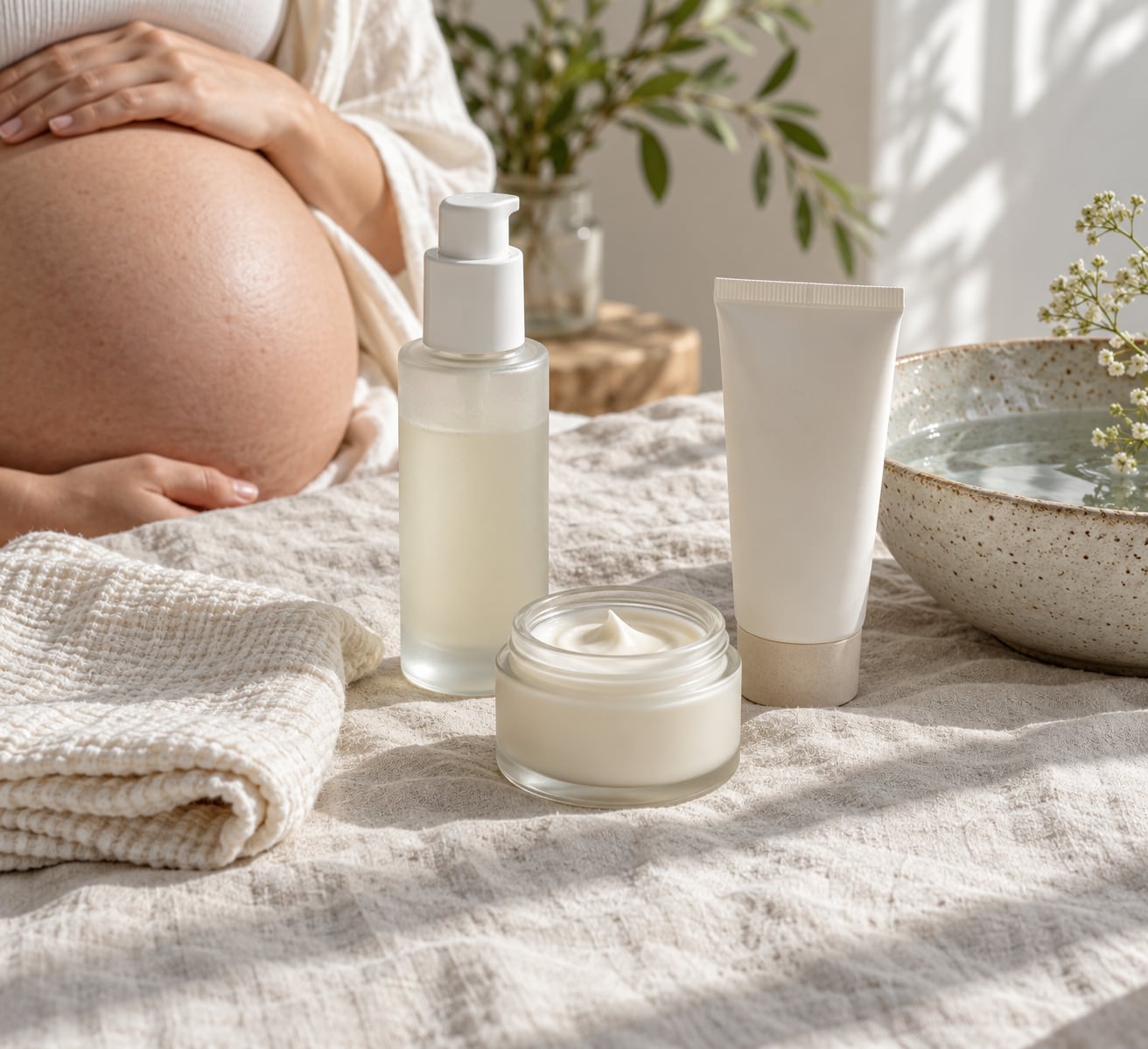
Pregnancy skin changes are the hormonal, vascular, immune and structural shifts that reshape your skin over roughly 40 weeks. Most are ordinary and temporary: more oil and breakouts, melasma, a dark line down the abdomen, dryness and itching, and stretch marks. A small number are not ordinary at all, and those are worth knowing early.
The scale of it is worth putting into perspective. In a 2017 screening study published in PubMed Central, 94.8% of the pregnant women examined had physiological skin changes, and 90.8% had pigmentary changes. Only 14% had one of the specific dermatoses of pregnancy, the small group of conditions worth naming out loud.
Below is what skin changes during pregnancy explained looks like in practice: what each change is, when it usually turns up, what helps, and which symptoms belong in a phone call to your midwife or doctor. General information only — your own care belongs with a clinician who can examine you.
Table of Contents
- What Skin Changes Are Common During Pregnancy?
- Skin Changes During Pregnancy by Trimester
- Why Does Pregnancy Change Your Skin?
- What Are the Most Common Changes?
- Pigmentation and melasma
- Acne and increased oil production
- Dryness, itching and a sensitive barrier
- Stretch marks
- How to Care for Changing Skin Safely
- When Should You Call a Doctor or Midwife?
- Frequently Asked Questions
- Are skin changes a normal part of pregnancy?
- Can pregnancy cause a rash or itching?
- When should pregnancy skin changes be checked by a doctor?
- Do stretch marks go away after giving birth?
- What skin products are generally safe during pregnancy?
- What to Do First
What Skin Changes Are Common During Pregnancy?
The most commonly reported changes are increased oil production and acne, melasma and other pigment shifts, the linea nigra, dryness and itching with a more reactive skin barrier, spider veins and flushing, and stretch marks on the abdomen, hips, breasts and thighs. Hair and nails usually move too, though people talk about them far less than they should.
Timing is the part that unsettles people most. Some notice something at seven weeks. Others get through the whole pregnancy with clear skin and then meet melasma and stretch marks in the same month. Both are ordinary. Skin follows the hormone curve rather than a calendar, and the curve is different for everyone.
If you have deeper skin, one thing is worth knowing early. Higher baseline melanocyte activity means melasma and post-inflammatory hyperpigmentation are more common for you, and the brown mark an old breakout leaves behind lingers far longer. That is a reason to go easy with acids and scrubs, not a reason to treat your skin as a problem.
Skin Changes During Pregnancy by Trimester
| Period | Common changes | Typical timing | When to contact a care professional |
|---|---|---|---|
| First trimester (weeks 1–13) | Increased oil production, acne along the jaw and chin, sensitivity to products you have used for years, flushing and warmth | Weeks 6–10 for acne; flushing often from the end of the first trimester | Rash with fever, or any reaction that spreads quickly |
| Second trimester (weeks 14–27) | The glow from raised blood volume, melasma appearing on cheeks, nose and forehead, linea nigra, spider veins, faster hair growth | Melasma commonly shows from weeks 14–24; hair growth from mid-pregnancy | Persistent itching on palms or soles, or a rash that does not settle |
| Third trimester (weeks 28–40) | Stretch marks, abdominal itching, worsening dryness, swelling-driven tightness, rib and belly skin irritation | Stretch marks most often weeks 25–35; itch can peak in the last weeks | Itching that keeps you awake, itching without a rash, or darkening on the palms |
| Postpartum (birth to 12 months) | Hair shedding, slow fading of melasma and the linea nigra, looser skin around the abdomen and breasts, acne settling | Hair shedding peaks around 2–4 months after birth; pigment fades over 3–12 months | Rash in the newborn alongside your own symptoms, or a wound opening |
First-trimester timing is the one people most often measure against their dating scan, and dates move around early on. How ultrasound dating works in early pregnancy is worth reading before you try to match a breakout to a specific week.
Why Does Pregnancy Change Your Skin?
Four mechanisms do most of the work. Once you know which one is behind a symptom, it stops being mysterious and starts being manageable.
1. Hormonal. Oestrogen, progesterone and androgens all climb, at different rates at different times. Androgens enlarge the sebaceous glands and thicken the sebum, which is why oily skin and acne often arrive together. Oestrogen and progesterone also stimulate melanocytes, the pigment-producing cells, which is the root of melasma, the linea nigra and darkened areolae. hCG, the hormone a home pregnancy test detects, has its own effects on skin tone early on.
2. Vascular. Blood volume rises by around 45% over a pregnancy. Skin flushed with more blood looks warmer and pinker, which is the origin of the so-called glow. The same extra volume pushes open small surface vessels, and that is where spider veins come from.
3. Immunological. Pregnancy is a carefully managed immune compromise. The body tolerates foreign tissue without becoming generally unwell, and that altered reactivity is why a minority of women develop the immune-mediated dermatoses, and why an ordinary product you tolerated for a decade can suddenly sting.
4. Structural. Collagen and connective tissue soften under the influence of relaxin, and skin stretches with a growing uterus, hips and breasts. That stretching is what produces stretch marks. Genetics decide how much you get; cream applied afterwards does not erase them.
One word of caution about that framework. It explains the common changes well, but it does not explain everything, and it should not be used to talk yourself out of a symptom. A more permeable, more reactive barrier also means anything you put on your skin absorbs more readily than it did before, which matters for the next section.
What Are the Most Common Changes?
| Change | What it looks like | When it appears | What helps |
|---|---|---|---|
| Increased oil and acne | Shiny T-zone, clogged pores, papules and pustules along the jaw, chest or back | Usually weeks 6–20, sometimes later | Gentle cleansing, a fragrance-free moisturiser, leaving actives at home |
| Melasma (chloasma) | Symmetrical brown or grey-brown patches on cheeks, forehead, upper lip | Most often weeks 14–24 | Daily broad-spectrum SPF, hats, cool compresses, patience |
| Linea nigra | A vertical dark line from the navel toward the pubic bone | Second and third trimesters | Nothing speeds it up; it fades over months after birth |
| Darkened areolae and genital skin | Deeper colouring of the nipple, areola, labia and inner thighs, sometimes with new freckles | First to second trimester | Generally permanent and harmless |
| Dryness, itching and sensitivity | Tight, flaky, reactive skin, especially on the belly, thighs and breasts | Often late second or third trimester | Plain emollient, lukewarm water, fragrance-free everything |
| Stretch marks (striae gravidarum) | Reddened or purple lines that later flatten to pale, silvery lines | Weeks 25–35, abdomen first, then hips, thighs and breasts | Moisturise for comfort; no cream prevents them |
| Spider veins and redness | Fine branching blue or red vessels, mostly on the face, neck and legs | Second trimester onward | Usually fades; cosmetic treatment after birth, not during |
| Hair, nails and body hair | Faster scalp and body hair growth, stronger nails, then shedding later | Mid-pregnancy, shedding 2–4 months after birth | Gentle shampooing; expect the shedding to be temporary |
Hair and nails belong in this table too, even though they rarely get mentioned. Scalp and body hair speed up from mid-pregnancy and shed heavily two to four months after birth, which surprises people more than the skin does.
Pigmentation and melasma
Melasma is the change people worry about most, and the one most often framed as permanent. It is common, symmetrical, and frequently fades substantially in the year after birth, though not always completely. Sun exposure makes it worse, which is why daily SPF does more here than any brightening product you could safely use while pregnant.
Acne and increased oil production
Breakouts in pregnancy are usually ordinary and usually manageable. What matters is that the skin is more reactive than it was, so new actives tend to irritate. If acne needs more than a basic routine, that is a good reason to book a dermatologist — it is entirely reasonable to do so while pregnant, and they can work with what is safe at your stage.
Dryness, itching and a sensitive barrier
Itching is the symptom that generates the most anxiety, mostly because people have no way to tell stretching-itch from something worth reporting. Stretching itch comes and goes with the belly and shows no rash. Itching that is severe, constant, or worst at night is a different category and belongs with your care team.
Stretch marks
Stretch marks track with how quickly skin stretches, not with whether you moisturised. The abdomen usually goes first, then hips, thighs and breasts — the same stretch that makes the third trimester so uncomfortable is what is writing the lines. Many of them fade to a paler colour over months, though the stretch itself tends to stay.
How common they are catches people out. One widely cited clinic estimate puts stretch marks at up to nine in ten pregnancies, so a few lines appearing does not mean you did anything wrong. The weeks they usually turn up are the same ones people spend reading about what the 20-week anatomy scan checks — different topic, same stretch of pregnancy.
How to Care for Changing Skin Safely
None of this needs a product with a pregnancy badge on it. The basics that work are unglamorous and cheap.
- Cleanse gently, twice a day at most. A mild fragrance-free wash, lukewarm water, pat dry rather than rub.
- Moisturise for comfort, not correction. Plain emollients with ceramides, glycerin or hyaluronic acid reduce water loss from a barrier that is already leaking more than usual.
- Treat sun as the main pigment driver. A zinc oxide or titanium dioxide broad-spectrum SPF 30 or higher, applied daily and reapplied, plus a hat when the sun is strong.
- Patch-test anything new on a small area for 24 hours before using it on your face. This matters more in pregnancy, not less.
- Check what is already in the cabinet. Retinoids including retinol and tretinoin, hydroquinone, and high-strength exfoliating acids are ones to discuss with your clinician before continuing.
- Leave exfoliating peels away from an itchy rash. Self-treating a rash of unknown cause with strong acids tends to make it worse and can mask the real picture.
Ingredients such as azelaic acid, niacinamide, ceramides and zinc oxide are generally considered low-risk in pregnancy, but the honest caveat is that few can be studied directly. Clinical trials on pregnant participants are close to impossible to run, so much of what passes for pregnancy safety is inference from ingredient class and existing use.
When Should You Call a Doctor or Midwife?
Most of what you will notice is normal. These are the exceptions, and they are worth acting on quickly.
- Itching that is severe or sudden, especially on the palms of the hands or the soles of the feet, or itching that keeps you awake with no rash. Intrahepatic cholestasis of pregnancy is a liver condition that shows up as itching and needs monitoring.
- A widespread or blistering rash. Pemphigoid gestationis (herpes gestationis) often starts as hives around the belly and progresses to fluid-filled blisters. It is uncommon but is treated differently from anything else on this page.
- Small hard red bumps clustered on the abdomen. Pruritic urticarial papules and plaques of pregnancy, usually in the third trimester, is intensely itchy but does not harm the baby.
- A rash with swelling of the face or hands, a severe headache, visual changes or pain under the ribs. These point to preeclampsia rather than a skin problem.
- Painful skin, fever, spreading redness or pus-filled blisters. An ordinary infection that needs seeing.
- A rash spreading to your newborn while you are unwell. Some infections in the first days after birth are urgent.
Any of those with breathing difficulty or swelling of the tongue or throat is an emergency. For anything else on the list, the next appointment may be soon rather than immediate, but waiting weeks is not the right call.
It is also fair to go to a dermatologist while pregnant, with your due date mentioned so they can choose accordingly.
Frequently Asked Questions
Are skin changes a normal part of pregnancy?
Yes, most of them. A 2017 screening study found physiological skin changes in 94.8% of the pregnant women examined, with pigmentary changes in 90.8%. Increased oil, acne, melasma, the linea nigra, dryness, itching and stretch marks are all expected adaptations rather than damage. Around 14% developed one of the specific dermatoses of pregnancy, which are different, need attention, and should be assessed by your midwife or doctor rather than managed at home.
Can pregnancy cause a rash or itching?
Itching on the abdomen that comes and goes with stretching is common, especially in the third trimester, and usually comes without a rash. A rash is a different story: PUPPP and pemphigoid gestationis both cause itchy rashes and need medical assessment. Severe itching with no rash at all, particularly on the palms or soles, needs same-week contact with your care team because it can signal intrahepatic cholestasis of pregnancy.
When should pregnancy skin changes be checked by a doctor?
Book in if an itch is severe, sudden or worse at night; if a rash is widespread, blistering or clustered into small hard red bumps on the belly; if your face or hands swell alongside a rash, a headache or visual changes; or if skin becomes painful, hot or pus-filled. Those patterns point to conditions that are not cosmetic. For ordinary breakouts, pigmentation or dry patches, a routine appointment is enough, and a dermatologist visit while pregnant is a reasonable option.
Do stretch marks go away after giving birth?
They fade, but they rarely vanish completely. Fresh marks are red, purple or brown; over months they flatten and turn pale silvery. Skin that was darker is more likely to leave a brown mark behind. How much fading happens varies a lot between people, and no cream applied during pregnancy prevents them, since they follow the physical stretch and your genetics rather than what you put on the skin.
What skin products are generally safe during pregnancy?
Generally low-risk ingredients include azelaic acid, niacinamide, ceramides, hyaluronic acid, glycerin, zinc oxide and mineral sunscreens. Retinoids such as retinol and tretinoin, hydroquinone, and high-strength exfoliating acids are the ones to stop or discuss with your clinician first. Note that few ingredients can be tested in pregnancy directly, so much of the guidance is inference rather than trial data. Personal product advice belongs with your doctor, pharmacist or midwife.
What to Do First
Write down when the change started and what it looked like. That note is the most useful thing you can bring to any appointment, and it is the part people cannot reconstruct later.
Then keep the routine boring: gentle cleanse, plain moisturiser, daily sunscreen. When something is new, check the ingredients against what is known to be risky in pregnancy rather than trusting a marketing claim.
And if the itch is severe, the rash is blistering or clustered, or the skin changes come with swelling, headache or visual symptoms, contact your midwife or doctor instead of trying another product. That is the moment where the small number of genuine problems hide, and they are all treatable when caught early. This article was last reviewed in 2026.