How to manage pregnancy fatigue at work comes down to a few levers, and none of them are heroic: short planned breaks every hour or two, steady food and water so blood sugar does not crash at 3pm, and an honest conversation with your manager about workload. Your body is doing something enormous and your calendar has not moved, so the calendar needs adjusting. Most people start with the first two on their own and put off the third for weeks.
Fatigue in early pregnancy is physiological, not a character flaw. Understanding why it happens, then building a routine around your actual work hours, gets you further than pushing through it.
Table of Contents
- What You Need
- Step-by-Step
- How to manage pregnancy fatigue at work during the day
- How to manage pregnancy fatigue at work by changing your workload
- How to protect your energy before and after work
- How to talk with your employer or coworkers
- How to track whether your fatigue is improving
- When to contact a prenatal clinician
- Common Mistakes
- Frequently Asked Questions
- Is pregnancy fatigue normal in the first trimester?
- Should I drink coffee or energy drinks to get through the workday?
- Can short naps help with pregnancy fatigue at work?
- What workplace adjustments can help during pregnancy?
- How much fatigue is too much during pregnancy?
- Can I manage pregnancy fatigue while working from home?
- What to Do First
What You Need
The preparation is mostly free. A clear bottle you can keep at your desk, a small box of food that does not require cooking, and a written list of what is genuinely due this week versus what can wait are the three things that change a week fastest.
A short nap option matters more than most people expect. One woman described putting a floor bed in her office and taking her rest periods there, which turned an impossible two-hour stretch into something survivable. A car, a quiet room, or even a conference room with the lights off at lunch can do the same job.
Also worth having ready before you need them:
- A simple notebook or phone note for logging energy, sleep, and symptoms
- Pregnancy-appropriate snacks that travel: nuts, whole-grain crackers, fruit, protein bars
- The name and number of your prenatal clinician, plus how to reach them between visits
- A written list of your tasks, so triage takes minutes rather than an afternoon
- A clear start and end time for your workday, defended as firmly as a meeting
Skip the expensive purchases. Supplements, including iron, should not be started on your own; your clinician decides whether you need them and at what dose. Special pregnancy energy drinks and supplements are not the answer, and the caffeine in them adds up fast against a well-known pregnancy limit.
Step-by-Step
How to manage pregnancy fatigue at work during the day
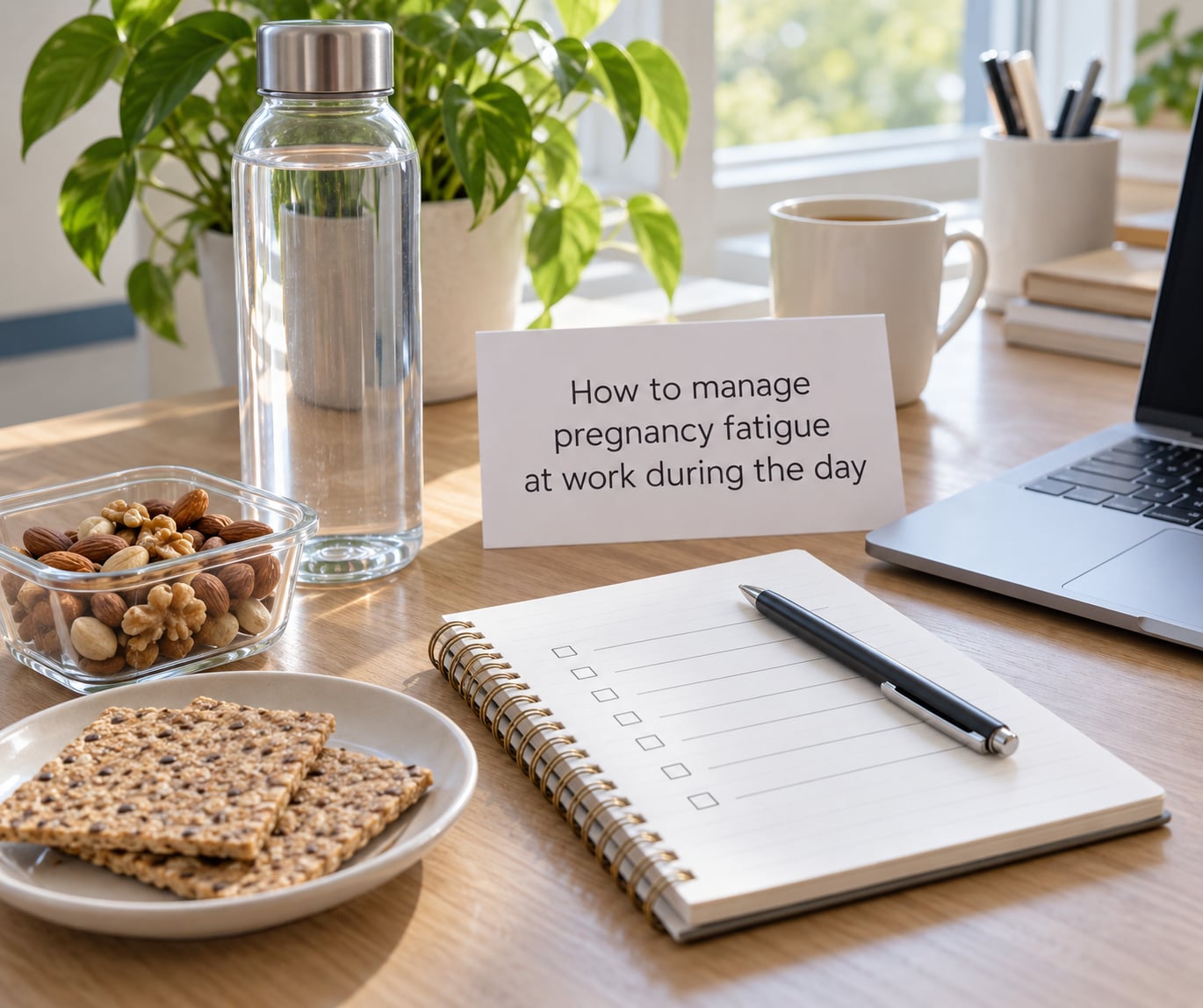
Match your intake to your work hours, because most office schedules are badly timed for a pregnant body. Three substantial meals with small snacks between them is easier on blood sugar than one large lunch at noon, which many people experience as a hard crash by 2pm.
Keep the food within reach. A snack box in your bag beats a vending machine on a bad afternoon, and community members consistently report that regular meal times, plus snacking through the day, made the biggest difference to their afternoons. Cold water matters more than most people expect; staying hydrated is the simplest energy lever you control.
Then build in movement. A ten-minute walk outside your building at the midpoint of the day clears more fog than another coffee. Pair it with a short break every hour or two: rest your eyes, stand up, refill the bottle. These are small, but they stop the long sitting stretch that leaves you wrecked by 4pm.
You will know it is working when the 2pm slump becomes a dip rather than a wall, and when a meeting no longer costs you the rest of the evening to recover from.
How to manage pregnancy fatigue at work by changing your workload
Triage is the highest-return activity in the whole plan. Write down everything on your plate, then sort it into three piles: needs doing today, needs doing this week, and needs doing someday. Most of what feels urgent is really in the second pile.
Batch similar work. Three hours of similar tasks in one block costs less than the same three hours scattered across a day with interruptions, because context switching is expensive when your concentration is already thin.
Protect one or two deep-focus blocks of 60 to 90 minutes, ideally early when your energy is best, and put low-demand tasks, email, and routine approvals into the softer hours. Write things down twice. Pregnancy brain is real, and a system that compensates for it beats relying on memory you already know is unreliable.
For structured roles, write your request as a short list of specific adjustments: a modified schedule, breaks to eat and drink, occasional rest periods, time off for prenatal appointments, remote work for part of the week, reduced hours during a difficult phase. Specific asks get answered far faster than a general request for help, since your manager can act on them without a conversation about the underlying reason. No particular accommodation is guaranteed, so frame the list as what would work for you and be willing to negotiate.
How to protect your energy before and after work

The workday is not the whole problem; the recovery around it is. A commute you cannot shorten plus a household you are still running adds up to a fourteen-hour day even when the office is eight.
Build a transition that is small enough to survive a bad week. Shoes off, water in hand, ten minutes of doing nothing before you start the evening’s tasks. One reader described a routine of closed work bag and a chair by the door, the physical signal that the day was over. It sounds trivial and it is not.
Where you can, move work earlier in the evening and protect an earlier bedtime, because sleep is named more often than anything else as the single most effective lever. Front-load demanding work into the second trimester, when energy typically rebounds, and push low-stakes projects away from your worst weeks. Where household load is the drain, ask for help specifically rather than generally: a specific errand that someone else handles is worth more than moral support.
You will know this is working when you stop doing Sunday-night recovery arithmetic for the week ahead.
How to talk with your employer or coworkers
Most managers do not want a medical briefing. They want to know what will get done and what they need to change, which is why a short, specific script works far better than an explanation.
Something along these lines: I am having a harder time than usual with energy and focus, and I want to keep my commitments. I have three adjustments that would help me deliver the same work: a start time 30 minutes later on Fridays, ten minutes every two hours away from my desk, and shifting the weekly report to Thursday. I am not asking for anything that changes my role.
You decide how much you disclose. In the United States, the Pregnant Workers Fairness Act requires employers to provide reasonable accommodations for known pregnancy-related limitations without requiring you to disclose a specific diagnosis, and the Family and Medical Leave Act covers qualifying medical leave. Rules vary by state and country, so confirm your own protections with HR or your state’s labor department before you assume anything. The CDC and NIOSH also offer a free Health Hazard Evaluation for pregnant workers who are exposed to chemicals, radiation, or heavy physical demands, which is underused and worth knowing about.
For coworkers, you can simply set an availability window and decline the rest. Do not owe anyone the details of your body to justify a boundary.
How to track whether your fatigue is improving
A two-week log beats memory, and it takes under a minute a day. Record your energy each morning and afternoon on a simple scale, plus the previous night’s sleep, what you ate, your water intake, and anything you noticed, such as dizziness, shortness of breath on stairs, or trouble concentrating.
Patterns show up fast. Most people discover their worst window and protect it, or discover the days after a long meeting week and stop scheduling two of those in a row.
ACOG and other prenatal care guidance treats fatigue as a symptom worth discussing, and a written record makes that conversation concrete. If your clinician suggests a blood count, thyroid testing, or another assessment, you will have the information to help them decide.
When to contact a prenatal clinician
Some fatigue is expected. Fatigue that is severe, sudden in onset, clearly worsening week over week, or unlike your usual tiredness deserves a call to your prenatal clinician rather than a workplace adjustment. Causes such as anemia, thyroid dysfunction, depression or anxiety, and severe vomiting are worth ruling out, and each has a different response.
Call the same day or seek prompt care if fatigue comes with fainting, chest pain, shortness of breath at rest, a rapid or irregular heartbeat, heavy bleeding, severe abdominal pain, fever, or vomiting so persistent you cannot keep fluids down. Inability to keep down fluids, or signs of dehydration such as very dark urine and dizziness on standing, need same-day attention. Urgent symptoms go to urgent care or an emergency department, not to a message in a patient portal.
Fatigue that shows up suddenly and severely, particularly with chest pain, breathlessness, or one-sided leg swelling, is different from ordinary tiredness and should be treated as urgent. ACOG guidance is clear that a shift from your own baseline is a reason to be assessed rather than endured.
Common Mistakes
Pushing through exhaustion. It feels virtuous and it costs you the following day, and often the whole week. Replace it with a planned recovery period that is scheduled like a meeting, so it happens before you crash.
Using caffeine as the main strategy. The commonly cited pregnancy guidance puts the limit at 200 mg of caffeine a day, roughly one 12-ounce coffee, and energy drinks make that limit surprisingly easy to blow through without counting properly. Talk to your prenatal clinician about what is safe for you, especially if you are managing nausea and poor appetite at the same time.
Skipping meals because nausea seems worse when you eat. An empty stomach makes nausea and fatigue worse, not better. Small, bland, frequent snacks often work where three big meals do not.
Saying yes to everything. The first work trip, the extra project, the evening event. The cost shows up days later when you have nothing left. Decline first, decide later.
Waiting for a better week to ask for help. There is no better week in the first trimester. A conversation in week six is easier than a crisis in week eleven.
Frequently Asked Questions
Is pregnancy fatigue normal in the first trimester?
Yes. Fatigue in the first trimester is one of the most common early pregnancy symptoms, driven by rising hCG and progesterone, increased blood volume, and changes in blood sugar. It often starts before a missed period and usually eases as the second trimester begins. Exhaustion that is extreme, sudden, or unlike your usual energy is worth discussing with your prenatal clinician rather than assuming it is typical.
Should I drink coffee or energy drinks to get through the workday?
Common pregnancy guidance sets the caffeine limit at about 200 mg a day, roughly one 12-ounce coffee, so a moderate amount is generally considered acceptable. Energy drinks are harder to judge because caffeine content varies widely and is often not listed clearly. Ask your prenatal clinician what fits your situation, especially if caffeine is also upsetting your stomach.
Can short naps help with pregnancy fatigue at work?
Yes, and short naps fit better into a workday than long ones. Fifteen to twenty minutes restores alertness without leaving you groggy, and you can plan it inside a break you already take. Many people make it work with a chair, a car, or a quiet room. If no private space exists at all, a 10-minute eyes-closed rest can still help, even without actually falling asleep.
What workplace adjustments can help during pregnancy?
Common useful adjustments include a modified or flexible schedule, breaks to eat, drink, and use the restroom, occasional rest periods, time off for prenatal appointments, remote or hybrid work, a temporary transfer to a less demanding role, and reduced hours. Specific written requests are easier for managers to act on than a general request for help. In the United States, the Pregnant Workers Fairness Act sets a baseline; state rules may add more.
How much fatigue is too much during pregnancy?
Fatigue becomes a concern when it is severe, begins suddenly, worsens steadily week over week, or stops you from functioning at work or at home. That pattern can point to anemia, thyroid dysfunction, depression, or severe vomiting, and each needs its own assessment. Contact your prenatal clinician to describe the change. Seek urgent care for fatigue with chest pain, breathlessness, fainting, heavy bleeding, or fever.
Can I manage pregnancy fatigue while working from home?
Working from home gives you control over breaks, but it also removes the natural boundaries a commute provides, so the day tends to expand. Set a firm start and end time, keep a short midday walk and a real lunch break, and change clothes between work and home so the transition is visible. Without those, the same fatigue arrives anyway, only later in the day.
What to Do First
Start with one week, four decisions. Pick the single task that drains you most and move it into your best hour, or hand it off. Put a 15-minute recovery period on your calendar at a fixed time so it is treated like a meeting. Set up the water bottle and the snack box where you can reach them without leaving your desk. Then, if fatigue is getting in the way of your work, send your manager the three-item written request.
Keep the two-week log going at the same time. It costs a minute a day and it is the thing that tells you whether any of this worked, and it gives you something concrete to bring to your prenatal clinician when you get to week twelve and you cannot remember what your energy was like in April.